Overview
The species is known from specimens collected on Tongatapu, Tonga. The two known specimens have 65 or 67 rows of scales around the middle of the body.
Written 26 November 2026 from the sources listed below. Each statement was checked against the passage it cites; statements that could not be supported were removed.
Conservation
The Tonga Ground Skink is considered extinct by the IUCN Red List. It has been listed as extinct in every IUCN Red List assessment since 1994.[1][2]
More than 90% of Tongatapu has been deforested and converted to agricultural land. Human colonization, habitat loss, and predation by introduced animals are believed to have contributed to the species' extinction.[3][4]
Introduced pigs, rats, dogs, and cats are among the proposed causes of the species' extinction through predation. Searches in the remaining forest patches on Tongatapu have failed to locate the species.[5][6]
The IUCN Red List assessment record identifies 2011 as the most recent assessment year.[7]
Uses
The Tonga Ground Skink featured in Tongan folklore before its presumed extinction. According to a Tongan legend, seeing the species was considered an omen of a major family event such as a wedding or funeral.[8][9]
Appearance
The two known type specimens have snout-to-vent lengths of 143 mm and 177 mm. They have 65 or 67 rows of scales around the middle of the body.[10][11]
Habitat
The species is believed to have been terrestrial and to have inhabited forests.[12]
The species is known from specimens collected on Tongatapu, Tonga. Archaeological evidence suggests that it may also have inhabited ʻEua.[13][14]
The species has been suggested to potentially survive on ʻEua and the small island of Kalau south of ʻEua.[15]
Behaviour
The species may have lived underground and emerged at night or after very heavy rainfall. Researchers have suggested that heavy rainfall during the Astrolabe expedition may have brought the skinks above ground.[16][17]
Classification of the Tonga Ground Skink
| Kingdom | Animalia |
|---|---|
| Phylum | Chordata |
| Subphylum | Vertebrata |
| Infraphylum | Gnathostomata |
| Parvphylum | Osteichthyes |
| Megaclass | Tetrapoda |
| Class | Reptilia (Reptile) |
| Order | Squamata (Snakes) |
| Suborder | Autarchoglossa |
| Family | Scincidae (Skink) |
| Subfamily | Eugongylinae |
| Genus | Tachygyia (Tonga Ground Skink) |
| Species | Tachygyia microlepis (Duméril & Bibron, 1839) |
Where the Tonga Ground Skink is found
Range as the checklists state it
Tonga Islands, Friendly Islands (fide SMITH 1937); Tongatabu (fide BOULENGER 1887).
A number beside a place is its count of GBIF occurrence records. A place without a number comes from a checklist alone. Records show where a species has been observed or collected, which can include escapes and vagrants.
Common names
English
- Tonga Ground Skink
- Giant Tonga Skink
Synonyms
2 other scientific names have been used for this species and are now treated as synonyms of Tachygyia microlepis.
- Tachygia microlepis (Duméril & Bibron, 1839) [orth. error]
- Eumeces microlepis Duméril & Bibron, 1839 ambiguous synonym
Related species
-
 ShinglebackTiliqua rugosa
-
 Five-lined SkinkPlestiodon fasciatus
- Common Garden SkinkLampropholis guichenoti
-
 Blue-tailed SkinkCryptoblepharus egeriae
-
 Red-eyed Crocodile SkinkTribolonotus gracilis
-
 Common Blue-tongued SkinkTiliqua scincoides
-
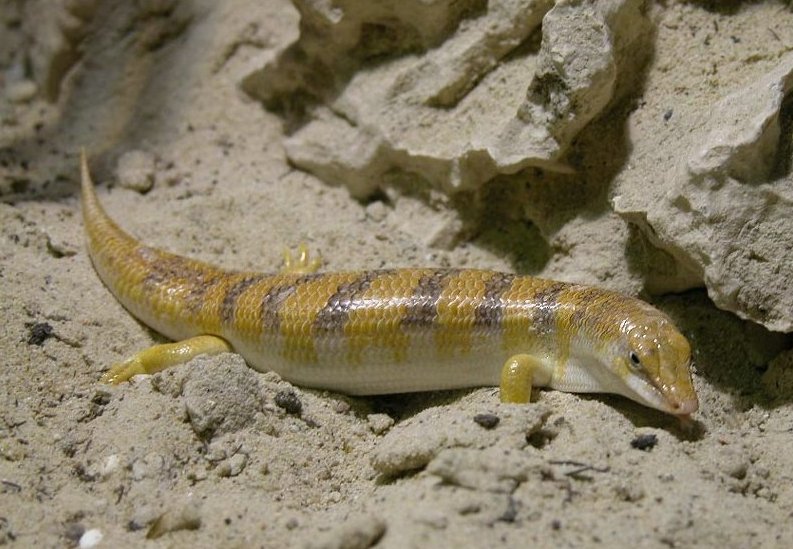 Sandfish SkinkScincus scincus
-
 Land MulletBellatorias major
Compare
Questions and answers
What is the scientific name of the Tonga Ground Skink?
The scientific name of the Tonga Ground Skink is Tachygyia microlepis. Written with its author, the full name is Tachygyia microlepis (Duméril & Bibron, 1839).
Which family does the Tonga Ground Skink belong to?
Tachygyia microlepis belongs to the family Scincidae, in the order Squamata and the class Reptilia.
What is the conservation status of the Tonga Ground Skink?
The IUCN Red List category recorded for Tachygyia microlepis is Extinct (EX).
What other names does the Tonga Ground Skink have?
Tachygyia microlepis is also known in English as Giant Tonga Skink.
Sources
Passages the profile rests on
- The species is considered extinct by the IUCN Red List. Source passage: “It is considered to be extinct by the IUCN Red List” — English Wikipedia
- The species has been listed as extinct in every IUCN Red List assessment since 1994. Source passage: “having been listed as such by all of its IUCN Red List assessments, beginning in 1994.” — English Wikipedia
- More than 90% of Tongatapu has been deforested and converted to agricultural land. Source passage: “over 90% of Tongatapu has been deforested and replaced with agriculture” — English Wikipedia
- Human colonization, habitat loss, and predation by introduced animals are believed to have contributed to the species' extinction. Source passage: “the cause behind its extinction believed to have been caused by human colonization and subsequent habitat loss” — English Wikipedia
- Introduced pigs, rats, dogs, and cats are among the proposed causes of the species' extinction through predation. Source passage: “predation by introduced species such as pigs, rats, dogs and cats.” — English Wikipedia
- Searches for the species in the remaining forest patches on Tongatapu have failed to locate it. Source passage: “Multiple searches for the Tonga ground skink in the last patches of forest on Tongatapu have been undertaken, but all have failed to find the skink.” — English Wikipedia
- The IUCN Red List assessment record identifies 2011 as the most recent assessment year. Source passage: “Tonga Ground Skink Tachygyia microlepis has most recently been assessed for The IUCN Red List of Threatened Species in 2011.” — iucnredlist.org
- The species featured in Tongan folklore before its presumed extinction. Source passage: “Prior to its presumed extinction the skink held a place in Tongan folklore.” — English Wikipedia
- According to a Tongan legend, seeing the species was considered an omen of a major family event such as a wedding or funeral. Source passage: “According to one legend, sighting it is an omen of a major family event, such as a wedding or funeral.” — English Wikipedia
- The two known type specimens have snout-to-vent lengths of 143 mm and 177 mm. Source passage: “its syntypes having snout–vent lengths of 143 mm (5.6 in) and 177 mm (7.0 in) respectively.” — English Wikipedia
- The species has 65 or 67 rows of scales around the middle of its body in the two known specimens. Source passage: “The namesake midbody scales of the species come in 65 and 67 scale rows in the two specimens collected” — English Wikipedia
- The species is believed to have been terrestrial and to have inhabited forests. Source passage: “The skink is believed to have been terrestrial and to have inhabited the forest” — English Wikipedia
- The species is known from specimens collected on Tongatapu, Tonga. Source passage: “A pair of specimens collected by Jean René Constant Quoy and Paul Gaimard during the 1826–1829 voyage of the Astrolabe under Jules Dumont d'Urville were given as syntypes, with the type locality being Tongatapu, Tonga.” — English Wikipedia
- Archaeological evidence suggests that the species may also have inhabited the island of ʻEua. Source passage: “Archaelogical findings suggest it may at one point also have been present on ʻEua.” — English Wikipedia
- The species has been suggested to potentially survive on ʻEua and the small island of Kalau south of ʻEua. Source passage: “it is possible that it is extant on ʻEua and the small island Kalau to the south of ʻEua” — English Wikipedia
- The species may have lived underground and emerged at night or after very heavy rainfall. Source passage: “hypothesized that it lived underground and only came out at night or after very heavy rains.” — English Wikipedia
- Researchers have suggested that heavy rainfall during the Astrolabe expedition may have brought the skinks above ground. Source passage: “noting that Jules Dumont d'Urville had reported very heavy rains during the visit of the Astrolabe to Tonga, forcing them above ground where they were found by Quoy and Gaimard.” — English Wikipedia
Data
- Catalogue of Life, 2026-10-16 XR cc by
- Wikidata CC0
- Within the Catalogue of Life, this name comes from The Reptile Database cc by
References
- Duméril, A. M. C. and G. Bibron. (1839). Erpétologie Générale on Histoire Naturelle Complète des Reptiles. Vol. 5. Roret/Fain et Thunot, Paris, 871 Pp.
- Fitzinger, L. (1843). Systema Reptilium, fasciculus primus, Amblyglossae. Braumüller et Seidel, Wien: 106 Pp.
- Gray, J. E. (1845). Catalogue of the specimens of lizards in the collection of the British Museum. Trustees of Die British Museum/Edward Newman, London: Xxvii + 289 Pp.
- Boulenger, G. A. (1887). Catalogue of the lizards in the British Museum (Nat. Hist.) III. Lacertidae, Gerrhosauridae, Scincidae, Anelytropsidae, Dibamidae, Chamaeleontidae. London: 575 Pp.
- Smith, M. A. (1937). A review of the genus Lygosoma (Scincidae: Reptilia) and its allies. Records of the Indian Museum 39 (3): 213-234.
- Greer, A. E. (1974). The generic relationships of the scincid lizard genus Leiolopisma and its relatives. Australian Journal of Zoology 31: 1-67.
- Böhme, W. (1976). Über die Gattung Eugongylus Fitzinger, mit Beschreibung einer neuen Art (Reptilia: Scincidae). Bonner Zoologische Beiträge 27: 245-251.
- Adler,G.H.; Austin,C.C. & Dudley,R. (1995). Dispersal and speciation of skinks among archipelagos in the tropical Pacific Ocean. Evolutionary Ecology 9: 529-541.
- Ineich, Ivan; Zug, George R. (1996). Tachygyia, the giant Tongan skink: extinct or extant? Cryptozoology 12: 30-35.
- Meiri, Shai; Aaron M. Bauer, Allen Allison, Fernando Castro-Herrera, Laurent Chirio, Guarino Colli, Indraneil Das, Tiffany M. Doan, Frank Glaw, Lee L. Grismer, Marinus Hoogmoed, Fred Kraus, Matthew LeBreton, Danny Meirte, Zoltán T. Nagy, Cristiano de C. Nogueira, Paul Oliver, Olivier S. G. Pauwels, Daniel Pincheira-Donoso, Glenn Shea, Roberto Sindaco, Oliver J. S. Tallowin, Omar Torres-Carvajal, Jean-Francois Trape, Peter Uetz, Philipp Wagner, Yuezhao Wang, Thomas Ziegler, and Uri Roll. (2017). Extinct, obscure or imaginary: the lizard species with the smallest ranges. Diversity and Distributions 24 (2): 262-273.
- Uetz, P. H., Patel, M., Gbadamosi, Z., Nguyen, A., & Shoope, S. (2024). A Reference Database of Reptile Images. Taxonomy 4: 723–732.
- Ineich, I., & Böhme, W. (2024). Was it premature to declare the giant Tongan Ground Skink Tachygyia microlepis extinct? Salamandra 60 (1): 82–93.
This species in other databases
Page built on 29 November 2026. See how the catalog is made and all sources and licences.
Cite this page
ScientificNames.org. (2026). Tachygyia microlepis (Tonga Ground Skink). Retrieved November 29, 2026, from https://scientificnames.org/species/tachygyia-microlepis
“Tachygyia microlepis (Tonga Ground Skink).” ScientificNames.org, 2026, scientificnames.org/species/tachygyia-microlepis. Accessed 29 Nov. 2026.
ScientificNames.org. “Tachygyia microlepis (Tonga Ground Skink).” Accessed November 29, 2026. https://scientificnames.org/species/tachygyia-microlepis.
@misc{scientificnames_tachygyia_microlepis_tonga_ground_skink,
  author = {{ScientificNames.org}},
  title = {Tachygyia microlepis (Tonga Ground Skink)},
  year = {2026},
  url = {https://scientificnames.org/species/tachygyia-microlepis},
  note = {Accessed 2026-11-29}
}