Species · Amphibians
Mount Glorious Day Frog Taudactylus diurnus
The scientific name of the Mount Glorious Day Frog is Taudactylus diurnus. It is a species of amphibian in the family Myobatrachidae (australian frogs), order Anura. The name dates from 1966.
- Scientific name
- Taudactylus diurnus Straughan & Lee, 1966
- Common name
- Mount Glorious Day Frog
- Genus
- Taudactylus
- Family
- Myobatrachidae (Australian Frogs)
- Order
- Anura
- Class
- Amphibia
- Red List category
- EX Extinct
- Recorded in
- 1 country
- Name status
- accepted in the Catalogue of Life
Overview
The Mount Glorious Day Frog (Taudactylus diurnus) was an amphibian in the family Myobatrachidae, order Anura and class Amphibia. It was native to Australia and occurred in the Blackall, Conondale and D’Aguilar Ranges of Queensland at elevations between 350 and 800 metres above sea level. Adults measured between 22.0 and 30.6 mm in length and had grey or brown dorsal skin with dark spots or streaks.
Written 26 November 2026 from the sources listed below. Each statement was checked against the passage it cites; statements that could not be supported were removed.
Appearance
The dorsal skin was grey or brown with dark spots or streaks. It was mostly smooth but had some granular texture.[1][2]
The abdominal skin was creamy white or bluish-grey and sometimes had grey spots.[3]
Adults measured between 22.0 and 30.6 mm in length. Adult males measured between 22.0 and 27.2 mm, while adult females measured between 23.3 and 30.6 mm.[4][5][6]
Habitat
The Mount Glorious Day Frog inhabited montane rainforests and occupied permanent and temporary streams. It used stream substrates consisting of gravel, clay and sand, usually in areas with rocky soil.[7][8][9]
It was also recorded in exposed areas, gorges and densely vegetated wet areas. Its recorded habitats included notophyll vine forest and sclerophyll fern forest.[10][11][12]
Behaviour
The species was primarily active during daylight hours and became less active toward evening. Individuals rarely moved far from wet environments such as streams.[13][14]
Individuals frequently entered water to swim or submerge themselves for rehydration.[15]
At night, individuals moved through cool rock crevices and occupied moist microhabitats. Resting locations included areas beneath debris, stream edges and damp vegetation.[16][17]
Diet
The Mount Glorious Day Frog fed primarily on small invertebrates found along the forest floor. Its diet included flat-bodied crustaceans, butterfly and moth larvae, and other small insects found along streams.[18][19][20][21]
Reproduction and life cycle
Breeding occurred during warm weather after or during heavy rainfall, from late October through May. Breeding activity peaked between January and March.[22][23]
Males and females engaged in amplexus during mating. Females deposited clutches of 24 to 36 eggs in gelatinous clumps beneath rocks or branches in water.[24][25][26]
Tadpoles were recorded throughout the year.[27]
Conservation
Feral pigs were identified as a threat because they muddied water, interfered with reproduction and development, and preyed on the species.[28][29]
Changes in stream-water flow and the spread of chytridiomycosis were implicated in the species' disappearance.[30][31]
The invasive plants Lantana camara and Ageratina riparia were associated with the species' extinction.[32]
Classification of the Mount Glorious Day Frog
| Kingdom | Animalia |
|---|---|
| Phylum | Chordata |
| Subphylum | Vertebrata |
| Infraphylum | Gnathostomata |
| Parvphylum | Osteichthyes |
| Megaclass | Tetrapoda |
| Class | Amphibia (Amphibians) |
| Order | Anura (Frogs) |
| Superfamily | Myobatrachoidea |
| Family | Myobatrachidae (Australian Frogs) |
| Genus | Taudactylus (Torrent Frogs) |
| Species | Taudactylus diurnus Straughan & Lee, 1966 |
Where the Mount Glorious Day Frog is found
Checklists and occurrence records place Taudactylus diurnus in 1 country. GBIF holds 442 georeferenced records of it.
Countries
Regions and cities with the most records
A number beside a place is its count of GBIF occurrence records. A place without a number comes from a checklist alone. Records show where a species has been observed or collected, which can include escapes and vagrants.
Common names
English
- Mount Glorious Day Frog
- Mount Glorious Torrent Frog
- Mt Glorious Day Frog
- Mt Glorious Torrent Frog
- Southern Day Frog
Names in 2 other languages
- Czech
- paropucha skokanovitá
- Russian
- молчаливая речница
Related species
- Sharp Snouted Day FrogTaudactylus acutirostris
-
 Eungella Torrent FrogTaudactylus eungellensis
- Kroombit Tinker FrogTaudactylus pleione
- Northern Tinker FrogTaudactylus rheophilus
-
 Eungella Tinker FrogTaudactylus liemi
-
 Turtle FrogMyobatrachus gouldii
-
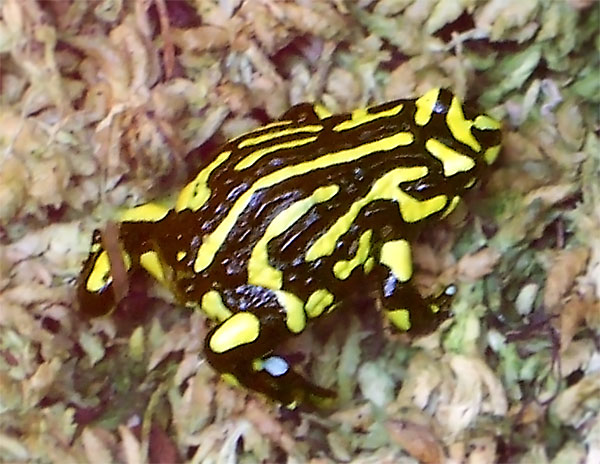 Southern Corroboree FrogPseudophryne corroboree
-
 Northern Corroboree FrogPseudophryne pengilleyi
Compare
Questions and answers
What is the scientific name of the Mount Glorious Day Frog?
The scientific name of the Mount Glorious Day Frog is Taudactylus diurnus. Written with its author, the full name is Taudactylus diurnus Straughan & Lee, 1966.
Which family does the Mount Glorious Day Frog belong to?
Taudactylus diurnus belongs to the family Myobatrachidae, in the order Anura and the class Amphibia.
Where is the Mount Glorious Day Frog found?
Checklists and occurrence records place Taudactylus diurnus in 1 country: Australia.
What is the conservation status of the Mount Glorious Day Frog?
The IUCN Red List category recorded for Taudactylus diurnus is Extinct (EX).
What other names does the Mount Glorious Day Frog have?
Taudactylus diurnus is also known in English as Mount Glorious Torrent Frog, Mt Glorious Day Frog, Mt Glorious Torrent Frog and Southern Day Frog.
Sources
Passages the profile rests on
- The dorsal skin was grey or brown with dark spots or streaks. Source passage: “The dorsal skin had a grey or brown tone with dark spots or streaks” — English Wikipedia
- The dorsal skin was mostly smooth but had some granular texture. Source passage: “was mostly smooth, with some granular texture.” — English Wikipedia
- The abdominal skin was creamy white or bluish-grey and sometimes had grey spots. Source passage: “The abdominal skin was a creamy white or bluish-grey, with occasional grey spots.” — English Wikipedia
- Adults measured between 22.0 and 30.6 mm in length. Source passage: “Mount Glorious day frogs varied in size, ranging from 22.0-30.6 mm in length.” — English Wikipedia
- Adult males measured between 22.0 and 27.2 mm in length. Source passage: “Males generally ranged from 22.0-27.2 mm long” — English Wikipedia
- Adult females measured between 23.3 and 30.6 mm in length. Source passage: “females were slightly larger, ranging from 23.3-30.6 mm.” — English Wikipedia
- The species inhabited montane rainforests. Source passage: “The species occupied montane rain forests” — English Wikipedia
- The species occupied permanent and temporary streams. Source passage: “specifically in long-lasting and temporary streams” — English Wikipedia
- The species used stream substrates consisting of gravel, clay and sand, usually in areas with rocky soil. Source passage: “on gravel, clay, sand and usually areas with rocky soil substrate.” — English Wikipedia
- The species was also recorded in exposed areas, gorges and densely vegetated wet areas. Source passage: “It was also found in exposed areas, gorges, and dense wet areas with a lot of vegetation.” — English Wikipedia
- The species was recorded in notophyll vine forest. Source passage: “notophyll vine forest” — amphibiaweb.org
- The species was recorded in sclerophyll fern forest. Source passage: “sclerophyll fern forest” — amphibiaweb.org
- The species was primarily active during daylight hours and became less active toward evening. Source passage: “The Mount Glorious day frog was most active during the day, becoming less and less active toward the evening.” — English Wikipedia
- Individuals rarely moved far from wet environments such as streams. Source passage: “it rarely moved far away from such wet environments” — English Wikipedia
- Individuals frequently entered water to swim or submerge themselves for rehydration. Source passage: “This included swimming often or submerging itself in the water from time to time for rehydration.” — English Wikipedia
- At night, individuals moved through cool rock crevices and occupied moist microhabitats. Source passage: “At night, when the frogs were less active, they could be seen moving throughout cool rock crevices and staying in moist parts of their environment” — English Wikipedia
- Night-time resting locations included areas beneath debris, stream edges and damp vegetation. Source passage: “like under debris, along the water's edge, and around damp vegetation.” — English Wikipedia
- The species fed primarily on small invertebrates found along the forest floor. Source passage: “The Mount Glorious day frog fed primarily on small invertebrates along the forest floor.” — English Wikipedia
- Its diet included flat-bodied crustaceans. Source passage: “These include flat-bodied crustaceans” — English Wikipedia
- Its diet included butterfly and moth larvae. Source passage: “butterfly or moth larvae” — English Wikipedia
- Its diet included other small insects found along streams. Source passage: “and other small insects along streams.” — English Wikipedia
- Breeding occurred during warm weather after or during heavy rainfall, from late October through May. Source passage: “The species bred in warm weather after or during heavy rain from late October to May” — English Wikipedia
- Breeding activity peaked between January and March. Source passage: “with a January to March peak.” — English Wikipedia
- Females deposited clutches of 24 to 36 eggs. Source passage: “The female deposited 24-36 eggs” — English Wikipedia
- Eggs were deposited in gelatinous clumps beneath rocks or branches in water. Source passage: “in gelatinous clumps under rocks or branches in the water” — English Wikipedia
- Males and females engaged in amplexus during mating. Source passage: “Males and females participated in amplexus mating behavior.” — English Wikipedia
- Tadpoles were recorded throughout the year. Source passage: “tadpoles could be found throughout the year.” — English Wikipedia
- Feral pigs were identified as a threat because they muddied water and interfered with reproduction and development. Source passage: “Feral pigs made the water muddy making it difficult for the frogs to reproduce and develop.” — English Wikipedia
- Feral pigs also preyed on the species. Source passage: “In addition, feral pigs also preyed on the frogs.” — English Wikipedia
- Changes in stream-water flow were implicated in the species' disappearance. Source passage: “Changes in the flow of stream water” — English Wikipedia
- The spread of chytridiomycosis was implicated in the species' disappearance. Source passage: “the spread of chytridiomycosis have also been implicated in the disappearance of the species.” — English Wikipedia
- The invasive plants Lantana camara and Ageratina riparia were associated with the species' extinction. Source passage: “A connection has been made between the frog's extinction and the presence of the invasive plant species Lantana camara and Ageratina riparia.” — English Wikipedia
Data
- Catalogue of Life, 2026-10-16 XR cc by
- Global Biodiversity Information Facility CC BY 4.0
- Wikidata CC0
- GeoNames CC BY 4.0
- Within the Catalogue of Life, this name comes from The Integrated Taxonomic Information System cc0
References
- Frost, Darrel R. (1997). Amphibian Species of the World, A Taxonomic and Geographic Reference. Second Edition.
This species in other databases
Page built on 29 November 2026. See how the catalog is made and all sources and licences.
Cite this page
ScientificNames.org. (2026). Taudactylus diurnus (Mount Glorious Day Frog). Retrieved November 29, 2026, from https://scientificnames.org/species/taudactylus-diurnus
“Taudactylus diurnus (Mount Glorious Day Frog).” ScientificNames.org, 2026, scientificnames.org/species/taudactylus-diurnus. Accessed 29 Nov. 2026.
ScientificNames.org. “Taudactylus diurnus (Mount Glorious Day Frog).” Accessed November 29, 2026. https://scientificnames.org/species/taudactylus-diurnus.
@misc{scientificnames_taudactylus_diurnus_mount_glorious_day_frog,
  author = {{ScientificNames.org}},
  title = {Taudactylus diurnus (Mount Glorious Day Frog)},
  year = {2026},
  url = {https://scientificnames.org/species/taudactylus-diurnus},
  note = {Accessed 2026-11-29}
}