Species · Amphibians
Eungella Torrent Frog Taudactylus eungellensis
The scientific name of the Eungella Torrent Frog is Taudactylus eungellensis. It is a species of amphibian in the family Myobatrachidae (australian frogs), order Anura. The name dates from 1973.
- Scientific name
- Taudactylus eungellensis Liem & Hosmer, 1973
- Common name
- Eungella Torrent Frog
- Genus
- Taudactylus
- Family
- Myobatrachidae (Australian Frogs)
- Order
- Anura
- Class
- Amphibia
- Red List category
- EN Endangered
- Recorded in
- 1 country
- Name status
- accepted in the Catalogue of Life

Overview
Taudactylus eungellensis inhabits montane rainforest and tall open forests, occurring in and around flowing creeks. It is distinguished by an X-shaped marking on its back and distinctive body and limb movements.
Written 27 November 2026 from the sources listed below. Each statement was checked against the passage it cites; statements that could not be supported were removed.
Appearance
The Eungella Torrent Frog has a slender head and body with long, lean limbs. Its dorsal colour ranges from yellowish-tan to dark brown with darker mottling, and it has an X-shaped marking on its back.[1][2][3]
The front half of its head is usually lighter in colour than the rear half. Its arms and legs have banded markings, while its toes and feet have wedge-shaped pads and lack webbing.[4][5][6]
Its back is smooth or granular and has a few low warts. Its belly is smooth and deep yellow, its irises are horizontally restricted and golden in colour, and its tympanum is indistinct.[7][8][9][10]
The species reaches approximately 35 mm in length.[11]
Habitat
The Eungella Torrent Frog inhabits montane rainforest and tall open forests. It occurs in and around flowing creeks and is stream-dwelling.[12][13][14]
Behaviour
The Eungella Torrent Frog is active during both daytime and nighttime. When alarmed, it may jump into a creek and hide beneath rocks until the danger has passed.[15][16]
Males produce a soft tinkering call that is barely audible above cascading water. The species is the only known member of Myobatrachidae that advertises its presence through body and limb movements.[17][18]
Its distinctive movements include leg flicking and waving, head bobbing and hopping. These movements are suspected to be a form of courtship.[19][20]
Reproduction and life cycle
Breeding may occur throughout the year, with the greatest intensity from November to December. Eggs are deposited in clumps containing 30–50 eggs.[21][22]
The eggs are attached beneath the surface of submerged rocks or logs.[23]
Conservation
The Eungella Torrent Frog is endemic to Australia. Its distribution is restricted to mountain ranges west of Mackay in mid-eastern Queensland.[24][25]
The species is listed as Endangered on the IUCN Red List and is classified as Endangered under Queensland's Nature Conservation (Animals) Regulation 2020. It was first observed to be declining during the 1980s.[26][27][28]
The species was not encountered during surveys conducted between 1987 and 1992. Since 1992, it has been rediscovered at nine sites.[29][30]
Its populations appear to be increasing slowly following rediscovery but have not recovered to their pre-decline abundance.[31][32]
The chytrid fungus Batrachochytrium dendrobatidis is believed to have caused the species' decline. The species now appears capable of coexisting with the chytrid fungus associated with its previous near extinction.[33][34]
A five-year recovery plan covers the Eungella Torrent Frog alongside Rheobatrachus vitellinus.[35]
Classification of the Eungella Torrent Frog
| Kingdom | Animalia |
|---|---|
| Phylum | Chordata |
| Subphylum | Vertebrata |
| Infraphylum | Gnathostomata |
| Parvphylum | Osteichthyes |
| Megaclass | Tetrapoda |
| Class | Amphibia (Amphibians) |
| Order | Anura (Frogs) |
| Superfamily | Myobatrachoidea |
| Family | Myobatrachidae (Australian Frogs) |
| Genus | Taudactylus (Torrent Frogs) |
| Species | Taudactylus eungellensis Liem & Hosmer, 1973 |
Where the Eungella Torrent Frog is found
Checklists and occurrence records place Taudactylus eungellensis in 1 country. GBIF holds 591 georeferenced records of it.
Countries
Regions and cities with the most records
A number beside a place is its count of GBIF occurrence records. A place without a number comes from a checklist alone. Records show where a species has been observed or collected, which can include escapes and vagrants.
Common names
English
- Eungella Torrent Frog
- Eungella Day Frog
Names in 3 other languages
- Czech
- paropucha štíhlá
- Japanese
- ユンゲラタニガエル
- Russian
- металлическая речница
Related species
- Mount Glorious Day FrogTaudactylus diurnus
- Sharp Snouted Day FrogTaudactylus acutirostris
- Kroombit Tinker FrogTaudactylus pleione
- Northern Tinker FrogTaudactylus rheophilus
-
 Eungella Tinker FrogTaudactylus liemi
-
 Turtle FrogMyobatrachus gouldii
-
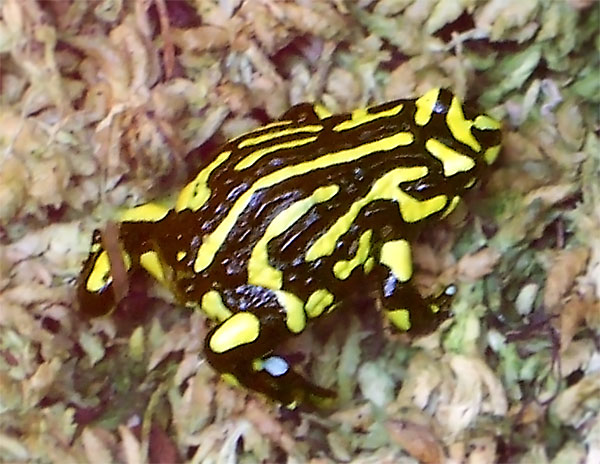 Southern Corroboree FrogPseudophryne corroboree
-
 Northern Corroboree FrogPseudophryne pengilleyi
Compare
Questions and answers
What is the scientific name of the Eungella Torrent Frog?
The scientific name of the Eungella Torrent Frog is Taudactylus eungellensis. Written with its author, the full name is Taudactylus eungellensis Liem & Hosmer, 1973.
Which family does the Eungella Torrent Frog belong to?
Taudactylus eungellensis belongs to the family Myobatrachidae, in the order Anura and the class Amphibia.
Where is the Eungella Torrent Frog found?
Checklists and occurrence records place Taudactylus eungellensis in 1 country: Australia.
What is the conservation status of the Eungella Torrent Frog?
The IUCN Red List category recorded for Taudactylus eungellensis is Endangered (EN).
What other names does the Eungella Torrent Frog have?
Taudactylus eungellensis is also known in English as Eungella Day Frog.
Sources
Passages the profile rests on
- The species has a slender head and body with long, lean limbs. Source passage: “The head and body are slender and the limbs are long and lean.” — English Wikipedia
- Its dorsal colour ranges from yellowish-tan to dark brown with darker mottling. Source passage: “The dorsum ranges from yellowish-tan to dark brown in colour with darker mottling.” — English Wikipedia
- It has an X-shaped marking on its back. Source passage: “There is an X-shaped marking on the back.” — English Wikipedia
- The front half of its head is usually lighter in colour than the rear half. Source passage: “The front half of the head is usually lighter than the back half” — English Wikipedia
- Its arms and legs have banded markings. Source passage: “the arms and legs have banding.” — English Wikipedia
- Its toes and feet have wedge-shaped pads and lack webbing. Source passage: “The toes and feet have wedge-shaped pads and no webbing.” — English Wikipedia
- Its back is smooth or granular and has a few low warts. Source passage: “The back is smooth or granular with a few low warts.” — English Wikipedia
- Its belly is smooth and deep yellow. Source passage: “The belly is smooth and deep yellow.” — English Wikipedia
- Its irises are horizontally restricted and golden in colour. Source passage: “The irises are restricted horizontally and are golden.” — English Wikipedia
- Its tympanum is indistinct. Source passage: “The tympanum is indistinct.” — English Wikipedia
- The species reaches approximately 35 mm in length. Source passage: “It is a relatively small frog reaching 35 mm (1.38 in) in length.” — English Wikipedia
- The species inhabits montane rainforest and tall open forests. Source passage: “This frog inhabits montane rainforest and tall open forests.” — English Wikipedia
- It occurs in and around flowing creeks. Source passage: “It is found in and around flowing creeks.” — English Wikipedia
- The species is stream-dwelling. Source passage: “The Eungella torrent frog or Eungella day frog (Taudactylus eungellensis) is a species of stream dwelling frog endemic to Australia.” — English Wikipedia
- The species is active during both daytime and nighttime. Source passage: “Taudactylus eungellensis is active during day and night” — amphibiaweb.org
- When alarmed, it may jump into a creek and hide beneath rocks until the danger has passed. Source passage: “If alarmed, the Eungella torrent frog may jump into a creek where it will hide beneath rocks until the danger has passed.” — English Wikipedia
- Males produce a soft tinkering call that is barely audible above cascading water. Source passage: “Males make a soft tinkering sound barely audible over the sound of cascading water.” — English Wikipedia
- The species is the only known member of Myobatrachidae that advertises its presence through body and limb movements. Source passage: “The Eungella torrent frog is the only Myobatrachidae that is known to advertise its presence by the movement of its body and limbs.” — English Wikipedia
- Its distinctive movements include leg flicking and waving, head bobbing and hopping. Source passage: “These movements include: flicking and waving of legs, head bobbing, and distinctive hops.” — English Wikipedia
- Its body and limb movements are suspected to be a form of courtship. Source passage: “It is suspected that these movements are a form of courtship.” — English Wikipedia
- Breeding may occur throughout the year, with the greatest intensity from November to December. Source passage: “Breeding may occur all year round, but is most intense from November to December.” — English Wikipedia
- Eggs are deposited in clumps containing 30–50 eggs. Source passage: “Eggs are laid in clumps of 30–50.” — English Wikipedia
- The eggs are attached beneath the surface of submerged rocks or logs. Source passage: “They are attached to the under the surface of submerged rocks or logs.” — English Wikipedia
- The species is endemic to Australia. Source passage: “is a species of stream dwelling frog endemic to Australia.” — English Wikipedia
- Its distribution is restricted to mountain ranges west of Mackay in mid-eastern Queensland. Source passage: “It is restricted to ranges west of Mackay in mid-eastern Queensland.” — English Wikipedia
- The species is listed as Endangered on the IUCN Red List. Source passage: “It is listed as Endangered on the IUCN Red List” — English Wikipedia
- It is classified as Endangered under Queensland's Nature Conservation (Animals) Regulation 2020. Source passage: “and as "Endangered" under Queensland's Nature Conservation (Animals) Regulation (2020).” — English Wikipedia
- The species was first observed to be declining during the 1980s. Source passage: “The Eungella torrent frog was first noted to be in decline in the 1980s.” — English Wikipedia
- The species was not encountered during surveys conducted between 1987 and 1992. Source passage: “From 1987 to 1992, the frog was not encountered, despite surveys.” — English Wikipedia
- Since 1992, the species has been rediscovered at nine sites. Source passage: “From 1992 onwards, it has been rediscovered at nine sites” — English Wikipedia
- Its populations appear to be increasing slowly following rediscovery. Source passage: “populations appear to be slowly on the rise.” — English Wikipedia
- Its populations have not recovered to their pre-decline abundance. Source passage: “populations have not rebounded to what they were before the decline, when they were still considered common.” — English Wikipedia
- The chytrid fungus Batrachochytrium dendrobatidis is believed to have caused the species' decline. Source passage: “The cause for decline is believed to be the chytrid fungus Batrachochytrium dendrobatidis” — English Wikipedia
- The species now appears capable of coexisting with the chytrid fungus associated with its previous near extinction. Source passage: “the frogs now seem to be able to coexist with the fungus that once caused their near extinction.” — English Wikipedia
- A five-year recovery plan covers the species alongside Rheobatrachus vitellinus. Source passage: “This document is a five year plan for the recovery of two endangered frogs, Rheobatrachus vitellinus and Taudactylus eungellensis, species ...” — dcceew.gov.au
Data
- Catalogue of Life, 2026-10-16 XR cc by
- Global Biodiversity Information Facility CC BY 4.0
- Wikidata CC0
- GeoNames CC BY 4.0
- Wikimedia Commons per image; credit shown with each image
- Within the Catalogue of Life, this name comes from The Integrated Taxonomic Information System cc0
This species in other databases
Page built on 28 November 2026. See how the catalog is made and all sources and licences.
Cite this page
ScientificNames.org. (2026). Taudactylus eungellensis (Eungella Torrent Frog). Retrieved November 28, 2026, from https://scientificnames.org/species/taudactylus-eungellensis
“Taudactylus eungellensis (Eungella Torrent Frog).” ScientificNames.org, 2026, scientificnames.org/species/taudactylus-eungellensis. Accessed 28 Nov. 2026.
ScientificNames.org. “Taudactylus eungellensis (Eungella Torrent Frog).” Accessed November 28, 2026. https://scientificnames.org/species/taudactylus-eungellensis.
@misc{scientificnames_taudactylus_eungellensis_eungella_torrent_frog,
  author = {{ScientificNames.org}},
  title = {Taudactylus eungellensis (Eungella Torrent Frog)},
  year = {2026},
  url = {https://scientificnames.org/species/taudactylus-eungellensis},
  note = {Accessed 2026-11-28}
}