Species · Reptiles
Bartle Frere Cool-skink Techmarscincus jigurru
The scientific name of the Bartle Frere Cool-skink is Techmarscincus jigurru. It is a species of reptile in the family Scincidae (skink), order Squamata. The name dates from 1984.
- Scientific name
- Techmarscincus jigurru (Covacevich, 1984)
- Common name
- Bartle Frere Cool-skink
- Genus
- Techmarscincus
- Family
- Scincidae (Skink)
- Order
- Squamata
- Class
- Reptilia
- Red List category
- VU Vulnerable
- Recorded in
- 1 country
- Name status
- accepted in the Catalogue of Life
Overview
Bartle Frere Cool-skink is a reptile in the family Scincidae, order Squamata and class Reptilia. It is endemic to Mount Bartle Frere in Queensland, Australia. It has rainbow-sheen coloration, a long, flat body, short limbs and a long tail.
Written 27 November 2026 from the sources listed below. Each statement was checked against the passage it cites; statements that could not be supported were removed.
Appearance
Bartle Frere Cool-skink has rainbow-sheen coloration. Its body is long and flat, with short limbs and a long tail.[1][2]
Habitat
The species occurs at elevations between 1,400 and 1,622 metres above sea level.[3]
Behaviour
Bartle Frere Cool-skink is agile and energetic. It is active and basks during daylight hours.[4][5]
At night, it retreats into cracks in exposed granite. It tolerates juveniles occupying the same area.[6][7]
Reproduction and life cycle
Bartle Frere Cool-skink is oviparous.[8]
Conservation
Bartle Frere Cool-skink is described as rare and endangered. It is classified as critically endangered under Queensland's NCA status.[9][10]
The species is listed as critically endangered in the Queensland rare or threatened wildlife records for the Bartle Frere map tile.[11]
Classification of the Bartle Frere Cool-skink
| Kingdom | Animalia |
|---|---|
| Phylum | Chordata |
| Subphylum | Vertebrata |
| Infraphylum | Gnathostomata |
| Parvphylum | Osteichthyes |
| Megaclass | Tetrapoda |
| Class | Reptilia (Reptile) |
| Order | Squamata (Snakes) |
| Suborder | Autarchoglossa |
| Family | Scincidae (Skink) |
| Subfamily | Eugongylinae |
| Genus | Techmarscincus |
| Species | Techmarscincus jigurru (Covacevich, 1984) |
Where the Bartle Frere Cool-skink is found
Checklists and occurrence records place Techmarscincus jigurru in 1 country across Oceania. GBIF holds 34 georeferenced records of it.
Countries
Regions and cities with the most records
Range as the checklists state it
Australia (Queensland, Cape York Peninsula), elevation 1524 m.
A number beside a place is its count of GBIF occurrence records. A place without a number comes from a checklist alone. Records show where a species has been observed or collected, which can include escapes and vagrants.
Common names
English
- Bartle Frere Cool-skink
- Bartle Frere Coolskink
- Bartle Frere Skink
Synonyms
One other scientific name has been used for this species and is now treated as a synonym of Techmarscincus jigurru.
- Leiolopisma jigurru Covacevich, 1984
Related species
-
 ShinglebackTiliqua rugosa
-
 Five-lined SkinkPlestiodon fasciatus
- Common Garden SkinkLampropholis guichenoti
-
 Blue-tailed SkinkCryptoblepharus egeriae
-
 Red-eyed Crocodile SkinkTribolonotus gracilis
-
 Common Blue-tongued SkinkTiliqua scincoides
-
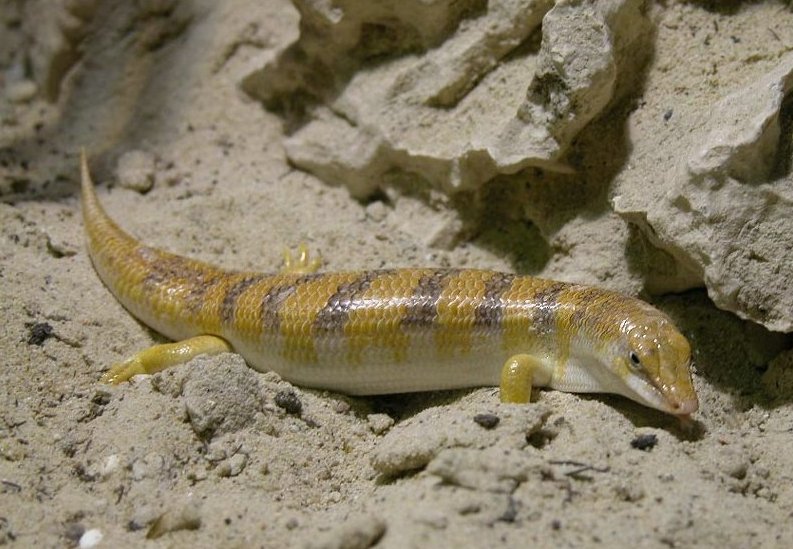 Sandfish SkinkScincus scincus
-
 Land MulletBellatorias major
Compare
Questions and answers
What is the scientific name of the Bartle Frere Cool-skink?
The scientific name of the Bartle Frere Cool-skink is Techmarscincus jigurru. Written with its author, the full name is Techmarscincus jigurru (Covacevich, 1984).
Which family does the Bartle Frere Cool-skink belong to?
Techmarscincus jigurru belongs to the family Scincidae, in the order Squamata and the class Reptilia.
Where is the Bartle Frere Cool-skink found?
Checklists and occurrence records place Techmarscincus jigurru in 1 country: Australia.
What is the conservation status of the Bartle Frere Cool-skink?
The IUCN Red List category recorded for Techmarscincus jigurru is Vulnerable (VU).
What other names does the Bartle Frere Cool-skink have?
Techmarscincus jigurru is also known in English as Bartle Frere Coolskink and Bartle Frere Skink.
Sources
Passages the profile rests on
- The species has a rainbow-sheen coloration. Source passage: “T. jigurru has a rainbow sheen color.” — English Wikipedia
- The species has a long, flat body, short limbs and a long tail. Source passage: “Its body is long and flat, with short limbs and a long tail.” — English Wikipedia
- The species occurs at elevations between 1,400 and 1,622 metres above sea level. Source passage: “The Bartle Frere skink occurs at elevations of 1,400 to 1,622 m (4,593 to 5,322 ft) on the top of Mount Bartle Frere.” — English Wikipedia
- The species is agile and energetic. Source passage: “The Bartle Frere skink is agile and energetic.” — English Wikipedia
- The species is active and basks during daylight hours. Source passage: “It is only seen out and basking during the day.” — English Wikipedia
- The species retreats into cracks in exposed granite at night. Source passage: “A night, it retreats into cracks in the exposed granite.” — English Wikipedia
- The species tolerates juveniles occupying the same area. Source passage: “The Bartle Frere skink tolerates juveniles in the same area, as most skinks do not.” — English Wikipedia
- The species is oviparous. Source passage: “T. jigurru is oviparous.” — English Wikipedia
- The species is described as rare and endangered. Source passage: “is a species of rare and endangered lizard first discovered in 1981.” — English Wikipedia
- The species is classified as critically endangered under Queensland's NCA status. Source passage: “NCA Status:Critically endangered.” — wildnet.science-data.qld.gov.au
- The species is listed as critically endangered in the Queensland rare or threatened wildlife records for the Bartle Frere map tile. Source passage: “Scincidae Techmarscincus jigurru Bartle Frere cool-skink CR Q 15 3 23/09/2024” — wetlandinfo.detsi.qld.gov.au
Data
- Catalogue of Life, 2026-10-16 XR cc by
- Global Biodiversity Information Facility CC BY 4.0
- Wikidata CC0
- GeoNames CC BY 4.0
- Within the Catalogue of Life, this name comes from The Reptile Database cc by
References
- Covacevich J. (1984). A biogeographically significant new species of Leiolopisma (Scincidae) from north eastern Queensland. Memoirs of the Queensland Museum 21 (2): 401-411.
- Hutchinson M N, Donnellan S C, Baverstock P R, Krieg M, Simms S, & Burgin S. (1990). Immunological relationships and generic revision of the Australian lizards assigned to the genus Leiolopisma (Scincidae: Lygosominae). Australian Journal of Zoology 38 (5): 535-554.
- Cogger, H. G. (2000). Reptiles and Amphibians of Australia, 6th ed. Ralph Curtis Publishing, Sanibel Island, 808 Pp.
- Couper, P., Covacevich, J., Amey, A., & Baker, A. (2006). The genera of skinks (Family Scincidae) of Australia and its island territories: diversity, distribution and identification. in: Merrick, J.R., Archer, M., Hickey, G.M. & Lee, M.S.Y. (eds.). Evolution and Zoogeography of Australasian Vertebrates. Australian Scientific Publishing, Sydney, Pp. 367-384.
- Wilson, S., & Swan, G. (2010). A complete guide to reptiles of Australia, 3rd ed. Chatswood: New Holland, 558 Pp.
- Cogger, H. G. (2014). Reptiles and Amphibians of Australia, 7th ed. CSIRO Publishing, Xxx + 1033 Pp.
- Meiri, Shai; Aaron M. Bauer, Allen Allison, Fernando Castro-Herrera, Laurent Chirio, Guarino Colli, Indraneil Das, Tiffany M. Doan, Frank Glaw, Lee L. Grismer, Marinus Hoogmoed, Fred Kraus, Matthew LeBreton, Danny Meirte, Zoltán T. Nagy, Cristiano de C. Nogueira, Paul Oliver, Olivier S. G. Pauwels, Daniel Pincheira-Donoso, Glenn Shea, Roberto Sindaco, Oliver J. S. Tallowin, Omar Torres-Carvajal, Jean-Francois Trape, Peter Uetz, Philipp Wagner, Yuezhao Wang, Thomas Ziegler, and Uri Roll. (2017). Extinct, obscure or imaginary: the lizard species with the smallest ranges. Diversity and Distributions 24 (2): 262-273.
- Chapple, D., Chapple, S., Smith, S., Shea, G., Brennan, I., & Sadlier, R. (2023). Phylogenetic relationships in the Eugongylini (Squamata: Scincidae): generic limits and biogeography. Australian Journal of Zoology 70(6): 165–203.
- Uetz, P. H., Patel, M., Gbadamosi, Z., Nguyen, A., & Shoope, S. (2024). A Reference Database of Reptile Images. Taxonomy 4: 723–732.
This species in other databases
Page built on 27 November 2026. See how the catalog is made and all sources and licences.
Cite this page
ScientificNames.org. (2026). Techmarscincus jigurru (Bartle Frere Cool-skink). Retrieved November 27, 2026, from https://scientificnames.org/species/techmarscincus-jigurru
“Techmarscincus jigurru (Bartle Frere Cool-skink).” ScientificNames.org, 2026, scientificnames.org/species/techmarscincus-jigurru. Accessed 27 Nov. 2026.
ScientificNames.org. “Techmarscincus jigurru (Bartle Frere Cool-skink).” Accessed November 27, 2026. https://scientificnames.org/species/techmarscincus-jigurru.
@misc{scientificnames_techmarscincus_jigurru_bartle_frere_cool_skink,
  author = {{ScientificNames.org}},
  title = {Techmarscincus jigurru (Bartle Frere Cool-skink)},
  year = {2026},
  url = {https://scientificnames.org/species/techmarscincus-jigurru},
  note = {Accessed 2026-11-27}
}