Species · Flowering plants
Common Meadow-Rue Thalictrum flavum
The scientific name of the Common Meadow-Rue is Thalictrum flavum. It is a species of flowering plant in the family Ranunculaceae (crowfoot family), order Ranunculales.
- Scientific name
- Thalictrum flavum L.
- Common name
- Common Meadow-Rue
- Genus
- Thalictrum
- Family
- Ranunculaceae (Crowfoot Family)
- Order
- Ranunculales
- Class
- Magnoliopsida
- Recorded in
- 43 countries
- Name status
- accepted in the Catalogue of Life
Overview
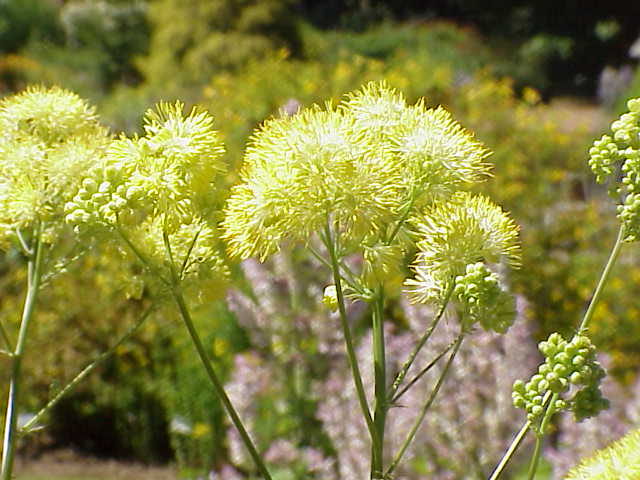
Thalictrum flavum occurs in grasslands, marshy fields, fens and along riverbanks. It produces clusters of fluffy, yellow, fragrant flowers with white sepals and longer, erect yellow stamens.
Written 26 November 2026 from the sources listed below. Each statement was checked against the passage it cites; statements that could not be supported were removed.
Appearance
Common Meadow-Rue has fibrous roots and wedge-shaped, dark green leaves with paler green undersides. The leaves are divided into multiple sections.[1][2]
The plant produces clusters of fluffy, yellow, fragrant flowers. Each flower has short white sepals and longer, erect yellow stamens, which give the flowers their yellow appearance.[3][4][5]
Each flower head subsequently produces three fruits.[6]
The plant can grow up to 100 cm tall and reach a breadth of 45 cm.[7][8]
Habitat
Common Meadow-Rue occurs in grasslands and marshy fields. It also grows in fens and along riverbanks.[9][10][11][12]
Reproduction and life cycle
Common Meadow-Rue blooms between June and August. Flies and bees are its main pollinators.[13][14]
The species disperses its seeds by wind.[15]
Behaviour
The larvae of the Marsh Carpet moth feed on Common Meadow-Rue seeds and flowers.[16]
Uses
Common Meadow-Rue is cultivated as an ornamental plant. Its foliage has been used as a purgative in folk medicine in the United Kingdom.[17][18]
Classification of the Common Meadow-Rue
| Kingdom | Plantae |
|---|---|
| Subkingdom | Pteridobiotina |
| Phylum | Tracheophyta |
| Class | Magnoliopsida |
| Order | Ranunculales |
| Family | Ranunculaceae (Crowfoot Family) |
| Subfamily | Thalictroideae |
| Genus | Thalictrum (Meadow-rue) |
| Species | Thalictrum flavum L. |
Where the Common Meadow-Rue is found
Checklists and occurrence records place Thalictrum flavum in 43 countries across Asia and Europe. GBIF holds 131,184 georeferenced records of it.
Countries where it is native or its origin is not stated
- Aland Islands 376
- Armenia 3
- Austria 488
- Azerbaijan
- Belarus 64
- Belgium 9,062
- Bosnia and Herzegovina 3
- Bulgaria 8
- China 38
- Croatia 8
- Czechia 216
- Denmark 4,813
- Estonia 1,855
- Finland 4,865
- France 27,950
- Georgia 1
- Germany 10,644
- Greece 4
- Hungary 82
- Ireland 56
- Italy 280
- Kazakhstan 73
- Kyrgyzstan 2
- Latvia 118
- Lithuania 12
- Luxembourg 49
- Moldova
- Montenegro 1
- Norway 2,591
- Poland 1,415
- Portugal 30
- Romania 13
- Russia 2,801
- Serbia 6
- Slovakia 668
- Slovenia 16
- Spain 427
- Sweden 13,347
- Switzerland 6,742
- The Netherlands 27,104
- Turkey 14
- Ukraine 268
Countries where it has been introduced
Regions and cities with the most records
- England, United Kingdom 13,571
- Bavaria, Germany 5,938
- Gelderland, The Netherlands 5,755
- Hauts-de-France, France 5,647
- Auvergne-Rhône-Alpes, France 3,745
- Gorinchem, The Netherlands 3,664
- Neuchâtel, Switzerland 3,585
- Centre-Val de Loire, France 3,559
- Heist-op-den-Berg, Belgium 3,536
- Sliedrecht, The Netherlands 3,476
- Grand Est, France 3,462
- Zealand, Denmark 3,456
- Elst, The Netherlands 3,395
- Aarschot, Belgium 3,347
- Diest, Belgium 3,265
- Beuningen, The Netherlands 3,255
- Westerlo, Belgium 3,235
- Dordrecht, The Netherlands 3,183
- Friesland, The Netherlands 3,113
- Papendrecht, The Netherlands 3,077
- Tessenderlo, Belgium 3,040
- Geertruidenberg, The Netherlands 3,004
- Nijmegen, The Netherlands 2,991
- Overijssel, The Netherlands 2,956
- Île-de-France, France 2,946
- Alblasserdam, The Netherlands 2,934
- Geel, Belgium 2,922
- Hendrik-Ido-Ambacht, The Netherlands 2,912
- Beringen, Belgium 2,861
- Zwijndrecht, The Netherlands 2,816
- Arnhem, The Netherlands 2,621
- Steenwijk, The Netherlands 2,617
- Huissen, The Netherlands 2,615
- Wageningen, The Netherlands 2,597
- Waalwijk, The Netherlands 2,571
- Bourgogne-Franche-Comté, France 2,548
4 more countries have a few records outside this range
These countries hold a few records of Thalictrum flavum but lie outside the range the checklists give for it. Such records are often zoo or garden specimens, museum material or vagrants, so the species is not counted as occurring there.
Range as the checklists state it
England (England, Wales, Scotland [I]); Ireland (Ireland, Northern Ireland); Denmark; Norway; Sweden; Finland; Luxembourg; Germany (Brandenburg, Berlin, Baden-Württemberg, Bayern, Hessen, Hamburg, Mecklenburg-Vorpommern, Niedersachsen, Nordrhein-Westfalen, Rheinland-Pfalz, Schleswig-Holstein, Saarland, Sachsen, Sachsen-Anhalt, Thüringen); Switzerland; Austria; Czech Republic; Slovakia; Hungary; NW-Spain; France; N-Italy (rare); Slovenia; Croatia; Montenegro; Serbia; S-Romania; Estonia; Latvia; Lithuania; Belarus; European Russia; Moldova; W-Ukraine; Siberia (Altay, Buryatia, Irkutsk, Krasnoyarsk, W-Siberia/Siberian Urals, NW-Siberia, SW-Siberia); Kazakhstan; Kyrgyzstan; Northern Caucasus; Georgia [Caucasus]; Armenia; Azerbaijan
A number beside a place is its count of GBIF occurrence records. A place without a number comes from a checklist alone. Records show where a species has been observed or collected, which can include escapes and vagrants.
Common names
English
- Common Meadow-Rue
- Yellow Meadow-rue
Names in 24 other languages
- Chinese
- 马尾连, 黄唐松草
- Czech
- žluťucha žlutá
- Danish
- Gul frøstjerne
- Dutch
- Poelruit
- Estonian
- kollane ängelhein
- Finnish
- keltaängelmä
- French
- Pigamon jaune, Pigamon noircissant
- German
- Gelbe Wiesenraute, Hohe Wiesenraute
- Hungarian
- sárga borkóró
- Italian
- Pigamo giallo, Talittro giallo
- Latvian
- Dzeltenais saulkrēsliņš
- Lithuanian
- Geltonasis vingiris
- Northern Sami
- fiskessiemanásti
- Polish
- Rutewka żółta
- Russian
- Василисник жёлтый, Василистник жёлтый
- Slovak
- žltuška žltá
- Slovenian
- rumeni talin
- Spanish
- Ruibarbo de los pobres
- Swedish
- ängsruta
- Ukrainian
- Рутвиця жовта
- Welsh
- Arianllys, Arianllys Cyffredin, Echryshaint, Llys y Pia, Troed y Barcud
- bak
- Баҡыр сәскә
- chv
- Сарă тар курăкĕ
- hsb
- Žołty žiwotnik
Synonyms
81 other scientific names have been used for this species and are now treated as synonyms of Thalictrum flavum.
- Anemone linnaeana Rouy & Foucaud
- Thalictrum altissimum Thomas
- Thalictrum angustatum Weinm. ex Lecoy.
- Thalictrum angustifolium subsp. mediterraneum (Jord.) Bonnier
- Thalictrum angustifolium var. flavum (L.) Fiori
- Thalictrum angustifolium var. mediterraneum (Jord.) Fiori
- Thalictrum angustifolium var. morisonii (C.C.Gmel.) Steud.
- Thalictrum angustifolium var. variifolium Rchb.
- Thalictrum anonymum Wallr. ex Lecoy.
- Thalictrum belgicum Jord.
- Thalictrum capitatum Jord.
- Thalictrum commutatum C.A.Mey. ex Ledeb.
- Thalictrum controversum subsp. flavum (L.) K.F.Schimp. & Spenn.
- Thalictrum exaltatum subsp. mediterraneum (Jord.) P.Fourn.
- Thalictrum exaltatum subsp. mediterraneum (Jord.) Rouy & Foucaud
- Thalictrum flaccidum Schleich. ex Hegetschw.
- Thalictrum flavum subsp. flavum
- Thalictrum flavum subsp. linnaeanum Rouy & Foucaud
- Thalictrum flavum subsp. mediterraneum (Jord.) Nyman
- Thalictrum flavum subsp. riparium (Jord. ex Boreau) Bonnier
- Thalictrum flavum subsp. rufinerve (Lej. & Courtois) Jáv.
- Thalictrum flavum subsp. rufinerve (Lej. & Courtois) Rouy & Foucaud
- Thalictrum flavum subsp. sphaerocarpum (Lej. & Courtois) Rouy & Foucaud
- Thalictrum flavum var. belgicum (Jord.) Nyman
- Thalictrum flavum var. campestre Laest.
- Thalictrum flavum var. capitatum (Jord.) Nyman
- Thalictrum flavum var. euskarum Elías & Pau ex P.Monts.
- Thalictrum flavum var. flaccidum (Schleich. ex Hegetschw.) Ducommun
- Thalictrum flavum var. genuinum Regel
- Thalictrum flavum var. latifolium Lecoy.
- Thalictrum flavum var. latifolium Willk.
- Thalictrum flavum var. latisectum Neilr.
- Thalictrum flavum var. laxum Sommier
- Thalictrum flavum var. medium Laest.
- Thalictrum flavum var. morisonii (C.C.Gmel.) Syme
- Thalictrum flavum var. morisonii (C.C.Gmel.) Willk.
- Thalictrum flavum var. pauperculum Gren. & Godr.
- Thalictrum flavum var. pauperculum Gren.
- Thalictrum flavum var. pauperculum Herm. ex DC.
- Thalictrum flavum var. pinguidum Laest.
Showing 40 of 81.
Related species
-
 Columbine Meadow-rueThalictrum aquilegiifolium
-
 Chinese Meadow-RueThalictrum delavayi
- Rue AnemoneThalictrum thalictroides
-
 Lesser Meadow-RueThalictrum minus
-
 Early Meadow-rueThalictrum dioicum
-
 Alpine Meadow-rueThalictrum alpinum
-
 Tall Meadow-rueThalictrum pubescens
-
 Lavender Mist MeadowrueThalictrum rochebruneanum
Compare
Questions and answers
What is the scientific name of the Common Meadow-Rue?
The scientific name of the Common Meadow-Rue is Thalictrum flavum. Written with its author, the full name is Thalictrum flavum L..
Which family does the Common Meadow-Rue belong to?
Thalictrum flavum belongs to the family Ranunculaceae, in the order Ranunculales and the class Magnoliopsida.
Where is the Common Meadow-Rue found?
Checklists and occurrence records place Thalictrum flavum in 43 countries, including France, The Netherlands, Sweden, Germany, Belgium and Switzerland.
What other names does the Common Meadow-Rue have?
Thalictrum flavum is also known in English as Yellow Meadow-rue.
Sources
Passages the profile rests on
- Thalictrum flavum has fibrous roots and wedge-shaped, dark green leaves with paler green undersides. Source passage: “Thalictrum flavum has fibrous roots, and wedge-shaped, dark green leaves, with a paler green underneath” — English Wikipedia
- The leaves are divided into multiple sections. Source passage: “they are divided into multiple sections.” — English Wikipedia
- The plant produces clusters of fluffy, yellow, fragrant flowers. Source passage: “producing clusters of fluffy yellow fragrant flowers in summer.” — English Wikipedia
- The flowers have short sepals and longer, erect stamens. Source passage: “The flowers are composed of short sepals and longer, erect stamens.” — English Wikipedia
- The sepals are white, while the yellow stamens give the flowers their yellow appearance. Source passage: “The sepals are actually white, but the multiple erect, yellow stamens, give the flower a yellow appearance.” — English Wikipedia
- Each flower head subsequently produces three fruits. Source passage: “Later, three fruits are formed from each flower head.” — English Wikipedia
- The plant can grow up to 100 cm tall. Source passage: “Growing to 100 cm (39 in) tall” — English Wikipedia
- The plant can reach a breadth of 45 cm. Source passage: “by 45 cm (18 in) broad” — English Wikipedia
- The species occurs in grasslands. Source passage: “It is found generally in grasslands, marshy fields, fens and riverbanks.” — English Wikipedia
- The species occurs in marshy fields. Source passage: “It is found generally in grasslands, marshy fields, fens and riverbanks.” — English Wikipedia
- The species occurs in fens. Source passage: “It is found generally in grasslands, marshy fields, fens and riverbanks.” — English Wikipedia
- The species occurs along riverbanks. Source passage: “It is found generally in grasslands, marshy fields, fens and riverbanks.” — English Wikipedia
- The species blooms between June and August. Source passage: “It blooms between June and August.” — English Wikipedia
- Flies and bees are the main pollinators of the species. Source passage: “It is pollinated mainly by flies and bees” — English Wikipedia
- The species disperses its seeds by wind. Source passage: “with wind dispersal of the seeds.” — English Wikipedia
- The larvae of the Marsh Carpet moth feed on the species' seeds and flowers. Source passage: “The larva of the Perizoma sagittata (Marsh Carpet moth) are found on the plant, eating the seeds and the flowers.” — English Wikipedia
- The species is cultivated as an ornamental plant. Source passage: “Thalictrum flavum is cultivated as an ornamental plant.” — English Wikipedia
- The foliage has been used as a purgative in folk medicine in the United Kingdom. Source passage: “It has been used in folk medicine in the UK, the foliage has been used a purgative.” — English Wikipedia
Data
- Catalogue of Life, 2026-10-16 XR cc by
- Global Biodiversity Information Facility CC BY 4.0
- Wikidata CC0
- GeoNames CC BY 4.0
- Wikimedia Commons per image; credit shown with each image
- Within the Catalogue of Life, this name comes from Synonymic Checklists of the Vascular Plants of the World cc by
References
- L. (1753). Sp. Pl. [Linnaeus] 1: 546 (1753). where the name was published
This species in other databases
- Catalogue of Life 7BTKQ
- Wikidata Q162764
- iNaturalist 354776
- World Flora Online wfo-0000454062
- GRIN 36434
Page built on 27 November 2026. See how the catalog is made and all sources and licences.
Cite this page
ScientificNames.org. (2026). Thalictrum flavum (Common Meadow-Rue). Retrieved November 27, 2026, from https://scientificnames.org/species/thalictrum-flavum
“Thalictrum flavum (Common Meadow-Rue).” ScientificNames.org, 2026, scientificnames.org/species/thalictrum-flavum. Accessed 27 Nov. 2026.
ScientificNames.org. “Thalictrum flavum (Common Meadow-Rue).” Accessed November 27, 2026. https://scientificnames.org/species/thalictrum-flavum.
@misc{scientificnames_thalictrum_flavum_common_meadow_rue,
  author = {{ScientificNames.org}},
  title = {Thalictrum flavum (Common Meadow-Rue)},
  year = {2026},
  url = {https://scientificnames.org/species/thalictrum-flavum},
  note = {Accessed 2026-11-27}
}