Species · Flowering plants
Rue Anemone Thalictrum thalictroides
The scientific name of the Rue Anemone is Thalictrum thalictroides. It is a species of flowering plant in the family Ranunculaceae (crowfoot family), order Ranunculales.
- Scientific name
- Thalictrum thalictroides (L.) A.J.Eames & B.Boivin
- Common name
- Rue Anemone
- Genus
- Thalictrum
- Family
- Ranunculaceae (Crowfoot Family)
- Order
- Ranunculales
- Class
- Magnoliopsida
- Recorded in
- 3 countries
- Name status
- accepted in the Catalogue of Life
Overview
Thalictrum thalictroides is native to woodland in eastern North America, with a distribution concentrated mainly in the northeastern United States and Ontario, Canada.
Written 26 November 2026 from the sources listed below. Each statement was checked against the passage it cites; statements that could not be supported were removed.
Appearance
The rue anemone is a hairless herbaceous plant with upright flowering stems that grow between 10 and 30 cm tall. Its basal leaves have twice-ternately compound leaf blades, with broadly rounded leaflets that have three-lobed ends.[1][2][3][4]
Its flowers are white to pinkish-lilac and contain numerous yellow stamens. Each flower contains between four and fifteen carpels surrounded by yellow stamens.[5][6]
The plant produces green achenes with eight to ten prominent veins that turn dark brown when ripe. Its achenes measure between 3 and 4.5 mm long.[7][8]
Habitat
The rue anemone typically grows on banks and in thickets within low-lying deciduous woodland. It also grows singly on wooded slopes.[9][10]
Behaviour
The rue anemone flowers during spring. Its flowers are borne singly or in umbel-like inflorescences containing three to six flowers.[11][12]
Reproduction and life cycle
Its flowers contain between five and ten petal-like sepals. The species releases its achenes in late spring.[13][14]
Similar species
The false rue-anemone (Enemion biternatum) is frequently confused with the rue anemone. Unlike the false rue-anemone, the rue anemone can produce pale to dark pink sepals.[15][16]
The flowers of the rue anemone typically form clusters of three to six above leaf-like bracts. The rue anemone can have five to ten sepals, whereas the false rue-anemone always has five.[17][18]
Classification of the Rue Anemone
| Kingdom | Plantae |
|---|---|
| Subkingdom | Pteridobiotina |
| Phylum | Tracheophyta |
| Class | Magnoliopsida |
| Order | Ranunculales |
| Family | Ranunculaceae (Crowfoot Family) |
| Subfamily | Thalictroideae |
| Genus | Thalictrum (Meadow-rue) |
| Species | Thalictrum thalictroides (L.) A.J.Eames & B.Boivin |
Where the Rue Anemone is found
Checklists and occurrence records place Thalictrum thalictroides in 3 countries across Europe and North America. GBIF holds 40,433 georeferenced records of it.
Countries where it is native or its origin is not stated
Countries where it has been introduced
Regions and cities with the most records
- Ohio, United States 3,067
- Pennsylvania, United States 2,952
- Virginia, United States 2,950
- Tennessee, United States 2,819
- North Carolina, United States 2,694
- Maryland, United States 2,024
- Kentucky, United States 1,852
- Minnesota, United States 1,695
- New York, United States 1,669
- Illinois, United States 1,546
- Arkansas, United States 1,349
- Missouri, United States 1,315
- Georgia, United States 1,255
- Indiana, United States 1,186
- Alabama, United States 1,079
- New Jersey, United States 1,054
- Wisconsin, United States 990
- Michigan, United States 923
- Durham, United States 854
- Chapel Hill, United States 745
- North Bethesda, United States 737
- Rockville, United States 736
- Carrboro, United States 731
- Potomac, United States 722
- McLean, United States 709
- Aspen Hill, United States 703
- Wheaton, United States 676
- Bethesda, United States 671
- Connecticut, United States 662
- Reston, United States 648
- Great Falls, United States 646
- Vienna, United States 636
- Tysons, United States 635
- Wolf Trap, United States 618
- Oakton, United States 614
- Idylwood, United States 613
Range as the checklists state it
Germany [I]; Canada (Ontario); USA (Alabama, Arkansas, Connecticut, District of Columbia, Delaware, Florida, Georgia, Iowa, Illinois, Indiana, Kansas, Kentucky, Massachusetts, Maryland, Maine, Michigan, Minnesota, Missouri, Mississippi, North Carolina, New Hampshire, New Jersey, New York, Ohio, Oklahoma, Pennsylvania, Rhode Island, South Carolina, Tennessee, Texas, Virginia, Vermont, Wisconsin, West Virginia)
A number beside a place is its count of GBIF occurrence records. A place without a number comes from a checklist alone. Records show where a species has been observed or collected, which can include escapes and vagrants.
Common names
English
- Rue Anemone
- Rue-anemone
- Windflower
Names in 4 other languages
- French
- pigamon à ombelles
- Russian
- Василисник анемоновидный
- Swedish
- sippruta
- Ukrainian
- Рутвиця рутвичковидна
Synonyms
16 other scientific names have been used for this species and are now treated as synonyms of Thalictrum thalictroides.
- Anemone thalictroides L.
- Anemone thalictroides var. uniflora Pursh
- Anemone uniflora Pursh ex Steud.
- Anemonella thalictroides Trel., Branner & Coville
- Anemonella thalictroides (L.) Spach
- Anemonella thalictroides f. chlorantha Fassett
- Anemonella thalictroides f. favilliana Bergseng ex Fassett
- Anemonella thalictroides f. rosea (Millsp.) Moldenke
- Anemonella thalictroides f. thalictroides
- Syndesmon thalictroides (L.) Hoffmanns.
- Syndesmon thalictroides f. rosea Millsp.
- Thalictrum anemonoides Michx.
- Thalictrum thalictroides f. chloranthum (Fassett) B.Boivin
- Thalictrum thalictroides f. duplex B.Boivin
- Thalictrum thalictroides f. favillianum (Bergseng ex Fassett) B.Boivin
- Thalictrum thalictroides f. roseum (Millsp.) B.Boivin
Related species
-
 Columbine Meadow-rueThalictrum aquilegiifolium
-
 Chinese Meadow-RueThalictrum delavayi
-
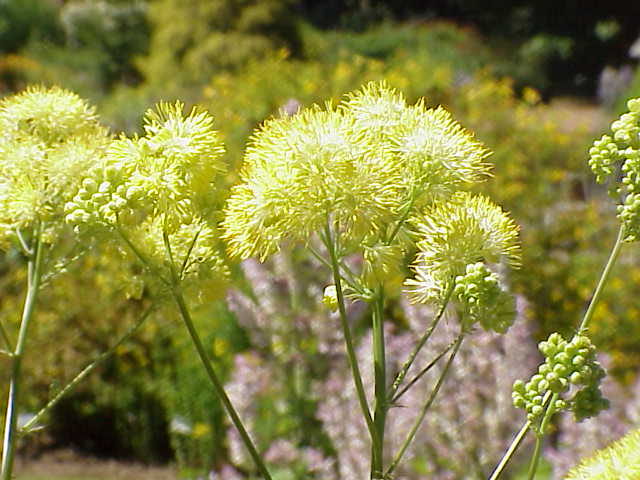 Common Meadow-RueThalictrum flavum
-
 Lesser Meadow-RueThalictrum minus
-
 Early Meadow-rueThalictrum dioicum
-
 Alpine Meadow-rueThalictrum alpinum
-
 Tall Meadow-rueThalictrum pubescens
-
 Lavender Mist MeadowrueThalictrum rochebruneanum
Compare
Questions and answers
What is the scientific name of the Rue Anemone?
The scientific name of the Rue Anemone is Thalictrum thalictroides. Written with its author, the full name is Thalictrum thalictroides (L.) A.J.Eames & B.Boivin.
Which family does the Rue Anemone belong to?
Thalictrum thalictroides belongs to the family Ranunculaceae, in the order Ranunculales and the class Magnoliopsida.
Where is the Rue Anemone found?
Checklists and occurrence records place Thalictrum thalictroides in 3 countries, including United States and Canada.
What other names does the Rue Anemone have?
Thalictrum thalictroides is also known in English as Rue-anemone and Windflower.
Sources
Passages the profile rests on
- Thalictrum thalictroides is a hairless herbaceous plant with upright flowering stems. Source passage: “Thalictrum thalictroides is a hairless plant growing from a cluster of tuberous roots” — English Wikipedia
- Its basal leaves are divided into twice-ternately compound leaf blades. Source passage: “The basal leaves have petioles (leaf stalks) 10–30 cm (4–12 in) long and leaf blades that are two times ternately compound.” — English Wikipedia
- Its leaflets are broadly rounded and have three-lobed ends. Source passage: “The leaflets are widely rounded in shape and the ends are three lobed.” — English Wikipedia
- The upright stems grow between 10 and 30 cm tall. Source passage: “upright stems 10 to 30 cm (4 to 12 in) tall” — English Wikipedia
- The plant produces white to pinkish-lilac flowers with numerous yellow stamens. Source passage: “a cup of 5 to 10 white to pinkish-lilac petal-like sepals.” — English Wikipedia
- The flowers contain between four and fifteen carpels surrounded by yellow stamens. Source passage: “The showy rounded flowers have 4-15 carpels surrounded by many yellow stamens in the middle” — English Wikipedia
- The plant produces green achenes with eight to ten prominent veins that turn dark brown when ripe. Source passage: “The green achenes have 8 to 10 prominent veins and become dark brown when ripe.” — English Wikipedia
- Its achenes measure between 3 and 4.5 mm long. Source passage: “3 to 4.5 mm (1⁄8 to 3⁄16 in) long, ovoid to fusiform shaped fruits called achenes” — English Wikipedia
- The species typically grows on banks and in thickets within low-lying deciduous woodland. Source passage: “It typically inhabits banks and thickets in low-lying deciduous woodland” — English Wikipedia
- The species grows singly on wooded slopes. Source passage: “the rue-anemone grows singly on wooded slopes.” — English Wikipedia
- The species flowers during spring. Source passage: “It flowers in spring” — English Wikipedia
- Its flowers are borne singly or in umbel-like inflorescences containing three to six flowers. Source passage: “flowers are borne singly or in umbel-like inflorescences with 3 to 6 flowers.” — English Wikipedia
- The species releases its achenes in late spring. Source passage: “In late spring, 3 to 4.5 mm (1⁄8 to 3⁄16 in) long, ovoid to fusiform shaped fruits called achenes are released.” — English Wikipedia
- Its flowers contain between five and ten petal-like sepals. Source passage: “a cup of 5 to 10 white to pinkish-lilac petal-like sepals.” — English Wikipedia
- The false rue-anemone (Enemion biternatum) is a species frequently confused with Thalictrum thalictroides. Source passage: “The rue-anemone is often confused with the similar species, the false rue-anemone (Enemion biternatum).” — English Wikipedia
- Unlike the false rue-anemone, Thalictrum thalictroides can produce pale to dark pink sepals. Source passage: “Sometimes rue-anemone sepals are pale to dark pink, whereas false rue-anemone sepals are always white.” — English Wikipedia
- The flowers of Thalictrum thalictroides typically form clusters of three to six above leaf-like bracts. Source passage: “the flowers of a rue-anemone appear in a cluster above a whorl of leaf-like bracts, most often in groups of three to six.” — English Wikipedia
- Thalictrum thalictroides can have five to ten sepals, whereas the false rue-anemone always has five. Source passage: “While false rue-anemones always have five sepals, rue-anemones can have five to ten sepals.” — English Wikipedia
- The species is native to woodland in eastern North America. Source passage: “a herbaceous perennial plant native to woodland in eastern North America.” — English Wikipedia
- Its distribution is concentrated mainly in the northeastern United States and Ontario, Canada. Source passage: “Distribution is mainly in the north eastern United States, and Ontario in Canada.” — English Wikipedia
Data
- Catalogue of Life, 2026-10-16 XR cc by
- Global Biodiversity Information Facility CC BY 4.0
- Wikidata CC0
- GeoNames CC BY 4.0
- Within the Catalogue of Life, this name comes from Synonymic Checklists of the Vascular Plants of the World cc by
References
- Eames, A. J., & Boivin, B. (1957). Bull. Soc. Roy. Bot. Belgique 89: 319 (1957). where the name was published
This species in other databases
- Catalogue of Life 562K5
- Wikidata Q18121632
- iNaturalist 118548
- World Flora Online wfo-0001129478-2026-06
- GRIN 456786
Page built on 28 November 2026. See how the catalog is made and all sources and licences.
Cite this page
ScientificNames.org. (2026). Thalictrum thalictroides (Rue Anemone). Retrieved November 28, 2026, from https://scientificnames.org/species/thalictrum-thalictroides
“Thalictrum thalictroides (Rue Anemone).” ScientificNames.org, 2026, scientificnames.org/species/thalictrum-thalictroides. Accessed 28 Nov. 2026.
ScientificNames.org. “Thalictrum thalictroides (Rue Anemone).” Accessed November 28, 2026. https://scientificnames.org/species/thalictrum-thalictroides.
@misc{scientificnames_thalictrum_thalictroides_rue_anemone,
  author = {{ScientificNames.org}},
  title = {Thalictrum thalictroides (Rue Anemone)},
  year = {2026},
  url = {https://scientificnames.org/species/thalictrum-thalictroides},
  note = {Accessed 2026-11-28}
}