Species · Flowering plants
Villous Deadly Carrot Thapsia villosa
The scientific name of the Villous Deadly Carrot is Thapsia villosa. It is a species of flowering plant in the family Apiaceae (umbellifer), order Apiales.
- Scientific name
- Thapsia villosa L.
- Common name
- Villous Deadly Carrot
- Genus
- Thapsia
- Family
- Apiaceae (Umbellifer)
- Order
- Apiales
- Class
- Magnoliopsida
- Recorded in
- 8 countries
- Name status
- accepted in the Catalogue of Life

Overview
Thapsia villosa is native to southwestern Europe and northwestern Africa around the Mediterranean Sea. It is distinguished by its bright yellow flowers arranged in compound umbels and its thick, carrot-like root.
Written 26 November 2026 from the sources listed below. Each statement was checked against the passage it cites; statements that could not be supported were removed.
Appearance
The villous deadly carrot has a robust, smooth, tapering stem and a thick root resembling a white carrot or turnip. It grows to approximately 70 to 190 cm tall, and its stem measures approximately 5 to 25 mm in diameter.[1][2][3][4]
The plant produces bright yellow flowers with five elliptical petals, arranged in compound, subhemispherical to globose umbels. These umbels have 9 to 29 spokes and measure approximately 6 to 12 cm in diameter.[5][6][7]
Its mature oblong fruits are light to dark brown and have four yellowish to brownish wings. They measure approximately 9 to 15 mm long and 6 to 11 mm wide.[8][9]
The species has considerable morphological variation between and within its recognized varieties. Two varieties are recognized: Thapsia villosa var. villosa and Thapsia villosa var. dissecta.[10][11]
Habitat
The villous deadly carrot grows in scrublands, clearings, and areas near recently disturbed land. It occurs at elevations from sea level to approximately 1,800 m.[12][13]
Its native European range includes southern France, Spain, Portugal, and Gibraltar. Its native African range includes Morocco, Algeria, and Tunisia.[14][15]
The species is native to southwestern Europe and northwestern Africa around the Mediterranean Sea. It has been introduced to Corsica.[16][17]
Behaviour
The species flowers earlier than most other members of the Apiaceae family. Its flowers are pollinated by various insects.[18][19]
Its smaller lateral umbels usually contain only stamens and wither rapidly.[20]
Reproduction and life cycle
The main umbel contains hermaphroditic flowers with both stamens and pistils. Each umbellule generally contains approximately 18 to 43 flowers.[21][22]
The flowers develop into winged fruits.[23]
The species has a diploid chromosome number reported as 22, 33, 44, or 66.[24]
Uses
The roots were traditionally used as purgatives and emetics. Poultices prepared from root bark infused with oil were traditionally used to relieve pain and treat rheumatism.[25][26]
The plant's resin was traditionally used as a blister-producing agent or counterirritant. In Segarra, Spain, it was traditionally used to treat scabies.[27][28]
Root poison was traditionally used by fishermen in Catalonia to stun fish.[29]
Root bark extracts have been used since ancient times as a yellow dye. In the 18th century, the flowers were also used to produce yellow dye for coloring wool.[30][31]
The species is cultivated as an ornamental plant because of its bright yellow flowers.[32]
Similar species
The villous deadly carrot is frequently confused with Ferula communis within its native range. Reports of the species in the Balearic Islands are likely attributable to confusion with Thapsia gymnesica.[33][34]
Classification of the Villous Deadly Carrot
| Kingdom | Plantae |
|---|---|
| Subkingdom | Pteridobiotina |
| Phylum | Tracheophyta |
| Class | Magnoliopsida |
| Order | Apiales |
| Family | Apiaceae (Umbellifer) |
| Subfamily | Apioideae |
| Tribe | Scandiceae |
| Subtribe | Daucinae |
| Genus | Thapsia (Deadly Carrot) |
| Species | Thapsia villosa L. |
Where the Villous Deadly Carrot is found
Checklists and occurrence records place Thapsia villosa in 8 countries across Africa and Europe. GBIF holds 22,050 georeferenced records of it.
Countries
Regions and cities with the most records
- Madrid, Spain 3,044
- Valencia, Spain 2,248
- Provence-Alpes-Côte d'Azur, France 2,094
- El Goloso, Spain 1,387
- Las Rozas de Madrid, Spain 1,381
- Chamartín, Spain 1,309
- Majadahonda, Spain 1,293
- Ciudad Lineal, Spain 1,244
- Alcobendas, Spain 1,217
- Pozuelo de Alarcón, Spain 1,208
- Tres Cantos, Spain 1,206
- Occitanie, France 1,202
- Madrid, Spain 1,191
- Colmenar Viejo, Spain 1,174
- Catalonia, Spain 1,169
- San Sebastián de los Reyes, Spain 1,121
- Torrelodones, Spain 1,049
- Coslada, Spain 933
- Villanueva del Pardillo, Spain 923
- Boadilla del Monte, Spain 857
- San Fernando de Henares, Spain 814
- Alcorcón, Spain 772
- Galapagar, Spain 704
- Algete, Spain 701
- Villaviciosa de Odón, Spain 700
- Leganés, Spain 694
- Bragança, Portugal 680
- Móstoles, Spain 652
- Collado-Villalba, Spain 629
- Villanueva de la Cañada, Spain 625
- Getafe, Spain 620
- Faro, Portugal 596
- Fuenlabrada, Spain 567
- Ontinyent, Spain 536
- Extremadura, Spain 504
- Fréjus, France 463
1 more country has a few records outside this range
These countries hold a few records of Thapsia villosa but lie outside the range the checklists give for it. Such records are often zoo or garden specimens, museum material or vagrants, so the species is not counted as occurring there.
Range as the checklists state it
Portugal; Spain; Gibraltar; Baleares (Menorca); S-France; Morocco; Algeria; Tunisia
A number beside a place is its count of GBIF occurrence records. A place without a number comes from a checklist alone. Records show where a species has been observed or collected, which can include escapes and vagrants.
Common names
English
- Villous Deadly Carrot
Names in 8 other languages
- Basque
- bermidorra
- Catalan
- Fonollassa groga
- Danish
- Dunet Vingeskærm
- French
- Thapsie velue
- Portuguese
- Canafrecha, Canavoura, Turbit-da-terra, Tápsia
- Russian
- Тапсия волосистая
- Slovak
- tapsia huňatá
- Spanish
- Zumillo, cañaheja
Synonyms
11 other scientific names have been used for this species and are now treated as synonyms of Thapsia villosa.
- Laserpitium villosum (L.) Calest.
- Thapsia laciniata Rouy
- Thapsia maxima Mill.
- Thapsia microcarpa Pomel
- Thapsia stenoptera Pomel
- Thapsia villosa subsp. maxima (Mill.) O.Bolòs & Vigo
- Thapsia villosa var. laciniata (Rouy) O.Bolòs & Vigo
- Thapsia villosa var. latifolia Boiss.
- Thapsia villosa var. microcarpa (Pomel) Batt.
- Thapsia villosa var. platyphyllos Franco & P.Silva
- Thapsia villosa var. stenoptera (Pomel) Batt.
Subspecies and varieties
- Thapsia villosa var. dissecta variety
- Thapsia villosa var. villosa variety
Related species
- Thapsia scabra
- Thapsia minor
- Thapsia nitida
- Thapsia cinerea
- Thapsia pelagica
-
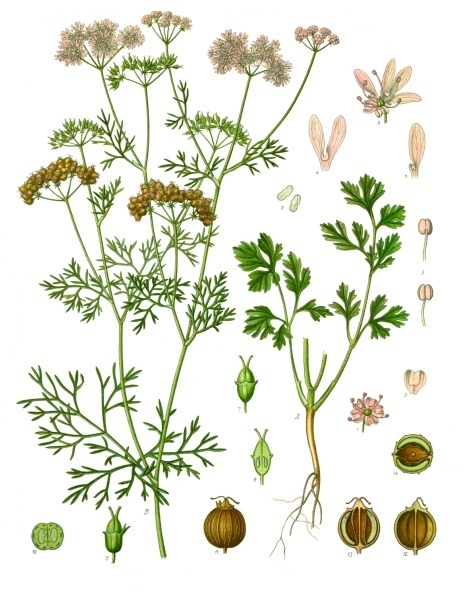 CorianderCoriandrum sativum
-
 Poison HemlockConium maculatum
-
 FennelFoeniculum vulgare
Compare
Questions and answers
What is the scientific name of the Villous Deadly Carrot?
The scientific name of the Villous Deadly Carrot is Thapsia villosa. Written with its author, the full name is Thapsia villosa L..
Which family does the Villous Deadly Carrot belong to?
Thapsia villosa belongs to the family Apiaceae, in the order Apiales and the class Magnoliopsida.
Where is the Villous Deadly Carrot found?
Checklists and occurrence records place Thapsia villosa in 8 countries, including Spain, France, Portugal, Morocco, Algeria and Gibraltar.
Sources
Passages the profile rests on
- Thapsia villosa is a poisonous perennial herb with a robust, smooth, tapering stem. Source passage: “It has a robust and smooth tapering stem about 5 to 25 mm (0.20 to 0.98 in) in diameter” — English Wikipedia
- The plant has a thick root resembling a white carrot or turnip. Source passage: “arising from a thick root resembling a white carrot or turnip.” — English Wikipedia
- Thapsia villosa grows to approximately 70 to 190 cm tall. Source passage: “It grows to about 70 to 190 cm (28 to 75 in) in height.” — English Wikipedia
- Its stem measures approximately 5 to 25 mm in diameter. Source passage: “about 5 to 25 mm (0.20 to 0.98 in) in diameter” — English Wikipedia
- The plant produces bright yellow flowers with five elliptical petals. Source passage: “Each umbellule has about 18 to 43 flowers, each with five bright yellow elliptical petals.” — English Wikipedia
- Its flowers are arranged in compound, subhemispherical to globose umbels. Source passage: “the inflorescence of Thapsia villosa is a compound subhemispherical to globose umbel.” — English Wikipedia
- Its compound umbels have 9 to 29 spokes and measure approximately 6 to 12 cm in diameter. Source passage: “It has 9 to 29 spokes and is about 6 to 12 cm (2.4 to 4.7 in) in diameter.” — English Wikipedia
- The mature fruits are light to dark brown and have four yellowish to brownish wings. Source passage: “When mature, they are light to dark brown in color with four yellowish to brownish wings characteristic of the genus.” — English Wikipedia
- Its mature oblong fruits measure approximately 9 to 15 mm long and 6 to 11 mm wide. Source passage: “The fruits are oblong and around 9 to 15 mm (0.35 to 0.59 in) long and 6 to 11 mm (0.24 to 0.43 in) wide.” — English Wikipedia
- The plant has considerable morphological variation between and within its recognized varieties. Source passage: “Thapsia villosa is highly variable in morphology.” — English Wikipedia
- Two varieties, Thapsia villosa var. villosa and Thapsia villosa var. dissecta, are recognized. Source passage: “Two varieties are recognized: T. villosa var. villosa and T. villosa var. dissecta.” — English Wikipedia
- The species grows in scrublands, clearings, and areas near recently disturbed land. Source passage: “They can be found growing at altitudes of 0 to 1,800 m (0 to 5,906 ft) above sea level in scrublands, clearings, and near recently disturbed land like roads or cultivated fields.” — English Wikipedia
- The species occurs at elevations from sea level to approximately 1,800 m. Source passage: “They can be found growing at altitudes of 0 to 1,800 m (0 to 5,906 ft) above sea level” — English Wikipedia
- Its native European range includes southern France, Spain, Portugal, and Gibraltar. Source passage: “The native range of Thapsia villosa extends from southern France and the Iberian Peninsula (Spain, Portugal, and Gibraltar)” — English Wikipedia
- Its native African range includes Morocco, Algeria, and Tunisia. Source passage: “to northwestern Africa (Morocco, Algeria, and Tunisia).” — English Wikipedia
- The species is native to southwestern Europe and northwestern Africa around the Mediterranean Sea. Source passage: “It is native to southwestern Europe and northwestern Africa surrounding the Mediterranean Sea.” — English Wikipedia
- The species has been introduced to Corsica. Source passage: “It has also been introduced into Corsica.” — English Wikipedia
- The species flowers earlier than most other members of the Apiaceae family. Source passage: “Unlike most members of the family Apiaceae, Thapsia villosa flowers early” — English Wikipedia
- Its flowers are pollinated by various insects. Source passage: “The flowers are pollinated by a variety of insects.” — English Wikipedia
- Its smaller lateral umbels usually contain only stamens and wither rapidly. Source passage: “Smaller umbels may develop from the sides of the stem which usually contains only stamens. These umbels wither away quickly.” — English Wikipedia
- The main umbel contains hermaphroditic flowers with both stamens and pistils. Source passage: “The main umbel has hermaphroditic flowers, containing both stamen and pistil.” — English Wikipedia
- Each umbellule generally contains approximately 18 to 43 flowers. Source passage: “Each umbellule has about 18 to 43 flowers” — English Wikipedia
- The flowers develop into winged fruits. Source passage: “The flowers develop into winged fruits that dry out around August” — English Wikipedia
- The species has a diploid chromosome number reported as 22, 33, 44, or 66. Source passage: “The diploid chromosome number (2n) of Thapsia villosa is 22, 33, 44, or 66.” — English Wikipedia
- The roots of Thapsia villosa were traditionally used as purgatives and emetics. Source passage: “the roots of Thapsia villosa were used as a purgative and emetic.” — English Wikipedia
- Poultices prepared from root bark infused with oil were traditionally used to relieve pain and treat rheumatism. Source passage: “Poultices made from root bark infused with oil was used as a pain-reliever and for treating rheumatism.” — English Wikipedia
- The plant's resin was traditionally used as a blister-producing agent or counterirritant. Source passage: “Resin from the Thapsia villosa was used as a blister-producing agent (vesicant) or a counterirritant” — English Wikipedia
- In Segarra, Spain, the plant's resin was traditionally used to treat scabies. Source passage: “In Spain, the resin is also traditionally used in Segarra as treatment for scabies.” — English Wikipedia
- Root poison was traditionally used by fishermen in Catalonia to stun fish. Source passage: “Poison from the roots of Thapsia villosa is traditionally used by fishermen in Catalonia as an ichthyotoxin for stunning fish” — English Wikipedia
- Root bark extracts have been used since ancient times as a yellow dye. Source passage: “Extracts from the root bark of Thapsia villosa have been used since ancient times as a yellow dye.” — English Wikipedia
- The flowers were used in the 18th century to produce yellow dye for coloring wool. Source passage: “In the 18th century, yellow dye from the flowers were used to color wool.” — English Wikipedia
- The species is cultivated as an ornamental plant because of its bright yellow flowers. Source passage: “Thapsia villosa are also grown as ornamentals for their bright yellow flowers.” — English Wikipedia
- Thapsia villosa is frequently confused with Ferula communis within its native range. Source passage: “In its native range, it is frequently confused with the similar-looking Ferula communis, the giant fennel.” — English Wikipedia
- Reports of Thapsia villosa in the Balearic Islands are likely attributable to confusion with Thapsia gymnesica. Source passage: “Reports of Thapsia villosa in the Balearic Isles is likely the result of confusion with Thapsia gymnesica.” — English Wikipedia
Data
- Catalogue of Life, 2026-10-16 XR cc by
- Global Biodiversity Information Facility CC BY 4.0
- Wikidata CC0
- GeoNames CC BY 4.0
- Wikimedia Commons per image; credit shown with each image
- Within the Catalogue of Life, this name comes from Synonymic Checklists of the Vascular Plants of the World cc by
References
- L. (1753). Sp. Pl. [Linnaeus] 1: 261 (1753). where the name was published
This species in other databases
- Catalogue of Life 564DQ
- Wikidata Q537992
- iNaturalist 450557
- World Flora Online wfo-0000409614
- GRIN 310966
Page built on 28 November 2026. See how the catalog is made and all sources and licences.
Cite this page
ScientificNames.org. (2026). Thapsia villosa (Villous Deadly Carrot). Retrieved November 28, 2026, from https://scientificnames.org/species/thapsia-villosa
“Thapsia villosa (Villous Deadly Carrot).” ScientificNames.org, 2026, scientificnames.org/species/thapsia-villosa. Accessed 28 Nov. 2026.
ScientificNames.org. “Thapsia villosa (Villous Deadly Carrot).” Accessed November 28, 2026. https://scientificnames.org/species/thapsia-villosa.
@misc{scientificnames_thapsia_villosa_villous_deadly_carrot,
  author = {{ScientificNames.org}},
  title = {Thapsia villosa (Villous Deadly Carrot)},
  year = {2026},
  url = {https://scientificnames.org/species/thapsia-villosa},
  note = {Accessed 2026-11-28}
}