Species · Insects
Wattle Blue Theclinesthes miskini
The scientific name of the Wattle Blue is Theclinesthes miskini. It is a species of insect in the family Lycaenidae (blues), order Lepidoptera. The name dates from 1889.
- Scientific name
- Theclinesthes miskini (Lucas, 1889)
- Common name
- Wattle Blue
- Genus
- Theclinesthes
- Family
- Lycaenidae (Blues)
- Order
- Lepidoptera
- Class
- Insecta
- Recorded in
- 2 countries
- Name status
- accepted in the Catalogue of Life

Overview
The Wattle Blue is a butterfly with an adult wingspan of approximately 20 mm. The species is recorded from Australia and New Guinea. Its larvae are dark green or brown, with a dark dorsal band and pale diagonal streaks.
Written 27 November 2026 from the sources listed below. Each statement was checked against the passage it cites; statements that could not be supported were removed.
Appearance
The larvae are dark green or brown and have a dark dorsal band with pale diagonal streaks. The adult butterfly has a wingspan of approximately 20 mm.[1][2]
Diet
The larvae generally feed on plants belonging to the family Fabaceae. They prefer young seedlings over older foliage when feeding.[3][4]
Recorded larval food plants include Paraserianthes lophantha and Sesbania cannabina. They also include Acacia anceps, Acacia auriculiformis, Acacia flavescens and Acacia pycnantha.[5][6]
Other recorded Acacia food plants are Acacia salicina, Acacia saligna and Acacia tetragonophylla. Acacia harpophylla, Acacia holosericea and Acacia neriifolia are also recorded.[7][8]
The larvae also feed on Alectryon diversifolius and Atalaya variifolia. Hakea vittata and Eucalyptus polycarpa are additional recorded larval food plants.[9][10]
Behaviour
The larvae are occasionally attended by black or green ants. Recorded attending ant genera include Iridomyrmex, Ochetellus and Calomyrmex.[11][12]
Camponotus, Notoncus and Paratrechina ants are also recorded attending the larvae.[13]
Classification of the Wattle Blue
| Kingdom | Animalia |
|---|---|
| Phylum | Arthropoda |
| Subphylum | Hexapoda |
| Class | Insecta (Insect) |
| Order | Lepidoptera |
| Superfamily | Papilionoidea |
| Family | Lycaenidae (Blues) |
| Subfamily | Lycaeninae |
| Genus | Theclinesthes |
| Species | Theclinesthes miskini (Lucas, 1889) |
Where the Wattle Blue is found
Checklists and occurrence records place Theclinesthes miskini in 2 countries. GBIF holds 2,249 georeferenced records of it.
Countries
Regions and cities with the most records
- Queensland, Australia 1,009
- Western Australia, Australia 363
- Northern Territory, Australia 284
- New South Wales, Australia 252
- Brisbane, Australia 102
- South Australia, Australia 101
- Bunbury, Australia 55
- Liverpool, Australia 55
- Victoria, Australia 41
- Palmerston, Australia 38
- Darwin, Australia 37
- Canberra, Australia 32
- Tuggeranong, Australia 32
- Adelaide, Australia 31
- Capalaba, Australia 31
- Australian Capital Territory, Australia 30
- Logan City, Australia 28
- Sunshine Coast, Australia 28
- Townsville, Australia 27
- Cairns, Australia 21
- Geraldton, Australia 20
- Toowoomba, Australia 15
- Caloundra, Australia 13
- Kwinana, Australia 13
- Narangba, Australia 13
- Newcastle, Australia 13
- Rockingham, Australia 12
- Bundaberg, Australia 10
- Central Coast, Australia 9
- Perth, Australia 9
- Rockhampton, Australia 9
- Gold Coast, Australia 8
- Alice Springs, Australia 7
- Coffs Harbour, Australia 7
- Kalgoorlie, Australia 6
- Mount Isa, Australia 6
1 more country has a few records outside this range
These countries hold a few records of Theclinesthes miskini but lie outside the range the checklists give for it. Such records are often zoo or garden specimens, museum material or vagrants, so the species is not counted as occurring there.
A number beside a place is its count of GBIF occurrence records. A place without a number comes from a checklist alone. Records show where a species has been observed or collected, which can include escapes and vagrants.
Common names
English
- Wattle Blue
Synonyms
One other scientific name has been used for this species and is now treated as a synonym of Theclinesthes miskini.
- Lycaena miskini Lucas, 1889
Subspecies and varieties
- Theclinesthes miskini arnoldi subspecies
- Theclinesthes miskini atrosuffusa subspecies
- Theclinesthes miskini brandti subspecies
- Theclinesthes miskini eucalypti subspecies
- Theclinesthes miskini feminalba subspecies
- Theclinesthes miskini gaura subspecies
Related species
-
 Cycad BlueTheclinesthes onycha
-
 Saltbush BlueTheclinesthes serpentata
-
 The Saltpan BlueTheclinesthes sulpitius
- Western Bitter-bush BlueTheclinesthes hesperia
- Theclinesthes petersi
- Bitter-bush BlueTheclinesthes albocincta
-
 Common BluePolyommatus icarus
-
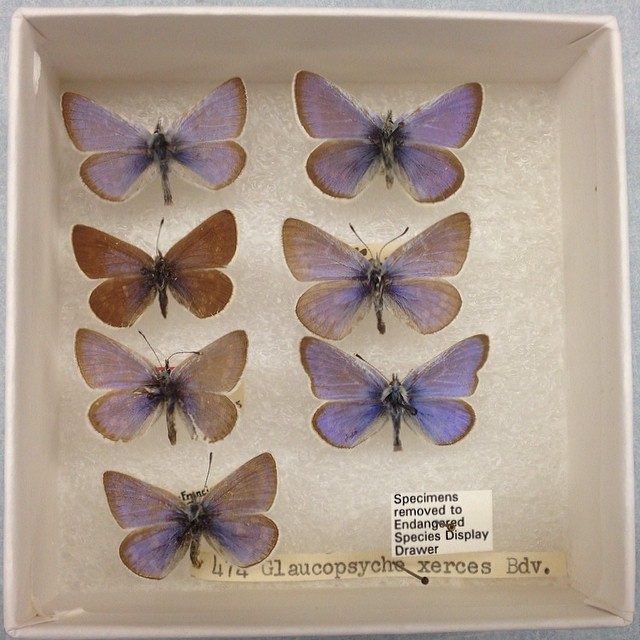 Xerces BlueGlaucopsyche xerces
Compare
Questions and answers
What is the scientific name of the Wattle Blue?
The scientific name of the Wattle Blue is Theclinesthes miskini. Written with its author, the full name is Theclinesthes miskini (Lucas, 1889).
Which family does the Wattle Blue belong to?
Theclinesthes miskini belongs to the family Lycaenidae, in the order Lepidoptera and the class Insecta.
Where is the Wattle Blue found?
Checklists and occurrence records place Theclinesthes miskini in 2 countries: Australia and Papua New Guinea.
Sources
Passages the profile rests on
- The larvae are dark green or brown and have a dark dorsal band with pale diagonal streaks. Source passage: “The larvae are dark green or brown with a dark dorsal band and pale diagonal streaks.” — English Wikipedia
- The adult butterfly has a wingspan of approximately 20 mm. Source passage: “The wingspan is about 20 mm.” — English Wikipedia
- The larvae generally feed on plants belonging to the family Fabaceae. Source passage: “The larvae generally feed on plants in the family Fabaceae” — English Wikipedia
- The larvae prefer young seedlings over older foliage when feeding. Source passage: “Young seedlings are preferred to older foliage.” — English Wikipedia
- Larval food plants include Paraserianthes lophantha and Sesbania cannabina. Source passage: “including Paraserianthes lophantha, Sesbania cannabina” — English Wikipedia
- Larval food plants include Acacia anceps, Acacia auriculiformis, Acacia flavescens and Acacia pycnantha. Source passage: “Acacia anceps, A. auriculiformis, A. flavescens, A. pycnantha” — English Wikipedia
- Larval food plants include Acacia salicina, Acacia saligna and Acacia tetragonophylla. Source passage: “A. salicina, A. saligna, A. tetragonophylla” — English Wikipedia
- Larval food plants include Acacia harpophylla, Acacia holosericea and Acacia neriifolia. Source passage: “A. harpophylla, A. holosericea, A. neriifolia” — English Wikipedia
- The larvae also feed on Alectryon diversifolius and Atalaya variifolia. Source passage: “but also on Alectryon diversifolius, Atalaya variifolia” — English Wikipedia
- Hakea vittata and Eucalyptus polycarpa are also recorded larval food plants. Source passage: “Hakea vittata and Eucalyptus polycarpa.” — English Wikipedia
- The larvae are occasionally attended by black or green ants. Source passage: “Larvae are occasionally attended by various black or green ants” — English Wikipedia
- Ant genera recorded attending the larvae include Iridomyrmex, Ochetellus and Calomyrmex. Source passage: “in the genera Iridomyrmex, Ochetellus, Calomyrmex” — English Wikipedia
- Camponotus, Notoncus and Paratrechina ants are also recorded attending the larvae. Source passage: “Camponotus, Notoncus, Paratrechina” — English Wikipedia
Data
- Catalogue of Life, 2026-10-16 XR cc by
- Global Biodiversity Information Facility CC BY 4.0
- Wikidata CC0
- GeoNames CC BY 4.0
- Wikimedia Commons per image; credit shown with each image
- Within the Catalogue of Life, this name comes from Global Lepidoptera Index cc by
This species in other databases
Page built on 27 November 2026. See how the catalog is made and all sources and licences.
Cite this page
ScientificNames.org. (2026). Theclinesthes miskini (Wattle Blue). Retrieved November 27, 2026, from https://scientificnames.org/species/theclinesthes-miskini
“Theclinesthes miskini (Wattle Blue).” ScientificNames.org, 2026, scientificnames.org/species/theclinesthes-miskini. Accessed 27 Nov. 2026.
ScientificNames.org. “Theclinesthes miskini (Wattle Blue).” Accessed November 27, 2026. https://scientificnames.org/species/theclinesthes-miskini.
@misc{scientificnames_theclinesthes_miskini_wattle_blue,
  author = {{ScientificNames.org}},
  title = {Theclinesthes miskini (Wattle Blue)},
  year = {2026},
  url = {https://scientificnames.org/species/theclinesthes-miskini},
  note = {Accessed 2026-11-27}
}