Species · Insects
Cycad Blue Theclinesthes onycha
The scientific name of the Cycad Blue is Theclinesthes onycha. It is a species of insect in the family Lycaenidae (blues), order Lepidoptera. The name dates from 1865.
- Scientific name
- Theclinesthes onycha (Hewitson, 1865)
- Common name
- Cycad Blue
- Genus
- Theclinesthes
- Family
- Lycaenidae (Blues)
- Order
- Lepidoptera
- Class
- Insecta
- Recorded in
- 1 country
- Name status
- accepted in the Catalogue of Life

Overview
Theclinesthes onycha, the cycad blue
Classification of the Cycad Blue
| Kingdom | Animalia |
|---|---|
| Phylum | Arthropoda |
| Subphylum | Hexapoda |
| Class | Insecta (Insect) |
| Order | Lepidoptera |
| Superfamily | Papilionoidea |
| Family | Lycaenidae (Blues) |
| Subfamily | Lycaeninae |
| Genus | Theclinesthes |
| Species | Theclinesthes onycha (Hewitson, 1865) |
Where the Cycad Blue is found
Checklists and occurrence records place Theclinesthes onycha in 1 country. GBIF holds 1,784 georeferenced records of it.
Countries
Regions and cities with the most records
- Queensland, Australia 1,335
- Brisbane, Australia 395
- New South Wales, Australia 370
- Logan City, Australia 197
- Capalaba, Australia 172
- Cairns, Australia 99
- Narangba, Australia 81
- Gold Coast, Australia 72
- Sunshine Coast, Australia 68
- Sydney, Australia 66
- Hornsby, Australia 59
- Toowoomba, Australia 50
- Caloundra, Australia 48
- Mackay, Australia 47
- Coffs Harbour, Australia 34
- Townsville, Australia 23
- Bundaberg, Australia 19
- Rockhampton, Australia 17
- Liverpool, Australia 16
- Central Coast, Australia 11
- Cessnock, Australia 10
- Hervey Bay, Australia 10
- Newcastle, Australia 6
- Port Macquarie, Australia 6
- Darwin, Australia 5
- Gympie, Australia 5
- Palmerston, Australia 5
- Gladstone, Australia 4
- Maitland, Australia 4
- Maryborough, Australia 4
A number beside a place is its count of GBIF occurrence records. A place without a number comes from a checklist alone. Records show where a species has been observed or collected, which can include escapes and vagrants.
Common names
English
- Cycad Blue
Synonyms
One other scientific name has been used for this species and is now treated as a synonym of Theclinesthes onycha.
- Utica onycha Hewitson, 1865
Subspecies and varieties
- Theclinesthes onycha capricornia subspecies
Related species
-
 The Chequered BlueTheclinesthes serpentata
-
 Wattle BlueTheclinesthes miskini
-
 The Saltpan BlueTheclinesthes sulpitius
- Western Bitter-bush BlueTheclinesthes hesperia
- Theclinesthes petersi
- Bitter-bush BlueTheclinesthes albocincta
-
 Common BluePolyommatus icarus
-
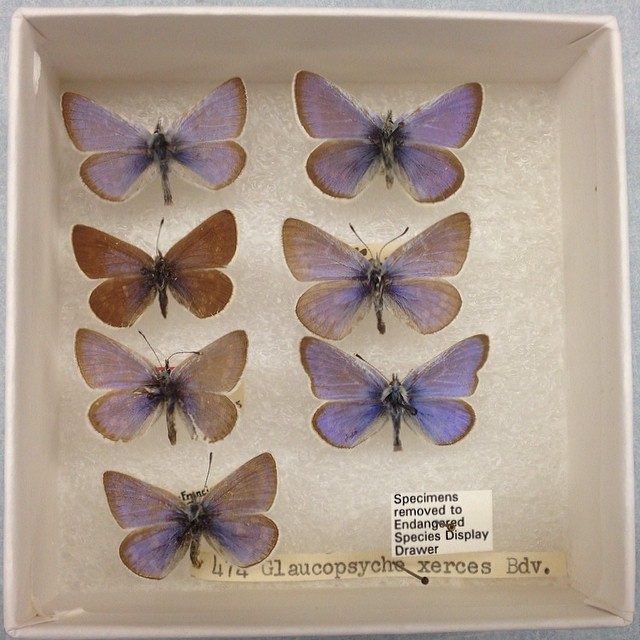 Xerces BlueGlaucopsyche xerces
Compare
Questions and answers
What is the scientific name of the Cycad Blue?
The scientific name of the Cycad Blue is Theclinesthes onycha. Written with its author, the full name is Theclinesthes onycha (Hewitson, 1865).
Which family does the Cycad Blue belong to?
Theclinesthes onycha belongs to the family Lycaenidae, in the order Lepidoptera and the class Insecta.
Where is the Cycad Blue found?
Checklists and occurrence records place Theclinesthes onycha in 1 country: Australia.
Sources
Data
- Catalogue of Life, 2026-10-16 XR cc by
- Global Biodiversity Information Facility CC BY 4.0
- Wikidata CC0
- English Wikipedia CC BY-SA 4.0
- GeoNames CC BY 4.0
- Wikimedia Commons per image; credit shown with each image
- Within the Catalogue of Life, this name comes from Global Lepidoptera Index cc by
References
- Hewitson. (1865). Illustrations of diurnal Lepidoptera. Lycaenidae. 1. http://www.biodiversitylibrary.org/item/95252#page/86/mode/2up Link where the name was published
This species in other databases
Page built on 26 November 2026. See how the catalog is made and all sources and licences.
Cite this page
ScientificNames.org. (2026). Theclinesthes onycha (Cycad Blue). Retrieved November 26, 2026, from https://scientificnames.org/species/theclinesthes-onycha
“Theclinesthes onycha (Cycad Blue).” ScientificNames.org, 2026, scientificnames.org/species/theclinesthes-onycha. Accessed 26 Nov. 2026.
ScientificNames.org. “Theclinesthes onycha (Cycad Blue).” Accessed November 26, 2026. https://scientificnames.org/species/theclinesthes-onycha.
@misc{scientificnames_theclinesthes_onycha_cycad_blue,
  author = {{ScientificNames.org}},
  title = {Theclinesthes onycha (Cycad Blue)},
  year = {2026},
  url = {https://scientificnames.org/species/theclinesthes-onycha},
  note = {Accessed 2026-11-26}
}