Species · Birds
Plumbeous Ibis Theristicus caerulescens
The scientific name of the Plumbeous Ibis is Theristicus caerulescens. It is a species of bird in the family Threskiornithidae (ibises), order Pelecaniformes. The name dates from 1817.
- Scientific name
- Theristicus caerulescens (Vieillot, 1817)
- Common name
- Plumbeous Ibis
- Genus
- Theristicus
- Family
- Threskiornithidae (Ibises)
- Order
- Pelecaniformes
- Class
- Aves
- Red List category
- LC Least Concern
- Environment
- freshwater, terrestrial
- Recorded in
- 5 countries
- Name status
- accepted in the Catalogue of Life
Overview
Theristicus caerulescens occurs in south-western Brazil, Paraguay, Uruguay, north-eastern Argentina and northern and eastern Bolivia. It has generally grey plumage, a shaggy crest of long grey feathers and a narrow white band across the forehead.
Written 26 November 2026 from the sources listed below. Each statement was checked against the passage it cites; statements that could not be supported were removed.
Appearance
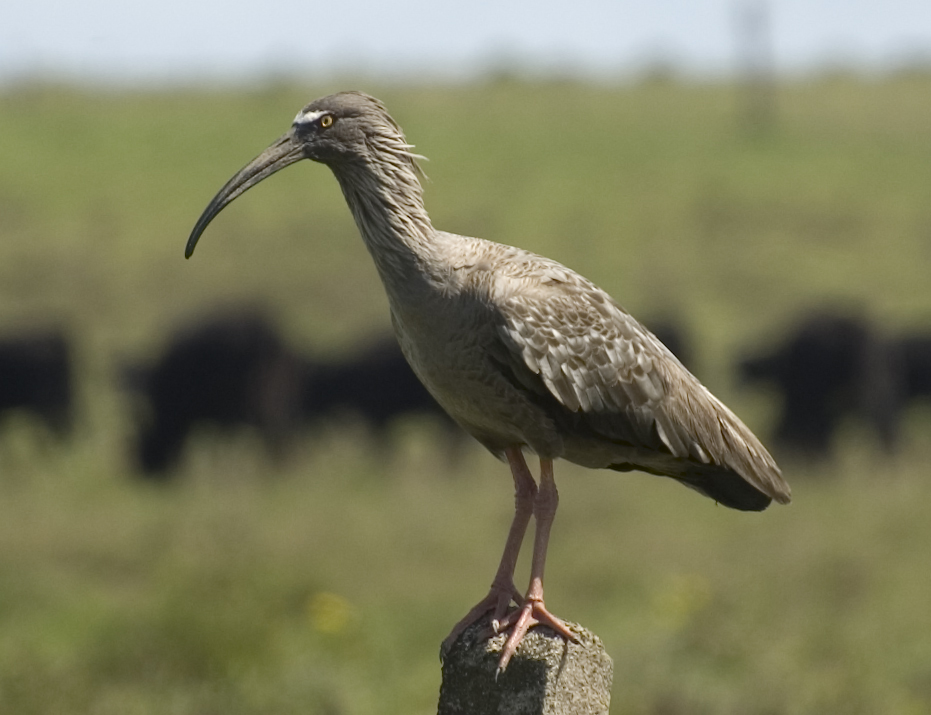
Adult plumage is generally grey, with bluish-grey, greenish-grey or brownish-grey variations. A shaggy crest of long grey feathers extends approximately 10 cm down the nape, and a narrow white feathered band crosses the forehead.[1][2][3]
The bill is black, curves downward and is serrated between the mandibles. The legs are pinkish orange and become darker during the breeding season, while the iris is deep orange, although some individuals have brownish-yellow irises.[4][5][6]
Adults measure 71–77 cm in length. Females are slightly smaller than males, with male wing lengths of 397 to 450 mm and female wing lengths of 360 to 406 mm.[7][8][9]
Male culmen length ranges from 145 to 167 mm, compared with 126 to 147 mm in females.[10]
Habitat
The species primarily inhabits lowland grassy wetlands in the Pantanal and Chaco. It forages in marshes, swamps, lagoons, shallow lakes, flooded pastures and ponds.[11][12]
It also occurs in upland marshes at elevations generally reaching 600 m, as well as in seasonally flooded rice fields and near artificial dams. It probably avoids saline and brackish waters.[13][14][15]
Diet
Its diet includes aquatic invertebrates, snails, mussels, crabs, frogs, fish and eels. It also consumes snakes, lizards, skinks and terrestrial invertebrates.[16][17]
In the Paraguay-Parana basin, the species specializes on molluscs.[18]
Behaviour
The species typically searches for prey by walking slowly through shallow mud and water while repeatedly probing with its bill. Individuals usually forage alone or in pairs but may form loose feeding flocks during winter.[19][20]
It is usually sedentary, although local migrations have occasionally been reported. It is generally observed singly or in pairs rather than in large flocks.[21][22]
The species is a non-colonial breeder.[23]
Reproduction and life cycle
Breeding occurs in sparsely wooded areas between March and mid-October. Both partners construct the nest, a process that takes approximately one month.[24][25]
Nests are commonly built on horizontal branches of fig trees or Luehea paniculata near or above water. A typical nest measures approximately 25 cm high and 50 cm wide and is generally situated 10–12 m above the ground.[26][27][28]
A typical clutch contains two to three pale greenish-grey eggs. Eggs weigh between 70 and 74 g and have average dimensions of 68.6 × 44.9 mm.[29][30][31]
The incubation period lasts 28 days, and young usually hatch in early September. They typically fledge 40–43 days after hatching.[32][33][34]
Both parents feed their chicks through regurgitation.[35]
Conservation
Potential threats include habitat loss caused by burning, logging of nesting trees, hydroelectric dams, mining and agricultural expansion. Agricultural pesticides may make the species particularly vulnerable to contamination.[36][37]
Similar species
The buff-necked ibis is the species' most morphologically similar relative occurring in the same geographic areas.[38]
Classification of the Plumbeous Ibis
| Kingdom | Animalia |
|---|---|
| Phylum | Chordata |
| Subphylum | Vertebrata |
| Infraphylum | Gnathostomata |
| Parvphylum | Osteichthyes |
| Megaclass | Tetrapoda |
| Class | Aves (Bird) |
| Order | Pelecaniformes (Herons) |
| Family | Threskiornithidae (Ibises) |
| Genus | Theristicus (Grassland Ibises) |
| Species | Theristicus caerulescens (Vieillot, 1817) |
Where the Plumbeous Ibis is found
Checklists and occurrence records place Theristicus caerulescens in 5 countries across South America. GBIF holds 27,054 georeferenced records of it.
Countries
Regions and cities with the most records
- Mato Grosso, Brazil 7,836
- Mato Grosso do Sul, Brazil 3,053
- Poconé, Brazil 2,186
- Maldonado, Uruguay 1,705
- Rio Grande do Sul, Brazil 1,606
- Rocha Department, Uruguay 1,506
- Entre Rios, Argentina 1,480
- Beni Department, Bolivia 1,367
- Corrientes, Argentina 1,349
- San Carlos, Uruguay 1,216
- Maldonado, Uruguay 1,197
- Formosa, Argentina 959
- Cerro Largo, Uruguay 734
- Santa Cruz Department, Bolivia 603
- Presidente Hayes, Paraguay 574
- Canelones, Uruguay 507
- Lavalleja, Uruguay 489
- Boquerón Department, Paraguay 269
- Tacuarembó Department, Uruguay 267
- Monte Caseros, Argentina 266
- Chaco, Argentina 263
- Rocha, Uruguay 241
- Rivera Department, Uruguay 223
- Artigas, Uruguay 220
- Treinta y Tres Department, Uruguay 211
- Trinidad, Bolivia 198
- Santa Fe, Argentina 182
- Alto Paraguay, Paraguay 176
- Rio Grande, Brazil 176
- Salta, Argentina 170
- Minas, Uruguay 142
- Buenos Aires, Argentina 141
- Pando, Uruguay 141
- Chajarí, Argentina 140
- Miranda, Brazil 137
- Barros Blancos, Uruguay 130
1 more country has a few records outside this range
These countries hold a few records of Theristicus caerulescens but lie outside the range the checklists give for it. Such records are often zoo or garden specimens, museum material or vagrants, so the species is not counted as occurring there.
Range as the checklists state it
South America
A number beside a place is its count of GBIF occurrence records. A place without a number comes from a checklist alone. Records show where a species has been observed or collected, which can include escapes and vagrants.
Common names
English
- Plumbeous Ibis
Names in 27 other languages
- Arabic
- أبو منجل الرصاصي
- Belarusian
- Свінцовы ібіс
- Catalan
- ibis plumbi
- Chinese
- 鉛鹮, 铅色鹮
- Croatian
- bjeločeli ibis
- Czech
- ibis běločelý
- Danish
- Blygrå Ibis
- Dutch
- Grijze Ibis
- Esperanto
- plumba ibiso
- Estonian
- halliibis
- Finnish
- harmaaiibis
- French
- Ibis plombé
- German
- Stirnbandibis
- Hungarian
- kék íbisz
- Italian
- Ibis piombato
- Japanese
- ハイイロトキ
- Lithuanian
- baltakaktis ibis
- Polish
- ibis ołowiany
- Portuguese
- Curicaca-cinza, Maçarico-real, curicaca-real, íbis-cinzenta
- Russian
- Свинцовый ибис
- Serbian
- Tamnosivi ibis
- Slovak
- ibis močiarny
- Spanish
- Bandurria Mora(Argentina), Bandurria mora
- Swedish
- grå ibis
- Turkish
- Kurşuni Aynak
- Ukrainian
- ібіс блакитний
- grn
- Kurukáu hovy
Synonyms
6 other scientific names have been used for this species and are now treated as synonyms of Theristicus caerulescens.
- Geronticus coerulescens (Vieillot, 1817)
- Harpiprion caerulescens (Vieillot, 1817)
- Harpiprion caerulescens caerulescens Stotz et al. (1996)
- Ibis caerulescens Vieillot, 1817
- Ibis coerulescens Vieillot, 1817
- Ibis plumbeus Temminck, CJ, 1823
Related species
-
 Black-faced IbisTheristicus melanopis
-
 Buff-necked IbisTheristicus caudatus
-
 Andean IbisTheristicus branickii
- Australian White IbisThreskiornis molucca
-
 Roseate SpoonbillPlatalea ajaja
-
 Scarlet IbisEudocimus ruber
-
 American White IbisEudocimus albus
-
 African Sacred IbisThreskiornis aethiopicus
Compare
Questions and answers
What is the scientific name of the Plumbeous Ibis?
The scientific name of the Plumbeous Ibis is Theristicus caerulescens. Written with its author, the full name is Theristicus caerulescens (Vieillot, 1817).
Which family does the Plumbeous Ibis belong to?
Theristicus caerulescens belongs to the family Threskiornithidae, in the order Pelecaniformes and the class Aves.
Where is the Plumbeous Ibis found?
Checklists and occurrence records place Theristicus caerulescens in 5 countries: Brazil, Uruguay, Argentina, Bolivia and Paraguay.
What is the conservation status of the Plumbeous Ibis?
The IUCN Red List category recorded for Theristicus caerulescens is Least Concern (LC).
Sources
Passages the profile rests on
- Adult plumage is generally grey, with possible bluish-grey, greenish-grey or brownish-grey variations. Source passage: “The adult plumage is usually grey; but can be bluish grey, greenish grey or brownish grey.” — English Wikipedia
- The species has a shaggy crest of long grey feathers extending approximately 10 cm down the nape. Source passage: “a distinctive shaggy crest comprising long grey plumes that extend from the back of head 10 cm down the nape.” — English Wikipedia
- A narrow white feathered band extends across the forehead. Source passage: “A prominent, narrow, white feathered band also extends around the forehead” — English Wikipedia
- The species has a black bill that curves downward and is serrated between the mandibles. Source passage: “The black, downward-curved bill is serrated between the mandibles.” — English Wikipedia
- Its legs are pinkish orange and become darker during the breeding season. Source passage: “The legs are a pinkish orange, darkening in the breeding season in preparation for courtship.” — English Wikipedia
- The iris is deep orange, although some individuals have brownish-yellow irises. Source passage: “The iris is deep orange, but has been noted to be slightly paler around the pupil. In some individuals, the iris has also been reported to be brownish yellow.” — English Wikipedia
- Adults measure 71–77 cm in length. Source passage: “This large ibis measures 71–77 cm in length” — English Wikipedia
- Male wing length ranges from 397 to 450 mm, while female wing length ranges from 360 to 406 mm. Source passage: “a wing length of 397-450mm in males and 360-406mm in females.” — English Wikipedia
- Females are slightly smaller than males. Source passage: “The sexes are similar in appearance, but the female is slightly smaller.” — English Wikipedia
- Male culmen length ranges from 145 to 167 mm, compared with 126 to 147 mm in females. Source passage: “The culmen length is 145-167mm in males, and 126-147mm in females.” — English Wikipedia
- The species primarily inhabits lowland grassy wetlands in the Pantanal and Chaco. Source passage: “Its habitat largely comprises the lowland grassy wetlands of the Pantanal and the Chaco.” — English Wikipedia
- It forages in marshes, swamps, lagoons, shallow lakes, flooded pastures and ponds. Source passage: “It is found here foraging at marshes, swamps, lagoons, shallow lakes, flooded pastures, ponds and other moist ground” — English Wikipedia
- The species also occurs in upland marshes at elevations generally reaching 600 m. Source passage: “It has also been sighted in upland marshes, usually up to 600m in elevation” — English Wikipedia
- It occurs in seasonally flooded rice fields and near artificial dams. Source passage: “including dams and seasonally-flooded rice fields.” — English Wikipedia
- The species probably avoids saline and brackish waters. Source passage: “but probably avoids the saline and brackish waters.” — English Wikipedia
- Its diet includes aquatic invertebrates, snails, mussels, crabs, frogs, fish and eels. Source passage: “This ibis's diet comprises aquatic invertebrates; snails, especially apple snails of the genus Pomacea; mussels; crabs; frogs; fish and eels.” — English Wikipedia
- The species also consumes snakes, lizards, skinks and terrestrial invertebrates. Source passage: “It has also been reported to eat snakes, lizards, skinks and terrestrial invertebrates” — English Wikipedia
- In the Paraguay-Parana basin, the species specializes on molluscs. Source passage: “it is found to specialise on molluscs in the Paraguay-Parana basin.” — English Wikipedia
- The species typically searches for prey by walking slowly through shallow mud and water while repeatedly probing with its bill. Source passage: “walking slowly through shallow mud and water, probing fast and repeatedly with its bill in the water in search of prey.” — English Wikipedia
- Individuals usually forage alone or in pairs, but may form loose feeding flocks during winter. Source passage: “The plumbeous ibis often feeds solitarily or in pairs, but may assemble in loose flocks to forage in winter when food is scarcer.” — English Wikipedia
- The species is usually sedentary, although local migrations have occasionally been reported. Source passage: “Individuals are usually sedentary and can remain in a specific area all year round. They have however been reported to migrate on a local scale.” — English Wikipedia
- It is generally observed singly or in pairs rather than in large flocks. Source passage: “It is most often seen singly or in pairs, but is also more rarely seen in groups of up to six individuals.” — English Wikipedia
- The species is a non-colonial breeder. Source passage: “Unlike many other ibises, the plumbeous ibis is a non-colonial breeder.” — English Wikipedia
- Breeding occurs in sparsely wooded areas between March and mid-October. Source passage: “Breeding occurs in sparsely wooded areas from March until mid-October.” — English Wikipedia
- Both partners construct the nest, a process that takes approximately one month. Source passage: “Nest building by both partners begins in March and takes about a month to complete.” — English Wikipedia
- Nests are commonly built on horizontal branches of fig trees or Luehea paniculata near or above water. Source passage: “Nests are commonly constructed above or near to water on horizontal limbs of massive fig trees of Ficus species. or in the species Luehea paniculata.” — English Wikipedia
- A typical nest measures approximately 25 cm high and 50 cm wide. Source passage: “The nest typically measures 25 cm in height and 50 cm in width” — English Wikipedia
- Nests are generally situated 10–12 m above the ground. Source passage: “which takes about a month to complete and is situated 10-12m above the ground” — English Wikipedia
- A typical clutch contains two to three pale greenish-grey eggs. Source passage: “A typical clutch consists of 2-3 eggs, which are pale greenish-grey” — English Wikipedia
- Eggs weigh between 70 and 74 g. Source passage: “which are pale greenish-grey and weigh 70-74g.” — English Wikipedia
- The average egg dimensions are 68.6 × 44.9 mm. Source passage: “Average egg dimensions have been reported as 68.6 x 44.9mm.” — English Wikipedia
- The incubation period lasts 28 days. Source passage: “The incubation period is 28 days” — English Wikipedia
- Young usually hatch in early September. Source passage: “and the young usually hatch in early September.” — English Wikipedia
- Young typically fledge 40–43 days after hatching. Source passage: “which fledge after 40–43 days of hatching” — English Wikipedia
- Both parents feed their chicks through regurgitation. Source passage: “Both parents feed the young by regurgitation.” — English Wikipedia
- Potential threats include habitat loss caused by burning, logging of nesting trees, hydroelectric dams, mining and agricultural expansion. Source passage: “it is likely threatened by habitat loss through burning and logging of nesting trees, construction and operation of hydroelectric dams in the Pantanal, and expansion of mining and agriculture.” — English Wikipedia
- Agricultural pesticides may make the species particularly vulnerable to contamination. Source passage: “The plumbeous ibis's apparent association with humans may render it particularly vulnerable to the effects of pesticides from agriculture” — English Wikipedia
- The buff-necked ibis is the species' most morphologically similar relative occurring in the same geographic areas. Source passage: “The plumbeous ibis is the most morphologically similar to the sympatric buff-necked ibis Theresticus caudatus” — English Wikipedia
Data
- Catalogue of Life, 2026-10-16 XR cc by
- Global Biodiversity Information Facility CC BY 4.0
- Wikidata CC0
- GeoNames CC BY 4.0
- Wikimedia Commons per image; credit shown with each image
- Within the Catalogue of Life, this name comes from The Integrated Taxonomic Information System cc0
References
- Gill, Frank, & and Minturn Wright. (2006). Birds of the World: Recommended English Names.
This species in other databases
- Catalogue of Life 7BWSX
- Wikidata Q279282
- iNaturalist 3768
- WoRMS urn:lsid:marinespecies.org:taxname:1461940
- Avibase pluibi1
Page built on 29 November 2026. See how the catalog is made and all sources and licences.
Cite this page
ScientificNames.org. (2026). Theristicus caerulescens (Plumbeous Ibis). Retrieved November 29, 2026, from https://scientificnames.org/species/theristicus-caerulescens
“Theristicus caerulescens (Plumbeous Ibis).” ScientificNames.org, 2026, scientificnames.org/species/theristicus-caerulescens. Accessed 29 Nov. 2026.
ScientificNames.org. “Theristicus caerulescens (Plumbeous Ibis).” Accessed November 29, 2026. https://scientificnames.org/species/theristicus-caerulescens.
@misc{scientificnames_theristicus_caerulescens_plumbeous_ibis,
  author = {{ScientificNames.org}},
  title = {Theristicus caerulescens (Plumbeous Ibis)},
  year = {2026},
  url = {https://scientificnames.org/species/theristicus-caerulescens},
  note = {Accessed 2026-11-29}
}