Species · Birds
Buff-necked Ibis Theristicus caudatus
The scientific name of the Buff-necked Ibis is Theristicus caudatus. It is a species of bird in the family Threskiornithidae (ibises), order Pelecaniformes. The name dates from 1783.
- Scientific name
- Theristicus caudatus (Boddaert, 1783)
- Common name
- Buff-necked Ibis
- Genus
- Theristicus
- Family
- Threskiornithidae (Ibises)
- Order
- Pelecaniformes
- Class
- Aves
- Red List category
- LC Least Concern
- Environment
- terrestrial
- Recorded in
- 10 countries
- Name status
- accepted in the Catalogue of Life

Overview
Theristicus caudatus occurs widely in open habitats of eastern and northern South America, predominantly in tropical and warmer subtropical lowlands. It is marked by a buff-coloured neck, grey upperparts, a black belly and flight feathers, and large white wing patches.
Written 26 November 2026 from the sources listed below. Each statement was checked against the passage it cites; statements that could not be supported were removed.
Appearance
The Buff-necked Ibis has a stocky body, buff-coloured neck and head, and grey upperparts. Its belly and flight feathers are black, and its wings have a large white patch.[1][2][3]
It has a blackish bill, bare skin around the eyes and red legs. Its total length is approximately 75 centimetres.[4][5]
Habitat
The Buff-necked Ibis inhabits open fields, marshes, savannas and grasslands.[6]
It occurs predominantly in tropical and warmer subtropical lowlands, with localized occurrence in highlands.[7]
Diet
The Buff-necked Ibis feeds mainly on insects, spiders, frogs, reptiles, snails, other invertebrates and small mammals.[8]
Behaviour
The Buff-necked Ibis is almost entirely resident, although local movements may occur.[9]
Reproduction and life cycle
The Buff-necked Ibis builds platform nests from twigs and branches in trees. The female usually lays between two and four eggs per clutch.[10][11]
Conservation
The Buff-necked Ibis is classified as Least Concern on the IUCN Red List. Its estimated population ranges from 25,000 to 100,000 individuals.[12][13]
Similar species
The Buff-necked Ibis and black-faced ibis have no overlapping ranges.[14]
Classification of the Buff-necked Ibis
| Kingdom | Animalia |
|---|---|
| Phylum | Chordata |
| Subphylum | Vertebrata |
| Infraphylum | Gnathostomata |
| Parvphylum | Osteichthyes |
| Megaclass | Tetrapoda |
| Class | Aves (Bird) |
| Order | Pelecaniformes (Herons) |
| Family | Threskiornithidae (Ibises) |
| Genus | Theristicus (Grassland Ibises) |
| Species | Theristicus caudatus (Boddaert, 1783) |
Where the Buff-necked Ibis is found
Checklists and occurrence records place Theristicus caudatus in 10 countries across South America. GBIF holds 127,606 georeferenced records of it.
Countries
- Argentina 12,176
- Bolivia 3,684
- Brazil 75,344
- Chile 23
- Colombia 29,616
- French Guiana 23
- Guyana 1,129
- Paraguay 1,448
- Uruguay 2,247
- Venezuela 1,916
Regions and cities with the most records
- São Paulo, Brazil 15,440
- Mato Grosso do Sul, Brazil 9,771
- Mato Grosso, Brazil 8,927
- Valle del Cauca Department, Colombia 7,878
- Minas Gerais, Brazil 7,816
- Santa Catarina, Brazil 7,725
- Paraná, Brazil 7,025
- Goiás, Brazil 6,738
- Quindío Department, Colombia 5,812
- Armenia, Colombia 4,904
- Montenegro, Colombia 4,658
- Calarcá, Colombia 4,421
- Rio Grande do Sul, Brazil 4,306
- Circasia, Colombia 4,294
- La Tebaida, Colombia 4,201
- Quimbaya, Colombia 4,175
- Salta, Argentina 4,020
- Casanare Department, Colombia 3,737
- Goiânia, Brazil 3,064
- Plano Piloto, Brazil 2,697
- Jujuy, Argentina 2,691
- Cruzeiro, Brazil 2,576
- Lago Sul, Brazil 2,538
- Jardim Botânico, Brazil 2,521
- Guará, Brazil 2,478
- Brasília, Brazil 2,468
- Setor Complementar de Indústria e Abastecimento, Brazil 2,419
- Lago Norte, Brazil 2,409
- Núcleo Bandeirante, Brazil 2,397
- Meta Department, Colombia 2,395
- Paranoá, Brazil 2,343
- Itapoã, Brazil 2,321
- Park Way, Brazil 2,285
- Poconé, Brazil 2,197
- Águas Claras, Brazil 2,150
- Caicedonia, Colombia 2,118
1 more country has a few records outside this range
These countries hold a few records of Theristicus caudatus but lie outside the range the checklists give for it. Such records are often zoo or garden specimens, museum material or vagrants, so the species is not counted as occurring there.
Range as the checklists state it
South America
A number beside a place is its count of GBIF occurrence records. A place without a number comes from a checklist alone. Records show where a species has been observed or collected, which can include escapes and vagrants.
Common names
English
- Buff-necked Ibis
Names in 29 other languages
- Arabic
- أبو منجل برتقالي العنق
- Catalan
- ibis alablanc
- Chinese
- 黃頸鹮, 黄颈鹮
- Croatian
- bjelokrili ibis
- Czech
- ibis bělokřídlý
- Danish
- Brunnakket Ibis
- Dutch
- Geelhalsibis
- Esperanto
- blankflugila ibiso
- Estonian
- väljaiibis
- Finnish
- amazonianiibis, eteläamerikaniibis
- French
- Ibis mandore
- German
- Weißhalsibis
- Hungarian
- szerrádó íbisz
- Italian
- Ibis collocamoscio
- Japanese
- クロハラトキ
- Lithuanian
- geltonkaklis ibis
- Norwegian
- gulhalsibis
- Polish
- ibis płowy
- Portuguese
- Curicaca, curicaca-branca, íbis-de-pescoço-ruivo
- Russian
- Белошейный ибис, Светлошейный ибис
- Serbian
- Belokrili žutovrati ibis
- Slovak
- ibis plavý
- Slovenian
- rumenovrati ibis
- Spanish
- Bandurria, Bandurria baya, Bandurria boreal, Bandurria común, Bandurria tastás, Cocli
- Swedish
- beigehalsad ibis
- Turkish
- Ak Kanatlı Sarıca Aynak, Sarı boyunlu aynak
- Ukrainian
- ібіс білокрилий
- Welsh
- ibis gyddf-frown
- grn
- Kurukáu para
Synonyms
3 other scientific names have been used for this species and are now treated as synonyms of Theristicus caudatus.
- Geronticus albicollis Boddaert
- Scolopax caudatus Boddaert, 1783
- Theristicus columbianus Finsch, FHO, 1899
Subspecies and varieties
- Theristicus caudatus caudatus subspecies
- Theristicus caudatus hyperorius subspecies
Related species
-
 Black-faced IbisTheristicus melanopis
-
 Andean IbisTheristicus branickii
-
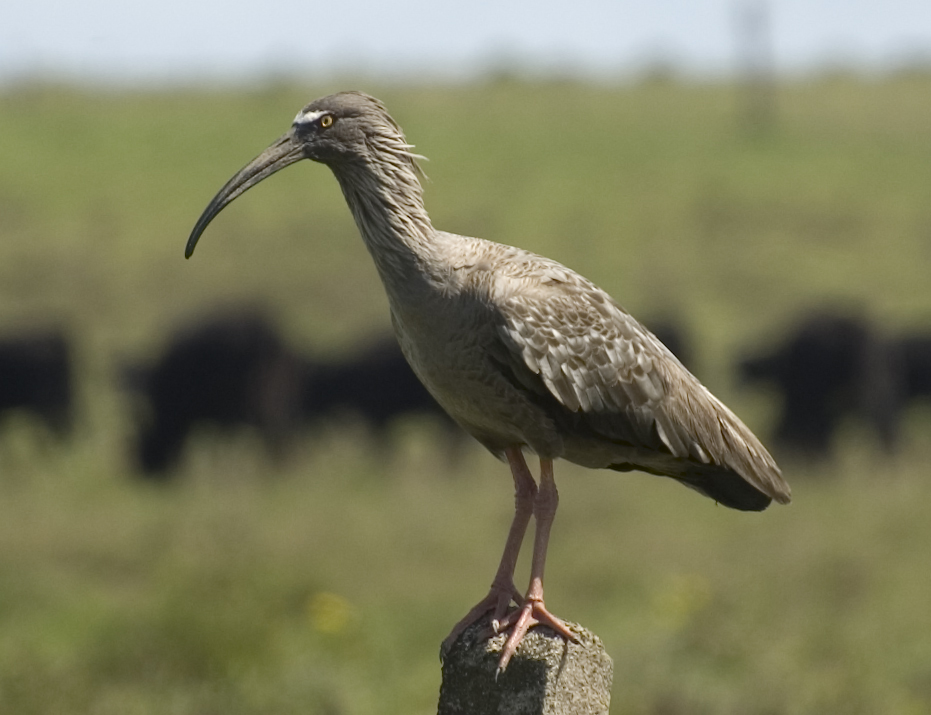 Plumbeous IbisTheristicus caerulescens
- Australian White IbisThreskiornis molucca
-
 Roseate SpoonbillPlatalea ajaja
-
 Scarlet IbisEudocimus ruber
-
 American White IbisEudocimus albus
-
 African Sacred IbisThreskiornis aethiopicus
Compare
Questions and answers
What is the scientific name of the Buff-necked Ibis?
The scientific name of the Buff-necked Ibis is Theristicus caudatus. Written with its author, the full name is Theristicus caudatus (Boddaert, 1783).
Which family does the Buff-necked Ibis belong to?
Theristicus caudatus belongs to the family Threskiornithidae, in the order Pelecaniformes and the class Aves.
Where is the Buff-necked Ibis found?
Checklists and occurrence records place Theristicus caudatus in 10 countries, including Brazil, Colombia, Argentina, Bolivia, Uruguay and Venezuela.
What is the conservation status of the Buff-necked Ibis?
The IUCN Red List category recorded for Theristicus caudatus is Least Concern (LC).
What does the ibis bird eat?
The Buff-necked Ibis feeds mainly on insects, spiders, frogs, reptiles, snails, other invertebrates and small mammals.[8]
Is an ibis a carnivore?
The Buff-necked Ibis feeds on insects, spiders, frogs, reptiles, snails, other invertebrates and small mammals.[8]
Sources
Passages the profile rests on
- The species has a buff-coloured neck and grey upperparts, with a black belly and flight feathers. Source passage: “The neck is buffish, the upperparts are grey, the belly and flight feathers are black” — English Wikipedia
- The species has a large white patch on its wings. Source passage: “and there is a large white patch in the wings.” — English Wikipedia
- The species has a stocky body and a buff-coloured neck and head. Source passage: “Stocky ibis. Very similar to Black-faced Ibis but no range overlap. Back and wings mostly gray with black belly and contrasting buffy neck and head.” — ebird.org
- The species has blackish bill and bare skin around the eyes, together with red legs. Source passage: “The bill and bare skin around the eyes are blackish and the legs are red.” — English Wikipedia
- The species measures approximately 75 centimetres in total length. Source passage: “It has a total length of approximately 75 centimetres (30 in).” — English Wikipedia
- The species inhabits open fields, marshes, savannas and grasslands. Source passage: “The buff-necked ibis lives in a wide range of open habitats, including fields, marshes, savanna and grassland.” — English Wikipedia
- The species occurs predominantly in tropical and warmer subtropical lowlands, with localized occurrence in highlands. Source passage: “It is almost entirely restricted to tropical and warmer subtropical lowlands, but very locally it extends into highlands” — English Wikipedia
- The species feeds mainly on insects, spiders, frogs, reptiles, snails, other invertebrates and small mammals. Source passage: “Its diet consists mainly of insects, spiders, frogs, reptiles, snails, invertebrates and small mammals found in soft soils.” — English Wikipedia
- The species is almost entirely resident, although local movements may occur. Source passage: “It is almost entirely resident, although local movements may occur.” — English Wikipedia
- The female usually lays between two and four eggs per clutch. Source passage: “The female usually lays two to four eggs” — English Wikipedia
- The species builds platform nests from twigs and branches in trees. Source passage: “in a platform nest, made from twigs and branches, in a tree.” — English Wikipedia
- The species is classified as Least Concern on the IUCN Red List. Source passage: “the buff-necked ibis is evaluated as Least Concern on the IUCN Red List of Threatened Species.” — English Wikipedia
- The estimated population of the species ranges from 25,000 to 100,000 individuals. Source passage: “an estimated population of 25,000 to 100,000” — English Wikipedia
- The buff-necked ibis and black-faced ibis have no overlapping ranges. Source passage: “Very similar to Black-faced Ibis but no range overlap.” — ebird.org
Data
- Catalogue of Life, 2026-10-16 XR cc by
- Global Biodiversity Information Facility CC BY 4.0
- Wikidata CC0
- GeoNames CC BY 4.0
- Wikimedia Commons per image; credit shown with each image
- Within the Catalogue of Life, this name comes from The Integrated Taxonomic Information System cc0
References
- Gill, Frank, & and Minturn Wright. (2006). Birds of the World: Recommended English Names.
This species in other databases
- Catalogue of Life 7BWT9
- Wikidata Q574693
- iNaturalist 3766
- WoRMS urn:lsid:marinespecies.org:taxname:1526126
- Avibase bunibi1
Page built on 28 November 2026. See how the catalog is made and all sources and licences.
Cite this page
ScientificNames.org. (2026). Theristicus caudatus (Buff-necked Ibis). Retrieved November 28, 2026, from https://scientificnames.org/species/theristicus-caudatus
“Theristicus caudatus (Buff-necked Ibis).” ScientificNames.org, 2026, scientificnames.org/species/theristicus-caudatus. Accessed 28 Nov. 2026.
ScientificNames.org. “Theristicus caudatus (Buff-necked Ibis).” Accessed November 28, 2026. https://scientificnames.org/species/theristicus-caudatus.
@misc{scientificnames_theristicus_caudatus_buff_necked_ibis,
  author = {{ScientificNames.org}},
  title = {Theristicus caudatus (Buff-necked Ibis)},
  year = {2026},
  url = {https://scientificnames.org/species/theristicus-caudatus},
  note = {Accessed 2026-11-28}
}