Species · Mammals
Northern Pocket Gopher Thomomys talpoides
The scientific name of the Northern Pocket Gopher is Thomomys talpoides. It is a species of mammal in the family Geomyidae (pocket gophers), order Rodentia. The name dates from 1828.
- Scientific name
- Thomomys talpoides (Richardson, 1828)
- Common name
- Northern Pocket Gopher
- Genus
- Thomomys
- Family
- Geomyidae (Pocket Gophers)
- Order
- Rodentia
- Class
- Mammalia
- Red List category
- LC Least Concern
- Recorded in
- 2 countries
- Name status
- accepted in the Catalogue of Life
Overview
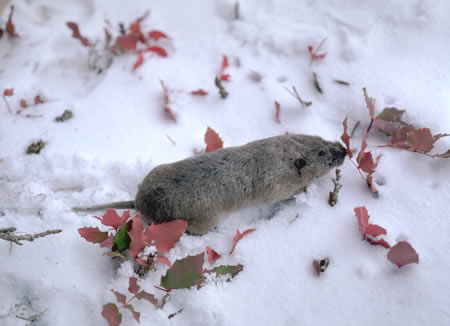
Thomomys talpoides inhabits western Canada and the western United States, from mid-Manitoba to New Mexico. It has a thick, tapering body, reduced eyes and ears, strong claws, and external cheek pouches for carrying food.
Written 26 November 2026 from the sources listed below. Each statement was checked against the passage it cites; statements that could not be supported were removed.
Appearance
Its body is thick and tapering, with short limbs, strong claws, loose skin, and reduced eyes and ears. Its rounded ears measure less than 6.9 mm.[1][2]
The species has external cheek pouches for carrying food. Its upper and lower incisors are sharp and grow rapidly, and the upper incisors have smooth anterior surfaces.[3][4][5]
Adults weigh between 60 and 160 grams and have a total body length of 165–260 mm and a tail length of 40–74 mm. Females are approximately 10% smaller than males in both weight and body length.[6][7][8]
Habitat
The Northern Pocket Gopher inhabits mountain meadows, tundra, valley grasslands, sagebrush steppe, and agricultural fields. Its habitat also includes meadows and stream margins, particularly in mountainous areas.[9][10]
It generally prefers deep, well-drained soils but also occurs in compacted clay and shallow rocky soils. It generally occupies habitats with little canopy cover and abundant ground vegetation.[11][12]
Its recorded elevation range is 915–3,750 metres, with the greatest abundance between 1,220 and 2,745 metres.[13]
Diet
Fruits of Opuntia species are among its preferred foods when available. Grasses can constitute up to half of its diet during certain seasons, and agricultural crops are preferred when available.[14][15][16]
Approximately 80% of its diet consists of above-ground plant material. The species caches food and consumes its own feces.[17][18]
Behaviour
The species constructs extensive underground tunnel networks that can extend for hundreds of feet. An individual can excavate up to 150 metres of tunnels.[19][20]
Its tunnels are typically plugged with soil, except when opened for ventilation during favourable weather. The species does not truly hibernate but experiences short periods of inactivity during summer and winter.[21][22]
Its vision and hearing are poorly developed, making touch and smell its primary communication senses.[23]
Reproduction and life cycle
Breeding takes place in spring and generally occurs later at higher elevations. The gestation period lasts approximately 18–20 days.[24][25]
Births generally occur between mid-May and mid-June, although they take place later at higher elevations. A mature female typically produces one litter of four to seven young annually.[26][27]
Newborn young have an average birth weight of approximately 3 grams and are weaned at approximately 40 days of age. Young individuals disperse from their natal burrows at approximately two months of age.[28][29][30]
Classification of the Northern Pocket Gopher
| Kingdom | Animalia |
|---|---|
| Phylum | Chordata |
| Subphylum | Vertebrata |
| Infraphylum | Gnathostomata |
| Parvphylum | Osteichthyes |
| Megaclass | Tetrapoda |
| Class | Mammalia (Mammal) |
| Subclass | Theria |
| Infraclass | Eutheria |
| Order | Rodentia (Rodent) |
| Suborder | Castorimorpha |
| Family | Geomyidae (Pocket Gophers) |
| Subfamily | Geomyinae |
| Tribe | Thomomyini (Smooth-toothed Pocket Gophers) |
| Genus | Thomomys (Western Pocket Gophers) |
| Species | Thomomys talpoides (Richardson, 1828) |
Where the Northern Pocket Gopher is found
Checklists and occurrence records place Thomomys talpoides in 2 countries across North America. GBIF holds 18,616 georeferenced records of it.
Countries
Regions and cities with the most records
- Colorado, United States 1,835
- Washington, United States 1,627
- Utah, United States 1,461
- Wyoming, United States 1,374
- Idaho, United States 977
- British Columbia, Canada 912
- New Mexico, United States 862
- Oregon, United States 849
- Montana, United States 804
- Saskatchewan, Canada 754
- Nevada, United States 626
- Alberta, Canada 615
- California, United States 542
- Walla Walla, United States 459
- Vernon, Canada 235
- South Dakota, United States 194
- Laramie, United States 192
- Arizona, United States 137
- North Dakota, United States 134
- Provo, United States 117
- Pullman, United States 111
- Calgary, Canada 98
- Moscow, United States 91
- Missoula, United States 78
- Springville, United States 74
- Tooele, United States 73
- Spanish Fork, United States 72
- Orem, United States 68
- Farmington, United States 66
- Kennewick, United States 66
- Pleasant Grove, United States 66
- Bend, United States 64
- Highland, United States 64
- Tri-Cities, United States 64
- American Fork, United States 63
- Pasco, United States 63
Range as the checklists state it
North America
A number beside a place is its count of GBIF occurrence records. A place without a number comes from a checklist alone. Records show where a species has been observed or collected, which can include escapes and vagrants.
Common names
English
- Northern Pocket Gopher
- Northern Pocket Gopher.
- Vancouver Pocket Gopher
Names in 10 other languages
- Czech
- pytlonoš severní
- Dutch
- Berggoffer
- Finnish
- kanadantaskurotta
- French
- gaufre gris
- German
- Nördliche Taschenratte
- Greek
- Βόρειος Γεώμυς
- Norwegian Bokmål
- Nordlig Kinnposerotte
- Polish
- Goffernik kreci
- Russian
- Северный гофер
- Spanish
- Tuza de montaña
Synonyms
One other scientific name has been used for this species and is now treated as a synonym of Thomomys talpoides.
- Cricetus talpoides Richardson, 1828
Subspecies and varieties
- Thomomys talpoides aequalidens subspecies
- Thomomys talpoides agrestis subspecies
- Thomomys talpoides andersoni subspecies
- Thomomys talpoides attenuatus subspecies
- Thomomys talpoides bridgeri subspecies
- Thomomys talpoides bullatus subspecies
- Thomomys talpoides caryi subspecies
- Thomomys talpoides cheyennensis subspecies
- Thomomys talpoides cognatus subspecies
- Thomomys talpoides columbianus subspecies
- Thomomys talpoides devexus subspecies
- Thomomys talpoides douglasii (Brush Prairie Pocket Gopher) subspecies
- Thomomys talpoides duranti subspecies
- Thomomys talpoides falcifer subspecies
- Thomomys talpoides fisheri subspecies
- Thomomys talpoides fossor subspecies
- Thomomys talpoides fuscus subspecies
- Thomomys talpoides gracilis subspecies
- Thomomys talpoides immunis subspecies
- Thomomys talpoides incensus subspecies
- Thomomys talpoides kaibabensis subspecies
- Thomomys talpoides kelloggi subspecies
- Thomomys talpoides levis subspecies
- Thomomys talpoides limosus subspecies
- Thomomys talpoides loringi subspecies
- Thomomys talpoides macrotis (Douglas County Pocket Gopher) subspecies
- Thomomys talpoides medius subspecies
- Thomomys talpoides meritus subspecies
- Thomomys talpoides monoensis subspecies
- Thomomys talpoides moorei subspecies
- Thomomys talpoides nebulosus subspecies
- Thomomys talpoides ocius subspecies
- Thomomys talpoides oquirrhensis subspecies
- Thomomys talpoides parowanensis subspecies
- Thomomys talpoides pierreicolus subspecies
- Thomomys talpoides pryori subspecies
- Thomomys talpoides quadratus subspecies
- Thomomys talpoides ravus subspecies
- Thomomys talpoides relicinus subspecies
- Thomomys talpoides retrorsus subspecies
- Thomomys talpoides rostralis subspecies
- Thomomys talpoides rufescens subspecies
- Thomomys talpoides saturatus subspecies
- Thomomys talpoides segregatus (Wynndel Pocket Gopher) subspecies
- Thomomys talpoides shawi subspecies
- Thomomys talpoides talpoides subspecies
- Thomomys talpoides taylori subspecies
- Thomomys talpoides tenellus subspecies
- Thomomys talpoides trivialis subspecies
- Thomomys talpoides uinta subspecies
- Thomomys talpoides wallowa subspecies
- Thomomys talpoides wasatchensis subspecies
- Thomomys talpoides whitmani subspecies
- Thomomys talpoides yakimensis subspecies
Related species
-
 Mazama Pocket GopherThomomys mazama
-
 Mountain Pocket GopherThomomys monticola
- Idaho Pocket GopherThomomys idahoensis
-
 Wyoming Pocket GopherThomomys clusius
-
 Plains Pocket GopherGeomys bursarius
-
 Southeastern Pocket GopherGeomys pinetis
-
 Yellow-faced Pocket GopherCratogeomys castanops
-
 Texas Pocket GopherGeomys personatus
Compare
Questions and answers
What is the scientific name of the Northern Pocket Gopher?
The scientific name of the Northern Pocket Gopher is Thomomys talpoides. Written with its author, the full name is Thomomys talpoides (Richardson, 1828).
Which family does the Northern Pocket Gopher belong to?
Thomomys talpoides belongs to the family Geomyidae, in the order Rodentia and the class Mammalia.
Where is the Northern Pocket Gopher found?
Checklists and occurrence records place Thomomys talpoides in 2 countries: United States and Canada.
What is the conservation status of the Northern Pocket Gopher?
The IUCN Red List category recorded for Thomomys talpoides is Least Concern (LC).
What other names does the Northern Pocket Gopher have?
Thomomys talpoides is also known in English as Northern Pocket Gopher. and Vancouver Pocket Gopher.
How long does a pocket gopher live?
The Northern Pocket Gopher has a life expectancy of approximately 18–24 months in the wild. Individuals can live for approximately five to six years in captivity.[31][32]
Why is it called a pocket gopher?
It has external cheek pouches for carrying food.[3]
What do northern pocket gophers eat?
They primarily consume roots, corms, rhizomes, and stems of forbs and herbs. Their diet also includes grasses, fruits of Opuntia species, and agricultural crops when available.[33][14][15][16]
Sources
Passages the profile rests on
- The species has a thick, tapering body, short limbs with strong claws, loose skin, and reduced eyes and ears. Source passage: “These pocket gophers have thick, tapering bodies, short limbs with strong claws, loose skin, and reduced eyes and ears.” — animaldiversity.org
- Its rounded ears measure less than 6.9 mm. Source passage: “1) small rounded ears less than 6.9 mm.” — animaldiversity.org
- The species has external cheek pouches for carrying food. Source passage: “These rodents have external cheek pouches.” — animaldiversity.org
- Its upper and lower incisors are sharp and grow rapidly. Source passage: “They have sharp and fast growing upper and lower incisors, which are extensively used to help them dig.” — animaldiversity.org
- The upper incisors have smooth anterior surfaces, distinguishing the species from other members of its genus. Source passage: “3) Smooth anterior surface of the upper incisors.” — animaldiversity.org
- Adult northern pocket gophers weigh between 60 and 160 grams. Source passage: “They weigh 60 to 160 grams (2.1 to 5.6 oz).” — English Wikipedia
- Adult individuals have a total body length of 165–260 mm and a tail length of 40–74 mm. Source passage: “The total body length is 165 to 260 mm, and tail length varies from 40 to 74 mm.” — animaldiversity.org
- Females are approximately 10% smaller than males in both weight and body length. Source passage: “Females are about 10% smaller than males, in both weight and length.” — animaldiversity.org
- The species inhabits mountain meadows, tundra, valley grasslands, sagebrush steppe, and agricultural fields. Source passage: “They can be found in mountain meadows, tundra, valley grasslands, sagebrush steppe, and agricultural fields.” — animaldiversity.org
- Its habitat includes meadows and stream margins, particularly in mountainous areas. Source passage: “Their habitat consists usually of good soil in meadows or along streams; most often in mountains, but also in lowlands.” — English Wikipedia
- The species generally prefers deep, well-drained soils but also occurs in compacted clay and shallow rocky soils. Source passage: “Generally speaking, they prefer deep well drained soils, but are also found in compacted clays and shallow rocky soils.” — animaldiversity.org
- The species generally occupies habitats with little canopy cover and abundant ground vegetation. Source passage: “The uniting feature of these habitats is the absence of significant canopy cover, and abundant ground cover that supplies their nutritional needs.” — animaldiversity.org
- Its recorded elevation range is 915–3,750 metres, with the greatest abundance between 1,220 and 2,745 metres. Source passage: “The elevation range of T. talpoides is 915-3750 meters, but they are most common at 1220-2745 meters.” — animaldiversity.org
- Fruits of Opuntia species are among its preferred foods when available. Source passage: “Fruits of Opuntia species are a favorite, if available.” — animaldiversity.org
- Grasses can constitute up to half of its diet during certain seasons. Source passage: “At certain times of year, grasses may compose up to 50% of their diet” — animaldiversity.org
- Agricultural crops are preferred when available. Source passage: “although they prefer agricultural crops, if available.” — animaldiversity.org
- Approximately 80% of its diet consists of above-ground plant material. Source passage: “Overall, the diet of T. talpoides is composed of 80% areal plant material.” — animaldiversity.org
- The species caches food and consumes its own feces. Source passage: “This species is known to eat its feces, and to cache food.” — animaldiversity.org
- The species constructs extensive underground tunnel networks that can extend for hundreds of feet. Source passage: “Underground, however, they often have tunnels that extend hundreds of feet where they live, store food, and give birth to their young.” — English Wikipedia
- An individual can excavate up to 150 metres of tunnels. Source passage: “An individual can dig up to 150 meters worth of tunnel.” — animaldiversity.org
- The species does not truly hibernate, although it experiences short periods of inactivity during summer and winter. Source passage: “In summer and winter there are brief periods of inactivity, but there is no true hibernation.” — animaldiversity.org
- The species typically keeps its tunnels plugged with soil, except when opening them for ventilation during favourable weather. Source passage: “The tunnels are usually kept plugged with soil, except to air them out during nice weather.” — animaldiversity.org
- Its vision and hearing are poorly developed, making touch and smell its primary communication senses. Source passage: “Vision and hearing are very poor in T. talpoides . Their senses of touch and smell are their primary means of communication.” — animaldiversity.org
- Breeding takes place in spring, generally occurring later at higher elevations. Source passage: “Reproduction occurs in the spring, generally occuring later at higher elevations.” — animaldiversity.org
- The gestation period lasts approximately 18–20 days. Source passage: “The gestation periods last 18 to 20 days.” — animaldiversity.org
- Births generally occur between mid-May and mid-June, although they take place later at higher elevations. Source passage: “Young are usually born from mid-May to mid June, but births occur later at higher elevations.” — animaldiversity.org
- A mature female typically produces one litter of four to seven young annually. Source passage: “An average mature female T. talpoides will have one litter per year that consists of 4-7 young.” — animaldiversity.org
- Newborn young have an average birth weight of approximately 3 grams. Source passage: “Birth weight averages 3 grams.” — animaldiversity.org
- Young are weaned at approximately 40 days of age. Source passage: “The young are weaned by day 40.” — animaldiversity.org
- Young individuals disperse from their natal burrows at approximately two months of age. Source passage: “Young disperse from the natal burrow around 2 months of age” — animaldiversity.org
- The species has a life expectancy of approximately 18–24 months in the wild. Source passage: “In the "real world" their life expectancy is 18-24 months.” — animaldiversity.org
- Individuals can live for approximately five to six years in captivity. Source passage: “In captivity, T. talpoides lives 5-6 years.” — animaldiversity.org
- The species is a generalist herbivore that primarily consumes roots, corms, rhizomes, and stems of forbs and herbs. Source passage: “They primarily consume the roots, corms, rhizomes, and stems, of forbs and herbs.” — animaldiversity.org
- The species occurs in western Canada, including Alberta, Saskatchewan, British Columbia, and Manitoba, as well as the western United States. Source passage: “The northern pocket gopher (Thomomys talpoides) is a small gopher species native to the western United States and the Canadian provinces of Alberta, Saskatchewan, British Columbia, and Manitoba.” — English Wikipedia
- Its North American range extends from mid-Manitoba in the north to New Mexico in the south. Source passage: “They occur on both sides of the continental divide, ranging from mid-Manitoba in the north, to New Mexico at the south end.” — animaldiversity.org
Data
- Catalogue of Life, 2026-10-16 XR cc by
- Global Biodiversity Information Facility CC BY 4.0
- Wikidata CC0
- GeoNames CC BY 4.0
- Wikimedia Commons per image; credit shown with each image
- Within the Catalogue of Life, this name comes from The Integrated Taxonomic Information System cc0
References
- Zool. J. vol.3 p.518 where the name was published
- Banks, R. C., R. W. McDiarmid, and A. L. Gardner. (1987). Checklist of Vertebrates of the United States, the U.S. Territories, and Canada. Resource Publication, No. 166.
- Wilson, Don E., and DeeAnn M. Reeder, eds. (1993). Mammal Species of the World: A Taxonomic and Geographic Reference, 2nd Ed., 3rd Printing.
- Wilson, Don E., and Sue Ruff, eds. (1999). The Smithsonian Book of North American Mammals.
- Wilson, Don E., and F. Russell Cole. (2000). Common Names of Mammals of the World.
- Wilson, Don E., and DeeAnn M. Reeder, eds. (2005). Mammal Species of the World: A Taxonomic and Geographic Reference, 3rd Ed., Vols. 1 & 2.
- Hafner, M. S. / Wilson, Don E., T. E. Lacher Jr., and R. A. Mittermeier, eds. (2016). Family Geomyidae (Pocket Gophers). Handbook of the Mammals of the World. Vol. 6: Lagomorphs and Rodents I.
- Burgin, Connor J., Don E. Wilson, Russell A. Mittermeier, Anthony B. Rylands, et al. (2020). Illustrated Checklist of the Mammals of the World. Vol. 1. Monotremata to Rodentia.
This species in other databases
Page built on 28 November 2026. See how the catalog is made and all sources and licences.
Cite this page
ScientificNames.org. (2026). Thomomys talpoides (Northern Pocket Gopher). Retrieved November 28, 2026, from https://scientificnames.org/species/thomomys-talpoides
“Thomomys talpoides (Northern Pocket Gopher).” ScientificNames.org, 2026, scientificnames.org/species/thomomys-talpoides. Accessed 28 Nov. 2026.
ScientificNames.org. “Thomomys talpoides (Northern Pocket Gopher).” Accessed November 28, 2026. https://scientificnames.org/species/thomomys-talpoides.
@misc{scientificnames_thomomys_talpoides_northern_pocket_gopher,
  author = {{ScientificNames.org}},
  title = {Thomomys talpoides (Northern Pocket Gopher)},
  year = {2026},
  url = {https://scientificnames.org/species/thomomys-talpoides},
  note = {Accessed 2026-11-28}
}