Overview
The recorded range extends from Texas east to Florida and north to Ohio. It is distinguished from Tigrosa helluo and Tigrosa georgicola by two white dashes behind its posterior median eyes.
Written 26 November 2026 from the sources listed below. Each statement was checked against the passage it cites; statements that could not be supported were removed.
Habitat
In Everglades National Park, Tigrosa annexa was most abundant in tropical hardwood hammock forests with xeric or limestone soil. It prefers grass over sand as a substrate for camouflage.[1][2]
Diet
Tigrosa annexa feeds on small invertebrates, including may beetles and mole crickets.[3]
Behaviour
Females are known to engage in cannibalism after copulation. Males exhibit courtship behaviour in response to pheromones in female silk.[4][5]
Larger spiders and spider wasps prey on Tigrosa annexa.[6]
Reproduction and life cycle
During the pre-emergence stage, females carry their egg sacs suspended from their spinnerets. The post-emergence stage begins four to six weeks after the pre-emergence stage.[7][8]
Females tear open their egg sacs to release their spiderlings. Newly emerged offspring remain on their mother's back for one to two weeks before dispersing.[9][10]
Females produce relatively few offspring, which are comparatively large. Female body mass is correlated with clutch mass and offspring number, with larger females producing larger offspring and larger clutches.[11][12]
Appearance
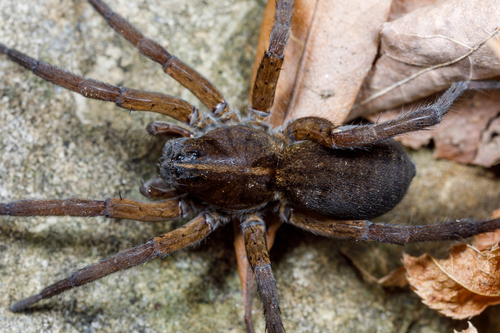
Tigrosa annexa has two dark brown to black bars on the dorsal surface of its cephalothorax, often accompanied by lighter yellowish-gray lines on either side.[13]
Similar species
Tigrosa annexa is distinguished from Tigrosa helluo and Tigrosa georgicola by two white dashes behind its posterior median eyes.[14]
Classification of Tigrosa annexa
| Kingdom | Animalia |
|---|---|
| Phylum | Arthropoda |
| Subphylum | Chelicerata |
| Class | Arachnida (Arachnid) |
| Order | Araneae (Spider) |
| Family | Lycosidae (Wolf Spider) |
| Genus | Tigrosa |
| Species | Tigrosa annexa (Chamberlin & Ivie, 1944) |
Origin of the name. Etymology. Latin, joining
Where Tigrosa annexa is found
Checklists and occurrence records place Tigrosa annexa in 1 country across North America. GBIF holds 6,768 georeferenced records of it.
Countries
Regions and cities with the most records
- Texas, United States 1,881
- Florida, United States 954
- North Carolina, United States 802
- Virginia, United States 573
- Georgia, United States 407
- Alabama, United States 371
- Tennessee, United States 341
- Maryland, United States 300
- Louisiana, United States 294
- Mississippi, United States 248
- Lake Jackson, United States 212
- Angleton, United States 197
- Brushy Creek, United States 195
- South Carolina, United States 192
- McLean, United States 185
- Round Rock, United States 174
- Cedar Park, United States 173
- Great Falls, United States 169
- Idylwood, United States 169
- Tysons, United States 169
- Pflugerville, United States 163
- Potomac, United States 161
- South Houston, United States 161
- North Bethesda, United States 158
- Pasadena, United States 157
- Bethesda, United States 156
- Vienna, United States 155
- Wolf Trap, United States 154
- Reston, United States 150
- Wheaton, United States 142
- Merrifield, United States 138
- Rockville, United States 138
- West Falls Church, United States 137
- Georgetown, United States 136
- North Potomac, United States 136
- Arlington, United States 135
Range as the checklists state it
USA
A number beside a place is its count of GBIF occurrence records. A place without a number comes from a checklist alone. Records show where a species has been observed or collected, which can include escapes and vagrants.
Synonyms
One other scientific name has been used for this species and is now treated as a synonym of Tigrosa annexa.
- Hogna annexa (Chamberlin & Ivie, 1944)
Related species
-
 Wetland Giant Wolf SpiderTigrosa helluo
-
 Georgia Wolf SpiderTigrosa georgicola
-
 Tigrosa grandis
- Woodland Giant Wolf SpiderTigrosa aspersa
-
 Rabid Wolf SpiderRabidosa rabida
-
 Carolina Wolf SpiderHogna carolinensis
-
 Hogna radiata
-
 Tarantula Wolf SpiderLycosa tarantula
Compare
Questions and answers
What kind of food do wolf spiders eat?
Tigrosa annexa feeds on small invertebrates, including may beetles and mole crickets.[3]
Sources
Passages the profile rests on
- In Everglades National Park, Tigrosa annexa was most abundant in tropical hardwood hammock forests with xeric or limestone soil. Source passage: “A study in Everglades National Park found Tigrosa annexa to be most abundant in tropical hardwood hammock forests with xeric or limestone soil.” — English Wikipedia
- Tigrosa annexa prefers grass over sand as a substrate for camouflage. Source passage: “This species prefers grass over sand to better camouflage with their environment.” — English Wikipedia
- Tigrosa annexa feeds on small invertebrates, including may beetles and mole crickets. Source passage: “Tigrosa annexa feeds on small invertebrates such as may beetles and mole crickets.” — English Wikipedia
- Females of Tigrosa annexa are known to engage in cannibalism after copulation. Source passage: “Females are known to engage in cannibalism after copulating.” — English Wikipedia
- Males exhibit courtship behaviour in response to pheromones in female silk. Source passage: “Males have shown courtship behaviors in response to female silk pheromones.” — English Wikipedia
- Larger spiders and spider wasps prey on Tigrosa annexa. Source passage: “They are preyed on by larger spiders and spider wasps.” — English Wikipedia
- Female Tigrosa annexa carry their egg sacs suspended from their spinnerets during the pre-emergence stage. Source passage: “During the pre-emergence stage, female wolf spiders carry the egg sacs suspended from their spinnerets, rather than making a web like many other spiders.” — English Wikipedia
- The post-emergence stage begins four to six weeks after the pre-emergence stage. Source passage: “The post-emergence stage begins in 4 to 6 weeks, in which the female tears open the egg sac for the spiderlings to emerge.” — English Wikipedia
- Female Tigrosa annexa tear open their egg sacs to release their spiderlings. Source passage: “the female tears open the egg sac for the spiderlings to emerge.” — English Wikipedia
- Newly emerged offspring remain on their mother's back for one to two weeks before dispersing. Source passage: “The emerged offspring then remain on the mother’s back for 1 to 2 weeks before dispersing.” — English Wikipedia
- Female Tigrosa annexa produce relatively few offspring, which are comparatively large. Source passage: “Female Tigrosa annexa produce small numbers of larger offspring.” — English Wikipedia
- Female body mass is correlated with clutch mass and offspring number, with larger females producing larger offspring and larger clutches. Source passage: “Body mass was found to be correlated with both clutch mass and the number of offspring, with larger females producing larger offspring at higher clutch sizes.” — English Wikipedia
- Tigrosa annexa has two dark brown to black bars on the dorsal surface of its cephalothorax, often accompanied by lighter yellowish-gray lines on either side. Source passage: “Tigrosa annexa has two distinct dark brown to black bars on the back of the cephalothorax, often with lighter yellowish gray lines on each side.” — English Wikipedia
- Tigrosa annexa is distinguished from Tigrosa helluo and Tigrosa georgicola by two white dashes behind the posterior median eyes. Source passage: “Distinguished from Tigrosa helluo and Tigrosa georgicola by the presence of two white dashes behind the posterior median eyes.” — English Wikipedia
Data
- Catalogue of Life, 2026-10-16 XR cc by
- Global Biodiversity Information Facility CC BY 4.0
- Wikidata CC0
- GeoNames CC BY 4.0
- Within the Catalogue of Life, this name comes from The World Spider Catalog cc by
References
- Chamberlin, R. V. & Ivie, W. (1944). Spiders of the Georgia region of North America. Bulletin of the University of Utah 35(9): 1-267. where the name was published
This species in other databases
Page built on 28 November 2026. See how the catalog is made and all sources and licences.
Cite this page
ScientificNames.org. (2026). Tigrosa annexa. Retrieved November 28, 2026, from https://scientificnames.org/species/tigrosa-annexa
“Tigrosa annexa.” ScientificNames.org, 2026, scientificnames.org/species/tigrosa-annexa. Accessed 28 Nov. 2026.
ScientificNames.org. “Tigrosa annexa.” Accessed November 28, 2026. https://scientificnames.org/species/tigrosa-annexa.
@misc{scientificnames_tigrosa_annexa,
  author = {{ScientificNames.org}},
  title = {Tigrosa annexa},
  year = {2026},
  url = {https://scientificnames.org/species/tigrosa-annexa},
  note = {Accessed 2026-11-28}
}