Species · Birds
Solitary Tinamou Tinamus solitarius
The scientific name of the Solitary Tinamou is Tinamus solitarius. It is a species of bird in the family Tinamidae (tinamou), order Tinamiformes. The name dates from 1819.
- Scientific name
- Tinamus solitarius (Vieillot, 1819)
- Common name
- Solitary Tinamou
- Genus
- Tinamus
- Family
- Tinamidae (Tinamou)
- Order
- Tinamiformes
- Class
- Aves
- Red List category
- NT Near Threatened
- Recorded in
- 3 countries
- Name status
- accepted in the Catalogue of Life

Overview
Tinamus solitarius inhabits lowland humid tropical forests and montane forests at elevations up to 1,200 metres above sea level. It has brownish plumage with prominent black barring and averages 45 cm in length.
Written 26 November 2026 from the sources listed below. Each statement was checked against the passage it cites; statements that could not be supported were removed.
Appearance
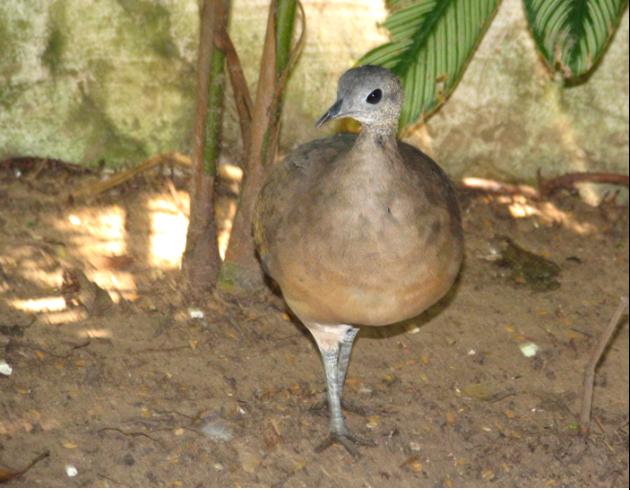
The Solitary Tinamou has brownish plumage with prominent black barring. Its neck, breast and flanks are grey, while its belly is white.[1][2]
It has a dark brown crown and a yellowish head and neck with a white throat. A distinctive buff-colored line runs along the side of its neck.[3][4]
The coloration of the back varies between olive and rusty shades. The intensity of black barring varies across the neck and other plumage areas.[5][6]
The Solitary Tinamou averages 45 cm in length.[7]
Habitat
The Solitary Tinamou inhabits lowland humid tropical forests and montane forests at elevations up to 1,200 metres above sea level. It is uncommon and mostly found in lowland humid forest up to 1,200 metres.[8][9][10]
The species readily occupies secondary forests and tolerates selective logging to some degree. Large plantations of exotic tree species are not favored.[11][12][13]
It occurs in forest mosaics containing cabruca smallholder plantings and secondary vegetation. Its habitat includes forest understoreys containing dense caeté Marantaceae and Merostachys bamboo, as well as areas with higher Guadua bamboo and mature heart-of-palm trees.[14][15][16]
Diet
The Solitary Tinamou eats fruits and seeds collected from the ground or low-growing plants.[17]
Behaviour
The Solitary Tinamou lays eggs with unusually shaped, glossy and colorful shells. Males incubate the eggs in ground nests and rear the young until they become independent.[18][19][20]
Conservation
The Solitary Tinamou is threatened by deforestation associated with urbanization, industrialization, agricultural expansion and road construction. Excessive hunting is an additional threat.[21][22]
The species has been classified as Near Threatened by the IUCN and has a reported range occurrence of 990,000 square kilometres.[23][24]
The northern population formerly classified as pernambucensis is either very rare or already locally extinct. Northern birds were historically rare, with possibly no more than six museum specimens.[25][26]
The species has been documented persisting in a 610-hectare forest fragment where it was not originally present.[27]
The species is also reported as not globally threatened by the IUCN in the document.[28]
Similar species
The Solitary Tinamou was formerly divided into two subspecies, T. s. pernambucensis and T. s. solitarius. The formerly recognized pernambucensis form is considered a color morph rather than a distinct subspecies.[29][30]
The pernambucensis color morph is characterized by yellower plumage and extensive barring, especially on the neck.[31]
Uses
The Solitary Tinamou can be introduced to suitable habitat without great difficulty.[32]
Classification of the Solitary Tinamou
| Kingdom | Animalia |
|---|---|
| Phylum | Chordata |
| Subphylum | Vertebrata |
| Infraphylum | Gnathostomata |
| Parvphylum | Osteichthyes |
| Megaclass | Tetrapoda |
| Class | Aves (Bird) |
| Order | Tinamiformes (Tinamou) |
| Family | Tinamidae (Tinamou) |
| Genus | Tinamus (Greater Tinamous) |
| Species | Tinamus solitarius (Vieillot, 1819) |
Where the Solitary Tinamou is found
Checklists and occurrence records place Tinamus solitarius in 3 countries across South America. GBIF holds 10,282 georeferenced records of it.
Countries
Regions and cities with the most records
- São Paulo, Brazil 6,054
- Guapiara, Brazil 1,272
- Espírito Santo, Brazil 834
- Santa Catarina, Brazil 677
- Paraná, Brazil 544
- Misiones, Argentina 529
- Rio de Janeiro, Brazil 480
- Sooretama, Brazil 440
- Puerto Iguazú, Argentina 422
- Peruíbe, Brazil 377
- Itariri, Brazil 369
- Ubatuba, Brazil 349
- Foz do Iguaçu, Brazil 331
- Bahia, Brazil 318
- Bertioga, Brazil 307
- Rio Grande do Sul, Brazil 303
- Cubatão, Brazil 296
- São Sebastião, Brazil 290
- Presidente Franco, Paraguay 279
- Ilhabela, Brazil 251
- Rio Grande da Serra, Brazil 245
- Ribeirão Pires, Brazil 243
- Santa Teresa, Brazil 234
- Fundão, Brazil 226
- Minas Gerais, Brazil 213
- Porto Seguro, Brazil 213
- Caraguatatuba, Brazil 208
- Santa Cruz Cabrália, Brazil 206
- Paraty, Brazil 189
- Juquitiba, Brazil 174
- São Miguel Arcanjo, Brazil 173
- Vila Galvão, Brazil 157
- Guarulhos, Brazil 153
- Mairiporã, Brazil 149
- Timóteo, Brazil 143
- Coronel Fabriciano, Brazil 140
Range as the checklists state it
South America
A number beside a place is its count of GBIF occurrence records. A place without a number comes from a checklist alone. Records show where a species has been observed or collected, which can include escapes and vagrants.
Common names
English
- Solitary Tinamou
Names in 26 other languages
- Catalan
- tinamú solitari
- Chinese
- 孤(共鳥), 孤䳍
- Croatian
- paragvajski tinamu
- Czech
- tinama samotářská
- Danish
- Olivengrå Tinamu
- Dutch
- Kluizenaarstinamoe
- Esperanto
- soleca tinamo
- Estonian
- eraktinamu
- Finnish
- erakkotinami
- French
- Tinamou solitaire
- German
- Grausteiß-Tinamu, Grausteißtinamu, Zimttinamu
- Hungarian
- remetetinamu
- Italian
- Tinamo solitario
- Japanese
- オバシギダチョウ
- Lithuanian
- tinamas atsiskyrėlis
- Norwegian
- eremittinamu
- Polish
- kusacz samotny
- Portuguese
- macuco-solitário, tinamu-solitário
- Russian
- Тинаму-отшельник, Тинаму-пустынник
- Serbian
- Skriveni tinamu
- Slovak
- tinama samotárska
- Spanish
- Macuco, Tinamu Grande, Tinamu Macuco, Tinamú macuco
- Swedish
- solitärtinamo
- Turkish
- Yalnız Tinamu
- Ukrainian
- тинаму-самітник
- Welsh
- tinamŵ mawr unig
Synonyms
4 other scientific names have been used for this species and are now treated as synonyms of Tinamus solitarius.
- Cryptura solitaria Vieillot, LJP, 1819
- Tinamus guttulatus Gray, GR, 1867
- Tinamus solitarius pernambucensis Berla, 1946
- Tinamus solitarius solitarius (Vieillot, 1819)
Related species
-
 Great TinamouTinamus major
-
 Grey TinamouTinamus tao
-
 White-throated TinamouTinamus guttatus
-
 Black TinamouTinamus osgoodi
-
 Slaty-masked TinamouTinamus resonans
-
 Elegant Crested TinamouEudromia elegans
-
 Little TinamouCrypturellus soui
-
 Dwarf TinamouTaoniscus nanus
Compare
Questions and answers
What is the scientific name of the Solitary Tinamou?
The scientific name of the Solitary Tinamou is Tinamus solitarius. Written with its author, the full name is Tinamus solitarius (Vieillot, 1819).
Which family does the Solitary Tinamou belong to?
Tinamus solitarius belongs to the family Tinamidae, in the order Tinamiformes and the class Aves.
Where is the Solitary Tinamou found?
Checklists and occurrence records place Tinamus solitarius in 3 countries: Brazil, Argentina and Paraguay.
What is the conservation status of the Solitary Tinamou?
The IUCN Red List category recorded for Tinamus solitarius is Near Threatened (NT).
Where is tinamou found?
The Solitary Tinamou occurs in the Atlantic Forest of eastern Brazil, including southeastern Bahia, eastern Minas Gerais, Espírito Santo, Rio de Janeiro and São Paulo. It also occurs in eastern Mato Grosso do Sul, Paraná, Santa Catarina, northern Rio Grande do Sul, southeastern Paraguay and Misiones province in extreme northeastern Argentina.[33][34][35][36][37]
What do tinamou eat?
The Solitary Tinamou eats fruits and seeds collected from the ground or low-growing plants.[17]
Sources
Passages the profile rests on
- The Solitary Tinamou has brownish plumage with prominent black barring. Source passage: “The solitary tinamou is a large brownish tinamou heavily barred with black.” — English Wikipedia
- The species has grey neck, breast and flank plumage, with a white belly. Source passage: “Its neck, breast, and flanks are grey, and its belly is white.” — English Wikipedia
- The bird has a dark brown crown and a yellowish head and neck with a white throat. Source passage: “It has a dark brown crown and a white throat on its yellowish head and neck” — English Wikipedia
- The species has a distinctive buff-colored line along the side of its neck. Source passage: “a distinctive buff line on the side of the neck.” — English Wikipedia
- The coloration of the back varies between olive and rusty shades. Source passage: “Notably, the hue of the back varies between olive and rusty” — English Wikipedia
- The intensity of black barring varies across the neck and other plumage areas. Source passage: “The black barring in these areas is more or less strong.” — English Wikipedia
- The Solitary Tinamou averages 45 cm in length. Source passage: “It averages 45 cm (18 in) in length.” — English Wikipedia
- The species inhabits lowland humid tropical forests. Source passage: “The solitary tinamou is found in lowland humid tropical forest” — English Wikipedia
- The species occurs in montane forests at elevations up to 1,200 metres above sea level. Source passage: “montane forests up to 1,200 m (3,900 ft) ASL.” — English Wikipedia
- The species is described as uncommon and is mostly found in lowland humid forest up to 1,200 metres. Source passage: “This species is described as 'uncommon' mostly found in lowland humid forest up to 1,200 m,” — datazone.birdlife.org
- The Solitary Tinamou readily occupies secondary forests. Source passage: “It readily inhabits secondary forest” — English Wikipedia
- The species tolerates selective logging to some degree. Source passage: “tolerating selective logging to some degree.” — English Wikipedia
- Large plantations of exotic tree species are not favored by the Solitary Tinamou. Source passage: “Large plantations of exotic species are not well-liked.” — English Wikipedia
- The species occurs in forest mosaics containing cabruca smallholder plantings and secondary vegetation. Source passage: “in a mosaic of cabruca smallholder plantings, interspersed with secondary growth” — English Wikipedia
- The species inhabits forest understoreys containing dense caeté Marantaceae and Merostachys bamboo. Source passage: “with dense caeté Marantaceae and Merostachys bamboo understorey” — English Wikipedia
- The species also occurs in habitats containing higher Guadua bamboo and mature heart-of-palm trees. Source passage: “as well as higher Guadua bamboo and full-grown heart-of-palm trees (Euterpe edulis).” — English Wikipedia
- The Solitary Tinamou eats fruits and seeds collected from the ground or low-growing plants. Source passage: “it eats fruits, and seeds off the ground or low plants.” — English Wikipedia
- The species lays eggs with unusually shaped, glossy and colorful shells. Source passage: “it lays oddly-shaped eggs with a glossy, colorful shell” — English Wikipedia
- Male Solitary Tinamous incubate the eggs in ground nests. Source passage: “Males will incubate the eggs which are in a nest on the ground” — English Wikipedia
- Males rear the young until they become independent. Source passage: “and will also rear the young for the short period of time before they are independent.” — English Wikipedia
- The species is threatened by deforestation associated with urbanization, industrialization, agricultural expansion and road construction. Source passage: “It is currently threatened by the ongoing deforestation caused by urbanisation, industrialisation, agricultural expansion, and associated road-building.” — English Wikipedia
- Excessive hunting is an additional threat to the Solitary Tinamou. Source passage: “It is also hunted excessively.” — English Wikipedia
- The species has been classified as Near Threatened by the IUCN. Source passage: “Consequently, the IUCN classifies it as a Near Threatened species” — English Wikipedia
- The species has a reported range occurrence of 990,000 square kilometres. Source passage: “with a range occurrence of 990,000 km2 (380,000 sq mi).” — English Wikipedia
- The northern population formerly classified as pernambucensis is either very rare or already locally extinct. Source passage: “The population formerly believed to be referred to by pernambucensis is either very rare or already extirpated.” — English Wikipedia
- Northern birds historically were rare, with possibly no more than six museum specimens. Source passage: “These northern birds have always been fairly rare in historical times, with possibly not more than 6 specimens in museums.” — English Wikipedia
- The species has been documented persisting in a 610-hectare forest fragment where it was not originally present. Source passage: “Solitary tinamous were found to persist in numbers in a forest fragment of 1,500 acres (610 ha) where they were not originally found.” — English Wikipedia
- The species is reported as not globally threatened by the IUCN in the document. Source passage: “It is not considered globally threatened by the IUCN.” — English Wikipedia
- The species was formerly divided into two subspecies, T. s. pernambucensis and T. s. solitarius. Source passage: “Formerly, this bird was divided into two subspecies: T. s. pernambucensis in north-east Brazil (Pernambuco and Alagoas), and T. s. solitarius found in south-east Paraguay and extreme north-east Argentina.” — English Wikipedia
- The formerly recognized pernambucensis form is considered a color morph rather than a distinct subspecies. Source passage: “The former, however, turned out to be not distinct from the nominate but rather individual birds that showed a particular color morph” — English Wikipedia
- The pernambucensis color morph is characterized by yellower plumage and extensive barring, especially on the neck. Source passage: “pernambucensis refers to yellower birds with much barring, especially on the neck.” — English Wikipedia
- The Solitary Tinamou can be introduced to suitable habitat without great difficulty. Source passage: “It has been noted that this species is not hard to introduce to suitable habitat.” — English Wikipedia
- The Solitary Tinamou occurs in the Atlantic Forest of eastern Brazil. Source passage: “This species is native to Atlantic forest of eastern Brazil.” — English Wikipedia
- The species occurs in southeastern Bahia, eastern Minas Gerais, Espírito Santo, Rio de Janeiro and São Paulo. Source passage: “It is found in southeastern Bahia, eastern Minas Gerais, Espírito Santo, Rio de Janeiro, São Paulo,” — English Wikipedia
- The species also occurs in eastern Mato Grosso do Sul, Paraná, Santa Catarina and northern Rio Grande do Sul. Source passage: “eastern Mato Grosso do Sul, Paraná, Santa Catarina, and northern Rio Grande do Sul states.” — English Wikipedia
- The species occurs in southeastern Paraguay. Source passage: “It is also found in southeastern Paraguay” — English Wikipedia
- The species occurs in Misiones province in extreme northeastern Argentina. Source passage: “and extreme north-east Argentina in Misiones province.” — English Wikipedia
Data
- Catalogue of Life, 2026-10-16 XR cc by
- Global Biodiversity Information Facility CC BY 4.0
- Wikidata CC0
- GeoNames CC BY 4.0
- Wikimedia Commons per image; credit shown with each image
- Within the Catalogue of Life, this name comes from The Integrated Taxonomic Information System cc0
References
- Dickinson, Edward C., ed. (2003). The Howard and Moore Complete Checklist of the Birds of the World, 3rd Edition.
- Gill, Frank, & and Minturn Wright. (2006). Birds of the World: Recommended English Names.
This species in other databases
Page built on 29 November 2026. See how the catalog is made and all sources and licences.
Cite this page
ScientificNames.org. (2026). Tinamus solitarius (Solitary Tinamou). Retrieved November 29, 2026, from https://scientificnames.org/species/tinamus-solitarius
“Tinamus solitarius (Solitary Tinamou).” ScientificNames.org, 2026, scientificnames.org/species/tinamus-solitarius. Accessed 29 Nov. 2026.
ScientificNames.org. “Tinamus solitarius (Solitary Tinamou).” Accessed November 29, 2026. https://scientificnames.org/species/tinamus-solitarius.
@misc{scientificnames_tinamus_solitarius_solitary_tinamou,
  author = {{ScientificNames.org}},
  title = {Tinamus solitarius (Solitary Tinamou)},
  year = {2026},
  url = {https://scientificnames.org/species/tinamus-solitarius},
  note = {Accessed 2026-11-29}
}