Species · Molluscs
Antarctic Flying Squid Todarodes filippovae
The scientific name of the Antarctic Flying Squid is Todarodes filippovae. It is a species of mollusc in the family Ommastrephidae (flying squids), order Oegopsida. The name dates from 1975.
- Scientific name
- Todarodes filippovae Adam, 1975
- Common name
- Antarctic Flying Squid
- Genus
- Todarodes
- Family
- Ommastrephidae (Flying Squids)
- Order
- Oegopsida
- Class
- Cephalopoda
- Red List category
- LC Least Concern
- Environment
- marine
- Recorded in
- 3 countries
- Name status
- accepted in the Catalogue of Life

Overview
Todarodes filippovae has a circumglobal distribution in the Southern Ocean south of 35°S and is common in waters of the subtropical convergence zone. It has a long, narrow muscular mantle, arrowhead-shaped fins, and a modified fourth right arm that forms a hectocotylus.
Written 26 November 2026 from the sources listed below. Each statement was checked against the passage it cites; statements that could not be supported were removed.
Appearance
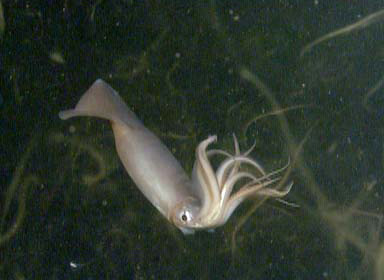
The Antarctic Flying Squid has a long, narrow, muscular mantle that tapers posteriorly to a pointed tail. Its arrowhead-shaped fins have both a length and width approximately half the mantle length.[1][2]
Its tentacular clubs have 12–14 transverse rows of suckers on the manus. The largest club suckers have rings bearing 7–13 teeth and diameters equal to 2.7–4.5% of mantle length.[3][4][5]
The tentacles have two pairs of carpal suckers.[6]
Habitat
The Antarctic Flying Squid occurs over continental slopes and in oceanic waters at depths ranging from the surface to 1,200 m. Individuals have been caught near the seabed, throughout the water column, and near the surface at night.[7][8]
The species is associated with faster ocean currents and occurs across waters with temperatures ranging from 3–3.6 °C to 24 °C.[9][10]
The species has a circumglobal distribution in the Southern Ocean south of 35°S and is common in waters of the subtropical convergence zone. It has been recorded as far north as Peru, where records are thought to represent individuals transported northward by the Humboldt Current.[11][12][13][14]
Diet
The Antarctic Flying Squid preys on fishes, crustaceans, and other cephalopods. Crustaceans are the predominant dietary component of smaller individuals, while individuals exceeding 200 mm in mantle length feed mainly on cephalopods.[15][16][17]
Behaviour
The species is caught near the surface at night as well as at greater depths.[18]
Reproduction and life cycle
The spawning season in the described populations extends from December through August. Studies in South African waters indicate a spawning period from February through August.[19][20]
Males measuring 260 mm in mantle length show visible spermatophores, while males measuring 320 mm possess formed spermatophores. The smallest recorded mature female with eggs in the oviduct had a mantle length of 380 mm.[21][22][23]
Specimens recovered from commercially whaled sperm whales off Durban provide evidence of breeding off southeastern Africa.[24]
Conservation
The Antarctic Flying Squid is currently taken as bycatch in fisheries targeting other species.[25]
Uses
Commercial fisheries have targeted the species in the Falkland Islands and the Tasman Sea. Its abundance and muscular flesh suggest potential for commercial exploitation.[26][27]
Classification of the Antarctic Flying Squid
| Kingdom | Animalia |
|---|---|
| Phylum | Mollusca |
| Class | Cephalopoda (Cephalopod) |
| Subclass | Coleoidea |
| Superorder | Decapodiformes |
| Order | Oegopsida |
| Superfamily | Cranchioidea |
| Family | Ommastrephidae (Flying Squids) |
| Subfamily | Todarodinae |
| Genus | Todarodes |
| Species | Todarodes filippovae Adam, 1975 |
Where the Antarctic Flying Squid is found
Checklists and occurrence records place Todarodes filippovae in 3 countries. GBIF holds 1,555 georeferenced records of it.
Countries
Regions and cities with the most records
2 more countries have a few records outside this range
These countries hold a few records of Todarodes filippovae but lie outside the range the checklists give for it. Such records are often zoo or garden specimens, museum material or vagrants, so the species is not counted as occurring there.
A number beside a place is its count of GBIF occurrence records. A place without a number comes from a checklist alone. Records show where a species has been observed or collected, which can include escapes and vagrants.
Common names
English
- Antarctic Flying Squid
Names in 3 other languages
- Italian
- Calamaro volente antartico, Todaro antartico, Totano antartico
- Japanese
- ミナミスルメイカ
- Russian
- Кальмар-тодародес Филипповой
Related species
-
 Japanese Flying SquidTodarodes pacificus
-
 European Flying SquidTodarodes sagittatus
- Little Flying SquidTodarodes pusillus
- Angolan Flying SquidTodarodes angolensis
-
 Humboldt SquidDosidicus gigas
-
 Northern Shortfin SquidIllex illecebrosus
-
 Neon Flying SquidOmmastrephes bartramii
-
 Argentine Shortfin SquidIllex argentinus
Compare
Questions and answers
What is the scientific name of the Antarctic Flying Squid?
The scientific name of the Antarctic Flying Squid is Todarodes filippovae. Written with its author, the full name is Todarodes filippovae Adam, 1975.
Which family does the Antarctic Flying Squid belong to?
Todarodes filippovae belongs to the family Ommastrephidae, in the order Oegopsida and the class Cephalopoda.
Where is the Antarctic Flying Squid found?
Checklists and occurrence records place Todarodes filippovae in 3 countries: New Zealand, Australia and Chile.
What is the conservation status of the Antarctic Flying Squid?
The IUCN Red List category recorded for Todarodes filippovae is Least Concern (LC).
Sources
Passages the profile rests on
- The species has a long, narrow, muscular mantle that tapers posteriorly to a pointed tail. Source passage: “It has a long, narrow and muscular mantle, which has a width which is roughly a quarter of its length, tapering posteriorly to a pointed tail.” — English Wikipedia
- Its fins are arrowhead-shaped, with both their length and width approximately half the mantle length. Source passage: “The fins are arrowhead shaped and both their length and width are roughly equivalent to half that of the mantle.” — English Wikipedia
- Its tentacular clubs have 12–14 transverse rows of suckers on the manus. Source passage: “the tentacular clubs which have 12-14 transverse rows of suckers on the manus” — English Wikipedia
- The largest tentacular-club suckers have rings bearing 7–13 teeth. Source passage: “the largest of which has 7-13 teeth on its ring” — English Wikipedia
- The largest tentacular-club suckers have a diameter equal to 2.7–4.5% of mantle length. Source passage: “a diameter equal to 2.7-4.5% of the mantle length.” — English Wikipedia
- The tentacles have two pairs of carpal suckers. Source passage: “The tentacle also has two pairs of carpal suckers.” — English Wikipedia
- The species occurs over continental slopes and in oceanic waters at depths ranging from the surface to 1,200 m. Source passage: “The Antarctic flying squid occurs over the continental slope and oceanic waters with depths between 0 and 1,200m.” — English Wikipedia
- Individuals have been caught near the seabed, throughout the water column, and near the surface at night. Source passage: “It has been caught from near to the bottom, through the water column to near the surface at night.” — English Wikipedia
- The species is associated with faster ocean currents. Source passage: “This species is associated with faster currents” — English Wikipedia
- The species occurs across waters with temperatures ranging from 3–3.6 °C to 24 °C. Source passage: “from cold Antarctic water 1t 3-3.6 °C to waters as warm as 24 °C.” — English Wikipedia
- The species has a circumglobal distribution in the Southern Ocean south of 35°S. Source passage: “The Antarctic flying squid has a circumglobal distribution in the Southern Ocean south of 35°S” — English Wikipedia
- The species is common in waters of the subtropical convergence zone. Source passage: “and it is common in the waters of the subtropical convergence zone.” — English Wikipedia
- The species has been recorded as far north as Peru. Source passage: “It has been found as far north as Peru” — English Wikipedia
- Records from Peru are thought to represent individuals transported northward by the Humboldt Current. Source passage: “but these are thought to have drifted north on the Humboldt Current.” — English Wikipedia
- The species preys on fishes, crustaceans, and other cephalopods. Source passage: “This species preys on fishes, crustaceans and cephalopods.” — English Wikipedia
- Crustaceans are the predominant dietary component of smaller individuals. Source passage: “Smaller squids have crustaceans as the predominant element in their diet” — English Wikipedia
- Individuals exceeding 200 mm in mantle length feed mainly on cephalopods. Source passage: “while larger squid, larger than 200mm mantle length, feed mainly on cephalopods.” — English Wikipedia
- The species is caught near the surface at night as well as at greater depths. Source passage: “It has been caught from near to the bottom, through the water column to near the surface at night.” — English Wikipedia
- The spawning season in the described populations extends from December through August. Source passage: “The spawning season occurs between December and August” — English Wikipedia
- Studies in South African waters indicate a spawning period from February through August. Source passage: “Studies in South African waters indicate a similarly extended spawning period running from February to August.” — English Wikipedia
- Males measuring 260 mm in mantle length show visible spermatophores. Source passage: “Spermatophores are obvious in males which have attained a mantle length of 260 mm” — English Wikipedia
- Males measuring 320 mm in mantle length possess formed spermatophores. Source passage: “those at 320 mm mantle length bear formed spermatophores.” — English Wikipedia
- The smallest recorded mature female with eggs in the oviduct had a mantle length of 380 mm. Source passage: “The smallest mature female recorded having eggs in the oviduct was measured with a mantle length of 380 mm.” — English Wikipedia
- Specimens recovered from commercially whaled sperm whales off Durban provide evidence of breeding off southeastern Africa. Source passage: “data gathered on specimens sampled from stomachs of commercially whaled sperm whales off Durban suggest that Antarctic flying squid breed off the southeast African coast.” — English Wikipedia
- The species is currently taken as bycatch in fisheries targeting other species. Source passage: “and is currently taken as a bycatch in fisheries pursuing other species.” — English Wikipedia
- Commercial fisheries have targeted the species in the Falkland Islands and the Tasman Sea. Source passage: “This species has been targeted by commercial fisheries in the Falkland Islands and the Tasman Sea” — English Wikipedia
- Its abundance and muscular flesh suggest potential for commercial exploitation. Source passage: “Its abundance and muscular flesh suggest it could be a viable commercial species.” — English Wikipedia
Data
- Catalogue of Life, 2026-10-16 XR cc by
- Global Biodiversity Information Facility CC BY 4.0
- Wikidata CC0
- GeoNames CC BY 4.0
- Wikimedia Commons per image; credit shown with each image
- Within the Catalogue of Life, this name comes from World Register of Marine Species cc by
References
- Adam, W. (1975). Notes sur les céphalopodes. 26. Un nouvelle espèce de Todarodes (Todarodes filippovae sp. nov.) de l’Ocean Indien. Bulletin de l’Institut Royal Des Sciences Naturelles de Belgique - Mededelingen. Koninklijk Belgisch Instituut Voor Natuurwetenschappen, 50 (9): 1–10. where the name was published
This species in other databases
Page built on 29 November 2026. See how the catalog is made and all sources and licences.
Cite this page
ScientificNames.org. (2026). Todarodes filippovae (Antarctic Flying Squid). Retrieved November 29, 2026, from https://scientificnames.org/species/todarodes-filippovae
“Todarodes filippovae (Antarctic Flying Squid).” ScientificNames.org, 2026, scientificnames.org/species/todarodes-filippovae. Accessed 29 Nov. 2026.
ScientificNames.org. “Todarodes filippovae (Antarctic Flying Squid).” Accessed November 29, 2026. https://scientificnames.org/species/todarodes-filippovae.
@misc{scientificnames_todarodes_filippovae_antarctic_flying_squid,
  author = {{ScientificNames.org}},
  title = {Todarodes filippovae (Antarctic Flying Squid)},
  year = {2026},
  url = {https://scientificnames.org/species/todarodes-filippovae},
  note = {Accessed 2026-11-29}
}