Species · Insects
Manna Scale-insect Trabutina mannipara
The scientific name of the Manna Scale-insect is Trabutina mannipara. It is a species of insect in the family Pseudococcidae (mealybug), order Hemiptera. The name dates from 1829.
- Scientific name
- Trabutina mannipara (Hemprich & Ehrenberg, 1829)
- Common name
- Manna Scale-insect
- Genus
- Trabutina
- Family
- Pseudococcidae (Mealybug)
- Order
- Hemiptera
- Class
- Insecta
- Recorded in
- 19 countries
- Name status
- accepted in the Catalogue of Life
Overview
The Manna Scale-insect is an insect in the family Pseudococcidae, order Hemiptera and class Insecta. It lives parasitically on tamarisk trees and occurs in the Middle East and southern Europe, including the Sinai and Iraq.
Written 26 November 2026 from the sources listed below. Each statement was checked against the passage it cites; statements that could not be supported were removed.
Habitat
The Manna Scale-insect lives parasitically on tamarisk trees. It occurs in the Middle East and southern Europe and is recorded from the Sinai and Iraq.[1][2][3]
Diet
The Manna Scale-insect feeds parasitically on tamarisk trees.[4]
Behaviour
The species is associated with the biblical story of manna because of its sweet excretions. It is considered a possible producer of the biblical manna described in historical accounts.[5][6]
Classification of the Manna Scale-insect
| Kingdom | Animalia |
|---|---|
| Phylum | Arthropoda |
| Subphylum | Hexapoda |
| Class | Insecta (Insect) |
| Order | Hemiptera |
| Suborder | Sternorrhyncha |
| Infraorder | Coccomorpha |
| Family | Pseudococcidae (Mealybug) |
| Genus | Trabutina |
| Species | Trabutina mannipara (Hemprich & Ehrenberg, 1829) |
Where the Manna Scale-insect is found
Checklists and occurrence records place Trabutina mannipara in 19 countries across Africa, Asia and Europe. GBIF holds 117 georeferenced records of it.
Countries
- Afghanistan
- Algeria
- China
- Egypt 13
- France 4
- Georgia
- Iran
- Israel 19
- Italy 8
- Kazakhstan
- Morocco
- Pakistan 7
- Russia
- Spain 66
- Tajikistan
- Tunisia
- Turkey
- Turkmenistan
- Uzbekistan
Regions and cities with the most records
- Almería, Spain 35
- Roquetas de Mar, Spain 35
- Vícar, Spain 32
- El Ejido, Spain 31
- Níjar, Spain 11
- Berja, Spain 7
- Adra, Spain 6
- El Puerto de Santa María, Spain 3
- Sicily, Italy
Range as the checklists state it
Sardegna
Sicily
Corse
A number beside a place is its count of GBIF occurrence records. A place without a number comes from a checklist alone. Records show where a species has been observed or collected, which can include escapes and vagrants.
Common names
English
- Manna Scale-insect
- Manna Mealybug
- Manna Scale
Names in 1 other language
- Arabic
- بق المن الدقيقى
Synonyms
7 other scientific names have been used for this species and are now treated as synonyms of Trabutina mannipara.
- Ceroplastes manniparus (Hemprich & Ehrenberg in Ehrenberg, 1829)
- Coccus manniparus Hemprich & Ehrenberg in Ehrenberg, 1829
- Eriococcus manniparus (Hemprich & Ehrenberg in Ehrenberg, 1829)
- Gossyparia manniparus (Hemprich & Ehrenberg in Ehrenberg, 1829)
- Trabutina bogdanovikatjkovi Borchsenius, 1941
- Trabutina leonardii Silvestri in Leonardi, 1920
- Trabutina palestina Bodenheimer, 1927
Related species
- Trabutina elastica
- Trabutina serpentina
- Trabutina tenax
- Trabutina crassispinosa
-
 Citrus MealybugPlanococcus citri
-
 Long-tailed Mealy BugPseudococcus longispinus
-
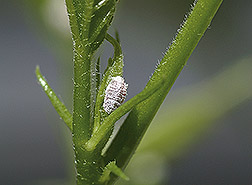 Pink Hibiscus MealybugMaconellicoccus hirsutus
-
 Cotton MealybugPhenacoccus solenopsis
Compare
Questions and answers
What is the scientific name of the Manna Scale-insect?
The scientific name of the Manna Scale-insect is Trabutina mannipara. Written with its author, the full name is Trabutina mannipara (Hemprich & Ehrenberg, 1829).
Which family does the Manna Scale-insect belong to?
Trabutina mannipara belongs to the family Pseudococcidae, in the order Hemiptera and the class Insecta.
Where is the Manna Scale-insect found?
Checklists and occurrence records place Trabutina mannipara in 19 countries, including Spain, Israel, Egypt, Italy, Pakistan and France.
What other names does the Manna Scale-insect have?
Trabutina mannipara is also known in English as Manna Mealybug and Manna Scale.
What is the tamarisk manna scale?
The Manna Scale-insect is Trabutina mannipara, an insect that lives and feeds parasitically on tamarisk trees. It produces sweet excretions that are associated with the biblical story of manna.[1][4][5][7]
Is scale a bug or fungus?
The Manna Scale-insect is an insect in the class Insecta, order Hemiptera and family Pseudococcidae.[8]
Sources
Passages the profile rests on
- The species lives parasitically on tamarisk trees. Source passage: “T. mannipara feeds parasitically on tamarisk trees” — English Wikipedia
- The species occurs in the Middle East and southern Europe. Source passage: “is a species of mealybug found in the Middle East and southern Europe.” — English Wikipedia
- The species is recorded from the Sinai and Iraq. Source passage: “This species can be found in the Sinai and Iraq.” — English Wikipedia
- The species feeds parasitically on tamarisk trees. Source passage: “T. mannipara feeds parasitically on tamarisk trees” — English Wikipedia
- The species is associated with the biblical story of manna because of its sweet excretions. Source passage: “due to its association with the biblical story of manna.” — English Wikipedia
- The species is considered a possible producer of the biblical manna described in historical accounts. Source passage: “the tamarisk manna scale, Trabutina mannipara, is thought to have produced the biblical manna” — britannica.com
- The species was described in 1829 by Hemprich and Ehrenberg under the name Coccus manniparus. Source passage: “It was described in 1829 by Hemprich and Ehrenberg (as Coccus manniparus)” — English Wikipedia
- Trabutina mannipara is the type species of the genus Trabutina. Source passage: “of which it is the type species” — English Wikipedia
- The species produces a sweet, sticky excretion containing a high proportion of sugar. Source passage: “In the case of mannipara, these excretions are high in sugar.” — English Wikipedia
- The species produces sweet excretions containing substantial amounts of undigested material. Source passage: “in its excretions is a great deal of undigested material.” — English Wikipedia
Data
- Catalogue of Life, 2026-10-16 XR cc by
- Global Biodiversity Information Facility CC BY 4.0
- Wikidata CC0
- GeoNames CC BY 4.0
- Within the Catalogue of Life, this name comes from Systematic Database of the Scale Insects of the World cc by
References
- Ehrenberg, 1829 where the name was published
- Kondo, T. & Gullan, P.J. (2022) Beneficial Scale Insects. In K.& Watson (Ed.). Encyclopedia of Scale Insect Pests. CABI, Wallingford, UK. 1–7 pp. [in English]
- Signoret, V. (1869) Essai sur les cochenilles ou gallinsectes (Homoptères - Coccides) 2e partie. [Essay on the gall forming insects (Homoptera - Coccidae) - 2nd Part.]. Annales de la Société Entomologique de France, 8.
- Danzig, E.M. & Miller, D.R. (1996) A systematic revision of the mealybug genus Trabutina (Homoptera: Coccoidea: Pseudococcidae). Israel Journal of Entomology, 30.
- Ben-Dov, Y. (2012) The scale insects (Hemiptera: Coccoidea) of Israel—checklist, host plants, zoogeographical considerations and annotations on species. Israel Journal of Entomology, 41–42.
- Blanchard, R. (1883) Les coccides utiles. [Useful coccids.]. Bulletin de la Société Zoologique de France, 8.
- Danzig, E.M. & Gavrilov-Zimin, I.A. (2015)
- Gavrilov-Zimin, I.A. (2016) New and earlier unnoted mealybugs and felt scale (Homoptera: Coccinea: Pseudococcidae, Eriococcidae) from Morocco. Annales de la Societe Entomologique de France (N.S.), 52(2). Link
- Ülgentürk, S., Ercan, C., Yaşar, B. & Kaydan, M.B. (2022) Checklist of Turkish Coccoidea (Hemiptera: Sternorryncha) Species. Trakya University Journal of Natural Sciences.
- Leonardi, G. (1920) In Monografia delle cocciniglie Italiane. Della Torre, Portici. 555 pp. [in Italian]
- Santiago, A., García-Saúco, G. & Ferrandis, P. (2022) Trabutina mannipara, una nueva amenaza para los tarayales del centro de la península ibérica. Propuestas de control biológico [Trabutina mannipara, a new threat to the tamarisks in the center of the Iberian Peninsula. Proposals for biological control]. Revista Foresta, 84.
- Borchsenius, N.S. (1941) [Species of the manna-producing scale insects (Trabutina, Coccidae, Hemiptera) from Central Asia.]. Izvestiya Kursov Prikladoni Zoologii i Fitopathologii. Leningrad, 12.
- Abd-Rabou, S. & Evans, G.A. (2021) An Annotated Checklist of the Scale Insects of Egypt (Hemiptera: Sternorrhyncha: Coccomorpha: Coccoidea)Coccoidea). Acta Phytopathologica et Entomologica Hungarica, 56(1).
- Batsankalashvili, M., Kaydan, M.B., Kirkitadze, G. & Japoshvili, G.O. (2017) Updated checklist of scale insects (Hemiptera: Coccomorpha) in Sakartvelo (Georgia). Annals of Agrarian Science, 15.
- Pellizzari, G., Chadzidimitriou, E., Milonas, P.G., Stathas, G.J. & Kozár, F. (2015) Check list and zoogeographic analysis of the scale insect fauna (Hemiptera: Coccomorpha) of Greece. Zootaxa, 4012(1).
- Giard, A. (1892) M. le Dr. A. Giard communique: [Dr. Giard communicates:]. M. le Dr. A. Giard communique: Annales de la Société Entomologique de France, 61.
- Abd-Rabou, S. (2001) Parasitoids attack mealybugs (Homoptera: Coccoidea: Pseudococcidae) in Egypt. Egyptian Journal of Agricultural Research, 79(4).
- Du, S., Wang, Y., Li, Y. & Cai, C. (2025) Phylogenomics resolves the evolution of Sternorrhyncha (Insecta: Hemiptera). Ecology and Evolution, 15. https://doi.org/10.1002/ece3.72636
- Tang, F.D. (1992) _. In [The Pseudococcidae of China.]. Chinese Agricultural Science Technology Press, Beijing, China. 768 pp. [in Chinese]
- Moghaddam, M. (2013) An annotated checklist of the scale insects of Iran (Hemiptera, Sternorrhyncha, Coccoidea) with new records and distribution data. ZooKeys, 334.
- Foldi, I. (2003) Les cochenilles de Corse (Hemiptera, Coccoidea). [The scale insects of Corsica (Hemiptera, Coccoidea).]. Bulletin de la Societe Entomologique de France, 108(2).
- Yasnosh, V.A. (2001) Observations on some mealybugs (Coccinea: Pseudococcidae) and their natural enemies on arborate plants in the Republic of Georgia. Entomologica, 33(1999).
- Hardy, N.B., Gullan, P.J. & Hodgson, C.J. (2008) A subfamily-level classification of mealybugs (Hemiptera: Pseudococcidae) based on integrated molecular and morphological data. Systematic Entomology, 33.
- Williams, D.J. (2004) In Mealybugs of Southern Asia. The Natural History Museum, Kuala Lumpur: Southdene SDN. BHD. 896 pp. [in English]
- Ben-Dov, Y. (1988) Manna scale, Trabutina mannipara (Hemprich & Ehrenberg) (Homoptera: Coccoidea: Pseudococcidae). Systematic Entomology, 13.
This species in other databases
Page built on 28 November 2026. See how the catalog is made and all sources and licences.
Cite this page
ScientificNames.org. (2026). Trabutina mannipara (Manna Scale-insect). Retrieved November 28, 2026, from https://scientificnames.org/species/trabutina-mannipara
“Trabutina mannipara (Manna Scale-insect).” ScientificNames.org, 2026, scientificnames.org/species/trabutina-mannipara. Accessed 28 Nov. 2026.
ScientificNames.org. “Trabutina mannipara (Manna Scale-insect).” Accessed November 28, 2026. https://scientificnames.org/species/trabutina-mannipara.
@misc{scientificnames_trabutina_mannipara_manna_scale_insect,
  author = {{ScientificNames.org}},
  title = {Trabutina mannipara (Manna Scale-insect)},
  year = {2026},
  url = {https://scientificnames.org/species/trabutina-mannipara},
  note = {Accessed 2026-11-28}
}