Species · Insects
Montane Ochre Trapezites phigalioides
The scientific name of the Montane Ochre is Trapezites phigalioides. It is a species of insect in the family Hesperiidae (skipper), order Lepidoptera. The name dates from 1903.
- Scientific name
- Trapezites phigalioides Waterhouse, 1903
- Common name
- Montane Ochre
- Genus
- Trapezites
- Family
- Hesperiidae (Skipper)
- Order
- Lepidoptera
- Class
- Insecta
- Recorded in
- 1 country
- Name status
- accepted in the Catalogue of Life

Overview
The Montane Ochre is the accepted scientific name Trapezites phigalioides Waterhouse, 1903. The species occurs primarily in open eucalypt forests, usually above 300 m altitude. Adults have brown upper surfaces, grey undersides and yellow or orange wing markings, including distinctive yellow spots and bands on the forewings.
Written 27 November 2026 from the sources listed below. Each statement was checked against the passage it cites; statements that could not be supported were removed.
Habitat
The Montane Ochre occurs primarily in open eucalypt forests and usually inhabits elevations above 300 m. In parts of New South Wales, it occurs in subalpine woodland at elevations reaching 1,400 m.[1][2][3]
The species is endemic to Australia, with a distribution that includes New South Wales, the Australian Capital Territory, Queensland and Victoria.[4][5]
Appearance
Adult butterflies have brown upper surfaces and grey undersides, with yellow or orange wing markings. Their wingspan is approximately 30 mm, and males and females have a similar appearance.[6][7][8]
Each forewing has three large yellow spots, a median yellow spot near the dorsum, a yellow streak along the dorsum and a subapical band of three pale yellow spots. Each hindwing has a large central band on its upper surface, while its underside has approximately 12 small brown circular markings.[9][10][11]
The eggs are dome-shaped and range in colour from white to cream. They measure approximately 1.3 mm in diameter and have up to 20 longitudinal ribs.[12][13][14]
Larvae are pinkish-brown or pinkish-grey with dark brown heads. They can reach 26 mm in length, depending on their instar.[15][16]
Pupae are brown with dark brown spots and are covered in a waxy grey powder. They measure approximately 20 mm in length.[17][18]
Diet
Adult butterflies feed readily at flowers.[19]
Larvae feed at night after emerging from their daytime shelters.[20][21]
Behaviour
Adults fly rapidly and close to the ground. Adult males engage in hilltopping and establish territories within one metre of the ground.[22][23][24]
After hatching, larvae construct vertical shelters from silk and debris at the base of their host plant. They rest in these shelters during the day and emerge to feed at night.[25][20][21]
Reproduction and life cycle
Females lay eggs individually on the undersides of leaves of the host plant wattle mat-rush (Lomandra filiformis). The species produces one generation each year.[26][27]
Pupation takes place inside the larval shelter, with the larva's head oriented upwards. Adults emerge primarily during November and December.[28][29]
Similar species
The Montane Ochre has a largely overlapping geographic range with the closely related heath ochre (Trapezites phigalia).[30]
Classification of the Montane Ochre
| Kingdom | Animalia |
|---|---|
| Phylum | Arthropoda |
| Subphylum | Hexapoda |
| Class | Insecta (Insect) |
| Order | Lepidoptera |
| Superfamily | Papilionoidea |
| Family | Hesperiidae (Skipper) |
| Subfamily | Trapezitinae |
| Genus | Trapezites (Ochres) |
| Species | Trapezites phigalioides Waterhouse, 1903 |
Where the Montane Ochre is found
Checklists and occurrence records place Trapezites phigalioides in 1 country. GBIF holds 936 georeferenced records of it.
Countries
Regions and cities with the most records
- Victoria, Australia 510
- New South Wales, Australia 209
- Australian Capital Territory, Australia 171
- Tuggeranong, Australia 98
- Canberra, Australia 47
- Queensland, Australia 29
- Ballarat, Australia 25
- Balwyn North, Australia 24
- Burwood, Australia 23
- Torquay, Australia 21
- Bacchus Marsh, Australia 9
- Wodonga, Australia 4
A number beside a place is its count of GBIF occurrence records. A place without a number comes from a checklist alone. Records show where a species has been observed or collected, which can include escapes and vagrants.
Common names
English
- Montane Ochre
Related species
-
 Splendid OchreTrapezites symmomus
- Southern Silver OchreTrapezites praxedes
-
 Eliena SkipperTrapezites eliena
-
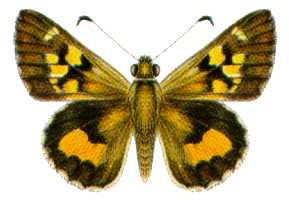 Heath OchreTrapezites phigalia
-
 Small Orange OchreTrapezites heteromacula
-
 Northern Silver OchreTrapezites maheta
-
 Brown OchreTrapezites iacchus
-
 Silver-studded OchreTrapezites iacchoides
Compare
Questions and answers
What is the scientific name of the Montane Ochre?
The scientific name of the Montane Ochre is Trapezites phigalioides. Written with its author, the full name is Trapezites phigalioides Waterhouse, 1903.
Which family does the Montane Ochre belong to?
Trapezites phigalioides belongs to the family Hesperiidae, in the order Lepidoptera and the class Insecta.
Where is the Montane Ochre found?
Checklists and occurrence records place Trapezites phigalioides in 1 country: Australia.
Sources
Passages the profile rests on
- The species occurs primarily in open eucalypt forests. Source passage: “It occurs primarily in open eucalypt forests” — English Wikipedia
- The species usually occurs above 300 m altitude. Source passage: “usually above 300 m (980 ft) altitude” — English Wikipedia
- In parts of New South Wales, the species occurs in subalpine woodland at elevations reaching 1,400 m. Source passage: “extending up to 1,400 m (4,600 ft) altitude in subalpine woodland habitat in parts of New South Wales.” — English Wikipedia
- The species is endemic to Australia. Source passage: “It is endemic to Australia” — English Wikipedia
- Its Australian distribution includes New South Wales, the Australian Capital Territory, Queensland and Victoria. Source passage: “where it occurs in New South Wales, Australian Capital Territory, Queensland and Victoria.” — English Wikipedia
- Adult butterflies have brown upper surfaces and grey undersides, with yellow or orange wing markings. Source passage: “Trapezites phigalioides adults are brown above and grey below with yellow or orange markings on the wings” — English Wikipedia
- Adults have a wingspan of approximately 30 mm. Source passage: “a wingspan of approximately 30 mm (1.2 in).” — English Wikipedia
- Adult males and females have a similar appearance. Source passage: “Adult males and females appear similar.” — English Wikipedia
- Each forewing has three large yellow spots, a median yellow spot near the dorsum, a yellow streak along the dorsum and a subapical band of three pale yellow spots. Source passage: “the forewings each exhibit three large yellow spots, a median yellow spot near the dorsum, a yellow dorsum streak, and a subapical band consisting of three pale yellow spots” — English Wikipedia
- Each hindwing has a large central band on its upper surface. Source passage: “the hindwings each exhibit a single large band near the center of the hindwing.” — English Wikipedia
- The underside of each hindwing has approximately 12 small brown circular markings. Source passage: “the hingwings exhibit roughly 12 small brown circular markings.” — English Wikipedia
- The eggs are dome-shaped and range in colour from white to cream. Source passage: “Eggs are dome shaped, white to cream in colour” — English Wikipedia
- Eggs measure approximately 1.3 mm in diameter. Source passage: “measuring approximately 1.3 mm (0.051 in) in diameter” — English Wikipedia
- The eggs have up to 20 longitudinal ribs. Source passage: “with up to 20 longitudinal ribs.” — English Wikipedia
- Larvae are pinkish-brown or pinkish-grey and have dark brown heads. Source passage: “Larvae are pinkish-brown or pinkish-grey with a dark brown head” — English Wikipedia
- Larvae can reach 26 mm in length, depending on their instar. Source passage: “measuring up to 26 mm (1.0 in) in length depending on instar.” — English Wikipedia
- Pupae are brown with dark brown spots and are covered in a waxy grey powder. Source passage: “Pupae are brown with dark brown spots, covered with a waxy grey powder” — English Wikipedia
- Pupae measure approximately 20 mm in length. Source passage: “measuring approximately 20 mm (0.79 in) in length.” — English Wikipedia
- Adult butterflies feed readily at flowers. Source passage: “readily feeding at flowers.” — English Wikipedia
- Larvae rest in their shelters during the day and emerge to feed at night. Source passage: “resting in their shelter during the day and emerging to feed at night.” — English Wikipedia
- Larvae feed at night after emerging from their daytime shelters. Source passage: “emerging to feed at night.” — English Wikipedia
- Adults fly rapidly and close to the ground. Source passage: “Adults fly fast and close to the ground” — English Wikipedia
- Adult males engage in hilltopping. Source passage: “Adult males engage in hilltopping” — English Wikipedia
- Adult males establish territories within one metre of the ground. Source passage: “establish territories within a meter of the ground.” — English Wikipedia
- After hatching, larvae construct vertical shelters from silk and debris at the base of their host plant. Source passage: “the larvae construct a vertical shelter from silk and debris at the base of the host plant” — English Wikipedia
- Females lay eggs individually on the undersides of leaves of the host plant wattle mat-rush (Lomandra filiformis). Source passage: “Adult females lay their eggs singly on the undersides of the leaves of the species' host plant, the wattle mat-rush (Lomandra filiformis).” — English Wikipedia
- The species produces one generation each year. Source passage: “There is a single generation each year” — English Wikipedia
- Pupation takes place inside the larval shelter, with the larva's head oriented upwards. Source passage: “Pupation occurs inside the larval shelter, with the head of the larva oriented upwards.” — English Wikipedia
- Adults emerge primarily during November and December. Source passage: “with adults emerging primarily in November and December.” — English Wikipedia
- The species has a largely overlapping geographic range with the closely related heath ochre (Trapezites phigalia). Source passage: “The range of this species largely overlaps with the closely related heath ocre (Trapezites phigalia).” — English Wikipedia
Data
- Catalogue of Life, 2026-10-16 XR cc by
- Global Biodiversity Information Facility CC BY 4.0
- Wikidata CC0
- GeoNames CC BY 4.0
- Wikimedia Commons per image; credit shown with each image
- Within the Catalogue of Life, this name comes from Global Lepidoptera Index cc by
This species in other databases
Page built on 28 November 2026. See how the catalog is made and all sources and licences.
Cite this page
ScientificNames.org. (2026). Trapezites phigalioides (Montane Ochre). Retrieved November 28, 2026, from https://scientificnames.org/species/trapezites-phigalioides
“Trapezites phigalioides (Montane Ochre).” ScientificNames.org, 2026, scientificnames.org/species/trapezites-phigalioides. Accessed 28 Nov. 2026.
ScientificNames.org. “Trapezites phigalioides (Montane Ochre).” Accessed November 28, 2026. https://scientificnames.org/species/trapezites-phigalioides.
@misc{scientificnames_trapezites_phigalioides_montane_ochre,
  author = {{ScientificNames.org}},
  title = {Trapezites phigalioides (Montane Ochre)},
  year = {2026},
  url = {https://scientificnames.org/species/trapezites-phigalioides},
  note = {Accessed 2026-11-28}
}