Species · Fishes
Trichopodus cantoris
Trichopodus cantoris has no English name on record in the checklists used here. It is a species of fish in the family Osphronemidae (gourami), order Anabantiformes. The name dates from 1861.
- Scientific name
- Trichopodus cantoris (Günther, 1861)
- Genus
- Trichopodus
- Family
- Osphronemidae (Gourami)
- Order
- Anabantiformes
- Class
- Teleostei
- Environment
- freshwater
- Name status
- accepted in the Catalogue of Life
Overview
The species is considered likely to occur throughout the Malay Peninsula. It has two black body spots connected by a longitudinal zigzag band extending from the mouth through the eye to the caudal fin, which has white spots.
Written 27 November 2026 from the sources listed below. Each statement was checked against the passage it cites; statements that could not be supported were removed.
Appearance
The two black spots on the body are connected by a longitudinal zigzag band extending from the mouth through the eye to the caudal fin. The caudal fin has white spots.[1][2]
The body height is two-fifths or three-sevenths of the standard length.[3]
Habitat
The type specimen originated from Penang, Malaysia. The species is considered likely to occur throughout the Malay Peninsula.[4][5]
Similar species
Some authorities treat this taxon as a synonym of Trichopodus trichopterus.[6]
Classification of Trichopodus cantoris
| Kingdom | Animalia |
|---|---|
| Phylum | Chordata |
| Subphylum | Vertebrata |
| Infraphylum | Gnathostomata |
| Parvphylum | Osteichthyes |
| Gigaclass | Actinopterygii |
| Superclass | Actinopteri |
| Class | Teleostei (Teleost) |
| Order | Anabantiformes |
| Suborder | Anabantoidei |
| Family | Osphronemidae (Gourami) |
| Subfamily | Trichogastrinae |
| Genus | Trichopodus |
| Species | Trichopodus cantoris (Günther, 1861) |
Synonyms
One other scientific name has been used for this species and is now treated as a synonym of Trichopodus cantoris.
- Osphromenus trichopterus cantoris Günther, 1861
Related species
-
 Three Spot GouramiTrichopodus trichopterus
-
 Pearl GouramiTrichopodus leerii
- False-eye GouramiTrichopodus poptae
- Snake-skin GouramiTrichopodus pectoralis
-
 Moonlight GouramiTrichopodus microlepis
-
 Siamese Fighting FishBetta splendens
-
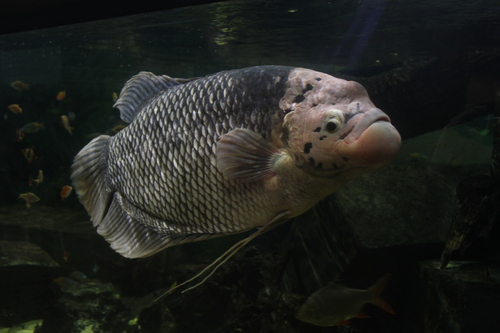 Giant GouramiOsphronemus goramy
-
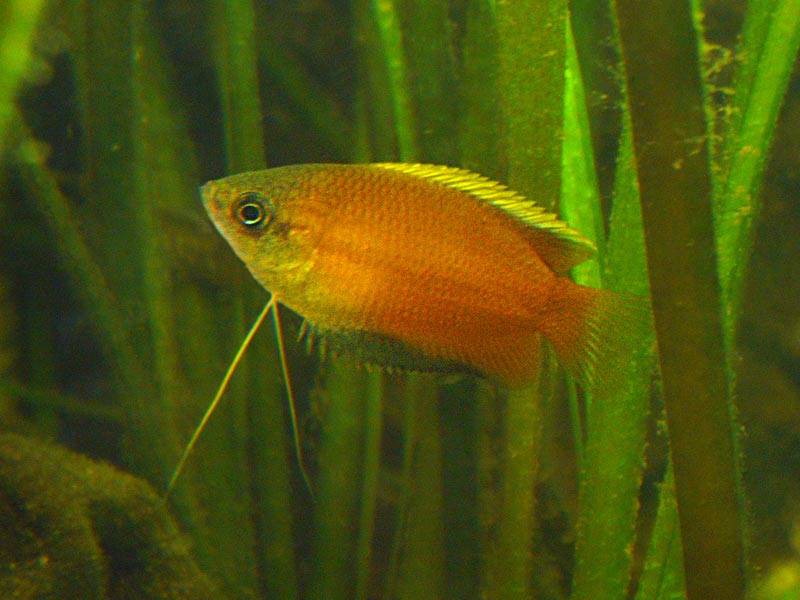 Honey GouramiTrichogaster chuna
Compare
Sources
Passages the profile rests on
- The two black spots on the body are connected by a longitudinal zigzag band extending from the mouth through the eye to the caudal fin. Source passage: “The two black spots on the body of Trichopodus cantoris are united by a longitudinal zigzag band running from the mouth through the eye to the caudal fin.” — English Wikipedia
- The caudal fin has white spots. Source passage: “The caudal fin is white-spotted” — English Wikipedia
- The body height is two-fifths or three-sevenths of the standard length. Source passage: “the height of the body is two-fifths or three-sevenths of the SL.” — English Wikipedia
- The type specimen originated from Penang, Malaysia. Source passage: “The type specimen of Trichopodus cantoris came from Penang, Malaysia.” — English Wikipedia
- The species is considered likely to occur throughout the Malay Peninsula. Source passage: “The distribution of the species is likely to be throughout the Malay Peninsula.” — English Wikipedia
- Some authorities treat this taxon as a synonym of Trichopodus trichopterus. Source passage: “This taxon is treated as a synonym of Trichopodus trichopterus by some authorities.” — English Wikipedia
Data
- Catalogue of Life, 2026-10-16 XR cc by
- Wikidata CC0
- Within the Catalogue of Life, this name comes from World Register of Marine Species cc by
This species in other databases
Page built on 27 November 2026. See how the catalog is made and all sources and licences.
Cite this page
ScientificNames.org. (2026). Trichopodus cantoris. Retrieved November 27, 2026, from https://scientificnames.org/species/trichopodus-cantoris
“Trichopodus cantoris.” ScientificNames.org, 2026, scientificnames.org/species/trichopodus-cantoris. Accessed 27 Nov. 2026.
ScientificNames.org. “Trichopodus cantoris.” Accessed November 27, 2026. https://scientificnames.org/species/trichopodus-cantoris.
@misc{scientificnames_trichopodus_cantoris,
  author = {{ScientificNames.org}},
  title = {Trichopodus cantoris},
  year = {2026},
  url = {https://scientificnames.org/species/trichopodus-cantoris},
  note = {Accessed 2026-11-27}
}