Species · Fishes
Longspine Croaker Umbrina analis
The scientific name of the Longspine Croaker is Umbrina analis. It is a species of fish in the family Sciaenidae (drums), order Perciformes. The name dates from 1868.
- Scientific name
- Umbrina analis Günther, 1868
- Common name
- Longspine Croaker
- Genus
- Umbrina
- Family
- Sciaenidae (Drums)
- Order
- Perciformes
- Class
- Teleostei
- Red List category
- LC Least Concern
- Environment
- marine
- Recorded in
- 3 countries
- Name status
- accepted in the Catalogue of Life
Overview
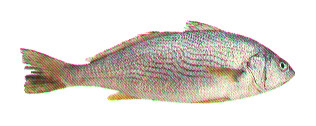
Umbrina analis is a demersal species that occurs in inshore waters, bays, and surfline environments. It is distinguished by a short, thick chin barbel and distinct, undulating, oblique dark lines along its scale rows.
Written 28 November 2026 from the sources listed below. Each statement was checked against the passage it cites; statements that could not be supported were removed.
Appearance
The longspine croaker has an oblong, moderately elongate, somewhat compressed body with an approximately horizontal lower profile. Its back is high and strongly curved at the front, while its head is low, broad, and conical.[1][2][3]
Its chin bears one short, thick, rigid barbel with a pore at its tip, accompanied by two pairs of pores beside the barbel's base. Its teeth occur in bands on both jaws, with the outer row on the upper jaw being larger.[4][5][6]
The species has 17 gill rakers, with a documented range of 16–18. Its preopercle is finely serrated.[7][8]
The dorsal fin has a deep notch and a formula of X + I, 24–26. Its dorsal-fin spines are slender, and the second dorsal fin has a long base.[9][10]
The anal fin is small and has two spines and six rays. Its second spine is thick and as long as the first ray.[11][12]
The pectoral fin has 17 rays, with a documented range of 16–18. The tail has a straight edge.[13][14]
Its scales are rough on the head and body but smooth on the fins. The soft dorsal and anal fins have scaly sheaths at their bases, and the lateral line has 46–50 scales.[15][16][17]
The body has distinct, undulating, oblique dark lines along the scale rows. The anal and pelvic fins are pale yellowish, and the inner lining of the gill cover is pale or lightly dotted.[18][19][20]
Habitat
The longspine croaker is demersal and occurs in inshore waters. It inhabits bays and surfline environments.[21][22]
Diet
The longspine croaker's recorded food categories include mobile benthic gastropods and bivalves. Its diet also includes mobile benthic crustaceans such as shrimps and crabs, and mobile benthic worms.[23][24][25]
Classification of the Longspine Croaker
| Kingdom | Animalia |
|---|---|
| Phylum | Chordata |
| Subphylum | Vertebrata |
| Infraphylum | Gnathostomata |
| Parvphylum | Osteichthyes |
| Gigaclass | Actinopterygii |
| Superclass | Actinopteri |
| Class | Teleostei (Teleost) |
| Order | Perciformes |
| Suborder | Percoidei |
| Family | Sciaenidae (Drums) |
| Genus | Umbrina (Croakers) |
| Species | Umbrina analis Günther, 1868 |
Where the Longspine Croaker is found
Checklists and occurrence records place Umbrina analis in 3 countries. GBIF holds 24 georeferenced records of it.
Countries
Regions and cities with the most records
A number beside a place is its count of GBIF occurrence records. A place without a number comes from a checklist alone. Records show where a species has been observed or collected, which can include escapes and vagrants.
Common names
English
- Longspine Croaker
- Longspine Drum
Names in 5 other languages
- Czech
- smuha dlouhotrnná
- Danish
- Langpigget trommefisk
- French
- Ombrine épineuse
- Portuguese
- Corvina-mexicana
- Spanish
- Verrugato espinoso, berrugata espinuda
Synonyms
One other scientific name has been used for this species and is now treated as a synonym of Umbrina analis.
- Umbrina tumacoensis Wilson, 1916
Related species
-
 Shi DrumUmbrina cirrosa
-
 Yellowfin CroakerUmbrina roncador
- Canary DrumUmbrina canariensis
-
 Fusca DrumUmbrina ronchus
- Umbrina reedi
-
 Sand DrumUmbrina coroides
-
 Surf CroakerUmbrina xanti
- Argentine CroakerUmbrina canosai
Compare
Questions and answers
What is the scientific name of the Longspine Croaker?
The scientific name of the Longspine Croaker is Umbrina analis. Written with its author, the full name is Umbrina analis Günther, 1868.
Which family does the Longspine Croaker belong to?
Umbrina analis belongs to the family Sciaenidae, in the order Perciformes and the class Teleostei.
Where is the Longspine Croaker found?
Checklists and occurrence records place Umbrina analis in 3 countries: Mexico, Colombia and Panama.
What is the conservation status of the Longspine Croaker?
The IUCN Red List category recorded for Umbrina analis is Least Concern (LC).
What other names does the Longspine Croaker have?
Umbrina analis is also known in English as Longspine Drum.
Sources
Passages the profile rests on
- The species has an oblong, moderately elongate, somewhat compressed body with an approximately horizontal lower profile. Source passage: “Body oblong, moderately elongate, somewhat compressed, lower body profile ~ horizontal” — biogeodb.stri.si.edu
- The fish has a high back that is strongly curved at the front. Source passage: “back high, strongly curved at front” — biogeodb.stri.si.edu
- Its head is low, broad, and conical. Source passage: “head low, broad, conical” — biogeodb.stri.si.edu
- Its chin bears one short, thick, rigid barbel with a pore at its tip. Source passage: “chin with 1 short, thick rigid barbel with a pore at its tip” — biogeodb.stri.si.edu
- The fish has two pairs of pores beside the base of its chin barbel. Source passage: “2 pairs of pores beside its base” — biogeodb.stri.si.edu
- Its teeth occur in bands on both jaws, with the outer row on the upper jaw being larger. Source passage: “teeth in bands on each jaw, outer row on top jaw larger” — biogeodb.stri.si.edu
- The species has 17 gill rakers, with a documented range of 16–18. Source passage: “17 (16-18) gill rakers” — biogeodb.stri.si.edu
- Its preopercle is finely serrated. Source passage: “preopercle finely serrated” — biogeodb.stri.si.edu
- The dorsal fin has a deep notch and a formula of X + I, 24–26. Source passage: “dorsal fin with a deep notch, X + I, 24-26” — biogeodb.stri.si.edu
- The species has slender dorsal-fin spines and a second dorsal fin with a long base. Source passage: “spines slender, second dorsal long base” — biogeodb.stri.si.edu
- Its anal fin is small and has two spines and six rays. Source passage: “anal small, II, 6 rays” — biogeodb.stri.si.edu
- The second anal-fin spine is thick and as long as the first ray. Source passage: “2nd spine thick, as long as 1st ray” — biogeodb.stri.si.edu
- Its pectoral fin has 17 rays, with a documented range of 16–18. Source passage: “pectoral short, 17 (16-18) rays” — biogeodb.stri.si.edu
- The species has a tail with a straight edge. Source passage: “tail with straight edge” — biogeodb.stri.si.edu
- Its scales are rough on the head and body but smooth on the fins. Source passage: “scales rough on head and body, smooth on fins” — biogeodb.stri.si.edu
- The soft dorsal and anal fins have scaly sheaths at their bases. Source passage: “bases of soft dorsal and anal fins with scaly sheath” — biogeodb.stri.si.edu
- The lateral line has 46–50 scales. Source passage: “lateral line scales 46-50” — biogeodb.stri.si.edu
- Its body has distinct, undulating, oblique dark lines along the scale rows. Source passage: “body with distinct, undulating oblique dark lines along scale rows” — biogeodb.stri.si.edu
- The anal and pelvic fins are pale yellowish. Source passage: “anal and pelvics pale yellowish” — biogeodb.stri.si.edu
- The inner lining of its gill cover is pale or lightly dotted. Source passage: “inner lining of gill cover pale to lightly dotted” — biogeodb.stri.si.edu
- The species is demersal and occurs in inshore waters. Source passage: “Habitat: demersal, inshore, bays, surfline; sandy bottoms.” — biogeodb.stri.si.edu
- The species inhabits bays and surfline environments. Source passage: “inshore, bays, surfline” — biogeodb.stri.si.edu
- The species' recorded food categories include mobile benthic gastropods and bivalves. Source passage: “Mobile benthic gastropods/bivalves” — biogeodb.stri.si.edu
- The species' recorded food categories include mobile benthic crustaceans such as shrimps and crabs. Source passage: “Mobile benthic crustacea (shrimps/crabs)” — biogeodb.stri.si.edu
- The species' recorded food categories include mobile benthic worms. Source passage: “Mobile benthic worms” — biogeodb.stri.si.edu
Data
- Catalogue of Life, 2026-10-16 XR cc by
- Global Biodiversity Information Facility CC BY 4.0
- Wikidata CC0
- GeoNames CC BY 4.0
- Within the Catalogue of Life, this name comes from World Register of Marine Species cc by
References
- Günther, A. (1868). An account of the fishes of the states of Central America based on collections made by Capt. J. M. Dow, F. Godman, Esq., and O. Salvin, Esq. Transactions of the Zoological Society of London, v. 6 (pt 7, no. 14): 377–494, Pls. 63–87. https://doi.org/10.1111/j.1096-3642.1868.tb00582.x Link where the name was published
This species in other databases
- Catalogue of Life 7DGK9
- Wikidata Q965000
- iNaturalist 114749
- WoRMS urn:lsid:marinespecies.org:taxname:273793
- ITIS 646717
Page built on 29 November 2026. See how the catalog is made and all sources and licences.
Cite this page
ScientificNames.org. (2026). Umbrina analis (Longspine Croaker). Retrieved November 29, 2026, from https://scientificnames.org/species/umbrina-analis
“Umbrina analis (Longspine Croaker).” ScientificNames.org, 2026, scientificnames.org/species/umbrina-analis. Accessed 29 Nov. 2026.
ScientificNames.org. “Umbrina analis (Longspine Croaker).” Accessed November 29, 2026. https://scientificnames.org/species/umbrina-analis.
@misc{scientificnames_umbrina_analis_longspine_croaker,
  author = {{ScientificNames.org}},
  title = {Umbrina analis (Longspine Croaker)},
  year = {2026},
  url = {https://scientificnames.org/species/umbrina-analis},
  note = {Accessed 2026-11-29}
}