Species · Fishes
Fusca Drum Umbrina ronchus
The scientific name of the Fusca Drum is Umbrina ronchus. It is a species of fish in the family Sciaenidae (drums), order Perciformes. The name dates from 1843.
- Scientific name
- Umbrina ronchus Valenciennes, 1843
- Common name
- Fusca Drum
- Genus
- Umbrina
- Family
- Sciaenidae (Drums)
- Order
- Perciformes
- Class
- Teleostei
- Red List category
- DD Data Deficient
- Environment
- marine
- Recorded in
- 5 countries
- Name status
- accepted in the Catalogue of Life

Overview
Umbrina ronchus inhabits inshore waters near sandy beaches and shelters among rocks in coastal waters. It has an elongated body, a small underside mouth and a short, stiff chin barbel.
Written 27 November 2026 from the sources listed below. Each statement was checked against the passage it cites; statements that could not be supported were removed.
Appearance
The fusca drum has an elongated body of moderate depth. Its small mouth is positioned on the underside of its head and contains villiform teeth characteristic of the genus Umbrina.[1][2][3]
It has a short, stiff chin barbel with a pore at its tip. Its tail is generally truncate but can be slightly emarginate, and most of its scales are ctenoid.[4][5][6]
Its body is dark brown with faint diagonal linear markings along the scale rows. These markings become faded in larger individuals.[7][8]
Its fins are dusky except for the pelvic fins and the distal portion of the anal fin, which are black.[9]
Its maximum recorded standard length is 77 cm, while most individuals measure approximately 40 cm in standard length.[10][11]
Habitat
The fusca drum inhabits inshore waters near sandy beaches and shelters among rocks in coastal waters. Its reported depth range is 20–200 m.[12][13][14]
Juveniles are predominantly found close to the shore. The species is not normally found in estuaries, unlike other sciaenids.[15][16]
Diet
Its prey includes small decapod crustaceans and other benthic invertebrates.[17][18]
Behaviour
Juveniles generally remain close to shore.[19]
Conservation
FishBase reports a moderate vulnerability score of 36 out of 100. Its estimated minimum population doubling time is between 1.4 and 4.4 years.[20][21]
Uses
The fusca drum has minor commercial importance in fisheries and is normally marketed fresh.[22][23]
Similar species
South African specimens previously identified as Umbrina ronchus were concluded by researchers to represent a different taxon. Researchers proposed resurrecting Umbrina robinsoni as the name for this taxon occurring off South Africa and in the western Indian Ocean.[24][25]
Some specimens identified as Umbrina ronchus in tropical West African waters are considered more likely to belong to Umbrina steindachneri.[26]
Classification of the Fusca Drum
| Kingdom | Animalia |
|---|---|
| Phylum | Chordata |
| Subphylum | Vertebrata |
| Infraphylum | Gnathostomata |
| Parvphylum | Osteichthyes |
| Gigaclass | Actinopterygii |
| Superclass | Actinopteri |
| Class | Teleostei (Teleost) |
| Order | Perciformes |
| Suborder | Percoidei |
| Family | Sciaenidae (Drums) |
| Genus | Umbrina (Croakers) |
| Species | Umbrina ronchus Valenciennes, 1843 |
Where the Fusca Drum is found
Checklists and occurrence records place Umbrina ronchus in 5 countries. GBIF holds 292 georeferenced records of it.
Countries
Regions and cities with the most records
- Santa Lucía, Spain 20
- Agüimes, Spain 19
- Carrizal, Spain 19
- Ingenio, Spain 19
- San Bartolomé de Tirajana, Spain 19
- Telde, Spain 18
- Western Cape, South Africa 18
- Scottburgh, South Africa 15
- KwaZulu-Natal, South Africa 14
- eMkhomazi, South Africa 14
- Canary Islands, Spain 13
- eMuziwezinto, South Africa 13
- Durban, South Africa 8
- Kuils River, South Africa 7
- Ntuzuma, South Africa 7
- Somerset West, South Africa 6
- Maputo Province, Mozambique 5
- Groot-Brakrivier, South Africa 4
- Mogán, Spain 4
- Mossel Bay, South Africa 4
- Aljaraque, Spain 3
- Cartaya, Spain 3
- Eastern Cape, South Africa 3
- Huelva, Spain 3
- Maspalomas, Spain 3
- Moguer, Spain 3
- Playa del Ingles, Spain 3
- Stellenbosch, South Africa 3
1 more country has a few records outside this range
These countries hold a few records of Umbrina ronchus but lie outside the range the checklists give for it. Such records are often zoo or garden specimens, museum material or vagrants, so the species is not counted as occurring there.
A number beside a place is its count of GBIF occurrence records. A place without a number comes from a checklist alone. Records show where a species has been observed or collected, which can include escapes and vagrants.
Common names
English
- Fusca Drum
- Fusca Croaker
- Roncador
- Slender Baardman
- Slender Tasselfish
- Tassel-fish
- Tasselfish
Names in 9 other languages
- Asturian
- verruguete'l sable
- Czech
- smuha temná
- Finnish
- tummaevärummuttaja
- French
- Ombrine fusca
- Greek
- Fouskomylokopi
- Italian
- Umbrina di canali
- Portuguese
- Calafate-fosco, Corvina-africâner, Macujana fusca
- Russian
- Бурая умбрина
- Spanish
- Verrugato Fusco
Synonyms
8 other scientific names have been used for this species and are now treated as synonyms of Umbrina ronchus.
- Sciaena capensis (Pappe, 1853)
- Sciaena robinsoni (Gilchrist & Thompson, 1908)
- Sciaena ronchus (non Valenciennes, 1843) Jordan, 1886
- Umbrina angustilineata Gilchrist & Thompson, 1911
- Umbrina capensis Pappe, 1853
- Umbrina fusca Dardignac, 1958
- Umbrina robinsoni Gilchrist & Thompson, 1908
- Corvina ronchus (Valenciennes, 1843) ambiguous synonym
Related species
-
 Shi DrumUmbrina cirrosa
-
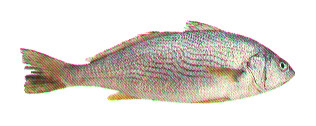 Yellowfin CroakerUmbrina roncador
- Canary DrumUmbrina canariensis
- Umbrina reedi
-
 Sand DrumUmbrina coroides
-
 Surf CroakerUmbrina xanti
- Argentine CroakerUmbrina canosai
- Longspine CroakerUmbrina analis
Compare
Questions and answers
What is the scientific name of the Fusca Drum?
The scientific name of the Fusca Drum is Umbrina ronchus. Written with its author, the full name is Umbrina ronchus Valenciennes, 1843.
Which family does the Fusca Drum belong to?
Umbrina ronchus belongs to the family Sciaenidae, in the order Perciformes and the class Teleostei.
Where is the Fusca Drum found?
Checklists and occurrence records place Umbrina ronchus in 5 countries: South Africa, Spain, Western Sahara, Mauritania and Senegal.
What is the conservation status of the Fusca Drum?
The IUCN Red List category recorded for Umbrina ronchus is Data Deficient (DD).
What other names does the Fusca Drum have?
Umbrina ronchus is also known in English as Fusca Croaker, Roncador, Slender Baardman, Slender Tasselfish, Tassel-fish and Tasselfish.
Where is the fusca drum distributed?
Its reported eastern Atlantic distribution extends from the western Mediterranean Sea and the Strait of Gibraltar southward to the Western Cape. The reported distribution also extends into the western Indian Ocean as far as the Persian Gulf. The Canary Islands are identified as its habitat location in the taxonomic discussion.[27][28][29]
Are there current records of the fusca drum from Namibia?
No current records of this species from Namibia are reported.[30]
How long does the fusca drum take to reach its median growth-study-based estimate?
A growth-study-based estimate gives a median value of 2.8 years using ln divided by the growth coefficient K.[31]
Sources
Passages the profile rests on
- Umbrina ronchus has an elongated body of moderate depth. Source passage: “Umbrina ronchus has a rather elongate and moderately deep body.” — English Wikipedia
- Its mouth is small and positioned on the underside of its head. Source passage: “The small mouth is positioned inferiorly” — English Wikipedia
- Its mouth contains villiform teeth characteristic of the genus Umbrina. Source passage: “contains the villiform teeth which are typical of the genus Umbrina” — English Wikipedia
- It has a short, stiff chin barbel with a pore at its tip. Source passage: “it has a short stiff barbell on its chin which has a pore on its tip.” — English Wikipedia
- Its tail is generally truncate but can be slightly emarginate. Source passage: “The tail is usually truncate but may be slightly emarginate.” — English Wikipedia
- Most of its scales are ctenoid. Source passage: “Its scales are mainly ctenoid.” — English Wikipedia
- Its body is dark brown with faint diagonal linear markings along the scale rows. Source passage: “They are dark brown in colour with faint diagonal linear markings along the scale rows” — English Wikipedia
- The diagonal markings on the scales become faded in larger individuals. Source passage: “in larger individuals these markings are faded.” — English Wikipedia
- Its fins are dusky except for the pelvic fins and the distal portion of the anal fin, which are black. Source passage: “The fins are dusky coloured except for the pelvic fins and the distal part of anal fin which are black.” — English Wikipedia
- Its maximum recorded standard length is 77 cm. Source passage: “They grow to 77 cm standard length” — English Wikipedia
- Most individuals measure approximately 40 cm in standard length. Source passage: “most are around 40 cm.” — English Wikipedia
- It inhabits inshore waters near sandy beaches. Source passage: “Umbrina ronchus is found in inshore waters off sandy beaches” — English Wikipedia
- It shelters among rocks in coastal waters. Source passage: “sheltering among rocks” — English Wikipedia
- Its reported depth range is 20–200 m. Source passage: “from 20 to 200 m depth.” — English Wikipedia
- Juveniles are predominantly found close to the shore. Source passage: “The juveniles are mainly found in close to the shore” — English Wikipedia
- It is not normally found in estuaries, unlike other sciaenids. Source passage: “but unlike other sciaenids they are not normally found in estuaries.” — English Wikipedia
- Its prey includes small decapod crustaceans. Source passage: “Its prey is small decapods” — English Wikipedia
- It consumes other benthic invertebrates. Source passage: “other benthic invertebrates.” — English Wikipedia
- Juveniles generally remain close to shore. Source passage: “The juveniles are mainly found in close to the shore” — English Wikipedia
- Its estimated minimum population doubling time is between 1.4 and 4.4 years. Source passage: “Medium, minimum population doubling time 1.4 - 4.4 years (K=0.3).” — fishbase.se
- FishBase reports a moderate vulnerability score of 36 out of 100. Source passage: “Moderate vulnerability (36 of 100).” — fishbase.se
- The species has minor commercial importance in fisheries. Source passage: “Umbrina ronchus is of minor commercial importance” — English Wikipedia
- It is normally marketed fresh. Source passage: “is normally sold fresh.” — English Wikipedia
- South African specimens previously identified as Umbrina ronchus were concluded by researchers to represent a different taxon. Source passage: “The researchers concluded that the South African specimens represented a different taxon” — English Wikipedia
- Researchers proposed resurrecting Umbrina robinsoni as the name for the different taxon occurring off South Africa and in the western Indian Ocean. Source passage: “they suggested resurrecting Umbrina robinsoni as the name for this taxon as the form occurring off South Africa and in the western Indian Ocean.” — English Wikipedia
- Some specimens identified as Umbrina ronchus in tropical West African waters are considered more likely to belong to Umbrina steindachneri. Source passage: “specimens identified as this species are considered more likely to be Steindachner's drum Umbrina steindachneri.” — English Wikipedia
- Its reported eastern Atlantic distribution extends from the western Mediterranean Sea and the Strait of Gibraltar southward to the Western Cape. Source passage: “Umbrina ronchus occurs in the eastern Atlantic Ocean from the western Mediterranean Sea and the Straits of Gibraltar south to the Western Cape” — English Wikipedia
- The reported distribution in the source also extends into the western Indian Ocean as far as the Persian Gulf. Source passage: “and into the western Indian Ocean to the Persian Gulf.” — English Wikipedia
- The Canary Islands are identified as the habitat location for this species in the taxonomic discussion. Source passage: “The habitat location for Umbrina ronchus is the Canary Islands” — English Wikipedia
- The source reports no current records of this species from Namibia. Source passage: “There are no current records from Namibia.” — English Wikipedia
- A growth-study-based estimate gives a median value of 2.8 years using ln(3) divided by the growth coefficient K. Source passage: “2.8 ( na - na) years. Estimated as median ln(3)/K based on 1 growth studies.” — fishbase.se
Data
- Catalogue of Life, 2026-10-16 XR cc by
- Global Biodiversity Information Facility CC BY 4.0
- Wikidata CC0
- GeoNames CC BY 4.0
- Wikimedia Commons per image; credit shown with each image
- Within the Catalogue of Life, this name comes from World Register of Marine Species cc by
References
- Valenciennes, A. (1837). Ichthyologie des îles Canaries, ou histoire naturelle des poissons rapportés par Webb & Berthelot. In: P. B. Webb & S. Berthelot. Histoire Naturelle Des Îles Canaries. Paris., v. 2 (pt 2): 1–109, 26 pls. where the name was published
This species in other databases
- Catalogue of Life 7DGD4
- Wikidata Q951195
- iNaturalist 321550
- WoRMS urn:lsid:marinespecies.org:taxname:127013
- ITIS 169305
Page built on 27 November 2026. See how the catalog is made and all sources and licences.
Cite this page
ScientificNames.org. (2026). Umbrina ronchus (Fusca Drum). Retrieved November 27, 2026, from https://scientificnames.org/species/umbrina-ronchus
“Umbrina ronchus (Fusca Drum).” ScientificNames.org, 2026, scientificnames.org/species/umbrina-ronchus. Accessed 27 Nov. 2026.
ScientificNames.org. “Umbrina ronchus (Fusca Drum).” Accessed November 27, 2026. https://scientificnames.org/species/umbrina-ronchus.
@misc{scientificnames_umbrina_ronchus_fusca_drum,
  author = {{ScientificNames.org}},
  title = {Umbrina ronchus (Fusca Drum)},
  year = {2026},
  url = {https://scientificnames.org/species/umbrina-ronchus},
  note = {Accessed 2026-11-27}
}