Species · Fishes
Bigeye Croaker Umbrina bussingi
The scientific name of the Bigeye Croaker is Umbrina bussingi. It is a species of fish in the family Sciaenidae (drums), order Perciformes. The name dates from 1980.
- Scientific name
- Umbrina bussingi López S., 1980
- Common name
- Bigeye Croaker
- Genus
- Umbrina
- Family
- Sciaenidae (Drums)
- Order
- Perciformes
- Class
- Teleostei
- Red List category
- LC Least Concern
- Environment
- marine
- Recorded in
- 3 countries
- Name status
- accepted in the Catalogue of Life
Overview
Umbrina bussingi occurs from the mouth of the Gulf of California southward to Colombia and is endemic to the Tropical Eastern Pacific. It has a short, thick chin barbel, a uniformly dark silver-grey body, dusky fins, and a black mouth and gill chamber.
Written 28 November 2026 from the sources listed below. Each statement was checked against the passage it cites; statements that could not be supported were removed.
Appearance
The bigeye croaker has a moderately elongate, somewhat compressed, oval body with convex dorsal and ventral profiles. It has a high back and a low, broad, conical head.[1][2]
Its chin bears one short, thick, rigid barbel with a pore at its tip and two pairs of pores beside its base. Its teeth occur in bands on both jaws, with the outer row on the upper jaw being larger.[3][4]
Its dorsal fin has a deep notch and a formula of ten spines followed by one spine and 22 soft rays, with the ray count ranging from 21 to 23. Its anal fin is small and has two spines and seven rays, with the second spine thick and almost as long as the first ray.[5][6]
Its pectoral fins are long, pointed, and longer than its pelvic fins. Its tail is S-shaped or has an angular point.[7][8]
Its scales are rough on the head and body but smooth on the fins. The bases of its soft dorsal and anal fins have scaly sheaths, and its lateral line has 45–49 scales.[9][10][11]
Its body is uniformly dark silver-grey and its fins are dusky. The inside of its mouth and gill chamber is black.[12][13]
The species has 20 gill rakers, with a recorded range of 17–22. Its preopercle is finely serrated.[14][15]
Habitat
The bigeye croaker is associated with near-bottom and bottom habitats. Its recorded soft-bottom habitats include mud, sand, gravel, beaches, estuaries, mangroves, and seagrass.[16][17]
Diet
The bigeye croaker feeds on mobile benthic worms, gastropods, and bivalves. Its recorded prey also include mobile benthic crustaceans such as shrimps and crabs.[18][19][20]
Classification of the Bigeye Croaker
| Kingdom | Animalia |
|---|---|
| Phylum | Chordata |
| Subphylum | Vertebrata |
| Infraphylum | Gnathostomata |
| Parvphylum | Osteichthyes |
| Gigaclass | Actinopterygii |
| Superclass | Actinopteri |
| Class | Teleostei (Teleost) |
| Order | Perciformes |
| Suborder | Percoidei |
| Family | Sciaenidae (Drums) |
| Genus | Umbrina (Croakers) |
| Species | Umbrina bussingi López S., 1980 |
Where the Bigeye Croaker is found
Checklists and occurrence records place Umbrina bussingi in 3 countries. GBIF holds 37 georeferenced records of it.
Countries
Regions and cities with the most records
- Mezcales, Mexico 5
- Puerto Vallarta, Mexico 5
- Bucerías, Mexico 4
- Ixtapa, Mexico 4
- San José del Valle, Mexico 3
A number beside a place is its count of GBIF occurrence records. A place without a number comes from a checklist alone. Records show where a species has been observed or collected, which can include escapes and vagrants.
Common names
English
- Bigeye Croaker
- Bussing's Drum
Names in 4 other languages
- Czech
- smuha Bussingova
- French
- Ombrine de Bussing
- Portuguese
- Corvina-da-Baja-Califórnia
- Spanish
- Verrugato prieto, berrugata ojona
Related species
-
 Shi DrumUmbrina cirrosa
-
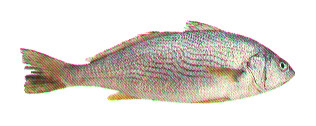 Yellowfin CroakerUmbrina roncador
- Canary DrumUmbrina canariensis
-
 Fusca DrumUmbrina ronchus
- Umbrina reedi
-
 Sand DrumUmbrina coroides
-
 Surf CroakerUmbrina xanti
- Argentine CroakerUmbrina canosai
Compare
Questions and answers
What is the scientific name of the Bigeye Croaker?
The scientific name of the Bigeye Croaker is Umbrina bussingi. Written with its author, the full name is Umbrina bussingi López S., 1980.
Which family does the Bigeye Croaker belong to?
Umbrina bussingi belongs to the family Sciaenidae, in the order Perciformes and the class Teleostei.
Where is the Bigeye Croaker found?
Checklists and occurrence records place Umbrina bussingi in 3 countries: Mexico, Panama and Costa Rica.
What is the conservation status of the Bigeye Croaker?
The IUCN Red List category recorded for Umbrina bussingi is Least Concern (LC).
What other names does the Bigeye Croaker have?
Umbrina bussingi is also known in English as Bussing's Drum.
Sources
Passages the profile rests on
- The species has a moderately elongate, somewhat compressed, oval body with convex dorsal and ventral profiles. Source passage: “Body moderately elongate, somewhat compressed, oval, both profiles convex” — biogeodb.stri.si.edu
- The fish has a high back and a low, broad, conical head. Source passage: “back high; head low, broad, conical” — biogeodb.stri.si.edu
- Its chin bears one short, thick, rigid barbel with a pore at its tip and two pairs of pores beside its base. Source passage: “chin with 1 short, thick rigid barbel with a pore at its tip, and 2 pairs of pores beside its base” — biogeodb.stri.si.edu
- Its teeth occur in bands on both jaws, with the outer row on the upper jaw being larger. Source passage: “teeth in bands on each jaw, outer row on top jaw larger” — biogeodb.stri.si.edu
- Its dorsal fin has a deep notch and a formula of ten spines followed by one spine and 22 soft rays, with the ray count ranging from 21 to 23. Source passage: “dorsal fin with a deep notch, X + I, 22 (21-23)” — biogeodb.stri.si.edu
- Its anal fin is small and has two spines and seven rays, with the second spine thick and almost as long as the first ray. Source passage: “anal small, II, 7 rays, 2nd spine thick, almost as long as 1st ray” — biogeodb.stri.si.edu
- Its pectoral fins are long, pointed, and longer than its pelvic fins. Source passage: “pectorals long, pointed, longer than pelvics” — biogeodb.stri.si.edu
- Its tail is S-shaped or has an angular point. Source passage: “tail S shaped or with angular point” — biogeodb.stri.si.edu
- Its scales are rough on the head and body but smooth on the fins. Source passage: “scales rough on head and body, smooth on fins” — biogeodb.stri.si.edu
- The bases of its soft dorsal and anal fins have scaly sheaths. Source passage: “bases of soft dorsal and anal fins with scaly sheath” — biogeodb.stri.si.edu
- Its lateral line has 45–49 scales. Source passage: “lateral line scales 45-49” — biogeodb.stri.si.edu
- Its body is uniformly dark silver-grey and its fins are dusky. Source passage: “Body uniform dark silver grey, fins dusky” — biogeodb.stri.si.edu
- The inside of its mouth and gill chamber is black. Source passage: “inside mouth and gill chamber black” — biogeodb.stri.si.edu
- The species has 20 gill rakers, with a recorded range of 17–22. Source passage: “20 (17-22) gill rakers” — biogeodb.stri.si.edu
- Its preopercle is finely serrated. Source passage: “preopercle finely serrated” — biogeodb.stri.si.edu
- The species is associated with near-bottom and bottom habitats. Source passage: “Near Bottom Bottom Bottom + water column” — biogeodb.stri.si.edu
- Its recorded soft-bottom habitats include mud, sand, gravel, beaches, estuaries, mangroves, and seagrass. Source passage: “Soft bottom (mud/sand/gravel/beach/estuary/mangrove/seagrass)” — biogeodb.stri.si.edu
- Its recorded prey include mobile benthic worms. Source passage: “Mobile benthic worms” — biogeodb.stri.si.edu
- Its recorded prey include mobile benthic gastropods and bivalves. Source passage: “Mobile benthic gastropods/bivalves” — biogeodb.stri.si.edu
- Its recorded prey include mobile benthic crustaceans such as shrimps and crabs. Source passage: “Mobile benthic crustacea (shrimps/crabs)” — biogeodb.stri.si.edu
Data
- Catalogue of Life, 2026-10-16 XR cc by
- Global Biodiversity Information Facility CC BY 4.0
- Wikidata CC0
- GeoNames CC BY 4.0
- Within the Catalogue of Life, this name comes from World Register of Marine Species cc by
References
- López S., M. I. (1980). Umbrina bussingi, a new sciaenid fish from the tropical eastern Pacific Ocean. Revista de Biología Tropical, 28 (1): 203–208. where the name was published
This species in other databases
- Catalogue of Life 7DGKP
- Wikidata Q1921149
- iNaturalist 114751
- WoRMS urn:lsid:marinespecies.org:taxname:273795
- ITIS 646718
Page built on 29 November 2026. See how the catalog is made and all sources and licences.
Cite this page
ScientificNames.org. (2026). Umbrina bussingi (Bigeye Croaker). Retrieved November 29, 2026, from https://scientificnames.org/species/umbrina-bussingi
“Umbrina bussingi (Bigeye Croaker).” ScientificNames.org, 2026, scientificnames.org/species/umbrina-bussingi. Accessed 29 Nov. 2026.
ScientificNames.org. “Umbrina bussingi (Bigeye Croaker).” Accessed November 29, 2026. https://scientificnames.org/species/umbrina-bussingi.
@misc{scientificnames_umbrina_bussingi_bigeye_croaker,
  author = {{ScientificNames.org}},
  title = {Umbrina bussingi (Bigeye Croaker)},
  year = {2026},
  url = {https://scientificnames.org/species/umbrina-bussingi},
  note = {Accessed 2026-11-29}
}