Species · Fishes
Blue-lined Goatfish Upeneichthys lineatus
The scientific name of the Blue-lined Goatfish is Upeneichthys lineatus. It is a species of fish in the family Mullidae (goatfish), order Mulliformes. The name dates from 1801.
- Scientific name
- Upeneichthys lineatus (Bloch & Schneider, 1801)
- Common name
- Blue-lined Goatfish
- Genus
- Upeneichthys
- Family
- Mullidae (Goatfish)
- Order
- Mulliformes
- Class
- Teleostei
- Red List category
- LC Least Concern
- Environment
- marine
- Recorded in
- 2 countries
- Name status
- accepted in the Catalogue of Life

Overview
Upeneichthys lineatus inhabits temperate seas off eastern and southeastern Australia, from around Fraser Island in Queensland to Tasmania and west to Lakes Entrance in Victoria. It is distinguished by blue and gold facial lines, yellow flank lines, blue spots and a mid-lateral stripe, and can rapidly change its body pattern.
Written 27 November 2026 from the sources listed below. Each statement was checked against the passage it cites; statements that could not be supported were removed.
Uses
The Blue-lined goatfish is commercially important.[1]
Appearance
The Blue-lined goatfish has a small mouth with fleshy lips and a single row of conical teeth on each jaw. It has two fleshy barbels on its chin.[2][3]
Its colour varies from pale cream to deep red, with blue and gold facial lines, yellow lines and blue spots along its flanks and tail. It has a distinct mid-lateral stripe and yellow stripes on its dorsal and anal fins.[4][5]
Its dorsal fins have nine spines and eight rays, while its anal fins have one spine and six rays.[6]
The species can rapidly change its body pattern from plain buff or white to a dark red and white vertically banded pattern.[7]
Habitat
The Blue-lined goatfish inhabits sheltered areas over rocky and sandy substrates, including sandy bottoms in sheltered bays and harbours. Its habitat also includes smooth bottoms and substrates covered with rocks and shells.[8][9][10]
It forages over the seabed at depths of 5–200 metres.[11]
Diet
The Blue-lined goatfish eats small molluscs, crustaceans, echinoderms and fishes. It also consumes larger soft-bodied animals resembling polychaetes.[12][13]
Behaviour
The Blue-lined goatfish uses its sensory barbels to probe sediment for prey. Individuals frequently forage over the seabed in small schools.[14][15]
The species rapidly changes from a white horizontally banded pattern to a more conspicuous vertically banded red pattern, often while foraging. Individuals are significantly more likely to adopt a dark red colour pattern while actively feeding during the day.[16][17]
Its shovelling feeding action involves burying its snout in the substrate while angling its body more than 30 degrees relative to the substrate.[18]
Conspecifics are more abundant around black- and red-banded models than around white models. They are also more likely to forage around model goatfish than to pass them or show attraction.[19][20]
There was no difference in the abundance or behaviour of associated heterospecifics around models displaying different colours. Some associated species spent more time around red- and black-banded models than around other models.[21][22]
The species' colour and pattern are likely to function as signalling tools.[23]
Reproduction and life cycle
The Blue-lined goatfish has separate sexes and external fertilisation. Spawning occurs above the seabed, and both eggs and larvae are pelagic.[24][25][26]
Classification of the Blue-lined Goatfish
| Kingdom | Animalia |
|---|---|
| Phylum | Chordata |
| Subphylum | Vertebrata |
| Infraphylum | Gnathostomata |
| Parvphylum | Osteichthyes |
| Gigaclass | Actinopterygii |
| Superclass | Actinopteri |
| Class | Teleostei (Teleost) |
| Order | Mulliformes |
| Family | Mullidae (Goatfish) |
| Genus | Upeneichthys |
| Species | Upeneichthys lineatus (Bloch & Schneider, 1801) |
Where the Blue-lined Goatfish is found
Checklists and occurrence records place Upeneichthys lineatus in 2 countries. GBIF holds 6,165 georeferenced records of it.
Countries
Regions and cities with the most records
- Sydney, Australia 1,483
- New South Wales, Australia 815
- Newcastle, Australia 145
- Batemans Bay, Australia 140
- Central Coast, Australia 121
- Hornsby, Australia 90
- Frankston East, Australia 54
- Wollongong, Australia 47
- Lower Hutt, New Zealand 36
- Porirua, New Zealand 33
- Wellington, New Zealand 30
- Karori, New Zealand 29
- Wainuiomata, New Zealand 29
- Whangarei, New Zealand 23
- Geelong, Australia 21
- Melbourne, Australia 20
- Burwood, Australia 19
- Auckland, New Zealand 18
- Albany, Australia 16
- Northland, New Zealand 16
- Remuera, New Zealand 13
- Coffs Harbour, Australia 12
- Victoria, Australia 12
- Western Australia, Australia 12
- Auckland, New Zealand 11
- St Albans, Australia 10
- Balwyn North, Australia 9
- Mount Eden, New Zealand 9
- South Australia, Australia 7
- Upper Hutt, New Zealand 6
- Kwinana, Australia 5
- Paraparaumu, New Zealand 5
- Tauranga, New Zealand 5
- Queensland, Australia 4
- Rockingham, Australia 4
- Tasmania, Australia 4
A number beside a place is its count of GBIF occurrence records. A place without a number comes from a checklist alone. Records show where a species has been observed or collected, which can include escapes and vagrants.
Common names
English
- Blue-lined Goatfish
- Blue-spotted Goat-fish
- Blue-spotted Goatfish
- Blue-striped Goatfish
- Blue-striped Mullet
- Blue-striped Red Mullet
- Bluestriped Goatfish
- Goatfish
- Red Mullet
- Bluespotted Goatfish
Names in 7 other languages
- Chinese
- 蓝点似绯鲤
- Danish
- Blåstribet mulle
- German
- Blaustreifen-Meerbarbe
- Italian
- Triglia a linee blu
- Māori
- Rarahi, Āhuruhuru
- Portuguese
- Trilha-escarlate
- Russian
- Австралийская барабуля
Synonyms
5 other scientific names have been used for this species and are now treated as synonyms of Upeneichthys lineatus.
- Atahua clarki Phillipps, 1941
- Mullus surmuletus lineatus Bloch & Schneider, 1801
- Mullus surmuletus var. lineatus Bloch & Schneider, 1801
- Upeneichthys porosus (Cuvier, 1829)
- Upeneus porosus Cuvier, 1829
Related species
-
 Southern GoatfishUpeneichthys vlamingii
- Stott's GoatfishUpeneichthys stotti
-
 Striped Red MulletMullus surmuletus
-
 Red MulletMullus barbatus
-
 Yellow GoatfishMulloidichthys martinicus
-
 Manybar GoatfishParupeneus multifasciatus
-
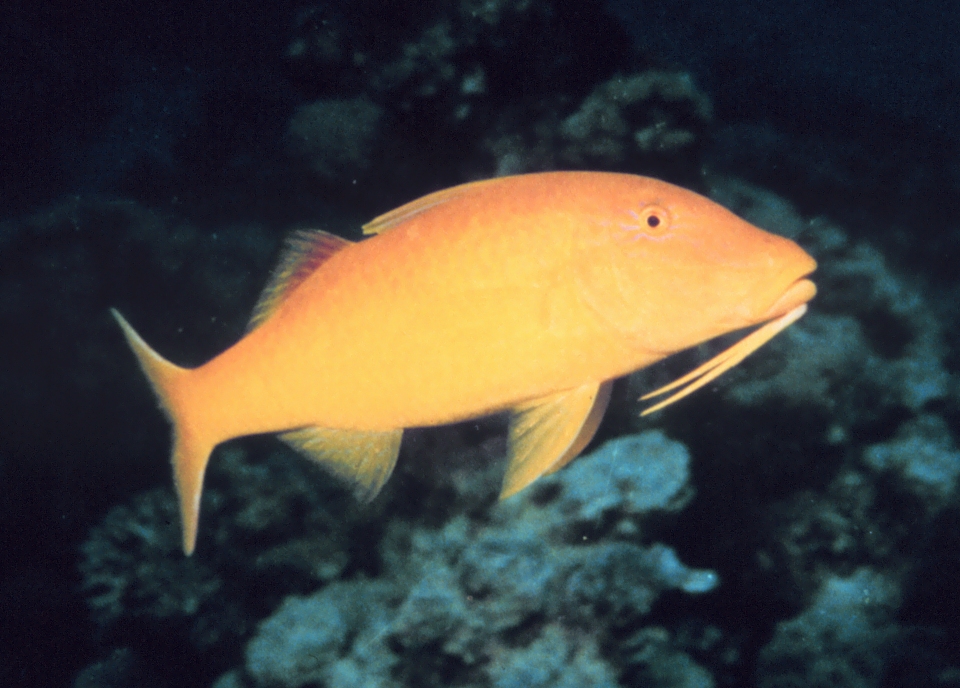 Goldsaddle GoatfishParupeneus cyclostomus
-
 Yellowstripe GoatfishMulloidichthys flavolineatus
Compare
Questions and answers
What is the scientific name of the Blue-lined Goatfish?
The scientific name of the Blue-lined Goatfish is Upeneichthys lineatus. Written with its author, the full name is Upeneichthys lineatus (Bloch & Schneider, 1801).
Which family does the Blue-lined Goatfish belong to?
Upeneichthys lineatus belongs to the family Mullidae, in the order Mulliformes and the class Teleostei.
Where is the Blue-lined Goatfish found?
Checklists and occurrence records place Upeneichthys lineatus in 2 countries: Australia and New Zealand.
What is the conservation status of the Blue-lined Goatfish?
The IUCN Red List category recorded for Upeneichthys lineatus is Least Concern (LC).
What other names does the Blue-lined Goatfish have?
Upeneichthys lineatus is also known in English as Blue-spotted Goat-fish, Blue-spotted Goatfish, Blue-striped Goatfish, Blue-striped Mullet, Blue-striped Red Mullet and Bluestriped Goatfish.
Sources
Passages the profile rests on
- The species is commercially important. Source passage: “This species is commercially important.” — English Wikipedia
- The species has a small mouth with fleshy lips and a single row of conical teeth on each jaw. Source passage: “Upeneichthys lineatus has a small, fleshy-lipped mouth with each jaw armed with a single row of conical teeth.” — English Wikipedia
- The species has two fleshy barbels on its chin. Source passage: “Like the other members of the family Mullidae it has two fleshy barbels on its chin.” — English Wikipedia
- Its colour varies from pale cream to deep red, with blue and gold facial lines and yellow lines and blue spots along its flanks and tail. Source passage: “They are highly variable in colour, which ranges from pale cream to deep red, normally with blue and gold lines on the face and thin yellow lines and blue dots along the flanks and tail.” — English Wikipedia
- The species has a distinct mid-lateral stripe and yellow stripes on its dorsal and anal fins. Source passage: “They have a distinct mid-lateral stripe, and yellow stripes on the dorsal and anal fins.” — English Wikipedia
- Its dorsal fins have nine spines and eight rays, while its anal fins have one spine and six rays. Source passage: “They have 9 spines and 8 rays in their dorsal fins and a single spine and 6 rays in their anal fins.” — English Wikipedia
- The species can rapidly change its body pattern from plain buff or white to a dark red and white vertically banded pattern. Source passage: “U. lineatus can rapidly modify its colouration and body pattern from plain buff/white to a prominent dark red and white vertically banded pattern in less than ten seconds” — pmc.ncbi.nlm.nih.gov
- The species inhabits sheltered areas over rocky and sandy substrates. Source passage: “It occurs in sheltered areas over rocky and sandy substrates” — English Wikipedia
- The species occurs over sandy bottoms in sheltered bays and harbours. Source passage: “Upeneichthys lineatus is found over sandy bottoms in sheltered waters such as in bays and harbours” — English Wikipedia
- Its habitat includes smooth bottoms and substrates covered with rocks and shells. Source passage: “They will live over varying substrates ranging from smooth bottoms, to rock and shell adorned bottoms.” — English Wikipedia
- The species forages over the seabed at depths of 5–200 metres. Source passage: “They frequently forage over the seabed in small schools, at depths of 5–200 metres (16–656 ft).” — English Wikipedia
- Its prey includes small molluscs, crustaceans, echinoderms and fishes. Source passage: “their prey is small molluscs, crustaceans, echinoderms and fishes” — English Wikipedia
- The species also consumes larger soft-bodied animals resembling polychaetes. Source passage: “also larger soft-bodied animals similar to polychaetes.” — English Wikipedia
- The species uses its sensory barbels to probe sediment for prey. Source passage: “where they use their sensory barbels to probe the sediment for prey.” — English Wikipedia
- Individuals frequently forage over the seabed in small schools. Source passage: “They frequently forage over the seabed in small schools” — English Wikipedia
- The species rapidly changes from a white horizontally banded pattern to a more conspicuous vertically banded red pattern, often while foraging. Source passage: “Bluelined goatfish (Upeneichthys lineatus) rapidly change their body colour from a white horizontally banded pattern to a seemingly more conspicuous vertically banded red pattern, often when foraging.” — pmc.ncbi.nlm.nih.gov
- Individuals are significantly more likely to adopt a dark red colour pattern while actively feeding during the day. Source passage: “during the day they are significantly more likely to shift colour and adopt a dark red pattern when actively feeding” — pmc.ncbi.nlm.nih.gov
- The species uses a shovelling feeding action in which its snout is buried in the substrate and its body is angled more than 30 degrees relative to the substrate. Source passage: “U. lineatus feed in a similar fashion to other goatfish using a shovelling action where their snout is buried in the substrate with their body angled more than 30 degrees relative to the substrate” — pmc.ncbi.nlm.nih.gov
- Conspecifics are more abundant around black- and red-banded models than around white models. Source passage: “We found that conspecifics were more abundant around the black- and red-banded model fish when compared with the white models.” — pmc.ncbi.nlm.nih.gov
- Conspecifics are more likely to forage around model goatfish than to pass them or show attraction. Source passage: “Conspecifics were also more likely to forage around the models than to pass or show attraction” — pmc.ncbi.nlm.nih.gov
- The study found no difference in the abundance or behaviour of associated heterospecifics around models displaying different colours. Source passage: “No difference in the abundance and behaviour of associated heterospecifics around the different models was observed” — pmc.ncbi.nlm.nih.gov
- Some associated species spent more time around red- and black-banded models than around other models. Source passage: “Some species did, however, spend more time around the red- and black-banded fish” — pmc.ncbi.nlm.nih.gov
- The species' colour and pattern are likely to function as signalling tools. Source passage: “Overall, the results suggest that the body colour/pattern of U. lineatus is likely a signalling tool” — pmc.ncbi.nlm.nih.gov
- The species has separate sexes. Source passage: “They have separate sexes” — English Wikipedia
- Fertilisation is external. Source passage: “fertilisation is external” — English Wikipedia
- Spawning occurs above the seabed, and both eggs and larvae are pelagic. Source passage: “spawning occurring above the bottom and both the eggs and larvae are pelagic.” — English Wikipedia
- The species can reach a maximum recorded length of 40 centimetres fork length. Source passage: “This species can reach a length of 40 centimetres (16 in) FL.” — English Wikipedia
- The species may attain a length of 31 centimetres. Source passage: “They may attain a length of 31 centimetres (12 in)” — English Wikipedia
Data
- Catalogue of Life, 2026-10-16 XR cc by
- Global Biodiversity Information Facility CC BY 4.0
- Wikidata CC0
- GeoNames CC BY 4.0
- Wikimedia Commons per image; credit shown with each image
- Within the Catalogue of Life, this name comes from World Register of Marine Species cc by
This species in other databases
- Catalogue of Life 7DLSW
- Wikidata Q2483226
- iNaturalist 410544
- WoRMS urn:lsid:marinespecies.org:taxname:283081
- ITIS 169463
Page built on 28 November 2026. See how the catalog is made and all sources and licences.
Cite this page
ScientificNames.org. (2026). Upeneichthys lineatus (Blue-lined Goatfish). Retrieved November 28, 2026, from https://scientificnames.org/species/upeneichthys-lineatus
“Upeneichthys lineatus (Blue-lined Goatfish).” ScientificNames.org, 2026, scientificnames.org/species/upeneichthys-lineatus. Accessed 28 Nov. 2026.
ScientificNames.org. “Upeneichthys lineatus (Blue-lined Goatfish).” Accessed November 28, 2026. https://scientificnames.org/species/upeneichthys-lineatus.
@misc{scientificnames_upeneichthys_lineatus_blue_lined_goatfish,
  author = {{ScientificNames.org}},
  title = {Upeneichthys lineatus (Blue-lined Goatfish)},
  year = {2026},
  url = {https://scientificnames.org/species/upeneichthys-lineatus},
  note = {Accessed 2026-11-28}
}