Species · Fishes
Southern Goatfish Upeneichthys vlamingii
The scientific name of the Southern Goatfish is Upeneichthys vlamingii. It is a species of fish in the family Mullidae (goatfish), order Mulliformes. The name dates from 1829.
- Scientific name
- Upeneichthys vlamingii (Cuvier, 1829)
- Common name
- Southern Goatfish
- Genus
- Upeneichthys
- Family
- Mullidae (Goatfish)
- Order
- Mulliformes
- Class
- Teleostei
- Environment
- marine
- Recorded in
- 1 country
- Name status
- accepted in the Catalogue of Life

Overview
Upeneichthys vlamingii inhabits bays, estuaries and sheltered coastal waters, normally over sandy and rubble substrates near reefs. Adults have blue spots on their body scales, and many individuals have a reddish or black stripe along their flanks.
Written 27 November 2026 from the sources listed below. Each statement was checked against the passage it cites; statements that could not be supported were removed.
Appearance
The Southern Goatfish has a moderately long, laterally compressed body with a rounded dorsal profile that rises steeply ahead of the first dorsal fin. Its snout is long, its eyes and mouth are small, and its fleshy lips do not extend to the front of the eye.[1][2]
It has two dorsal fins, with the first shorter-based and taller than the second. Its chin barbels are approximately as long as its head.[3][4]
Its background coloration ranges from greyish-cream and pale greenish to pinkish and orange-red. Many individuals have a reddish or black stripe extending along their flanks from the snout to the caudal peduncle, and adults have blue spots marking their body scales.[5][6][7]
The first dorsal fin has nine spines, and the second dorsal fin has eight rays. The anal fin has one or two spines and eight rays.[8][9][10]
Habitat
The Southern Goatfish inhabits bays, estuaries and sheltered coastal waters. It normally occupies sandy and rubble substrates near reefs and occurs at depths ranging from 2 to 200 metres.[11][12][13]
It occurs along the southern Australian coast from southern Western Australia eastward to Tasmania. Its distribution extends north along Australia's east coast to southern New South Wales.[14][15]
Diet
The Southern Goatfish feeds mainly on crustaceans, supplemented by some polychaete worms and a few small fish. It searches the substrate for prey using its chin barbels.[16][17]
Behaviour
The Southern Goatfish often darkens to a reddish coloration at night or when stimulated. Juveniles frequently gather in schools in sheltered bays.[18][19]
Conservation
The Southern Goatfish can be very common within its southern Australian coastal range.[20]
Uses
The Southern Goatfish is mostly caught as bycatch. It is valued as a food fish in South Australia.[21][22]
Similar species
The Southern Goatfish can be difficult to distinguish from the blue-striped goatfish (Upeneus lineatus). Compared with that species, it has a slightly longer head and a dark flank stripe.[23][24]
Classification of the Southern Goatfish
| Kingdom | Animalia |
|---|---|
| Phylum | Chordata |
| Subphylum | Vertebrata |
| Infraphylum | Gnathostomata |
| Parvphylum | Osteichthyes |
| Gigaclass | Actinopterygii |
| Superclass | Actinopteri |
| Class | Teleostei (Teleost) |
| Order | Mulliformes |
| Family | Mullidae (Goatfish) |
| Genus | Upeneichthys |
| Species | Upeneichthys vlamingii (Cuvier, 1829) |
Where the Southern Goatfish is found
Checklists and occurrence records place Upeneichthys vlamingii in 1 country. GBIF holds 5,558 georeferenced records of it.
Countries
Regions and cities with the most records
- Adelaide, Australia 215
- Burwood, Australia 210
- Melbourne, Australia 181
- South Australia, Australia 181
- Balwyn North, Australia 165
- Victoria, Australia 155
- Kwinana, Australia 110
- Rockingham, Australia 95
- Western Australia, Australia 92
- Perth, Australia 78
- Frankston East, Australia 76
- Albany, Australia 62
- Busselton, Australia 59
- Sydney, Australia 59
- Tasmania, Australia 58
- New South Wales, Australia 34
- Adelaide Hills, Australia 32
- St Albans, Australia 24
- Hobart, Australia 17
- Bunbury, Australia 9
- Whyalla, Australia 9
- Torquay, Australia 8
- Bairnsdale, Australia 4
- Burnie, Australia 3
- Geelong, Australia 3
A number beside a place is its count of GBIF occurrence records. A place without a number comes from a checklist alone. Records show where a species has been observed or collected, which can include escapes and vagrants.
Common names
English
- Southern Goatfish
- Black-striped Goatfish
- Blue-spotted Goatfish
- Blue-striped Red Mullet
- Bluespotted Goatfish
- Red Mullet
- Southern Red Mullet
- Western Red Mullet
Names in 3 other languages
- Czech
- parmice Vlamingova
- Italian
- Triglia meridionale striscia nera
- Portuguese
- Trilha-de-Vlaming
Synonyms
3 other scientific names have been used for this species and are now treated as synonyms of Upeneichthys vlamingii.
- Upeneichthys flamingii (Cuvier, 1829)
- Upeneichthys lineatus vlamingii (Cuvier in Cuvier & Valenciennes, 1829)
- Upeneus vlamingii Cuvier, 1829
Related species
-
 Blue-lined GoatfishUpeneichthys lineatus
- Stott's GoatfishUpeneichthys stotti
-
 Striped Red MulletMullus surmuletus
-
 Red MulletMullus barbatus
-
 Yellow GoatfishMulloidichthys martinicus
-
 Manybar GoatfishParupeneus multifasciatus
-
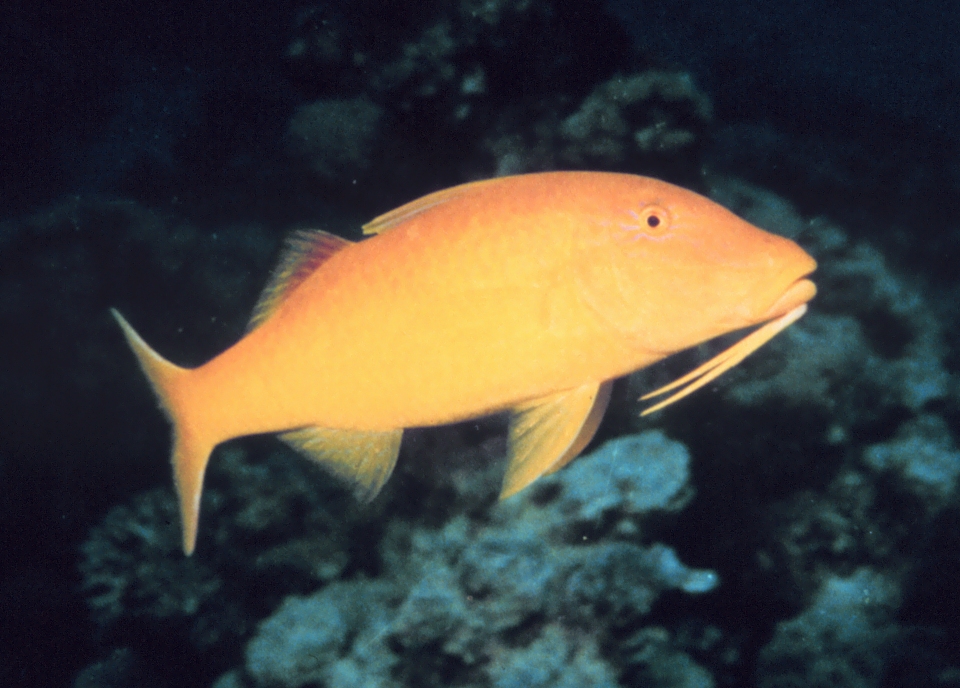 Goldsaddle GoatfishParupeneus cyclostomus
-
 Yellowstripe GoatfishMulloidichthys flavolineatus
Compare
Questions and answers
What is the scientific name of the Southern Goatfish?
The scientific name of the Southern Goatfish is Upeneichthys vlamingii. Written with its author, the full name is Upeneichthys vlamingii (Cuvier, 1829).
Which family does the Southern Goatfish belong to?
Upeneichthys vlamingii belongs to the family Mullidae, in the order Mulliformes and the class Teleostei.
Where is the Southern Goatfish found?
Checklists and occurrence records place Upeneichthys vlamingii in 1 country: Australia.
What other names does the Southern Goatfish have?
Upeneichthys vlamingii is also known in English as Black-striped Goatfish, Blue-spotted Goatfish, Blue-striped Red Mullet, Bluespotted Goatfish, Red Mullet and Southern Red Mullet.
What does red mullet eat?
The Southern Goatfish feeds mainly on crustaceans, supplemented by some polychaete worms and a few small fish.[16]
Can you describe the characteristics of mullet fish?
The Southern Goatfish has a moderately long, laterally compressed body, a long snout, small eyes and mouth, and chin barbels approximately as long as its head. Its coloration ranges from greyish-cream and pale greenish to pinkish and orange-red. Adults have blue spots on their body scales, and many individuals have a reddish or black flank stripe.[1][2][4][5][6][7]
Where do red mullets live?
The Southern Goatfish inhabits bays, estuaries and sheltered coastal waters, normally over sandy and rubble substrates near reefs. It occurs along the southern Australian coast from southern Western Australia eastward to Tasmania, with its distribution extending north along Australia's east coast to southern New South Wales.[12][13][14][15]
Sources
Passages the profile rests on
- The species has a moderately long, laterally compressed body with a rounded dorsal profile that rises steeply ahead of the first dorsal fin. Source passage: “Upeneichthys vlamingii has a moderately long and compressed body with a rounded dorsal profile which is steep in front of first dorsal fin.” — English Wikipedia
- Its snout is long, its eyes and mouth are small, and its fleshy lips do not extend to the front of the eye. Source passage: “It has a long snout and is small eyed with a small mouth which has fleshy lips which do not reach the front of the eye.” — English Wikipedia
- The species has two dorsal fins, with the first being shorter-based and taller than the second. Source passage: “It has two dorsal fins. The first is spiny and is taller and shorter base than the second which contains soft-rays.” — English Wikipedia
- Its chin barbels are approximately as long as its head. Source passage: “The barbels on its chin are roughly the same length as its head.” — English Wikipedia
- Its background coloration ranges from greyish-cream and pale greenish to pinkish and orange-red. Source passage: “The colour of this species is very variable with a background colour which may be greyish-cream, pale greenish, pinkish to orange-red.” — English Wikipedia
- Many individuals have a reddish or black stripe extending along their flanks from the snout to the caudal peduncle. Source passage: “Many specimens show a reddish or black stripe along the flanks from the snout to the caudal peduncle.” — English Wikipedia
- Adults have blue spots marking their body scales. Source passage: “The adults have the scales on their bodies marked with blue spots.” — English Wikipedia
- The species has nine spines on its first dorsal fin. Source passage: “The first dorsal fin has 9 spines” — English Wikipedia
- Its second dorsal fin has eight rays. Source passage: “the second dorsal fin has 8 rays” — English Wikipedia
- Its anal fin has one or two spines and eight rays. Source passage: “the anal fin has 1-2 spinesd and 8 rays.” — English Wikipedia
- The species occurs at depths ranging from 2 to 200 metres. Source passage: “in depths of 2–200 metres” — English Wikipedia
- The species inhabits bays, estuaries and sheltered coastal waters. Source passage: “Upeneichthys vlamingii occurs in bays, estuaries and sheltered coastal waters” — English Wikipedia
- It normally occupies sandy and rubble substrates near reefs. Source passage: “normally where there are sandy and rubble bottoms near reefs” — English Wikipedia
- The species occurs along the southern Australian coast from southern Western Australia eastward to Tasmania. Source passage: “Its range extends from southern Western Australia east along the southern Australian coast to Tasmania” — English Wikipedia
- Its distribution extends north along Australia's east coast to southern New South Wales. Source passage: “and north along the east coast as far as southern New South Wales.” — English Wikipedia
- The species feeds mainly on crustaceans, supplemented by some polychaete worms and a few small fish. Source passage: “which for U vlamingii is mainly crustaceans but also some polychaete worms and a few small fish.” — English Wikipedia
- The species searches the substrate for prey using its chin barbels. Source passage: “Like other goatfishes this species uses its barbels to search I the substrate for prey” — English Wikipedia
- The species often darkens to a reddish coloration at night or when stimulated. Source passage: “During the night and when stimulated, they often darken their body to a reddish colour.” — English Wikipedia
- Juveniles frequently gather in schools in sheltered bays. Source passage: “The juveniles frequently form schools in sheltered bays.” — English Wikipedia
- The species can be very common within its southern Australian coastal range. Source passage: “where it can be very common.” — English Wikipedia
- The species is mostly caught as bycatch. Source passage: “Upeneichthys vlamingii is mostly taken as bycatch” — English Wikipedia
- The species is valued as a food fish in South Australia. Source passage: “but is valued as a food fish in South Australia.” — English Wikipedia
- The species can be difficult to distinguish from the blue-striped goatfish (Upeneus lineatus). Source passage: “This species may be difficult to distinguish from the blue-striped goatfish (Upeneus lineatus)” — English Wikipedia
- Compared with the blue-striped goatfish, this species has a slightly longer head and a dark flank stripe. Source passage: “but this species has a marginally longer head a dark flank stripe.” — English Wikipedia
Data
- Catalogue of Life, 2026-10-16 XR cc by
- Global Biodiversity Information Facility CC BY 4.0
- Wikidata CC0
- GeoNames CC BY 4.0
- Wikimedia Commons per image; credit shown with each image
- Within the Catalogue of Life, this name comes from World Register of Marine Species cc by
References
- Cuvier and Valenciennes, 1829 where the name was published
This species in other databases
- Catalogue of Life 7DLSV
- Wikidata Q2698320
- iNaturalist 416588
- WoRMS urn:lsid:marinespecies.org:taxname:283083
- ITIS 620936
Page built on 29 November 2026. See how the catalog is made and all sources and licences.
Cite this page
ScientificNames.org. (2026). Upeneichthys vlamingii (Southern Goatfish). Retrieved November 29, 2026, from https://scientificnames.org/species/upeneichthys-vlamingii
“Upeneichthys vlamingii (Southern Goatfish).” ScientificNames.org, 2026, scientificnames.org/species/upeneichthys-vlamingii. Accessed 29 Nov. 2026.
ScientificNames.org. “Upeneichthys vlamingii (Southern Goatfish).” Accessed November 29, 2026. https://scientificnames.org/species/upeneichthys-vlamingii.
@misc{scientificnames_upeneichthys_vlamingii_southern_goatfish,
  author = {{ScientificNames.org}},
  title = {Upeneichthys vlamingii (Southern Goatfish)},
  year = {2026},
  url = {https://scientificnames.org/species/upeneichthys-vlamingii},
  note = {Accessed 2026-11-29}
}