Species · Flowering plants
Cape Bladderwort Utricularia bisquamata
The scientific name of the Cape Bladderwort is Utricularia bisquamata. It is a species of flowering plant in the family Lentibulariaceae (bladderwort family), order Lamiales.
- Scientific name
- Utricularia bisquamata Schrank
- Common name
- Cape Bladderwort
- Genus
- Utricularia
- Family
- Lentibulariaceae (Bladderwort Family)
- Order
- Lamiales
- Class
- Magnoliopsida
- Red List category
- LC Least Concern
- Recorded in
- 5 countries
- Name status
- accepted in the Catalogue of Life

Overview
Utricularia bisquamata is native to southern Africa and occurs in Angola, Namibia, South Africa, Eswatini, Lesotho and Madagascar. It has translucent traps in its roots and two-lipped flowers that are white, pale violet or occasionally yellow.
Written 26 November 2026 from the sources listed below. Each statement was checked against the passage it cites; statements that could not be supported were removed.
Appearance
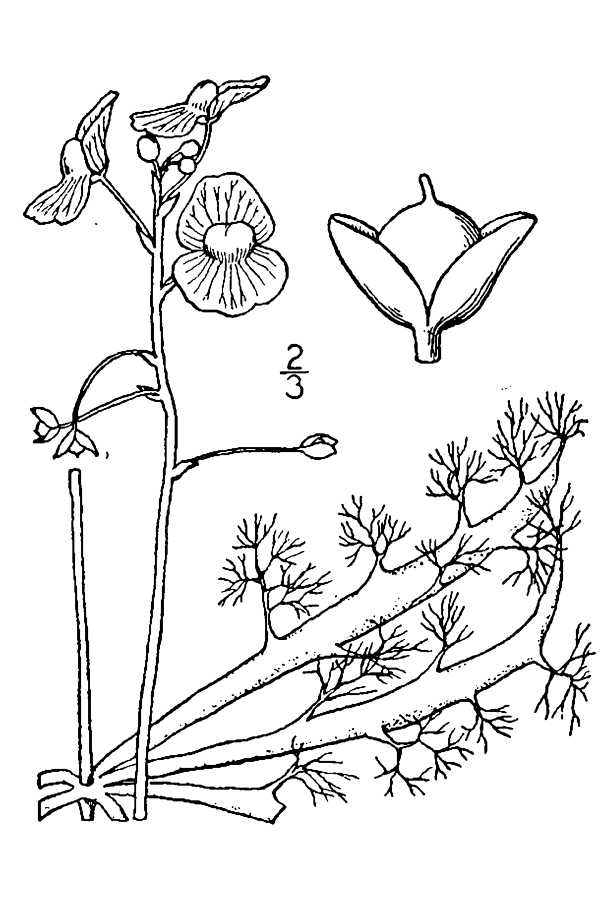
Cape Bladderwort has a rosette of narrow leaves and wiry flowering stems. It grows to approximately 12 cm in height.[1][2]
Its flowers have two lips and are white, pale violet or occasionally yellow. The upper lip has two or three lobes, while the lower lip has two short lateral lobes and a central lobe, with a yellow patch of variable size at its base.[3][4][5][6]
The plant develops translucent traps in its roots.[7]
Habitat
Cape Bladderwort grows terrestrially in damp, sandy or peaty soils among mosses near streams or in wet depressions. It typically inhabits acidic, boggy soils in sandstone areas and occurs among mosses in wet places.[8][9][10]
The species occurs as part of the fynbos plant community.[11]
In South Africa, it occurs at elevations ranging from near sea level to 1,200 metres. In Angola, it occurs at elevations reaching 2,250 metres.[12][13]
Reproduction and life cycle
Cape Bladderwort is an annual plant that germinates readily from seed.[14][15]
Uses
Cape Bladderwort is sometimes grown in cultivation.[16]
Classification of the Cape Bladderwort
| Kingdom | Plantae |
|---|---|
| Subkingdom | Pteridobiotina |
| Phylum | Tracheophyta |
| Class | Magnoliopsida |
| Order | Lamiales |
| Family | Lentibulariaceae (Bladderwort Family) |
| Subfamily | Utricularioideae |
| Genus | Utricularia (Bladderwort) |
| Species | Utricularia bisquamata Schrank |
Where the Cape Bladderwort is found
Checklists and occurrence records place Utricularia bisquamata in 5 countries across Africa. GBIF holds 1,198 georeferenced records of it.
Countries
Regions and cities with the most records
- Western Cape, South Africa 972
- Muizenberg, South Africa 129
- Retreat, South Africa 117
- Rondebosch, South Africa 113
- Cape Town, South Africa 112
- Grabouw, South Africa 100
- Franschhoek, South Africa 92
- Le Roux, South Africa 90
- Paarl, South Africa 82
- Wellington, South Africa 77
- Hermanus, South Africa 65
- Stellenbosch, South Africa 57
- Somerset West, South Africa 51
- Caledon, South Africa 35
- Bredasdorp, South Africa 31
- Northern Cape, South Africa 31
- George, South Africa 29
- Ceres, South Africa 23
- Eastern Cape, South Africa 19
- Swellendam, South Africa 19
- Gansbaai, South Africa 14
- Riversdale, South Africa 13
- Malmesbury, South Africa 9
- Groot-Brakrivier, South Africa 8
- Knysna, South Africa 8
- Kraaifontein, South Africa 8
- Worcester, South Africa 7
- Kuils River, South Africa 5
- Mossel Bay, South Africa 4
- Atlantis, South Africa 3
- Durbanville, South Africa 3
- Humansdorp, South Africa 3
- Jeffreys Bay, South Africa 3
- Kruisfontein, South Africa 3
- KwaZulu-Natal, South Africa 3
- Plettenberg Bay, South Africa 3
1 more country has a few records outside this range
These countries hold a few records of Utricularia bisquamata but lie outside the range the checklists give for it. Such records are often zoo or garden specimens, museum material or vagrants, so the species is not counted as occurring there.
Range as the checklists state it
Angola; Namibia; South Africa (Limpopo, Gauteng, Mpulamanga, KwaZulu-Natal, N-Cape Prov., W-Cape Prov., E-Cape Prov.); Lesotho; Madagascar
A number beside a place is its count of GBIF occurrence records. A place without a number comes from a checklist alone. Records show where a species has been observed or collected, which can include escapes and vagrants.
Common names
English
- Cape Bladderwort
- Weedy Bladderwort
Names in 3 other languages
- Afrikaans
- Blasieskruid, Fonteingesiggie
- Chinese
- 雙鱗片狸藻
- Malayalam
- യൂട്രിക്കുലേറിയ ബിസ്ക്വമാതാ
Synonyms
25 other scientific names have been used for this species and are now treated as synonyms of Utricularia bisquamata.
- Antirrhinum aphyllum L.f.
- Bucranion capemse (Spreng.) Raf.
- Bucranion capense (Spreng.) Raf.
- Bucranion spicatum Raf.
- Calpidisca capensis (Spreng.) Barnhart
- Linaria aphylla (L.fil.) Spreng.
- Linaria aphylla (L.f.) Chaz.
- Utricularia acicularis Sol. ex Stapf
- Utricularia brachyceras Schltr.
- Utricularia brachyceras Schltr. ex Stephens
- Utricularia capensis Spreng.
- Utricularia capensis var. brevicalcarata Oliv.
- Utricularia capensis var. elatior Kamieński
- Utricularia delicata Kamieński
- Utricularia ecklonii Spreng.
- Utricularia exilis var. ecklonii (Spreng.) Kamieński
- Utricularia exilis var. elatior Kamieński
- Utricularia exilis var. minor Kamieński
- Utricularia lehmannii Benj.
- Utricularia parkeri Baker
- Utricularia rehmannii Kamieński
- Utricularia schinzii Kamieński
- Utricularia sprengelii Kamieński
- Utricularia sprengelii var. acuticeras Kamieński
- Utricularia strumosa Sol. ex Stapf
Related species
-
 Sandersons BladderwortUtricularia sandersonii
-
 Greater BladderwortUtricularia vulgaris
-
 Floating BladderwortUtricularia gibba
-
 Fairy ApronsUtricularia dichotoma
-
 Lesser BladderwortUtricularia minor
-
 Swollen BladderwortUtricularia inflata
-
 Leaden BladderwortUtricularia livida
-
 American BladderwortUtricularia macrorhiza
Compare
Questions and answers
What is the scientific name of the Cape Bladderwort?
The scientific name of the Cape Bladderwort is Utricularia bisquamata. Written with its author, the full name is Utricularia bisquamata Schrank.
Which family does the Cape Bladderwort belong to?
Utricularia bisquamata belongs to the family Lentibulariaceae, in the order Lamiales and the class Magnoliopsida.
Where is the Cape Bladderwort found?
Checklists and occurrence records place Utricularia bisquamata in 5 countries: South Africa, Madagascar, Angola, Lesotho and Namibia.
What is the conservation status of the Cape Bladderwort?
The IUCN Red List category recorded for Utricularia bisquamata is Least Concern (LC).
What other names does the Cape Bladderwort have?
Utricularia bisquamata is also known in English as Weedy Bladderwort.
Sources
Passages the profile rests on
- Utricularia bisquamata has a rosette of narrow leaves and wiry flowering stems. Source passage: “It has a rosette of narrow leaves and wiry stems supporting racemes of flowers” — English Wikipedia
- Utricularia bisquamata grows to approximately 12 cm in height. Source passage: “growing to a height of about 12 cm (4.7 in).” — English Wikipedia
- Its flowers have two lips and are white, pale violet, or occasionally yellow. Source passage: “flowers with two lips, white, pale violet or occasionally yellow.” — English Wikipedia
- The upper flower lip has two or three lobes. Source passage: “The upper lip is small with two or three lobes” — English Wikipedia
- The lower flower lip has two short lateral lobes and a central lobe. Source passage: “the lower lip has two short lobes at the side and acentral lobe.” — English Wikipedia
- The lower flower lip has a yellow patch of variable size at its base. Source passage: “The base of the lower lip has a patch of yellow which is variable in size.” — English Wikipedia
- The plant develops translucent traps in its roots. Source passage: “The traps, translucent, are developed in the roots.” — English Wikipedia
- The species grows terrestrially in damp, sandy or peaty soils among mosses near streams or in wet depressions. Source passage: “damp, sandy or peaty soils among mosses by streams or wet depressions” — English Wikipedia
- The species typically inhabits acidic, boggy soils in sandstone areas. Source passage: “The typical habitat of this species is acidic, boggy soils in sandstone areas” — English Wikipedia
- The species grows among mosses in wet places. Source passage: “where it grows among mosses in wet places.” — English Wikipedia
- The species occurs as part of the fynbos plant community. Source passage: “and forms part of the fynbos community.” — English Wikipedia
- In South Africa, the species occurs at elevations ranging from near sea level to 1,200 metres. Source passage: “at altitudes from near sea level to 1,200 m (3,937 ft) in South Africa” — English Wikipedia
- In Angola, the species occurs at elevations reaching 2,250 metres. Source passage: “and up to 2,250 m (7,382 ft) in Angola.” — English Wikipedia
- Utricularia bisquamata is an annual plant. Source passage: “Utricularia bisquamata is a small annual carnivorous plant” — English Wikipedia
- The species germinates readily from seed. Source passage: “germinates freely from seed.” — English Wikipedia
- Utricularia bisquamata is sometimes grown in cultivation. Source passage: “U. bisquamata is sometimes found in cultivation” — English Wikipedia
Data
- Catalogue of Life, 2026-10-16 XR cc by
- Global Biodiversity Information Facility CC BY 4.0
- Wikidata CC0
- GeoNames CC BY 4.0
- Wikimedia Commons per image; credit shown with each image
- Within the Catalogue of Life, this name comes from Synonymic Checklists of the Vascular Plants of the World cc by
References
- Schrank. (1824). Flora 7(2. Beibl.): 9 (1824). where the name was published
This species in other databases
Page built on 29 November 2026. See how the catalog is made and all sources and licences.
Cite this page
ScientificNames.org. (2026). Utricularia bisquamata (Cape Bladderwort). Retrieved November 29, 2026, from https://scientificnames.org/species/utricularia-bisquamata
“Utricularia bisquamata (Cape Bladderwort).” ScientificNames.org, 2026, scientificnames.org/species/utricularia-bisquamata. Accessed 29 Nov. 2026.
ScientificNames.org. “Utricularia bisquamata (Cape Bladderwort).” Accessed November 29, 2026. https://scientificnames.org/species/utricularia-bisquamata.
@misc{scientificnames_utricularia_bisquamata_cape_bladderwort,
  author = {{ScientificNames.org}},
  title = {Utricularia bisquamata (Cape Bladderwort)},
  year = {2026},
  url = {https://scientificnames.org/species/utricularia-bisquamata},
  note = {Accessed 2026-11-29}
}