Species · Flowering plants
Fairy Aprons Utricularia dichotoma
The scientific name of the Fairy Aprons is Utricularia dichotoma. It is a species of flowering plant in the family Lentibulariaceae (bladderwort family), order Lamiales.
- Scientific name
- Utricularia dichotoma Labill.
- Common name
- Fairy Aprons
- Genus
- Utricularia
- Family
- Lentibulariaceae (Bladderwort Family)
- Order
- Lamiales
- Class
- Magnoliopsida
- Red List category
- LC Least Concern
- Recorded in
- 3 countries
- Name status
- accepted in the Catalogue of Life

Overview
Fairy aprons (Utricularia dichotoma Labill.) is a variable, perennial terrestrial bladderwort in the family Lentibulariaceae. The species is native to Australia, New Zealand, and New Caledonia. Its mauve or purple flowers frequently occur in pairs and have prominent white or yellow markings on the lower lip.
Written 26 November 2026 from the sources listed below. Each statement was checked against the passage it cites; statements that could not be supported were removed.
Appearance
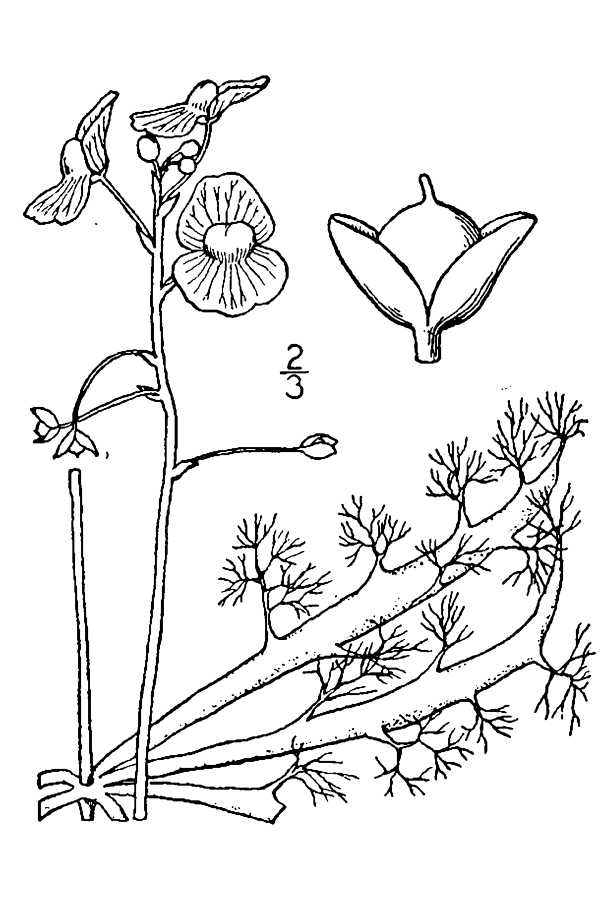
Leaves measure 2–4 mm long in typical wet-soil plants and can reach 40 mm in submerged plants. Flowering stems measure 5–50 cm in length.[1][2]
Flowers occur singly, in pairs, or in clusters of three or four near the ends of the stems. They are mauve or purple, with a small upper petal and a broader semicircular lower lip bearing two or three prominent white or yellow markings.[3][4][5][6]
The lower flower lip measures 1–2 cm wide, and the corolla measures 12–22 mm in length. The fruit is a globular capsule reaching a maximum width of 4 mm.[7][8][9][10]
Habitat
Fairy aprons grows in moist and wet locations. Plants growing in wet soil typically have shorter leaves than fully submerged plants.[11][12]
Reproduction and life cycle
Fairy aprons flowers between August and April.[13]
Classification of the Fairy Aprons
| Kingdom | Plantae |
|---|---|
| Subkingdom | Pteridobiotina |
| Phylum | Tracheophyta |
| Class | Magnoliopsida |
| Order | Lamiales |
| Family | Lentibulariaceae (Bladderwort Family) |
| Subfamily | Utricularioideae |
| Genus | Utricularia (Bladderwort) |
| Species | Utricularia dichotoma Labill. |
Where the Fairy Aprons is found
Checklists and occurrence records place Utricularia dichotoma in 3 countries across Oceania. GBIF holds 4,995 georeferenced records of it.
Countries
Regions and cities with the most records
- New South Wales, Australia 1,171
- Tasmania, Australia 1,063
- Victoria, Australia 1,003
- South Australia, Australia 279
- Queensland, Australia 213
- Canterbury, New Zealand 192
- Australian Capital Territory, Australia 144
- West Coast, New Zealand 128
- Tuggeranong, Australia 101
- Southland, New Zealand 85
- Manawatu-Wanganui, New Zealand 69
- Canberra, Australia 64
- Frankston East, Australia 61
- Waikato Region, New Zealand 42
- Otago, New Zealand 36
- Burwood, Australia 31
- Balwyn North, Australia 27
- Logan City, Australia 24
- Western Australia, Australia 24
- Melbourne, Australia 22
- Capalaba, Australia 21
- Armidale, Australia 20
- Parramatta, Australia 20
- Wangaratta, Australia 20
- Wollongong, Australia 19
- Adelaide, Australia 18
- Adelaide Hills, Australia 18
- Brisbane, Australia 18
- Christchurch, New Zealand 17
- Liverpool, Australia 16
- Auckland, New Zealand 15
- Rangiora, New Zealand 14
- Mount Barker, Australia 12
- Northland, New Zealand 12
- Narangba, Australia 10
- Central Coast, Australia 9
A number beside a place is its count of GBIF occurrence records. A place without a number comes from a checklist alone. Records show where a species has been observed or collected, which can include escapes and vagrants.
Common names
English
- Fairy Aprons
- Fairies' Aprons
Names in 2 other languages
- Chinese
- 雙岔狸藻
- Russian
- Пузырчатка вильчатая
Synonyms
One other scientific name has been used for this species and is now treated as a synonym of Utricularia dichotoma.
- Utricularia dichotoma var. typica Domin
Subspecies and varieties
- Utricularia dichotoma subsp. aquilonia subspecies
- Utricularia dichotoma subsp. dichotoma subspecies
- Utricularia dichotoma subsp. fontana subspecies
- Utricularia dichotoma subsp. maritima subspecies
- Utricularia dichotoma subsp. monanthos (Tasmanian Bladderwort) subspecies
- Utricularia dichotoma subsp. novae-angliae subspecies
- Utricularia dichotoma subsp. novae-zelandiae subspecies
- Utricularia dichotoma subsp. oxleyensis subspecies
Related species
-
 Sandersons BladderwortUtricularia sandersonii
-
 Greater BladderwortUtricularia vulgaris
-
 Floating BladderwortUtricularia gibba
-
 Lesser BladderwortUtricularia minor
-
 Swollen BladderwortUtricularia inflata
-
 Leaden BladderwortUtricularia livida
-
 Cape BladderwortUtricularia bisquamata
-
 American BladderwortUtricularia macrorhiza
Compare
Questions and answers
What is the scientific name of the Fairy Aprons?
The scientific name of the Fairy Aprons is Utricularia dichotoma. Written with its author, the full name is Utricularia dichotoma Labill..
Which family does the Fairy Aprons belong to?
Utricularia dichotoma belongs to the family Lentibulariaceae, in the order Lamiales and the class Magnoliopsida.
Where is the Fairy Aprons found?
Checklists and occurrence records place Utricularia dichotoma in 3 countries: Australia, New Zealand and New Caledonia.
What is the conservation status of the Fairy Aprons?
The IUCN Red List category recorded for Utricularia dichotoma is Least Concern (LC).
What other names does the Fairy Aprons have?
Utricularia dichotoma is also known in English as Fairies' Aprons.
Sources
Passages the profile rests on
- Its leaves measure 2–4 mm long in typical wet-soil plants and can reach 40 mm in submerged plants. Source passage: “leaves 2–4 mm (0.08–0.16 in) long and up to 40 mm (1.6 in) long.” — English Wikipedia
- Its flowering stems measure 5–50 cm in length. Source passage: “stem 5–50 cm (2.0–19.7 in) long” — English Wikipedia
- Its flowers occur singly, in pairs, or in clusters of three or four near the ends of the stems. Source passage: “they are solitary, paired or in whorls of three or four in clusters near the end of the stem.” — English Wikipedia
- Its flowers are mauve or purple. Source passage: “They are mauve or purple” — English Wikipedia
- Its flowers have a small upper petal and a broader semicircular lower lip. Source passage: “a small upper petal and a broader, semicircular lower lip” — English Wikipedia
- Its lower flower lip has two or three prominent white or yellow markings. Source passage: “with two or three prominent white or yellow markings” — English Wikipedia
- Its lower flower lip measures 1–2 cm wide. Source passage: “lower lip 1–2 cm (0.4–0.8 in) wide” — English Wikipedia
- Its corolla measures 12–22 mm in length. Source passage: “the corolla is 12–22 mm (0.5–0.9 in) long.” — English Wikipedia
- Its fruit is a globular capsule. Source passage: “the fruit is a globular capsule” — English Wikipedia
- Its fruit capsule reaches a maximum width of 4 mm. Source passage: “capsule up to 4 mm (0.16 in) wide.” — English Wikipedia
- The species grows in moist and wet locations. Source passage: “It grows in moist and wet locations.” — English Wikipedia
- Plants growing in wet soil typically have shorter leaves than fully submerged plants. Source passage: “The former is more typical of plants growing in wet soil, the latter of plants growing fully submerged.” — English Wikipedia
- The species flowers between August and April. Source passage: “Flowering occurs from August to April” — English Wikipedia
Data
- Catalogue of Life, 2026-10-16 XR cc by
- Global Biodiversity Information Facility CC BY 4.0
- Wikidata CC0
- GeoNames CC BY 4.0
- Wikimedia Commons per image; credit shown with each image
- Within the Catalogue of Life, this name comes from Synonymic Checklists of the Vascular Plants of the World cc by
References
- Labill. where the name was published
This species in other databases
- Catalogue of Life 7F5JQ
- Wikidata Q7903041
- iNaturalist 123241
- World Flora Online wfo-0001072776
- GRIN 495943
Page built on 28 November 2026. See how the catalog is made and all sources and licences.
Cite this page
ScientificNames.org. (2026). Utricularia dichotoma (Fairy Aprons). Retrieved November 28, 2026, from https://scientificnames.org/species/utricularia-dichotoma
“Utricularia dichotoma (Fairy Aprons).” ScientificNames.org, 2026, scientificnames.org/species/utricularia-dichotoma. Accessed 28 Nov. 2026.
ScientificNames.org. “Utricularia dichotoma (Fairy Aprons).” Accessed November 28, 2026. https://scientificnames.org/species/utricularia-dichotoma.
@misc{scientificnames_utricularia_dichotoma_fairy_aprons,
  author = {{ScientificNames.org}},
  title = {Utricularia dichotoma (Fairy Aprons)},
  year = {2026},
  url = {https://scientificnames.org/species/utricularia-dichotoma},
  note = {Accessed 2026-11-28}
}