Species · Flowering plants
Large-flowered Bellwort Uvularia grandiflora
The scientific name of the Large-flowered Bellwort is Uvularia grandiflora. It is a species of flowering plant in the family Colchicaceae (meadow saffron family), order Liliales.
- Scientific name
- Uvularia grandiflora Sm.
- Common name
- Large-flowered Bellwort
- Genus
- Uvularia
- Family
- Colchicaceae (Meadow Saffron Family)
- Order
- Liliales
- Class
- Liliopsida
- Recorded in
- 2 countries
- Name status
- accepted in the Catalogue of Life

Overview
Uvularia grandiflora Sm., commonly known as large-flowered bellwort, is a long-lived, rhizomatous herbaceous perennial flowering plant in the family Colchicaceae. It is native to eastern North America, with a range extending from the Appalachian region westward to the Dakotas, Kansas, and Oklahoma, and from Louisiana and Georgia northward to Manitoba, Ontario, and Quebec. It is distinguished by its large, yellow, downward-hanging bell-shaped flowers and perfoliate leaves through which the stems appear to pass.
Written 26 November 2026 from the sources listed below. Each statement was checked against the passage it cites; statements that could not be supported were removed.
Similar species
Uvularia grandiflora differs from Uvularia sessilifolia by having larger flowers. Uvularia perfoliata has similarly large perfoliate leaves but bears flowers with orange-colored bumps on the petals.[1][2]
Appearance
The plant produces large, pale yellow, bell-shaped flowers that hang downward. Each flower has six overlapping tepals that flare at their ends, and hanging flowers are approximately 1.5 inches long.[3][4][5][6]
The stems are round, smooth, light green, and covered with a glaucous surface. They are single or branched and arise from short underground rhizomes with fleshy, fibrous roots.[7][8]
The leaves are alternate, bluish-green, and perfoliate, with the stem appearing to pass through their bases. They hang downward, have hairy undersides, and can reach six inches in length.[9][10][11][12]
The upper portions of the plant bend downward under the weight of its leaves and flowers. The drooping leaves can partially or completely conceal the flowers.[13][14][15]
Individual stems usually grow in small clusters from a shared rhizome. The foliage is generally paler green than that of other spring plant species growing nearby.[16][17]
Habitat
The species inhabits open shade in rich, moist woodland with calcareous to neutral soils. It grows best in lightly to moderately shaded locations with moist, fertile soil.[18][19]
It is frequently found in rich, sloping woodland habitats, including steep hillsides. Its habitats include mesic deciduous woodlands, wooded riverbank slopes, and shady wet places.[20][21][22]
The species commonly grows in shaded areas beneath sugar maple and northern red oak trees.[23]
Diet
Bumblebees, mason bees, halictid bees, and andrenid bees obtain nectar and pollen from the flowers. Multiple bee species use the plant as a food resource.[24][25][26]
Deer eat the plant and graze on its foliage. White-tailed deer actively seek out the plant for food.[27][28][29]
Behaviour
The plant produces shoots and flowers before the overhead trees develop their leaves. It is among the first wildflowers to emerge in spring.[30][31]
The plant retains its foliage throughout summer rather than becoming dormant after flowering. Its stems and leaves become more upright after flowering has finished.[32][33]
Excessive deer populations can substantially reduce the number of plants in an area.[34]
Reproduction and life cycle
The plant flowers in mid- to late spring, and its flowering period usually lasts approximately two weeks. Each stem produces one terminal inflorescence bearing between one and four hanging flowers.[35][36][37]
The fruits are three-cornered capsules containing one to three brownish-red seeds per locule. The seeds are released when three ovaries enclosed in capsules split open in late summer.[38][39]
Seeds can germinate after being discarded by ants if they land in a favorable location. The species can also reproduce through self-seeding.[40][41]
Clumps can be propagated by dividing and relocating them in autumn.[42]
Conservation
The species is listed as endangered in New Hampshire and Connecticut. Isolated populations occur along Chesapeake Bay in Maryland.[43][44]
Uses
The Menominee use the plant to treat swellings. The Ojibwa have documented use of the root for pain in the solar plexus.[45][46]
The Potawatomi prepare a root infusion mixed with lard as a salve for massaging sore muscles and tendons.[47]
Classification of the Large-flowered Bellwort
| Kingdom | Plantae |
|---|---|
| Subkingdom | Pteridobiotina |
| Phylum | Tracheophyta |
| Class | Liliopsida |
| Order | Liliales |
| Family | Colchicaceae (Meadow Saffron Family) |
| Genus | Uvularia (Bellwort) |
| Species | Uvularia grandiflora Sm. |
Where the Large-flowered Bellwort is found
Checklists and occurrence records place Uvularia grandiflora in 2 countries across North America. GBIF holds 22,231 georeferenced records of it.
Countries
Regions and cities with the most records
- Ontario, Canada 3,219
- Wisconsin, United States 2,414
- Minnesota, United States 2,368
- Illinois, United States 1,803
- Quebec, Canada 1,118
- Michigan, United States 1,057
- Missouri, United States 851
- Vermont, United States 734
- Indiana, United States 730
- Ohio, United States 528
- North Carolina, United States 450
- Middleton, United States 443
- New York, United States 435
- Richfield, United States 427
- Bloomington, United States 419
- Madison, United States 418
- Edina, United States 417
- Fitchburg, United States 408
- Tennessee, United States 408
- Saint Louis Park, United States 404
- West Saint Paul, United States 400
- Longfellow Community, United States 395
- Iowa, United States 393
- Arkansas, United States 386
- Saint Paul, United States 385
- Minneapolis, United States 379
- Laval, Canada 375
- Laval-des-Rapides, Canada 375
- Minnetonka Mills, United States 373
- Cartierville, Canada 370
- Eagan, United States 368
- Golden Valley, United States 367
- Val-des-Arbres, Canada 367
- Dollard-Des Ormeaux, Canada 363
- Pierrefonds-Roxboro, Canada 363
- Mont-Royal, Canada 361
A number beside a place is its count of GBIF occurrence records. A place without a number comes from a checklist alone. Records show where a species has been observed or collected, which can include escapes and vagrants.
Common names
English
- Large-flowered Bellwort
- Bellwort
- Largeflower Bellwort
- Yellow Bellwort
Names in 10 other languages
- Chinese
- 大顎花
- Finnish
- keltakielokki
- French
- uvulaire grandes-fleurs, uvulaire grandiflore, uvulaire à grandes fleurs
- Lithuanian
- Stambiažiedis uogminys
- Norwegian Bokmål
- stornikkeblom
- Polish
- jagodowiec wielkokwiatowy
- Russian
- Увулярия крупноцветковая
- Slovak
- uvulária veľkokvetá
- Swedish
- guldrams
- oji
- Waabishkijiibik
Synonyms
4 other scientific names have been used for this species and are now treated as synonyms of Uvularia grandiflora.
- Uvularia grandiflora f. grandiflora
- Uvularia grandiflora f. latifolia Louis-Marie
- Uvularia grandiflora f. rotundifolia Louis-Marie
- Uvularia grandiflora f. variegata Louis-Marie
Related species
-
 Perfoliate BellwortUvularia perfoliata
-
 Sessile BellwortUvularia sessilifolia
-
 Mountain BellwortUvularia puberula
- Florida BellwortUvularia floridana
-
 Autumn CrocusColchicum autumnale
-
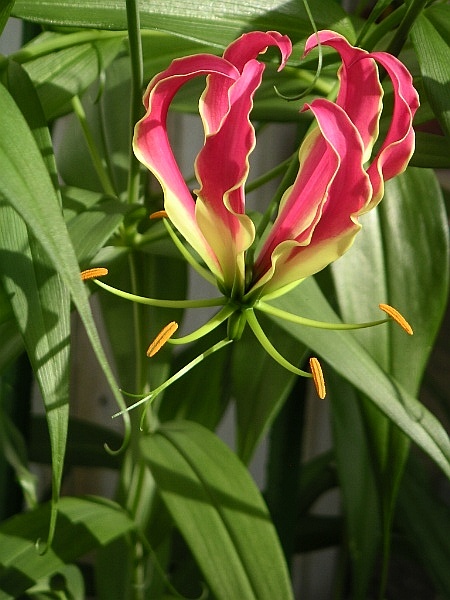 Flame LilyGloriosa superba
-
 ChristmasbellsSandersonia aurantiaca
-
 Giant Meadow SaffronColchicum speciosum
Compare
Questions and answers
What is the scientific name of the Large-flowered Bellwort?
The scientific name of the Large-flowered Bellwort is Uvularia grandiflora. Written with its author, the full name is Uvularia grandiflora Sm..
Which family does the Large-flowered Bellwort belong to?
Uvularia grandiflora belongs to the family Colchicaceae, in the order Liliales and the class Liliopsida.
Where is the Large-flowered Bellwort found?
Checklists and occurrence records place Uvularia grandiflora in 2 countries: United States and Canada.
What other names does the Large-flowered Bellwort have?
Uvularia grandiflora is also known in English as Bellwort, Largeflower Bellwort and Yellow Bellwort.
Does Bellwort spread?
Yes. Large-flowered bellwort can reproduce through self-seeding, and ants collect and redistribute its seeds. Clumps can also be propagated by division in autumn.[48][49][41][42][50]
When to plant Bellwort?
Clumps can be divided and relocated in autumn.[42]
Sources
Passages the profile rests on
- Uvularia grandiflora differs from Uvularia sessilifolia by having larger flowers. Source passage: “This plant differs from Uvularia sessilifolia in that the leaves of the latter grow from the stem and its flowers are smaller.” — English Wikipedia
- Uvularia perfoliata has similar large perfoliate leaves but bears flowers with orange-colored bumps on the petals. Source passage: “The latter has similar large perfoliate leaves, but the flowers have orange-colored bumps on the petals.” — English Wikipedia
- The plant produces large, yellow, bell-shaped flowers that hang downward. Source passage: “producing large yellow, solitary or paired, bell-shaped, pendent flowers.” — English Wikipedia
- The flowers are pale yellow, drooping, and bell-shaped. Source passage: “with its large, drooping bell-shaped, pale yellow flower” — nps.gov
- The hanging yellow flowers are approximately 1.5 inches long. Source passage: “The hanging yellow flowers are about 1 ½ inches long.” — hort.extension.wisc.edu
- Each flower has six overlapping tepals that flare at their ends. Source passage: “The six overlapping tepals flare at the ends.” — hort.extension.wisc.edu
- The stems are round, smooth, light green, and covered with a glaucous surface. Source passage: “The light green stems are round, glabrous, and glaucous” — English Wikipedia
- The stems are single or branched and arise from short underground rhizomes with fleshy, fibrous roots. Source passage: “Single or 1 to branched stems arise from short underground rhizomes with fleshy, fibrous roots and no stolons.” — hort.extension.wisc.edu
- The leaves hang downward and have hairy undersides. Source passage: “with pendent leaves which are hairy on the undersides.” — English Wikipedia
- The leaves are perfoliate, with the stem appearing to pass through their bases. Source passage: “the leaves are perfoliate since the stem appears to come through the leaves at the base.” — English Wikipedia
- The leaves can reach six inches in length. Source passage: “The narrow leaves are up to six inches long” — nps.gov
- The leaves are bluish-green, alternate, and perfoliate. Source passage: “bluish-green, alternate, perfoliate leaves.” — hort.extension.wisc.edu
- The upper portions of the plant bend downward under the weight of its leaves and flowers. Source passage: “The top parts of the plant tend to bend downward due to the weight of the leaves and flowers.” — English Wikipedia
- The drooping leaves can partially or completely conceal the flowers. Source passage: “also droop, often hiding the flower.” — nps.gov
- The upper portions of the plant nod downward under the weight of the flowers and leaves. Source passage: “The upper part of each plant nods because of the weight of the flowers and leaves.” — lakeforest.edu
- Individual stems usually grow in small clusters from a shared rhizome. Source passage: “is usually found in small clusters of individual stems, which spring from a common rhizome.” — nps.gov
- The foliage is generally paler green than that of other spring plant species growing nearby. Source passage: “The foliage is usually a paler green than surrounding spring plants of other species.” — nps.gov
- The species inhabits open shade in rich, moist woodland with calcareous to neutral soils. Source passage: “found in open shade in rich moist woods with calcareous to neutral soils.” — English Wikipedia
- The species grows best in lightly to moderately shaded locations with moist, fertile soil. Source passage: “U. grandiflora does best in a lightly to moderately shaded spot in moist, fertile soil.” — hort.extension.wisc.edu
- The species prefers rich, moist woodland habitats, including steep hillsides. Source passage: “This plant prefers rich, moist woodlands, including steep hillsides.” — nps.gov
- The species is frequently found in rich, sloping woodland habitats. Source passage: “Often located in rich, sloping woods” — lakeforest.edu
- The species occurs in mesic deciduous woodlands, wooded riverbank slopes, and shady wet places. Source passage: “It can be seen in mesic desiduous woodlands, slopes of riverbanks in wooded areas, and shady wet places.” — lakeforest.edu
- The species commonly grows in shaded areas beneath sugar maple and northern red oak trees. Source passage: “It is usually found in shaded regions under large trees such as Acer saccharum and Quercus rubra.” — lakeforest.edu
- Bumblebees, mason bees, halictid bees, and andrenid bees obtain nectar and pollen from its flowers. Source passage: “Bumblebees, mason bees, halictid bees, and andrenid bees feed from the nectar and collect pollen from the flowers.” — English Wikipedia
- Multiple bee species use the plant as a food resource. Source passage: “Many different species of bees use this plant” — nps.gov
- Bumblebees, mason bees, halictid bees, and andrenid bees collect nectar and pollen from the flowers. Source passage: “Bumble bees, mason bees, halictid bees, andrenid bees suck nectar and collect pollen from flowers.” — lakeforest.edu
- Deer eat the plant. Source passage: “Deer love to eat these plants.” — English Wikipedia
- White-tailed deer actively seek out the plant for food. Source passage: “white-tailed deer eagerly seek it out.” — nps.gov
- Deer graze on the foliage. Source passage: “The foliage is grazed by deer” — lakeforest.edu
- The plant produces shoots and flowers before the overhead trees develop their leaves. Source passage: “the bellwort sends up shoots and flowers before the overhead trees leaf out.” — nps.gov
- The plant is among the first wildflowers to emerge in spring. Source passage: “this woodland plant is one of the first wildflowers to emerge in spring.” — hort.extension.wisc.edu
- The plant retains its foliage throughout summer rather than becoming dormant after flowering. Source passage: “The plants remain throughout the summer, unlike many spring wildflowers that go dormant after blooming.” — hort.extension.wisc.edu
- The stems and leaves become more upright after flowering has finished. Source passage: “Once they have finished flowering, the leaves and stems become more erect” — hort.extension.wisc.edu
- Excessive deer populations can substantially reduce the number of plants in an area. Source passage: “the number of plants of an area can be greatly declined when there is an overpopulation of deer in area.” — lakeforest.edu
- The plant flowers in mid- to late spring. Source passage: “It blooms in mid- to late spring” — English Wikipedia
- The flowering period usually lasts approximately two weeks. Source passage: “The flowering period usually lasts about two weeks.” — nps.gov
- Each stem produces one terminal inflorescence bearing between one and four hanging flowers. Source passage: “One terminal inflorescence is produced on each stem, with 1 to 4 hanging flowers.” — hort.extension.wisc.edu
- The plant releases its seeds when three ovaries enclosed in capsules split open in late summer. Source passage: “In late summer three capsuled ovaries split open releasing the seeds.” — English Wikipedia
- The fruits are three-cornered capsules containing one to three brownish-red seeds per locule. Source passage: “The fruits that follow the flowers are a 3-cornered capsule with 1 to 3 brownish-red seeds per locule.” — hort.extension.wisc.edu
- Seeds can germinate after being discarded by ants if they land in a favorable location. Source passage: “If the seed falls in a favorable location it will sprout.” — nps.gov
- The species can reproduce through self-seeding. Source passage: “Plants may self seed” — hort.extension.wisc.edu
- The species can be propagated by dividing and relocating clumps in autumn. Source passage: “although it can be propagated by cutting up and moving clumps in the fall.” — hort.extension.wisc.edu
- Isolated populations occur along Chesapeake Bay in Maryland. Source passage: “There are also isolated populations along Chesapeake Bay in Maryland.” — English Wikipedia
- The species is listed as endangered in New Hampshire and Connecticut. Source passage: “The plant is listed as endangered in New Hampshire and Connecticut.” — English Wikipedia
- The Menominee use the plant to treat swellings. Source passage: “The Menominee use this plant for swellings.” — English Wikipedia
- The Ojibwa have documented use of the root for pain in the solar plexus. Source passage: “The Ojibwa are documented to use the root for pain in the solar plexus, which may refer to pleurisy.” — English Wikipedia
- The Potawatomi prepare a root infusion mixed with lard as a salve for massaging sore muscles and tendons. Source passage: “The Potawatomi mix an infusion of the root mixed with lard and use it as salve to massage sore muscles and tendons.” — English Wikipedia
- The seeds have attached elaiosomes that attract ants, which collect and redistribute the seeds. Source passage: “The seeds have attached food bodies called (elaiosome) that are attractive to ants, which collect and redistribute the seeds.” — English Wikipedia
- Ants carry the seeds away after eating their protein- and fat-rich elaiosomes. Source passage: “The elaiosome attracts an ant, which carries the seed away from the parent plant, eats the elaiosome, and discards the seed.” — nps.gov
- Ants distribute the seeds. Source passage: “The seeds are distributed by ants.” — lakeforest.edu
- The plant is a rhizomatous herbaceous perennial. Source passage: “it is a rhizomatous herbaceous perennial” — English Wikipedia
Data
- Catalogue of Life, 2026-10-16 XR cc by
- Global Biodiversity Information Facility CC BY 4.0
- Wikidata CC0
- GeoNames CC BY 4.0
- Wikimedia Commons per image; credit shown with each image
- Within the Catalogue of Life, this name comes from The World Checklist of Vascular Plants (WCVP) cc by
References
- Exot. Bot. 1: 99 (1805) where the name was published
This species in other databases
- Catalogue of Life 7F7S9
- Wikidata Q635060
- iNaturalist 126749
- World Flora Online wfo-0000751341
- GRIN 405142
Page built on 29 November 2026. See how the catalog is made and all sources and licences.
Cite this page
ScientificNames.org. (2026). Uvularia grandiflora (Large-flowered Bellwort). Retrieved November 29, 2026, from https://scientificnames.org/species/uvularia-grandiflora
“Uvularia grandiflora (Large-flowered Bellwort).” ScientificNames.org, 2026, scientificnames.org/species/uvularia-grandiflora. Accessed 29 Nov. 2026.
ScientificNames.org. “Uvularia grandiflora (Large-flowered Bellwort).” Accessed November 29, 2026. https://scientificnames.org/species/uvularia-grandiflora.
@misc{scientificnames_uvularia_grandiflora_large_flowered_bellwort,
  author = {{ScientificNames.org}},
  title = {Uvularia grandiflora (Large-flowered Bellwort)},
  year = {2026},
  url = {https://scientificnames.org/species/uvularia-grandiflora},
  note = {Accessed 2026-11-29}
}