Species · Mammals
Spectral Bat Vampyrum spectrum
The scientific name of the Spectral Bat is Vampyrum spectrum. It is a species of mammal in the family Phyllostomidae (new world leaf-nosed bats), order Chiroptera. The name dates from 1758.
- Scientific name
- Vampyrum spectrum (Linnaeus, 1758)
- Common name
- Spectral Bat
- Genus
- Vampyrum
- Family
- Phyllostomidae (New World Leaf-nosed Bats)
- Order
- Chiroptera
- Class
- Mammalia
- Red List category
- NT Near Threatened
- Recorded in
- 17 countries
- Name status
- accepted in the Catalogue of Life

Overview
Vampyrum spectrum occurs in Belize, Bolivia, Brazil, Colombia, Costa Rica, Ecuador, French Guiana, Guatemala, Guyana, Honduras, Mexico, Nicaragua, Peru, Suriname, Trinidad and Tobago, and Venezuela. It is exclusively carnivorous and has large, recurved, grooved claws on its thumbs for securing prey.
Written 26 November 2026 from the sources listed below. Each statement was checked against the passage it cites; statements that could not be supported were removed.
Appearance
The Spectral Bat has reddish-brown fur on its back and shorter, paler fur on its belly. Its ears are large and rounded, measuring 39–42 mm in length, and its nose-leaf measures approximately 17 mm.[1][2][3]
The species has no discernible tail and possesses a long, broad tail membrane. Each thumb has a large, recurved, grooved claw.[4][5]
Its wingspan typically measures between 0.7 and 1.0 metres. Its forearm measures between 101 and 110 mm, and its body length ranges from 135 to 147 mm.[6][7][8]
Its recorded body mass ranges from 134 to 189 g, and individuals can reach 235 g.[9][10]
Habitat
The Spectral Bat is associated with tropical rainforests and has been documented at elevations ranging from sea level to 1,650 m.[11][12]
It primarily roosts in large hollow tree trunks in primary forests. It also inhabits moist evergreen forests, secondary woodlands, forest edges and swampy areas.[13][14]
The species has been observed roosting in human structures. Its roosts are commonly located near rivers or streams.[15][16]
Diet
The Spectral Bat is exclusively carnivorous and consumes birds, rodents and other bats. Beetles are among the insects it eats.[17][18]
A Costa Rican study identified 18 bird species from feathers collected beneath a roost. Doves and cuckoos accounted for more than half of the documented prey items.[19][20]
DNA metabarcoding identified 27 vertebrate prey species, including birds, rodents and other bats. The species can consume prey associated with both mature forests and forest edges.[21][22]
The species does not necessarily consume fruit. A captive pair refused offered fruit for five years.[23]
Behaviour
The Spectral Bat uses echolocation to navigate during flight. It has slow, maneuverable flight that generally takes place close to the ground.[24][25]
The species stalks prey before landing on it from above and securing it with its thumb claws. It kills prey by delivering a forceful bite to the skull.[26][27]
The species has been recorded responding to distress calls from smaller bats while hunting. Individuals generally roost independently or in colonies containing up to five bats.[28][29]
The species emerges from its roosts at dusk to forage. One radio-tagged male foraged over an area of 3.2 hectares.[30][31]
Reproduction and life cycle
The Spectral Bat is monogamous. Females generally give birth at the end of the dry season or beginning of the rainy season and typically produce one offspring per litter.[32][33][34]
Males provide parental care by bringing food to females and their offspring at the roost. Both parents participate in feeding their young.[35][36]
Conservation
The IUCN classified the Spectral Bat as Near Threatened in 2018. Its population trend is decreasing, and habitat destruction is identified as a threat.[37][38][39]
Similar species
The big-eared woolly bat is identified as the Spectral Bat's closest living relative.[40]
Classification of the Spectral Bat
| Kingdom | Animalia |
|---|---|
| Phylum | Chordata |
| Subphylum | Vertebrata |
| Infraphylum | Gnathostomata |
| Parvphylum | Osteichthyes |
| Megaclass | Tetrapoda |
| Class | Mammalia (Mammal) |
| Subclass | Theria |
| Infraclass | Eutheria |
| Order | Chiroptera (Bat) |
| Suborder | Yangochiroptera |
| Superfamily | Noctilionoidea |
| Family | Phyllostomidae (New World Leaf-nosed Bats) |
| Subfamily | Phyllostominae |
| Tribe | Vampyrini (False Vampire Bats) |
| Genus | Vampyrum (Spectral Bat) |
| Species | Vampyrum spectrum (Linnaeus, 1758) |
Where the Spectral Bat is found
Checklists and occurrence records place Vampyrum spectrum in 17 countries across North America and South America. GBIF holds 359 georeferenced records of it.
Countries
- Belize 9
- Bolivia 4
- Brazil 45
- Colombia 22
- Costa Rica 33
- Ecuador 20
- French Guiana 28
- Guatemala 7
- Guyana 12
- Honduras 6
- Mexico 32
- Nicaragua 10
- Panama 25
- Peru 12
- Suriname 20
- Trinidad and Tobago 67
- Venezuela 7
Regions and cities with the most records
- Arima, Trinidad and Tobago 17
- Sangre Grande, Trinidad and Tobago 14
- Campeche, Mexico 11
- Veracruz, Mexico 10
- Puntarenas Province, Costa Rica 9
- Paradise, Trinidad and Tobago 8
- Chaguanas, Trinidad and Tobago 7
- Guanacaste Province, Costa Rica 7
- Guayas, Ecuador 7
- Tunapuna, Trinidad and Tobago 7
- Amazonas, Brazil 6
- Couva-Tabaquite-Talparo, Trinidad and Tobago 6
- Limón Province, Costa Rica 6
- Meta Department, Colombia 6
- Allende, Mexico 5
- Cañas, Costa Rica 5
- Coatzacoalcos, Mexico 5
- Fraccionamiento Ciudad Olmeca, Mexico 5
- Laventille, Trinidad and Tobago 5
- Madre de Dios, Peru 5
- Nanchital de Lázaro Cárdenas del Río, Mexico 5
- Port of Spain, Trinidad and Tobago 5
- Potaro-Siparuni, Guyana 5
- Roraima, Brazil 5
- Tunapuna/Piarco, Trinidad and Tobago 5
- Diego Martin, Trinidad and Tobago 4
- Orellana Province, Ecuador 4
- Acre, Brazil 3
- Amazonas, Peru 3
- Beni Department, Bolivia 3
- Caldas Department, Colombia 3
- Chiapas, Mexico 3
- Darién, Panama 3
- Izabal Department, Guatemala 3
- Mato Grosso, Brazil 3
- Morales, Guatemala 3
Range as the checklists state it
Middle America
South America
Caribbean
A number beside a place is its count of GBIF occurrence records. A place without a number comes from a checklist alone. Records show where a species has been observed or collected, which can include escapes and vagrants.
Common names
English
- Spectral Bat
- False Vampire Bat
- Great Spectral Bat
Names in 20 other languages
- Bulgarian
- Голям плодояден вампир
- Chinese
- 美洲假吸血蝠
- Czech
- listonos nosatý
- Dutch
- Vampiervleermuis
- Esperanto
- Vampiro
- Estonian
- Vampiir (loom)
- Finnish
- isopetoleikko
- French
- Chauve-souris javelot, Chauve-souris spectrale, Chauve-souris spectre, Faux-Vampire spectre, Faux-vampire de Linné
- Georgian
- ვამპირი (ცხოველი)
- German
- Große Spießblattnase
- Italian
- Falso vampiro americano, Vampiro spettro
- Japanese
- チスイコウモリモドキ
- Norwegian Bokmål
- Stor Spydnese
- Polish
- Liścionos wielki, Widmowiec wielki
- Portuguese
- Morcego-Espectral
- Russian
- Большой листонос, Гигантский лжевампир, Ложный вампир
- Slovenian
- Linnéjev nosorožec
- Spanish
- Falso vampiro, Faso vampiro gigante, Mulero, falso vampiro de Linneo
- Swedish
- Stor spjutnäsa
- Turkish
- Amerika yalancı vampir yarasası
Synonyms
One other scientific name has been used for this species and is now treated as a synonym of Vampyrum spectrum.
- Vespertilio spectrum Linnaeus, 1758
Related species
-
 Common Vampire BatDesmodus rotundus
-
 Honduran White BatEctophylla alba
-
 Hairy-legged Vampire BatDiphylla ecaudata
-
 Big-eared Woolly BatChrotopterus auritus
-
 Seba's Short-tailed BatCarollia perspicillata
-
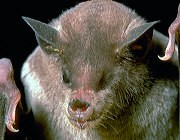 Lesser Long-nosed BatLeptonycteris yerbabuenae
-
 Wrinkle-faced BatCenturio senex
-
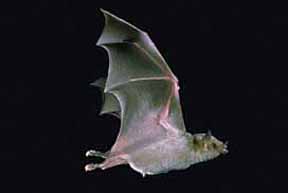 Greater Long-nosed BatLeptonycteris nivalis
Compare
Questions and answers
What is the scientific name of the Spectral Bat?
The scientific name of the Spectral Bat is Vampyrum spectrum. Written with its author, the full name is Vampyrum spectrum (Linnaeus, 1758).
Which family does the Spectral Bat belong to?
Vampyrum spectrum belongs to the family Phyllostomidae, in the order Chiroptera and the class Mammalia.
Where is the Spectral Bat found?
Checklists and occurrence records place Vampyrum spectrum in 17 countries, including Trinidad and Tobago, Brazil, Costa Rica, Mexico, French Guiana and Panama.
What is the conservation status of the Spectral Bat?
The IUCN Red List category recorded for Vampyrum spectrum is Near Threatened (NT).
What other names does the Spectral Bat have?
Vampyrum spectrum is also known in English as False Vampire Bat and Great Spectral Bat.
Is the spectral bat a vampire bat?
The Spectral Bat is exclusively carnivorous and consumes birds, rodents and other bats.[17]
What is the largest vampire bat in the world?
The Spectral Bat can reach a body mass of 235 g.[10]
Is the 6 foot bat real?
The Spectral Bat has a wingspan of between 0.7 and 1.0 metres.[6]
What do spectral bats eat?
Spectral Bats eat birds, rodents, other bats and insects including beetles. They are exclusively carnivorous.[17][18]
Sources
Passages the profile rests on
- The spectral bat has reddish-brown fur on its back and shorter, paler fur on its belly. Source passage: “Its back fur is reddish-brown, long, and soft, while its belly fur is shorter and paler.” — English Wikipedia
- The species has large, rounded ears measuring 39–42 mm in length. Source passage: “The ears are large and rounded, at 39–42 mm (1.5–1.7 in) long.” — English Wikipedia
- Its nose-leaf measures approximately 17 mm in length. Source passage: “Its nose-leaf is large, at 17 mm (0.67 in) in length.” — English Wikipedia
- The species has no discernible tail and possesses a long, broad tail membrane. Source passage: “There is no discernible tail, but the uropatagium (tail membrane) is long and broad.” — English Wikipedia
- Each thumb has a large, recurved, grooved claw. Source passage: “Each of its thumbs has a large, recurved claw that is grooved, similar to those of cats.” — English Wikipedia
- Its wingspan typically measures between 0.7 and 1.0 metres. Source passage: “The wingspan typically ranges from 0.7–1.0 m (2.3–3.3 ft).” — English Wikipedia
- Its forearm measures between 101 and 110 mm in length. Source passage: “Its forearm length is 101–110 mm (4.0–4.3 in).” — English Wikipedia
- Its body length ranges from 135 to 147 mm. Source passage: “Its body length is 135–147 mm (5.3–5.8 in)” — English Wikipedia
- Its recorded body mass ranges from 134 to 189 g. Source passage: “its mass is 134–189 g (4.7–6.7 oz).” — English Wikipedia
- Individuals can reach a body mass of 235 g. Source passage: “With a mass of up to 235 g, the spectral bat (Vampyrum spectrum) is the largest bat species on the American continents” — pmc.ncbi.nlm.nih.gov
- The species is associated with tropical rainforests. Source passage: “It is associated with tropical rainforests.” — English Wikipedia
- The species has been documented at elevations ranging from sea level to 1,650 m. Source passage: “It has been documented at elevations from 0–1,650 m (0–5,413 ft) above sea level” — English Wikipedia
- The species roosts primarily in large hollow tree trunks in primary forests. Source passage: “Based on roost descriptions from Costa Rica, Mexico, Trinidad and Tobago, the species selects large hollow tree trunks in primary forests” — pmc.ncbi.nlm.nih.gov
- The species also inhabits moist evergreen forests, secondary woodlands, forest edges and swampy areas. Source passage: “They are also found in other moist, evergreen forest, yards, secondary growth woodlands, forest edges, and swampy areas.” — animaldiversity.org
- The species has been observed roosting in human structures. Source passage: “They have been observed roosting in human structures and hollow trees.” — animaldiversity.org
- Roosts are commonly located near rivers or streams. Source passage: “They roost in dense, lowland forest below 1,650 m elevation, usually near a river or stream.” — animaldiversity.org
- The species is exclusively carnivorous and consumes birds, rodents and other bats. Source passage: “The spectral bat is exclusively carnivorous, consuming birds, rodents, and other species of bat.” — English Wikipedia
- Beetles are among the insects consumed by the species. Source passage: “Additionally, it consumes some insects such as beetles.” — English Wikipedia
- A Costa Rican study identified 18 bird species from feathers collected beneath a roost. Source passage: “Over the course of a year, 18 bird species were identified from feathers left under a roost in Costa Rica” — English Wikipedia
- Doves and cuckoos accounted for more than half of the prey items documented in a Costa Rican study. Source passage: “Doves and cuckoos are frequently consumed—they represented over half the prey items documented in the Costa Rican study.” — English Wikipedia
- DNA metabarcoding identified 27 vertebrate prey species, including birds, rodents and other bats. Source passage: “We identified 27 species of vertebrate prey which included birds, rodents, and other bat species.” — pmc.ncbi.nlm.nih.gov
- The species can consume prey associated with both mature forests and forest edges. Source passage: “Our evidence suggested that V. spectrum can forage on a variety of species, from those associated with mature forests to forest edge-dwellers.” — pmc.ncbi.nlm.nih.gov
- The species does not necessarily consume fruit, as a captive pair refused offered fruit for five years. Source passage: “a mated pair kept in captivity for 5 years refused any fruit offered to them.” — animaldiversity.org
- The species uses echolocation to navigate during flight. Source passage: “The spectral bat uses echolocation to navigate” — English Wikipedia
- The species has slow, maneuverable flight that generally takes place close to the ground. Source passage: “Their flight has been characterized as slow, maneuverable, and generally close to the ground.” — animaldiversity.org
- The species stalks prey before landing on it from above and securing it with its thumb claws. Source passage: “It stalks the prey and then lands on it from above, securing the prey by hooking it with its sharp thumb claws.” — English Wikipedia
- The species kills prey by delivering a forceful bite to the skull. Source passage: “It kills its prey by delivering a forceful bite to the skull.” — English Wikipedia
- The species has been recorded responding to distress calls from smaller bats while hunting. Source passage: “It has been recorded as being attracted to the distress calls of smaller bats while hunting.” — English Wikipedia
- Individuals generally roost independently or in colonies containing up to five bats. Source passage: “Spectral bats roost independently or in small colonies of up to five individuals in hollow trees.” — English Wikipedia
- The species emerges from its roosts at dusk to forage. Source passage: “Vampyrum spectrum emerges from roosts at dusk to forage for prey.” — animaldiversity.org
- One radio-tagged male foraged over an area of 3.2 hectares. Source passage: “One radio-tagged male foraged over an area of 3.2 hectares for 1 to 4.5 hours at a time.” — animaldiversity.org
- The species is monogamous. Source passage: “Unlike the majority of bat species, it is monogamous.” — English Wikipedia
- Females generally give birth at the end of the dry season or beginning of the rainy season. Source passage: “females giving birth at the end of the dry season or the beginning of the rainy season.” — English Wikipedia
- The species typically produces one offspring per litter. Source passage: “The litter size is one individual, with offspring called "pups."” — English Wikipedia
- Males provide parental care by bringing food to females and their offspring at the roost. Source passage: “The adult male will bring food back to the roost to provision the adult female and their offspring.” — English Wikipedia
- Both parents participate in feeding their young. Source passage: “Both parents bring food back to roosts for their young and are solicitous of the young until they reach independence.” — animaldiversity.org
- The IUCN classified the species as Near Threatened in 2018. Source passage: “As of 2018, the spectral bat is classified as near threatened by the IUCN.” — English Wikipedia
- The population trend of the species is decreasing. Source passage: “The International Union for Conservation of Nature (IUCN) has designated the species as Near Threatened with a decreasing population trend throughout its range.” — pmc.ncbi.nlm.nih.gov
- Habitat destruction is identified as a threat to the species. Source passage: “Due to habitat destruction and its low population density, it is listed as a near-threatened species by the International Union for Conservation of Nature (IUCN).” — English Wikipedia
- The big-eared woolly bat is identified as the spectral bat's closest living relative. Source passage: “its closest living relative is the big-eared woolly bat.” — English Wikipedia
Data
- Catalogue of Life, 2026-10-16 XR cc by
- Global Biodiversity Information Facility CC BY 4.0
- Wikidata CC0
- GeoNames CC BY 4.0
- Wikimedia Commons per image; credit shown with each image
- Within the Catalogue of Life, this name comes from The Integrated Taxonomic Information System cc0
References
- Syst. Nat., 10th ed. vol.1 p.31 where the name was published
- Wilson, Don E., and DeeAnn M. Reeder, eds. (1993). Mammal Species of the World: A Taxonomic and Geographic Reference, 2nd Ed., 3rd Printing.
- Wilson, Don E., and F. Russell Cole. (2000). Common Names of Mammals of the World.
- Simmons, Nancy B. / Wilson, Don E., and DeeAnn M. Reeder, eds. (2005). Order Chiroptera. Mammal Species of the World: A Taxonomic and Geographic Reference, 3rd Ed., Vols. 1 & 2.
- Wilson, D. E., and R. A. Mittermeier, eds. (2019). Handbook of the Mammals of the World. Vol. 9: Bats.
This species in other databases
Page built on 27 November 2026. See how the catalog is made and all sources and licences.
Cite this page
ScientificNames.org. (2026). Vampyrum spectrum (Spectral Bat). Retrieved November 27, 2026, from https://scientificnames.org/species/vampyrum-spectrum
“Vampyrum spectrum (Spectral Bat).” ScientificNames.org, 2026, scientificnames.org/species/vampyrum-spectrum. Accessed 27 Nov. 2026.
ScientificNames.org. “Vampyrum spectrum (Spectral Bat).” Accessed November 27, 2026. https://scientificnames.org/species/vampyrum-spectrum.
@misc{scientificnames_vampyrum_spectrum_spectral_bat,
  author = {{ScientificNames.org}},
  title = {Vampyrum spectrum (Spectral Bat)},
  year = {2026},
  url = {https://scientificnames.org/species/vampyrum-spectrum},
  note = {Accessed 2026-11-27}
}