Species · Insects
European Hornet Vespa crabro
The scientific name of the European Hornet is Vespa crabro. It is a species of insect in the family Vespidae (hornets), order Hymenoptera.
- Scientific name
- Vespa crabro Linnaeus
- Common name
- European Hornet
- Genus
- Vespa
- Family
- Vespidae (Hornets)
- Order
- Hymenoptera
- Class
- Insecta
- Recorded in
- 45 countries
- Name status
- accepted in the Catalogue of Life

Overview
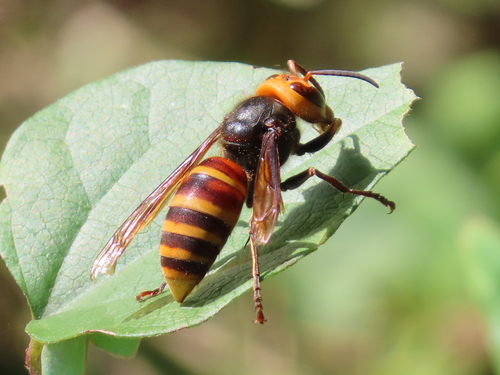
Vespa crabro commonly inhabits forests and neighboring areas, as well as parks and suburban areas where suitable trees or nesting habitats are available. It has reddish-orange wings, a reddish-brown head, and a brown and yellow striped abdomen.
Written 24 November 2026 from the sources listed below. Each statement was checked against the passage it cites; statements that could not be supported were removed.
Appearance
The eyes are deeply indented and shaped like the letter C. The head is reddish-brown and becomes yellowish near the face.[1][2]
The thorax is red and brown, while the abdomen is brown toward the front and mostly yellow toward the rear with brown teardrop markings. The wings are reddish-orange.[3][4]
The thorax and abdomen are covered with hair, although the species is less hairy than most bees.[5]
Workers average approximately 25 mm in length, while queens can reach approximately 35 mm. The typical body mass is approximately 477.5 ± 59.9 mg.[6][7][8]
Similar species
The European Hornet is frequently mistaken for the Asian giant hornet because of its coloration and abdominal pattern.[9]
Its closest relative identified in a phylogenetic study is Vespa dybowskii.[10]
Habitat
The species commonly nests inside hollow tree trunks. Nests are also constructed in barns, sheds, attics, and wall cavities.[11][12]
It commonly inhabits forests and neighboring areas because of its preference for hollow trees. It also occurs in parks and suburban areas where suitable trees or nesting habitats are available.[13][14]
Subterranean nests have occasionally been reported. Most nests contain between 1,500 and 3,000 cells.[15][16]
Diet
The European Hornet hunts beetles, wasps, large moths, dragonflies, mantises, grasshoppers, flies, bees, and yellowjackets. Its prey also includes cicadas and honey bees.[17][18][19]
It also consumes fallen fruit and other sugary foods. Workers collect oozing tree sap as a food source.[20][21]
Behaviour
The species generally avoids conflict but may sting when stepped on or grabbed. It defends its nest and can behave aggressively around food sources.[22][23]
It can fly at night and may be attracted to exterior lighting. Workers may switch from hunting to scavenging during autumn.[24][25]
European Hornets have been observed stealing captured insects from spider webs. Workers may girdle tree twigs and branches while collecting sap or other plant materials.[26][27]
Reproduction and life cycle
Queens begin nest construction in spring after emerging from overwintering sites. After selecting a nesting site, queens lay eggs in the nest combs.[28][29]
The average egg-laying rate measured in laboratory data was 2.31 eggs per day. Only queens mate and produce fertilized female eggs, while workers can lay haploid male eggs.[30][31]
Conservation
The species is locally threatened or endangered in some areas following nest destruction driven by fear of the hornet.[32]
Classification of the European Hornet
| Kingdom | Animalia |
|---|---|
| Phylum | Arthropoda |
| Subphylum | Hexapoda |
| Class | Insecta (Insect) |
| Order | Hymenoptera (Ants) |
| Suborder | Apocrita (Ants) |
| Infraorder | Aculeata |
| Superfamily | Vespoidea (Vespoid Wasps) |
| Family | Vespidae (Hornets) |
| Subfamily | Vespinae |
| Genus | Vespa (Hornet) |
| Species | Vespa crabro Linnaeus |
Where the European Hornet is found
Checklists and occurrence records place Vespa crabro in 45 countries. GBIF holds 320,491 georeferenced records of it.
Countries
- Aland Islands 101
- Albania 35
- Austria 6,343
- Belarus 124
- Belgium 19,856
- Bosnia and Herzegovina 31
- Bulgaria 217
- Canada 1,916
- China 613
- Croatia 453
- Czechia 1,059
- Denmark 1,965
- Estonia 864
- Finland 3,305
- France 20,921
- Germany 82,182
- Greece 407
- Hungary 924
- Italy 3,742
- Japan 1,284
- Jersey 31
- Kosovo 6
- Latvia 49
- Liechtenstein 30
- Lithuania 256
- Luxembourg 2,059
- Moldova 25
- Montenegro 74
- North Macedonia 39
- Norway 3,347
- Poland 1,803
- Portugal 786
- Romania 322
- Russia 4,190
- Serbia 1,200
- Slovakia 226
- Slovenia 174
- South Korea 436
- Spain 2,021
- Sweden 19,136
- Switzerland 6,613
- The Netherlands 93,720
- Ukraine 1,073
- United Kingdom 22,218
- United States 14,315
Regions and cities with the most records
- England, United Kingdom 19,767
- North Rhine-Westphalia, Germany 19,500
- Gelderland, The Netherlands 17,682
- Lower Saxony, Germany 10,238
- Limburg, The Netherlands 9,878
- Bavaria, Germany 9,019
- Hesse, Germany 8,897
- Nijmegen, The Netherlands 7,865
- Baden-Wurttemberg, Germany 7,592
- Overijssel, The Netherlands 7,426
- Utrecht, The Netherlands 7,404
- Zeist, The Netherlands 7,103
- Rheinland-Pfalz, Germany 7,010
- Arnhem, The Netherlands 6,902
- Soest, The Netherlands 6,882
- Utrecht, The Netherlands 6,796
- Amersfoort, The Netherlands 6,634
- Ede, The Netherlands 6,559
- Veenendaal, The Netherlands 6,409
- Hilversum, The Netherlands 6,184
- Drenthe, The Netherlands 5,735
- Maastricht, The Netherlands 5,666
- Heerlen, The Netherlands 5,656
- Sittard, The Netherlands 5,650
- Nieuwegein, The Netherlands 5,518
- Oosterhout, The Netherlands 5,375
- Tilburg, The Netherlands 5,309
- Eindhoven, The Netherlands 5,102
- Kerkrade, The Netherlands 4,825
- Waalwijk, The Netherlands 4,783
- Saxony, Germany 4,726
- Breda, The Netherlands 4,569
- Herzogenrath, Germany 4,344
- 's-Hertogenbosch, The Netherlands 4,197
- Roermond, The Netherlands 4,116
- Deventer, The Netherlands 3,944
7 more countries have a few records outside this range
These countries hold a few records of Vespa crabro but lie outside the range the checklists give for it. Such records are often zoo or garden specimens, museum material or vagrants, so the species is not counted as occurring there.
A number beside a place is its count of GBIF occurrence records. A place without a number comes from a checklist alone. Records show where a species has been observed or collected, which can include escapes and vagrants.
Common names
English
- European Hornet
- Giant Hornet
- Hornet
Names in 44 other languages
- Asturian
- tártagu
- Belarusian
- Шэршань еўрапейскі
- Bulgarian
- Европейски стършел
- Catalan
- Vespa xana, xana
- Chinese
- 費邊胡蜂, 黃邊胡蜂, 黄边胡蜂
- Croatian
- Europski stršljen, Ljuti stršljen
- Czech
- sršeň obecná
- Danish
- Stor gedehams
- Dutch
- Europese hoornaar, Hoornaar
- Estonian
- Vapsik
- Finnish
- Herhiläinen
- French
- Frelon européen
- Galician
- Tártago
- Georgian
- ონავარი
- German
- Europäische Hornisse, Hornisse
- Greek
- Ευρωπαϊκή σφήκα, Σφήκα η Ευρωπαϊκή
- Hungarian
- lódarázs
- Italian
- Calabrone, Calabrone europeo
- Japanese
- モンスズメバチ, 紋雀蜂
- Korean
- 말벌
- Latvian
- Irsis, Sirsenis, Sirseņi
- Lithuanian
- Širšuolas
- Luxembourgish
- Runn
- Northern Sami
- stuorravievssis
- Norwegian Bokmål
- geithams
- Occitan
- Cabridan europèu
- Polish
- Szerszeń europejski
- Portuguese
- Vespa-europeia, Vespão europeu
- Romanian
- Gărgăun
- Russian
- Шершень обыкновенный
- Scottish Gaelic
- beach mòr, beachan mòra, connspeach, connspeachan, seillean-nimh, seilleanan-nimhe
- Serbian
- Stršljen, Стршљен
- Slovak
- sršeň obyčajný
- Slovenian
- Evropski sršen, sršen
- Spanish
- Avispón europeo
- Swedish
- Bålgeting
- Thai
- ต่อหัวเสือยุโรป
- Turkish
- Avrupa Eşekarısı, Sarı Pizoz, Sarıca
- Ukrainian
- Шершень звичайний
- bar
- Huanaus
- kur
- Pîzang
- nan
- Hó͘-thâu-phang
- stq
- Doarne
- wln
- Fonnet d' Urope
Synonyms
13 other scientific names have been used for this species and are now treated as synonyms of Vespa crabro.
- Vespa borealis Radoszkowski, 1863
- Vespa crabro germana Christ, 1791
- Vespa crabro major Retzius
- Vespa crabro nigra Birula, 1925
- Vespa crabro var. altaica Perez, 1910
- Vespa crabro var. borealis Radoszkowski, 1863
- Vespa crabro var. caspica Perez, 1910
- Vespa crabro var. tartarea du Buysson, 1905
- Vespa flavofasciata Cameron, 1903
- Vespa germana Christ, 1791
- Vespa major Retzius, 1783
- Vespa tartarea Buysson, 1904
- Vespa vexator Harris, 1776
Subspecies and varieties
- Vespa crabro altaica subspecies
- Vespa crabro birulai subspecies
- Vespa crabro caspica subspecies
- Vespa crabro crabroniformis subspecies
- Vespa crabro f. altaica form
- Vespa crabro f. birulai form
- Vespa crabro f. caspica form
- Vespa crabro f. crabro form
- Vespa crabro f. crabroniformis form
- Vespa crabro f. flavofasciata form
- Vespa crabro f. germana form
- Vespa crabro f. oberthuri form
- Vespa crabro f. vexator form
- Vespa crabro gribodoi subspecies
- Vespa crabro meridionalis subspecies
- Vespa crabro oberthuri subspecies
Related species
-
 Asian Giant HornetVespa mandarinia
-
 Asian HornetVespa velutina
-
 Oriental HornetVespa orientalis
- Philippine HornetVespa luctuosa
-
 Greater Banded HornetVespa tropica
-
 Lesser Banded HornetVespa affinis
-
 Yellow-vented HornetVespa analis
-
 Southern Giant HornetVespa soror
Compare
Questions and answers
What is the scientific name of the European Hornet?
The scientific name of the European Hornet is Vespa crabro. Written with its author, the full name is Vespa crabro Linnaeus.
Which family does the European Hornet belong to?
Vespa crabro belongs to the family Vespidae, in the order Hymenoptera and the class Insecta.
Where is the European Hornet found?
Checklists and occurrence records place Vespa crabro in 45 countries, including The Netherlands, Germany, United Kingdom, France, Belgium and Sweden.
What other names does the European Hornet have?
Vespa crabro is also known in English as Giant Hornet and Hornet.
What do European hornets eat?
European Hornets hunt beetles, wasps, large moths, dragonflies, mantises, grasshoppers, flies, bees, yellowjackets, and cicadas. They also consume fallen fruit, other sugary foods, and oozing tree sap.[17][20][18][21][19]
What habitat do hornets live in?
European Hornets commonly inhabit forests and neighboring areas because of their preference for hollow trees. They also occur in parks and suburban areas where suitable trees or nesting habitats are available, and nest in barns, sheds, attics, and wall cavities.[11][12][13][14]
Sources
Passages the profile rests on
- The eyes are deeply indented and shaped like the letter C. Source passage: “The eyes of V. crabro are deeply indented and shaped like a "C".” — English Wikipedia
- The head is reddish-brown and becomes yellowish near the face. Source passage: “The head of European hornets is reddish-brown, becoming yellowish near the face.” — content.ces.ncsu.edu
- Its wings are reddish-orange and its abdomen has brown and yellow stripes. Source passage: “Its wings are reddish-orange, while the petiolate abdomen is striped with brown and yellow.” — English Wikipedia
- The thorax is red and brown, while the abdomen is brown toward the front and mostly yellow toward the rear with brown teardrop markings. Source passage: “the thorax is red and brown, while the abdomen is brown anteriorly and mostly yellow posteriorly with brown tear-drops.” — extension.psu.edu
- Its thorax and abdomen are covered with hair, although it is less hairy than most bees. Source passage: “It has hair on the thorax and abdomen, although the European hornet is not as hairy as most bees.” — English Wikipedia
- Workers average approximately 25 mm in length. Source passage: “Workers average around 25 mm (1.0 in) in length” — English Wikipedia
- Queens can reach approximately 35 mm in length. Source passage: “the larger queens can reach up to 35 mm (1+3⁄8 in).” — English Wikipedia
- The typical body mass is approximately 477.5 ± 59.9 mg. Source passage: “Typical mass size for the European Hornet is 477.5±59.9 mg.” — English Wikipedia
- The European hornet is frequently mistaken for the Asian giant hornet because of its coloration and abdominal pattern. Source passage: “Due to this coloration and abdomen pattern, V. crabro is often mistaken for the Asian giant hornet.” — English Wikipedia
- Its closest relative identified in a phylogenetic study is Vespa dybowskii. Source passage: “According to a recent phylogenetic study, its closest relative is Vespa dybowskii.” — English Wikipedia
- The species commonly nests inside hollow tree trunks. Source passage: “V. crabro prefers to build nests in dark places, usually hollow tree trunks.” — English Wikipedia
- Nests are also constructed in barns, sheds, attics, and wall cavities. Source passage: “they are often found in barns, sheds, attics, and wall voids of houses.” — content.ces.ncsu.edu
- The species commonly inhabits forests and neighboring areas because of its preference for hollow trees. Source passage: “Because they usually nest in hollow trees, European hornets are most commonly found in forests and adjacent areas.” — extension.psu.edu
- It also occurs in parks and suburban areas where suitable trees or nesting habitats are available. Source passage: “However, they can also be found in parks and suburban areas with sufficient trees or other suitable nesting habitats.” — extension.psu.edu
- Most nests contain between 1,500 and 3,000 cells. Source passage: “most nests only contain 1,500–3,000 cells.” — extension.psu.edu
- Subterranean nests have occasionally been reported. Source passage: “Subterranean nests have also been occasionally reported.” — extension.psu.edu
- The species hunts beetles, wasps, large moths, dragonflies, and mantises. Source passage: “hunt large insects such as beetles, wasps, large moths, dragonflies, and mantises.” — English Wikipedia
- Its diet includes grasshoppers, flies, bees, and yellowjackets. Source passage: “Their diet consists mainly of large insects such grasshoppers, flies, bees, and yellow jackets.” — content.ces.ncsu.edu
- The species preys on a wide range of arthropods, including dragonflies, cicadas, and honey bees. Source passage: “Like other wasps, V. crabro is a predator of a wide range of arthropods [7,11,12], including odonates [13], cicadas [14], and honey bees [15].” — pmc.ncbi.nlm.nih.gov
- It also consumes fallen fruit and other sugary foods. Source passage: “They also feed on fallen fruit and other sources of sugary food.” — English Wikipedia
- Workers collect oozing tree sap as a food source. Source passage: “Hornet workers are sometimes noticed collecting from the oozing sap of trees.” — content.ces.ncsu.edu
- It generally avoids conflict but may sting when stepped on or grabbed. Source passage: “This species stings in response to being stepped on or grabbed, but generally avoids conflict.” — English Wikipedia
- It defends its nest and can behave aggressively around food sources. Source passage: “It is also defensive of its nest and can be aggressive around food sources.” — English Wikipedia
- It can fly at night and may be attracted to exterior lighting. Source passage: “Unlike most other stinging insects, European hornets also fly at night. They may be attracted to bright exterior lighting” — content.ces.ncsu.edu
- Workers may switch from hunting to scavenging during autumn. Source passage: “Later, typically around the fall season, the foraging workers switch to scavengers.” — English Wikipedia
- European hornets have been observed stealing captured insects from spider webs. Source passage: “European hornets have been observed to steal prey from spiders, which can be classified as an example of kleptoparasitism.” — English Wikipedia
- Workers may girdle tree twigs and branches while collecting sap or other plant materials. Source passage: “They have been reported to girdle twigs of numerous trees such as dogwood, birch, rhododendron, and fruit trees” — content.ces.ncsu.edu
- Queens lay eggs in the nest combs after selecting a nesting site. Source passage: “After the site has been chosen, the queen lays eggs in the combs inside the nest.” — English Wikipedia
- Queens begin nest construction in spring after emerging from overwintering sites. Source passage: “nest foundation in spring, when queens, previously fertilized in autumn, leave their overwintering sites” — pmc.ncbi.nlm.nih.gov
- The average egg-laying rate measured in laboratory data was 2.31 eggs per day. Source passage: “Based on laboratory data, the average rate of egg-laying is 2.31 eggs per day.” — English Wikipedia
- Only queens mate and produce fertilized female eggs, while workers can lay haploid male eggs. Source passage: “While only queens mate and produce fertilized female eggs, workers are capable of laying haploid male eggs.” — English Wikipedia
- The species is locally threatened or endangered in some areas following nest destruction driven by fear of the hornet. Source passage: “This has led to the decline of the species, which is often locally threatened or even endangered.” — English Wikipedia
Data
- Catalogue of Life, 2026-10-16 XR cc by
- Global Biodiversity Information Facility CC BY 4.0
- Wikidata CC0
- GeoNames CC BY 4.0
- Wikimedia Commons per image; credit shown with each image
- Within the Catalogue of Life, this name comes from Vespidae based on Zoological-Botanical Database cc by
References
- Generani, M. (2001). Gli imenotteri delle isole di Capraia, Giglio, Gorgona, Pianosa e Montecristo (Arcipelago Toscano). Frustula Entomologica, N.S., Pisa 24 (37): (2001): Frustula Entomol. where the name was published
This species in other databases
Page built on 24 November 2026. See how the catalog is made and all sources and licences.
Cite this page
ScientificNames.org. (2026). Vespa crabro (European Hornet). Retrieved November 24, 2026, from https://scientificnames.org/species/vespa-crabro
“Vespa crabro (European Hornet).” ScientificNames.org, 2026, scientificnames.org/species/vespa-crabro. Accessed 24 Nov. 2026.
ScientificNames.org. “Vespa crabro (European Hornet).” Accessed November 24, 2026. https://scientificnames.org/species/vespa-crabro.
@misc{scientificnames_vespa_crabro_european_hornet,
  author = {{ScientificNames.org}},
  title = {Vespa crabro (European Hornet)},
  year = {2026},
  url = {https://scientificnames.org/species/vespa-crabro},
  note = {Accessed 2026-11-24}
}