Species · Insects
Asian Giant Hornet Vespa mandarinia
The scientific name of the Asian Giant Hornet is Vespa mandarinia. It is a species of insect in the family Vespidae (hornets), order Hymenoptera. The name dates from 1852.
- Scientific name
- Vespa mandarinia Smith, 1852
- Common name
- Asian Giant Hornet
- Genus
- Vespa
- Family
- Vespidae (Hornets)
- Order
- Hymenoptera
- Class
- Insecta
- Recorded in
- 13 countries
- Name status
- accepted in the Catalogue of Life

Overview
Vespa mandarinia primarily inhabits low mountains and forested areas across its native distribution in East Asia, South Asia, and mainland Southeast Asia.
Written 24 November 2026 from the sources listed below. Each statement was checked against the passage it cites; statements that could not be supported were removed.
Appearance
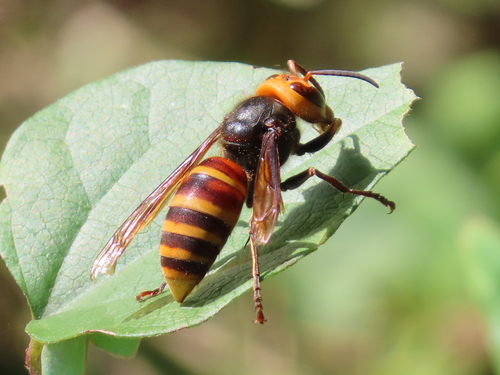
A pronounced clypeus and large genae distinguish the species from other hornets.[1]
Queens can exceed 50 mm in body length, while workers measure approximately 35–40 mm. The wingspan is approximately 75 mm, and the stinger is typically 6 mm long.[2][3][4][5]
Male adults lack stingers.[6]
Habitat
The Asian Giant Hornet primarily inhabits low mountains and forested areas. It is notably absent from plains and higher elevations.[7][8]
The species can also nest in tree hollows and urban structures. Aerial nesting is extremely rare.[9][10]
Diet
The species feeds primarily on large insects, including beetles. Its diet also includes honey bees, spiders, tree sap, nectar, honey, and soft fruits.[11][12]
Adults feed on animal prey or plant juices, while larvae receive prey chewed by adult hornets into a nutritious paste.[13][14]
In Japan, the species primarily preys on other social Hymenoptera and opportunistically consumes other insect taxa. Its diet can also include carrion and other non-insect protein sources.[15][16]
Larval fecal analysis in Washington detected Dolichovespula maculata, Polistes dominula, and Apis mellifera in most samples.[17]
Behaviour
The Asian Giant Hornet is eusocial and exhibits cooperative brood care, overlapping generations, and reproductive and non-reproductive castes.[18]
Workers generally forage within approximately one mile of their nest but can travel up to about five miles.[19]
During the slaughter phase, as many as 50 hornets can attack a marked hive.[20]
The species generally avoids aggression toward humans unless its nest or food source is disturbed. Its venomous stinger can deliver repeated stings.[21][22]
Reproduction and life cycle
After overwintering, fertilized queens establish colonies in spring. A newly established queen can produce an initial clutch of up to 40 eggs.[23][24]
Toward the end of summer, queens produce thousands of additional eggs. Fertilized eggs develop into queens for the following season, whereas unfertilized eggs develop into males.[25][26]
Larvae undergo complete metamorphosis before emerging as adults.[27]
Conservation
No conservation efforts are directed toward the species or its habitats because it is common in areas with little human disturbance.[28]
Similar species
Vespa soror is the most closely related species within the Vespa tropica species group.[29]
Classification of the Asian Giant Hornet
| Kingdom | Animalia |
|---|---|
| Phylum | Arthropoda |
| Subphylum | Hexapoda |
| Class | Insecta (Insect) |
| Order | Hymenoptera (Ants) |
| Suborder | Apocrita (Ants) |
| Infraorder | Aculeata |
| Superfamily | Vespoidea (Vespoid Wasps) |
| Family | Vespidae (Hornets) |
| Subfamily | Vespinae |
| Genus | Vespa (Hornet) |
| Species | Vespa mandarinia Smith, 1852 |
Where the Asian Giant Hornet is found
Checklists and occurrence records place Vespa mandarinia in 13 countries. GBIF holds 6,039 georeferenced records of it.
Countries
- Bhutan 15
- China 572
- India 57
- Japan 3,376
- Laos 8
- Myanmar 7
- Nepal 16
- North Korea 3
- Pakistan 10
- South Korea 1,591
- Taiwan 362
- Thailand 15
- Vietnam 7
Regions and cities with the most records
- Ibaraki, Japan 970
- Hokkaido, Japan 590
- Hitachi-Naka, Japan 583
- Inada, Japan 583
- Katsuta, Japan 583
- Mito, Japan 583
- Kasama, Japan 582
- Hitachi-ota, Japan 563
- Komae, Japan 375
- Chōfu, Japan 374
- Inagi, Japan 369
- Machida, Japan 352
- Tama, Japan 339
- Minamirinkan, Japan 338
- Yamato, Japan 336
- Musashino, Japan 335
- Koganei, Japan 322
- Fuchū, Japan 314
- Nishi-Tokyo-shi, Japan 313
- Zama, Japan 297
- Kunitachi, Japan 288
- Kokubunji, Japan 287
- Kodaira, Japan 285
- Higashikurume, Japan 279
- Hino, Japan 279
- Tokyo, Japan 279
- Tachikawa, Japan 267
- Higashimurayama, Japan 243
- Musashimurayama, Japan 239
- Kanagawa, Japan 236
- Omitama, Japan 232
- Aihara, Japan 222
- Kiyose, Japan 222
- Ōta, Japan 219
- Akishima, Japan 215
- Higashiyamato, Japan 211
4 more countries have a few records outside this range
These countries hold a few records of Vespa mandarinia but lie outside the range the checklists give for it. Such records are often zoo or garden specimens, museum material or vagrants, so the species is not counted as occurring there.
A number beside a place is its count of GBIF occurrence records. A place without a number comes from a checklist alone. Records show where a species has been observed or collected, which can include escapes and vagrants.
Common names
English
- Asian Giant Hornet
- Giant Asian Hornet
- Giant Mandarin Hornet
- Mandarin Giant Hornet
- Mandarin Hornet
- Murder Hornet
- Northern Giant Hornet
Names in 16 other languages
- Asturian
- tártagu xigante
- Chinese
- كيف تصبح مجتهد, 中國大虎頭蜂, 中華大虎頭蜂, 台灣大虎頭蜂, 土蜂仔, 大土蜂(台語), 大虎頭蜂, 臺灣大虎頭蜂
- Czech
- sršeň mandarínská
- Danish
- Asiatisk kæmpegedehams
- Dutch
- Aziatische reuzenhoornaar, Reuzenhoornaar
- Finnish
- Kiinanherhiläinen
- Japanese
- オオスズメバチ, 大雀蜂
- Korean
- 장수말벌
- Polish
- Szerszeń azjatycki
- Portuguese
- Vespa-gigante-asiática
- Russian
- Азиатский огромный шершень
- Slovak
- sršeň mandarínsky
- Slovenian
- orjaški azijski sršen
- Spanish
- Avispón asiático gigante
- Swedish
- asiatisk jättebålgeting
- Thai
- ต่อหัวเสือยักษ์เอเชีย
Synonyms
6 other scientific names have been used for this species and are now treated as synonyms of Vespa mandarinia.
- Vespa latilineata Cameron, 1903
- Vespa magnifica sonani Matsumura, 1930
- Vespa magnifica var. latilineata Cameron, 1903
- Vespa mandarina Smith, 1852
- Vespa sonani Matsumura, 1930
- Vespa japonica Radoszkowski, 1857 ambiguous synonym
Subspecies and varieties
- Vespa mandarinia bellona subspecies
- Vespa mandarinia f. magnifica form
- Vespa mandarinia f. nobilis form
- Vespa mandarinia japonica (Japanese Giant Hornet) subspecies
- Vespa mandarinia magnifica subspecies
- Vespa mandarinia nobilis subspecies
Related species
-
 European HornetVespa crabro
-
 Asian HornetVespa velutina
-
 Oriental HornetVespa orientalis
- Philippine HornetVespa luctuosa
-
 Greater Banded HornetVespa tropica
-
 Lesser Banded HornetVespa affinis
-
 Yellow-vented HornetVespa analis
-
 Southern Giant HornetVespa soror
Compare
Questions and answers
What is the scientific name of the Asian Giant Hornet?
The scientific name of the Asian Giant Hornet is Vespa mandarinia. Written with its author, the full name is Vespa mandarinia Smith, 1852.
Which family does the Asian Giant Hornet belong to?
Vespa mandarinia belongs to the family Vespidae, in the order Hymenoptera and the class Insecta.
Where is the Asian Giant Hornet found?
Checklists and occurrence records place Vespa mandarinia in 13 countries, including Japan, South Korea, China, Taiwan, India and Nepal.
What other names does the Asian Giant Hornet have?
Vespa mandarinia is also known in English as Giant Asian Hornet, Giant Mandarin Hornet, Mandarin Giant Hornet, Mandarin Hornet, Murder Hornet and Northern Giant Hornet.
What is the deadliest hornet in the world?
The Asian Giant Hornet conducts coordinated group attacks against honeybee colonies and other social insect nests. Its venomous stinger can deliver repeated stings, but its status as the deadliest hornet in the world is not established.[30][31][22]
Does the US still have Asian giant hornets?
No. The species was declared eradicated from North America in December 2024.[32][33]
What is the habitat of the Asian giant hornet?
The species primarily inhabits low mountains and forested areas and is notably absent from plains and higher elevations. It typically nests underground, often near rotten pine roots, but can also nest in tree hollows and urban structures.[7][8][34][35][9]
Sources
Passages the profile rests on
- The species has a pronounced clypeus and large genae that distinguish it from other hornets. Source passage: “V. mandarinia is distinguished from other hornets by its pronounced clypeus and large genae.” — English Wikipedia
- Queens can exceed 50 mm in body length. Source passage: “Queens can exceed 50 mm (2 in)” — English Wikipedia
- Worker hornets measure approximately 35–40 mm in body length. Source passage: “workers are between 35 and 40 mm (1+2⁄5 and 1+3⁄5 in).” — English Wikipedia
- The species has a wingspan of approximately 75 mm. Source passage: “a wingspan around 75 mm (3 in)” — English Wikipedia
- Its stinger is typically 6 mm long. Source passage: “Its stinger is typically 6 mm (1⁄4 in) long” — English Wikipedia
- Male adults lack stingers. Source passage: “Drones (males) are similar to females, and can attain 38 millimetres (1+1⁄2 in) in length, but lack stingers.” — English Wikipedia
- The species primarily inhabits low mountains and forested areas. Source passage: “Vespa mandarinia tends to live in low mountains and/or forested areas.” — animaldiversity.org
- The species is notably absent from plains and higher elevations. Source passage: “It is notably absent in plains and at higher elevations.” — animaldiversity.org
- The species can also nest in tree hollows and urban structures. Source passage: “These nests also can be found near rotted pine roots, in tree hollows, and even in urban structures.” — animaldiversity.org
- Aerial nesting is extremely rare in this species. Source passage: “aerial nesting is described as extremely rare.” — English Wikipedia
- The species feeds primarily on large insects, including beetles. Source passage: “AGH feeds mostly on large beetles, but will also consume honey bees and other insects, spiders, as well as tree sap, nectar, honey, and soft fruits.” — extension.usu.edu
- Its diet includes honey bees, spiders, tree sap, nectar, honey, and soft fruits. Source passage: “AGH feeds mostly on large beetles, but will also consume honey bees and other insects, spiders, as well as tree sap, nectar, honey, and soft fruits.” — extension.usu.edu
- Adults feed on animal prey or plant juices, while larvae receive chewed-up prey. Source passage: “Adults feed only on prey or plant juices, but feed their larvae chewed-up prey.” — extension.usu.edu
- Larvae are fed prey that adult hornets chew into a nutritious paste. Source passage: “The young are fed by adults that have chewed their prey, typically bees, into a fine paste.” — animaldiversity.org
- In Japan, the species primarily preys on other social Hymenoptera and also consumes other insect taxa opportunistically. Source passage: “In Japan, V. mandarinia is known to prey mainly on other social Hymenoptera and opportunistically on a range of other insect taxa” — pmc.ncbi.nlm.nih.gov
- Its diet in Japan can include carrion and other non-insect protein sources. Source passage: “their diet even extends to scavenging on carrion or other non-insect protein sources.” — pmc.ncbi.nlm.nih.gov
- Larval fecal analysis in Washington detected Dolichovespula maculata, Polistes dominula, and Apis mellifera in most samples. Source passage: “The most frequently detected species were other social Hymenoptera, with Dolichovespula maculata, P. dominula, and A. mellifera present in most samples.” — pmc.ncbi.nlm.nih.gov
- The species is eusocial and exhibits cooperative brood care, overlapping generations, and reproductive and non-reproductive castes. Source passage: “Cooperative care for the young, overlapping generations, and the existence of reproductive and non-reproductive classes are hallmarks of eusociality” — animaldiversity.org
- Workers generally forage within approximately one mile of their nest but can travel up to about five miles. Source passage: “Workers tend to forage for food within one mile from their nest, but can fly up to about five miles.” — extension.usu.edu
- During the slaughter phase, as many as 50 hornets can attack a marked hive. Source passage: “up to 50 hornets may attack the marked hive.” — extension.usu.edu
- The species generally avoids aggression toward humans unless its nest or food source is disturbed. Source passage: “AGH is generally not aggressive unless its nest or food source is disturbed.” — extension.usu.edu
- Its venomous stinger can deliver repeated stings. Source passage: “They can sting repeatedly and their venom is more toxic than that of most other insects.” — extension.usu.edu
- After overwintering, fertilized queens establish colonies in spring. Source passage: “After overwintering, a fertilized queen starts her colony in the spring.” — animaldiversity.org
- A newly established queen can produce an initial clutch of up to 40 eggs. Source passage: “she produces an initial clutch of up to 40 eggs” — animaldiversity.org
- Toward the end of summer, queens produce thousands of additional eggs. Source passage: “Toward the end of summer, the queen produces thousands of additional eggs.” — animaldiversity.org
- Fertilized eggs develop into queens for the following season, whereas unfertilized eggs develop into males. Source passage: “Fertilized eggs become the queens of the next season, and unfertilized eggs become the males of the next season.” — animaldiversity.org
- Larvae undergo complete metamorphosis before emerging as adults. Source passage: “The larvae eventually grow large enough to enter the pupal stage and undergo complete metamorphosis.” — animaldiversity.org
- No conservation efforts are directed toward the species or its habitats because it is common in areas with little human disturbance. Source passage: “no efforts are directed toward conserving V. mandarinia or its habitats, as they are common in areas of low human disturbance.” — English Wikipedia
- Vespa soror is the most closely related species within the Vespa tropica species group. Source passage: “The most closely related species within the species group is V. soror.” — English Wikipedia
- The species conducts coordinated group attacks against honeybee colonies and other social insect nests. Source passage: “Vespa mandarinia is unique in that it is the only eusocial wasp species to stage group attacks against beehives and other eusocial wasp nests.” — animaldiversity.org
- Group attacks involve hunting, slaughter, and occupation phases. Source passage: “AGH attacks honey bees and other social insects in three phases:” — extension.usu.edu
- The species was detected in northwestern Washington and British Columbia in 2019 and 2020. Source passage: “Asian giant hornet (AGH) is an invasive wasp that was detected in northwest Washington and British Columbia, Canada in fall 2019 and spring 2020” — extension.usu.edu
- The species was declared eradicated from North America in December 2024. Source passage: “in December 2024, WSDA declared that the hornets had been eradicated from North America.” — English Wikipedia
- The species typically constructs subterranean nests in cavities dug by itself or previously occupied by rodents. Source passage: “The species creates subterranean nests by digging, coopting cavities that were dug by small rodents” — animaldiversity.org
- Nests are frequently established near rotten pine roots. Source passage: “In a study of 31 nests, 25 were found around rotten pine roots” — English Wikipedia
Data
- Catalogue of Life, 2026-10-16 XR cc by
- Global Biodiversity Information Facility CC BY 4.0
- Wikidata CC0
- GeoNames CC BY 4.0
- Wikimedia Commons per image; credit shown with each image
- iNaturalist per image; credit shown with each image
- Within the Catalogue of Life, this name comes from Vespidae based on Zoological-Botanical Database cc by
References
- Smith, F. (1852 b) Descriptions of some new and apparently undescribed species of Hymenopterous insects from North China, collected by Robert Fortune, Esq. Transactions of the Royal Entomological Society of London, 2 (2), 33 - 44. https: // doi. org / 10.1111 / j. 1365 - 2311.1852. tb 02208. x where the name was published
This species in other databases
Page built on 24 November 2026. See how the catalog is made and all sources and licences.
Cite this page
ScientificNames.org. (2026). Vespa mandarinia (Asian Giant Hornet). Retrieved November 24, 2026, from https://scientificnames.org/species/vespa-mandarinia
“Vespa mandarinia (Asian Giant Hornet).” ScientificNames.org, 2026, scientificnames.org/species/vespa-mandarinia. Accessed 24 Nov. 2026.
ScientificNames.org. “Vespa mandarinia (Asian Giant Hornet).” Accessed November 24, 2026. https://scientificnames.org/species/vespa-mandarinia.
@misc{scientificnames_vespa_mandarinia_asian_giant_hornet,
  author = {{ScientificNames.org}},
  title = {Vespa mandarinia (Asian Giant Hornet)},
  year = {2026},
  url = {https://scientificnames.org/species/vespa-mandarinia},
  note = {Accessed 2026-11-24}
}