Species · Insects
Forest Yellowjacket Vespula acadica
The scientific name of the Forest Yellowjacket is Vespula acadica. It is a species of insect in the family Vespidae (hornets), order Hymenoptera. The name dates from 1918.
- Scientific name
- Vespula acadica (Sladen, 1918)
- Common name
- Forest Yellowjacket
- Genus
- Vespula
- Family
- Vespidae (Hornets)
- Order
- Hymenoptera
- Class
- Insecta
- Recorded in
- 2 countries
- Name status
- accepted in the Catalogue of Life
Overview
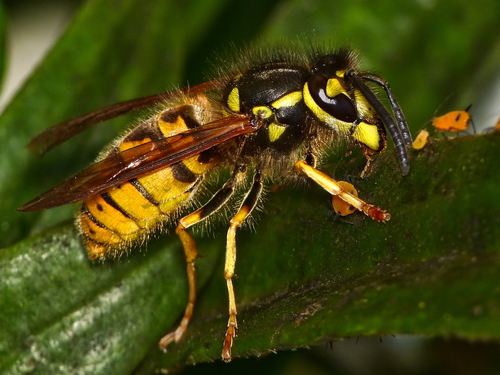
Vespula acadica occurs in arboreal habitats and is distributed throughout boreal North America. It has a black body with yellow markings and a yellow underside of the scape.
Written 26 November 2026 from the sources listed below. Each statement was checked against the passage it cites; statements that could not be supported were removed.
Appearance
The Forest Yellowjacket has a black body with yellow markings. The underside of its scape is yellow rather than entirely black.[1][2]
Adults measure between 10 and 15 mm in length.[3]
Habitat
The Forest Yellowjacket occurs in arboreal habitats. Its nests are most commonly constructed in decaying vegetation, including logs and leaf piles, although aerial nests have also been recorded.[4][5][6]
Nest entrance tunnels are usually 15–25 cm long but can reach 40 cm. The deepest recorded subterranean nest was located 15 cm below the surface.[7][8]
Diet
The Forest Yellowjacket obtains protein primarily from live arthropod prey and collects natural carbohydrate sources. Workers prey on live caterpillars, flies, and hemipterans.[9][10]
The species does not scavenge or forage on freshly killed insects.[11]
Behaviour
Workers may become aggressive and sting repeatedly when their colony is disturbed. The species generally has little contact with humans because of its preference for forest habitats.[12][13]
Workers sometimes consume liquid feces while leaving solid feces beneath the comb. Worker mauling interactions usually last ten seconds or less and occur mainly among older workers.[14][15][16]
Workers sometimes adopt an immobile stance on the nest envelope or comb edges when the nest experiences substrate vibrations. They hover during nest excavations as part of colony defense.[17][18]
Reproduction and life cycle
Colonies consist of morphologically distinct queens and workers. Each annual nest is governed by a single queen.[19][20]
A typical nest contains one worker-producing comb and one to three reproductive-producing combs. Most observed colonies contain between 75 and 400 workers and three to four combs.[21][22]
The seasonal reproductive cycle usually begins in mid-July and finishes by late August or early September. Males approach queens from the side and attempt to mount the dorsal surface of their gasters.[23][24]
Workers cannot mate but can lay haploid eggs that develop into males. Estimates indicate that colonies produce nearly equal numbers of males and females.[25][26]
Classification of the Forest Yellowjacket
| Kingdom | Animalia |
|---|---|
| Phylum | Arthropoda |
| Subphylum | Hexapoda |
| Class | Insecta (Insect) |
| Order | Hymenoptera (Ants) |
| Suborder | Apocrita (Ants) |
| Infraorder | Aculeata |
| Superfamily | Vespoidea (Vespoid Wasps) |
| Family | Vespidae (Hornets) |
| Subfamily | Vespinae |
| Genus | Vespula (Yellow Jackets) |
| Species | Vespula acadica (Sladen, 1918) |
Where the Forest Yellowjacket is found
Checklists and occurrence records place Vespula acadica in 2 countries. GBIF holds 1,143 georeferenced records of it.
Countries
Regions and cities with the most records
- British Columbia, Canada 171
- Alaska, United States 139
- New Brunswick, Canada 91
- Idaho, United States 89
- Ontario, Canada 75
- Nova Scotia, Canada 64
- Coeur d'Alene, United States 60
- California, United States 54
- Quebec, Canada 54
- Washington, United States 49
- Oregon, United States 37
- Maine, United States 34
- Fairbanks, United States 28
- Alberta, Canada 26
- Minnesota, United States 22
- Yukon, Canada 22
- Badger, United States 18
- Sydney, Canada 15
- North Vancouver, Canada 14
- Riley Park, Canada 14
- Vancouver, Canada 14
- Vermont, United States 14
- West Vancouver, Canada 14
- Burnaby, Canada 13
- Prince Edward Island, Canada 13
- Victoria-Fraserview, Canada 13
- Dartmouth, Canada 12
- Halifax, Canada 12
- Newfoundland and Labrador, Canada 11
- Manitoba, Canada 10
- Richmond, Canada 10
- Bedford, Canada 9
- Glace Bay, Canada 9
- Colorado, United States 8
- Covington, United States 8
- Maple Valley, United States 8
1 more country has a few records outside this range
These countries hold a few records of Vespula acadica but lie outside the range the checklists give for it. Such records are often zoo or garden specimens, museum material or vagrants, so the species is not counted as occurring there.
A number beside a place is its count of GBIF occurrence records. A place without a number comes from a checklist alone. Records show where a species has been observed or collected, which can include escapes and vagrants.
Common names
English
- Forest Yellowjacket
- Polka-dot Yellowjacket
Names in 2 other languages
- French
- Guêpe forestière
- Spanish
- Avispa chaqueta amarilla de lunares
Synonyms
2 other scientific names have been used for this species and are now treated as synonyms of Vespula acadica.
- Vespula sladeni Bequard, 1932
- Vespa americana Buysson, 1905 ambiguous synonym
Related species
-
 German YellowjacketVespula germanica
-
 Common WaspVespula vulgaris
-
 Eastern YellowjacketVespula maculifrons
-
 Southern YellowjacketVespula squamosa
-
 Western YellowjacketVespula pensylvanica
-
 BlackjacketVespula consobrina
-
 Alaska YellowjacketVespula alascensis
-
 Common Asian YellowjacketVespula flaviceps
Compare
Questions and answers
What is the scientific name of the Forest Yellowjacket?
The scientific name of the Forest Yellowjacket is Vespula acadica. Written with its author, the full name is Vespula acadica (Sladen, 1918).
Which family does the Forest Yellowjacket belong to?
Vespula acadica belongs to the family Vespidae, in the order Hymenoptera and the class Insecta.
Where is the Forest Yellowjacket found?
Checklists and occurrence records place Vespula acadica in 2 countries: Canada and United States.
What other names does the Forest Yellowjacket have?
Vespula acadica is also known in English as Polka-dot Yellowjacket.
Sources
Passages the profile rests on
- Vespula acadica has a black body with yellow markings. Source passage: “V. acadica is black with yellow markings” — English Wikipedia
- The underside of the species' scape is yellow rather than entirely black. Source passage: “The underside of its scape is yellow, rather than completely black.” — English Wikipedia
- Adults measure between 10 and 15 mm in length. Source passage: “ranges from 10-15mm in length” — English Wikipedia
- The species occurs in arboreal habitats. Source passage: “is found in arboreal areas” — English Wikipedia
- Nests are most commonly constructed in decaying vegetation, including logs and leaf piles. Source passage: “V. acadica normally builds its nests in decaying vegetation such as logs or leaf piles” — English Wikipedia
- Although uncommon, the species has also been recorded building aerial nests. Source passage: “although uncommon, aerial nests have been reported.” — English Wikipedia
- The entrance tunnels of its nests are usually 15–25 cm long but can reach 40 cm. Source passage: “The entrance tunnels are normally 15 to 25 cm, but can be as long as 40 cm.” — English Wikipedia
- The deepest recorded subterranean nest was located 15 cm below the surface. Source passage: “The deepest subterranean nest found was 15 cm under the surface.” — English Wikipedia
- The species obtains protein primarily from live arthropod prey and collects natural carbohydrate sources. Source passage: “rely on live arthropod prey as their main source of protein and collect natural carbohydrate sources.” — English Wikipedia
- Workers prey on live caterpillars, flies, and hemipterans. Source passage: “V. acadica workers are known to prey on live caterpillars, flies, and hemipterans.” — English Wikipedia
- The species does not scavenge or forage on freshly killed insects. Source passage: “V. acadica wasps do not scavenge or forage on freshly killed insects.” — English Wikipedia
- Workers may become aggressive and sting repeatedly when their colony is disturbed. Source passage: “when colonies are disturbed, workers of this yellowjacket may be quite aggressive and persistent and sting repeatedly.” — English Wikipedia
- The species generally has little contact with humans because of its preference for forest habitats. Source passage: “Due to its preference for forests V. acadica does not normally come into contact with humans” — English Wikipedia
- Workers sometimes consume liquid feces while leaving solid feces beneath the comb. Source passage: “workers will consume the liquid feces but leave behind the solids.” — English Wikipedia
- Worker mauling interactions usually last ten seconds or less. Source passage: “Ninety-seven percent of maulings last for 10 seconds or less” — English Wikipedia
- Mauling interactions occur mainly among older workers. Source passage: “These interactions are mostly seen amongst older workers” — English Wikipedia
- Workers sometimes adopt an immobile stance on the nest envelope or comb edges when the nest experiences substrate vibrations. Source passage: “workers are known to take on an immobile stance on the envelope or the edges of the comb during substrate vibrations of the nest.” — English Wikipedia
- Workers hover during nest excavations as part of colony defense. Source passage: “workers hover in a manner similar to workers of Vespula consobrina while defining the colony during excavations.” — English Wikipedia
- Colonies consist of morphologically distinct queens and workers. Source passage: “The V. acadica colony consists of morphologically distinct queens and workers.” — English Wikipedia
- Each annual nest is governed by a single queen. Source passage: “They form annual nests which are governed by a single queen.” — English Wikipedia
- A typical nest contains one worker-producing comb and one to three reproductive-producing combs. Source passage: “A nest is composed of one worker-producing comb and one to three reproductive-producing combs.” — English Wikipedia
- Most observed colonies contain between 75 and 400 workers and three to four combs. Source passage: “Most colonies of V. acadica that have been observed are relatively small, containing 75-400 workers and 3-4 combs” — English Wikipedia
- The seasonal reproductive cycle usually begins in mid-July and finishes by late August or early September. Source passage: “The seasonal cycle of V. acadica usually begins in mid-July, with the onset of reproductive rearing, and is completed in most areas by the last week of August or first week of September.” — English Wikipedia
- Males approach queens from the side and attempt to mount the dorsal surface of their gasters. Source passage: “Males approach the queens from the side and attempt to mount the dorsum of the queen's gaster.” — English Wikipedia
- Workers cannot mate but can lay haploid eggs that develop into males. Source passage: “Although V. acadica workers are unable to mate, they are able to lay haploid eggs, which are destined to become males.” — English Wikipedia
- Estimates indicate that colonies produce nearly equal numbers of males and females. Source passage: “Estimates of sex ratios indicate that near equal numbers of males and females are produced.” — English Wikipedia
Data
- Catalogue of Life, 2026-10-16 XR cc by
- Global Biodiversity Information Facility CC BY 4.0
- Wikidata CC0
- GeoNames CC BY 4.0
- Within the Catalogue of Life, this name comes from Vespidae based on Zoological-Botanical Database cc by
This species in other databases
Page built on 28 November 2026. See how the catalog is made and all sources and licences.
Cite this page
ScientificNames.org. (2026). Vespula acadica (Forest Yellowjacket). Retrieved November 28, 2026, from https://scientificnames.org/species/vespula-acadica
“Vespula acadica (Forest Yellowjacket).” ScientificNames.org, 2026, scientificnames.org/species/vespula-acadica. Accessed 28 Nov. 2026.
ScientificNames.org. “Vespula acadica (Forest Yellowjacket).” Accessed November 28, 2026. https://scientificnames.org/species/vespula-acadica.
@misc{scientificnames_vespula_acadica_forest_yellowjacket,
  author = {{ScientificNames.org}},
  title = {Vespula acadica (Forest Yellowjacket)},
  year = {2026},
  url = {https://scientificnames.org/species/vespula-acadica},
  note = {Accessed 2026-11-28}
}