Species · Insects
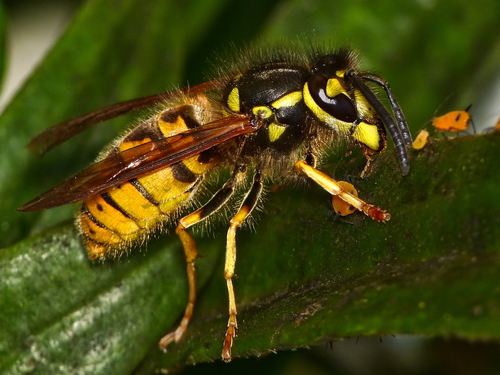
Guatemalan Yellowjacket Vespula akrei
The scientific name of the Guatemalan Yellowjacket is Vespula akrei. It is a species of insect in the family Vespidae (hornets), order Hymenoptera.
- Scientific name
- Vespula akrei Landolt
- Common name
- Guatemalan Yellowjacket
- Genus
- Vespula
- Family
- Vespidae (Hornets)
- Order
- Hymenoptera
- Class
- Insecta
- Recorded in
- 1 country
- Name status
- accepted in the Catalogue of Life
Overview
Wikidata describes Vespula akrei as “species of insect”.
Classification of the Guatemalan Yellowjacket
| Kingdom | Animalia |
|---|---|
| Phylum | Arthropoda |
| Subphylum | Hexapoda |
| Class | Insecta (Insect) |
| Order | Hymenoptera (Ants) |
| Suborder | Apocrita (Ants) |
| Infraorder | Aculeata |
| Superfamily | Vespoidea (Vespoid Wasps) |
| Family | Vespidae (Hornets) |
| Subfamily | Vespinae |
| Genus | Vespula (Yellow Jackets) |
| Species | Vespula akrei Landolt |
Origin of the name. Etymology. The species epithet, akrei, is in honor of our (PJL & RSZ) late mentor and friend, Roger D. Akre, who added so much to our understanding of the genus Ves p ul a. Placement of Vespula akrei. This species is aligned with the V. vulgaris species group (Bequaert 1930), based on the following key criteria indicated for Paravespula Bluthgen by Archer (1989 a, b, c). The occipital carina is complete along the posterior margin of the head from the vertex to the base of the mandible. The first gastral tergum possesses numerous long pale hairs. There are no longitudinal stripes on the mesoscutum and the antennae are completely black. We have no information on the colony cycle, colony size, or foraging habits of V. a k re i. DNA sequences also assist in the placement of V. a k re i within Vespula. A total of nine specimens, including one V. acadica, two V. a k re i, one V. alascensis, one V. intermedia, two V. maculifrons, one V. squamosa, and one D. arenaria were used for sequencing of portions of two mtDNA genes. Following methods presented in Horton et al. (2008), DNA was extracted from three legs of each specimen with DNAeasy Blood and Tissue Kit (Qiagen Inc., Valencia, CA). Target regions of the genes were amplified using universal primers for CO 1 (C-J- 1718, C- - 2151) and cytB (CB-J- 10933, CB- - 11367) (Simon et al. 1994). Products were cleaned with exoSAP (USB Corp., Cleveland, OH) and sequenced using the same primers. Sequences were trimmed and aligned using CLUSTALW in Bioedit (Hall 1999). DNA sequences are provided in Genbank as accessions HM 031092 - HM 031100 for 472 bp of CO 1 and HM 031083 - HM 031091 for 433 bp of cytB. Phylogenetic hypotheses for the combined 905 bp of mtDNA sequence (CO 1 and cvtB genes) were developed using a neighbor joining distance method with MEGA- 4 (p distance; gamma distributed substitutions, k- 0.07, 10,000 bootstrap replicates [Tamura et al. 2007]) and maximum parsimony as implemented in TNT (one technology sectarian search, find best tree 20 times, 34,540 trees examined, symmetric resampling p = 33 and 10,000 replicates; [Goboloff et al. 2008]). Data were also analyzed with PAUP 4 (Swofford 2003) and MrBayes 3.1 (Ronquist and Huelsenbeck 2003) testing gene-specific partitions and all base pair combinations. In all cases, D. arenaria was used to root the tree depicted and as an outgroup in parsimony analyses. The single phylogram presented in Fig. 3, with the shape of the tree (branch distances) defined by the NJ analysis shows the cladogram seen with all four methods of analysis. Statistics along branches of the tree were derived from NJ / TNT analyses. The number above the branch is the number of bp differences / number of synapomorphies. The number below the branch is the bootstrap support calculation / the symmetric sampling support calculation). The results show 100 % support for the distinct clade for V. a k re i, for the V. a k re i plus V. maculifrons clade, and for the V. a k re i plus V. maculifrons plus V. alascensis clade, placing V. a k re i in the V. vulgaris species group. Vespula maculifrons and V. alascensis are closely allied to Vespula vulgaris L., and within the V. vulgaris species group (Bequaert 1930; Carpenter 1987, Carpenter and Perera 2006). The clade containing V. acadica and V. intermedia, members of the V. r u f a species group (Bequaert 1930; Carpenter 1987) is also well supported. Addition of V. squamosa to this clade reduces support, and is not consistent with the placement of V. squamosa in the V. r u f a group. Carpenter (1987) placed V. squamosa in a separate sister group with Vespula sulphurea (de Saussure). The differences seen between V. a k re i and V. maculifrons were 26 bp substitutions (23 in CO 1 and 3 in cytB), 15 - 16 of which were synapomorphies, and no amino acid substitutions (data not shown). The CO 1 473 bp sequence for V. a k re i shows 23 bp differences (4.9 %) from the most closely related species that we sequenced (V. maculifrons), and similar distances from sequences of five other V. maculifrons in genbank. This represents a significant gap, and is greater than that observed for CO 1 differences between V. acadica and V. intermedia (2.75 %) for example.
This name was added to the Catalogue of Life from a contributing dataset by automated merging and has not yet been reviewed by its editors.
Where the Guatemalan Yellowjacket is found
Checklists and occurrence records place Vespula akrei in 1 country. GBIF holds 14 georeferenced records of it.
Countries
Regions and cities with the most records
A number beside a place is its count of GBIF occurrence records. A place without a number comes from a checklist alone. Records show where a species has been observed or collected, which can include escapes and vagrants.
Common names
English
- Guatemalan Yellowjacket
Names in 1 other language
- Spanish
- Avispa chaqueta amarilla guatemalteca
Related species
-
 German YellowjacketVespula germanica
-
 Common WaspVespula vulgaris
-
 Eastern YellowjacketVespula maculifrons
-
 Southern YellowjacketVespula squamosa
-
 Western YellowjacketVespula pensylvanica
-
 BlackjacketVespula consobrina
-
 Alaska YellowjacketVespula alascensis
-
 Common Asian YellowjacketVespula flaviceps
Compare
Questions and answers
What is the scientific name of the Guatemalan Yellowjacket?
The scientific name of the Guatemalan Yellowjacket is Vespula akrei. Written with its author, the full name is Vespula akrei Landolt.
Which family does the Guatemalan Yellowjacket belong to?
Vespula akrei belongs to the family Vespidae, in the order Hymenoptera and the class Insecta.
Where is the Guatemalan Yellowjacket found?
Checklists and occurrence records place Vespula akrei in 1 country: Guatemala.
Sources
Data
- Catalogue of Life, 2026-10-16 XR cc by
- Global Biodiversity Information Facility CC BY 4.0
- Wikidata CC0
- GeoNames CC BY 4.0
- Within the Catalogue of Life, this name comes from iNaturalist Taxonomy cc by
References
- Landolt, Peter J.;Sierra, José Monzón;Unruh, Thomas R.;Zack, Richard S. (2010). A new species of Ve s p u l a, and first record of Vespa crabro L. (Hymenoptera: Vespidae) from Guatemala, Central America. Zootaxa, 2629, 61–68. https://doi.org/10.5281/zenodo.198286 Link where the name was published
This species in other databases
Page built on 29 November 2026. See how the catalog is made and all sources and licences.
Cite this page
ScientificNames.org. (2026). Vespula akrei (Guatemalan Yellowjacket). Retrieved November 29, 2026, from https://scientificnames.org/species/vespula-akrei
“Vespula akrei (Guatemalan Yellowjacket).” ScientificNames.org, 2026, scientificnames.org/species/vespula-akrei. Accessed 29 Nov. 2026.
ScientificNames.org. “Vespula akrei (Guatemalan Yellowjacket).” Accessed November 29, 2026. https://scientificnames.org/species/vespula-akrei.
@misc{scientificnames_vespula_akrei_guatemalan_yellowjacket,
  author = {{ScientificNames.org}},
  title = {Vespula akrei (Guatemalan Yellowjacket)},
  year = {2026},
  url = {https://scientificnames.org/species/vespula-akrei},
  note = {Accessed 2026-11-29}
}