Species · Insects
Prairie Yellowjacket Vespula atropilosa
The scientific name of the Prairie Yellowjacket is Vespula atropilosa. It is a species of insect in the family Vespidae (hornets), order Hymenoptera. The name dates from 1918.
- Scientific name
- Vespula atropilosa (Sladen, 1918)
- Common name
- Prairie Yellowjacket
- Genus
- Vespula
- Family
- Vespidae (Hornets)
- Order
- Hymenoptera
- Class
- Insecta
- Recorded in
- 3 countries
- Name status
- accepted in the Catalogue of Life

Overview
The Prairie Yellowjacket (Vespula atropilosa) is an insect in the family Vespidae, order Hymenoptera, and class Insecta. It inhabits prairie and grassland environments, with nests commonly established in dry fields and pastures.
Written 26 November 2026 from the sources listed below. Each statement was checked against the passage it cites; statements that could not be supported were removed.
Conservation
The Prairie Yellowjacket is not generally considered a pest.[1]
Uses
The species provides a potential benefit by preying on local insect pests such as lacebugs and caterpillars.[2]
Appearance
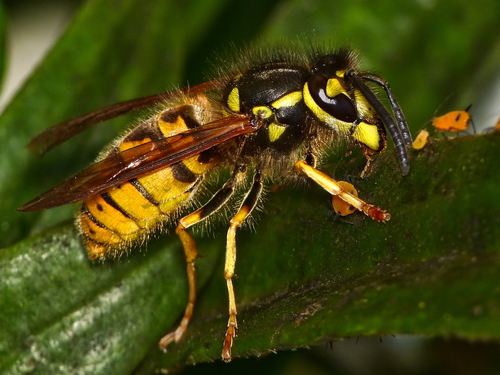
The Prairie Yellowjacket has a black and yellow body. Adults measure between 10 and 15 mm in length.[3][4]
Males can have either predominantly yellow or predominantly black abdominal coloration. The ventral section of the male scape is yellow, while its dorsal section is black.[5][6]
The metasomal tergites are covered with long, straight hairs. The black central region at the apex of the second gastral tergum is pointed.[7][8]
The male aedeagus has a saddle-shaped form.[9]
Habitat
The Prairie Yellowjacket inhabits prairie and grassland environments. Nests are commonly established in dry fields and pastures.[10][11]
Most nests are established in preexisting rodent burrows and are generally located between 3 and 23 cm beneath the soil surface. Nests can occur on both flat and sloping terrain.[12][13][14]
Colonies can occur in dry residential yards in the Pacific Northwest.[15]
Diet
The species preys on aphids, cicadas, leafhoppers, moths, butterflies and grasshoppers. Adult lacewings and spiders are also among its preferred prey.[16][17][18][19]
Behaviour
Workers rapidly leave prey capture sites after catching prey to process their food. Workers have also been observed stealing captured prey from other workers in screenhouses.[20][21]
Mating generally takes place around midday and begins while the queen is flying. Several males may pursue a queen and compete to mate with her.[22][23]
Copulations average approximately one minute because competing males frequently interrupt them.[24]
Reproduction and life cycle
Worker cell construction is greatest in early July, while queen cell construction becomes predominant in late July. Adult males generally begin emerging during the final week of July, and adult queens begin emerging during the first week of August.[25][26][27][28]
Queens can mate with multiple males during a short period. Female offspring develop from fertilized eggs, whereas males develop from unfertilized eggs.[29][30]
Classification of the Prairie Yellowjacket
| Kingdom | Animalia |
|---|---|
| Phylum | Arthropoda |
| Subphylum | Hexapoda |
| Class | Insecta (Insect) |
| Order | Hymenoptera (Ants) |
| Suborder | Apocrita (Ants) |
| Infraorder | Aculeata |
| Superfamily | Vespoidea (Vespoid Wasps) |
| Family | Vespidae (Hornets) |
| Subfamily | Vespinae |
| Genus | Vespula (Yellow Jackets) |
| Species | Vespula atropilosa (Sladen, 1918) |
Where the Prairie Yellowjacket is found
Checklists and occurrence records place Vespula atropilosa in 3 countries. GBIF holds 1,168 georeferenced records of it.
Countries
Regions and cities with the most records
- Colorado, United States 234
- Alberta, Canada 219
- British Columbia, Canada 130
- Idaho, United States 112
- Calgary, Canada 108
- California, United States 104
- Utah, United States 69
- Chestermere, Canada 54
- Englewood, United States 49
- Oregon, United States 49
- Washington, United States 49
- Greenwood Village, United States 48
- Littleton, United States 48
- Denver, United States 45
- Columbine, United States 44
- Lakewood, United States 43
- Wheat Ridge, United States 43
- Edmonton, Canada 42
- Lafayette, United States 41
- Sherrelwood, United States 40
- Westminster, United States 40
- Arvada, United States 39
- Boulder, United States 39
- St. Albert, Canada 39
- Commerce City, United States 38
- Erie, United States 36
- Louisville, United States 36
- Aurora, United States 35
- Dakota Ridge, United States 35
- Sherwood Park, Canada 35
- Centennial, United States 33
- Thornton, United States 33
- Cottonwood Heights, United States 31
- Highlands Ranch, United States 31
- Northglenn, United States 31
- Montana, United States 30
A number beside a place is its count of GBIF occurrence records. A place without a number comes from a checklist alone. Records show where a species has been observed or collected, which can include escapes and vagrants.
Common names
English
- Prairie Yellowjacket
Names in 1 other language
- Spanish
- Avispa chaqueta amarilla de la pradera
Related species
-
 German YellowjacketVespula germanica
-
 Common WaspVespula vulgaris
-
 Eastern YellowjacketVespula maculifrons
-
 Southern YellowjacketVespula squamosa
-
 Western YellowjacketVespula pensylvanica
-
 BlackjacketVespula consobrina
-
 Alaska YellowjacketVespula alascensis
-
 Common Asian YellowjacketVespula flaviceps
Compare
Questions and answers
What is the scientific name of the Prairie Yellowjacket?
The scientific name of the Prairie Yellowjacket is Vespula atropilosa. Written with its author, the full name is Vespula atropilosa (Sladen, 1918).
Which family does the Prairie Yellowjacket belong to?
Vespula atropilosa belongs to the family Vespidae, in the order Hymenoptera and the class Insecta.
Where is the Prairie Yellowjacket found?
Checklists and occurrence records place Vespula atropilosa in 3 countries: United States, Canada and Trinidad and Tobago.
What is the scientific name for a yellow jacket?
The scientific name of the Prairie Yellowjacket is Vespula atropilosa.[3]
Sources
Passages the profile rests on
- The species is not generally considered a pest. Source passage: “Prairie yellowjackets are not usually pests.” — English Wikipedia
- The species provides a potential benefit by preying on local insect pests such as lacebugs and caterpillars. Source passage: “Since prairie yellowjackets are predators of other insects, they have the benefit of getting rid of local pests such as lacebugs and caterpillars.” — English Wikipedia
- Vespula atropilosa has a black and yellow body. Source passage: “Vespula atropilosa is a black and yellow wasp.” — English Wikipedia
- Adults measure between 10 and 15 mm in length. Source passage: “It ranges from 10 to 15 mm in size.” — English Wikipedia
- Males can have either predominantly yellow or predominantly black abdominal coloration. Source passage: “In some places males have two different abdominal patterns of coloring: one with less black than yellow (xanthic) and the other with less yellow than black (melanic).” — English Wikipedia
- The ventral section of the male scape is yellow, while its dorsal section is black. Source passage: “the ventral section of the scape is yellow and the dorsal section of the scape is black.” — English Wikipedia
- The metasomal tergites are covered with long, straight hairs. Source passage: “the metasomal tergites are covered with long straight hair” — English Wikipedia
- The black central region at the apex of the second gastral tergum is pointed. Source passage: “the black central region of the apex of the second gastral tergum is pointed” — English Wikipedia
- The male aedeagus has a saddle-shaped form. Source passage: “the male aedeagus is saddle-shaped.” — English Wikipedia
- The species inhabits prairie and grassland environments. Source passage: “V. atropilosa inhabits prairie and grassland habitats.” — English Wikipedia
- Nests are commonly established in dry fields and pastures. Source passage: “Nests are typically subterranean and found in open areas such as dry fields and pastures.” — English Wikipedia
- Most nests are established in preexisting rodent burrows. Source passage: “Most nests are settled in preexisting rodent burrows.” — English Wikipedia
- Nests are generally located between 3 and 23 cm beneath the soil surface. Source passage: “Nests are located relatively close to the ground surface, ranging from 3–23 cm below the soil surface.” — English Wikipedia
- Nests can occur on both flat and sloping terrain. Source passage: “Nests are located on both flat and sloped terrain.” — English Wikipedia
- Colonies can occur in dry residential yards in the Pacific Northwest. Source passage: “Colonies are often found in dry yards of people residing in the Pacific Northwest” — English Wikipedia
- The species preys on aphids, cicadas and leafhoppers. Source passage: “for example aphids, cicadas, and leafhoppers” — English Wikipedia
- Its prey includes moths and butterflies. Source passage: “Lepidoptera (moths and butterflies)” — English Wikipedia
- The species also preys on grasshoppers. Source passage: “adult Diptera, Homoptera, Lepidoptera larvae, and grasshoppers.” — English Wikipedia
- Adult lacewings and spiders are among its preferred prey. Source passage: “The best prey include Hemiptera, adult lacewings, and spiders.” — English Wikipedia
- Workers rapidly leave prey capture sites after catching prey to process their food. Source passage: “After prey has been caught, workers fly off quickly so they can malaxate the prey.” — English Wikipedia
- Workers have been observed stealing captured prey from other workers in screenhouses. Source passage: “Workers in screenhouses often steal captured prey from each other even when there is no shortage of prey.” — English Wikipedia
- Mating generally takes place around midday and begins while the queen is flying. Source passage: “Mating usually occurs during mid-day and is initiated while the queen is in flight.” — English Wikipedia
- Several males may pursue a queen and compete to mate with her. Source passage: “Several males will chase a queen and attempt to mate with her.” — English Wikipedia
- Copulations average approximately one minute because competing males frequently interrupt them. Source passage: “It is typical for copulations to only last a minute on average due to frequent interruptions by competing males.” — English Wikipedia
- Worker cell construction is greatest in early July. Source passage: “with worker cell construction being greatest in early July.” — English Wikipedia
- Queen cell construction becomes predominant in late July. Source passage: “queen cell construction is greatest in late July.” — English Wikipedia
- Adult males generally begin emerging during the final week of July. Source passage: “Adult males begin to emerge during the final week of July” — English Wikipedia
- Adult queens begin emerging during the first week of August. Source passage: “They begin to emerge the first week of August” — English Wikipedia
- Queens can mate with multiple males during a short period. Source passage: “One queen was observed in a period of 10 minutes to mate 4 times with many males, each copulation lasting only about one minute.” — English Wikipedia
- Female offspring develop from fertilized eggs, whereas males develop from unfertilized eggs. Source passage: “females emerge from fertilized eggs (diploid) while males emerge from unfertilized eggs (haploid).” — English Wikipedia
- Workers forage exclusively on live prey under natural conditions rather than scavenging. Source passage: “Vespula atropilosa only forage for live prey and are not scavengers like other wasps.” — English Wikipedia
Data
- Catalogue of Life, 2026-10-16 XR cc by
- Global Biodiversity Information Facility CC BY 4.0
- Wikidata CC0
- GeoNames CC BY 4.0
- Wikimedia Commons per image; credit shown with each image
- Within the Catalogue of Life, this name comes from Vespidae based on Zoological-Botanical Database cc by
This species in other databases
Page built on 29 November 2026. See how the catalog is made and all sources and licences.
Cite this page
ScientificNames.org. (2026). Vespula atropilosa (Prairie Yellowjacket). Retrieved November 29, 2026, from https://scientificnames.org/species/vespula-atropilosa
“Vespula atropilosa (Prairie Yellowjacket).” ScientificNames.org, 2026, scientificnames.org/species/vespula-atropilosa. Accessed 29 Nov. 2026.
ScientificNames.org. “Vespula atropilosa (Prairie Yellowjacket).” Accessed November 29, 2026. https://scientificnames.org/species/vespula-atropilosa.
@misc{scientificnames_vespula_atropilosa_prairie_yellowjacket,
  author = {{ScientificNames.org}},
  title = {Vespula atropilosa (Prairie Yellowjacket)},
  year = {2026},
  url = {https://scientificnames.org/species/vespula-atropilosa},
  note = {Accessed 2026-11-29}
}