Species · Insects
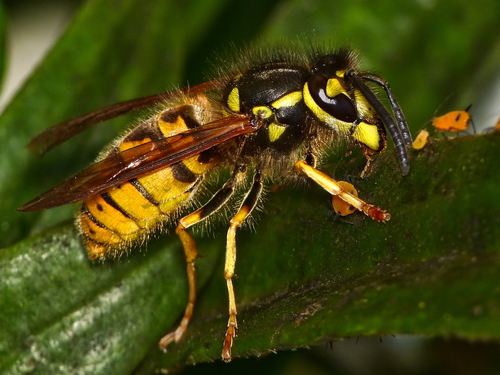
California Yellowjacket Vespula sulphurea
The scientific name of the California Yellowjacket is Vespula sulphurea. It is a species of insect in the family Vespidae (hornets), order Hymenoptera. The name dates from 1854.
- Scientific name
- Vespula sulphurea (de Saussure, 1854)
- Common name
- California Yellowjacket
- Genus
- Vespula
- Family
- Vespidae (Hornets)
- Order
- Hymenoptera
- Class
- Insecta
- Recorded in
- 2 countries
- Name status
- accepted in the Catalogue of Life

Overview
Vespula sulphurea feeds on and pollinates fennel, California figwort, and chaparral broom.
Written 26 November 2026 from the sources listed below. Each statement was checked against the passage it cites; statements that could not be supported were removed.
Appearance
The California Yellowjacket is identified by its common name.[1]
Habitat
Its distribution includes the Upper Sonoran Fauna region of California, southern Oregon, western Nevada, southern Arizona, and northern Baja California.[2][3]
Diet
The California Yellowjacket feeds on fennel, California figwort, and chaparral broom. It may occasionally seek sugary foods from human drinks and fruits.[4][5]
Behaviour
It generally leaves people and their food undisturbed and rarely appears in yellowjacket traps.[6][7]
Reproduction and life cycle
Colonies typically contain only a few hundred wasps at their peak population. The maximum documented worker population in a nest is 1,100 individuals.[8][9]
Colonies typically die out by the end of summer.[10]
Conservation
The California scrub jay is a documented predator of the California Yellowjacket. Spiders belonging to the genus Peucetia are also documented predators.[11][12]
Classification of the California Yellowjacket
| Kingdom | Animalia |
|---|---|
| Phylum | Arthropoda |
| Subphylum | Hexapoda |
| Class | Insecta (Insect) |
| Order | Hymenoptera (Ants) |
| Suborder | Apocrita (Ants) |
| Infraorder | Aculeata |
| Superfamily | Vespoidea (Vespoid Wasps) |
| Family | Vespidae (Hornets) |
| Subfamily | Vespinae |
| Genus | Vespula (Yellow Jackets) |
| Species | Vespula sulphurea (de Saussure, 1854) |
Where the California Yellowjacket is found
Checklists and occurrence records place Vespula sulphurea in 2 countries. GBIF holds 443 georeferenced records of it.
Countries
Regions and cities with the most records
- California, United States 375
- Soledad, United States 27
- Azusa, United States 25
- Glendora, United States 25
- Altadena, United States 23
- Arcadia, United States 21
- Monrovia, United States 21
- San Dimas, United States 21
- La Cañada Flintridge, United States 20
- La Verne, United States 19
- La Crescenta-Montrose, United States 18
- Los Gatos, United States 18
- Morgan Hill, United States 18
- Pasadena, United States 18
- Temple City, United States 18
- Burbank, United States 17
- Covina, United States 17
- Glendale, United States 17
- Greenfield, United States 17
- San Jose, United States 17
- Campbell, United States 16
- Claremont, United States 16
- Alhambra, United States 15
- San Gabriel, United States 15
- South Pasadena, United States 14
- Baja California, Mexico 13
- Duarte, United States 13
- Saratoga, United States 13
- Diamond Bar, United States 12
- Pomona, United States 12
- Rancho Cucamonga, United States 12
- Vincent, United States 12
- Montclair, United States 11
- Oregon, United States 11
- Upland, United States 11
- Castaic, United States 9
A number beside a place is its count of GBIF occurrence records. A place without a number comes from a checklist alone. Records show where a species has been observed or collected, which can include escapes and vagrants.
Common names
English
- California Yellowjacket
Names in 1 other language
- Spanish
- Avispa chaqueta amarilla de California
Related species
-
 German YellowjacketVespula germanica
-
 Common WaspVespula vulgaris
-
 Eastern YellowjacketVespula maculifrons
-
 Southern YellowjacketVespula squamosa
-
 Western YellowjacketVespula pensylvanica
-
 BlackjacketVespula consobrina
-
 Alaska YellowjacketVespula alascensis
-
 Common Asian YellowjacketVespula flaviceps
Compare
Questions and answers
What is the scientific name of the California Yellowjacket?
The scientific name of the California Yellowjacket is Vespula sulphurea. Written with its author, the full name is Vespula sulphurea (de Saussure, 1854).
Which family does the California Yellowjacket belong to?
Vespula sulphurea belongs to the family Vespidae, in the order Hymenoptera and the class Insecta.
Where is the California Yellowjacket found?
Checklists and occurrence records place Vespula sulphurea in 2 countries: United States and Mexico.
What kind of food do yellow jackets eat?
The California Yellowjacket feeds on fennel, California figwort, and chaparral broom. It may occasionally seek sugary foods from human drinks and fruits.[4][5]
What does a yellow jacket live in?
The California Yellowjacket builds nests underground.[13]
Sources
Passages the profile rests on
- Vespula sulphurea is identified by the common name California yellowjacket. Source passage: “Vespula sulphurea, the California yellowjacket, is a species of wasp within the family Vespidae.” — English Wikipedia
- The species occurs in the Upper Sonoran Fauna region of California. Source passage: “It is found distributed in the Upper Sonoran Fauna of California” — English Wikipedia
- Its recorded range also includes southern Oregon, western Nevada, southern Arizona, and northern Baja California. Source passage: “but has been known to occur in southern Oregon, western Nevada, southern Arizona, and northern Baja California.” — English Wikipedia
- The species feeds on plants including fennel, California figwort, and chaparral broom. Source passage: “It feeds and pollinates on plants such as fennel, California figwort, and the chaparral broom.” — English Wikipedia
- The species may occasionally seek sugary foods from human drinks and fruits. Source passage: “These wasps may occasionally seek out sweets from our sodas and fruits” — wasps.ucr.edu
- The species generally leaves people and their food undisturbed. Source passage: “however, most of the time, they leave humans and their food alone” — wasps.ucr.edu
- The species rarely appears in yellowjacket traps. Source passage: “and they rarely show up in yellowjacket traps.” — wasps.ucr.edu
- The maximum documented worker population in a nest is 1,100 individuals. Source passage: “with a maximum known worker count of 1,100.” — English Wikipedia
- Colonies of this species typically contain only a few hundred wasps at their peak population. Source passage: “These wasps typically make small colonies with only a few hundred wasps at peak population” — wasps.ucr.edu
- Colonies of this species typically die out by the end of summer. Source passage: “and the nests typically die out by the end of summer.” — wasps.ucr.edu
- The California scrub jay is a documented predator of this species. Source passage: “It is preyed upon by the California scrub jay and spiders in the Peucetia genus.” — English Wikipedia
- Spiders belonging to the genus Peucetia are documented predators of this species. Source passage: “It is preyed upon by the California scrub jay and spiders in the Peucetia genus.” — English Wikipedia
- Its nests are located underground. Source passage: “Nests of the species are found underground” — English Wikipedia
Data
- Catalogue of Life, 2026-10-16 XR cc by
- Global Biodiversity Information Facility CC BY 4.0
- Wikidata CC0
- GeoNames CC BY 4.0
- Wikimedia Commons per image; credit shown with each image
- Within the Catalogue of Life, this name comes from Vespidae based on Zoological-Botanical Database cc by
This species in other databases
Page built on 27 November 2026. See how the catalog is made and all sources and licences.
Cite this page
ScientificNames.org. (2026). Vespula sulphurea (California Yellowjacket). Retrieved November 27, 2026, from https://scientificnames.org/species/vespula-sulphurea
“Vespula sulphurea (California Yellowjacket).” ScientificNames.org, 2026, scientificnames.org/species/vespula-sulphurea. Accessed 27 Nov. 2026.
ScientificNames.org. “Vespula sulphurea (California Yellowjacket).” Accessed November 27, 2026. https://scientificnames.org/species/vespula-sulphurea.
@misc{scientificnames_vespula_sulphurea_california_yellowjacket,
  author = {{ScientificNames.org}},
  title = {Vespula sulphurea (California Yellowjacket)},
  year = {2026},
  url = {https://scientificnames.org/species/vespula-sulphurea},
  note = {Accessed 2026-11-27}
}