Species · Fishes
Fantail Flounder Xystreurys liolepis
The scientific name of the Fantail Flounder is Xystreurys liolepis. It is a species of fish in the family Paralichthyidae (sand flounders), order Pleuronectiformes. The name dates from 1880.
- Scientific name
- Xystreurys liolepis Jordan & Gilbert, 1880
- Common name
- Fantail Flounder
- Genus
- Xystreurys
- Family
- Paralichthyidae (Sand Flounders)
- Order
- Pleuronectiformes
- Class
- Teleostei
- Red List category
- LC Least Concern
- Environment
- marine
- Recorded in
- 2 countries
- Name status
- accepted in the Catalogue of Life

Overview
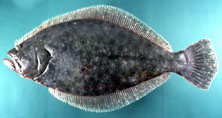
Xystreurys liolepis inhabits soft-bottom environments, including mud, sand, gravel, beaches, estuaries, mangroves, and seagrass habitats. It has a grey-brown eyed side with darker brown streaks and small pale spots, and its lateral line arches strongly above the pectoral fin.
Written 28 November 2026 from the sources listed below. Each statement was checked against the passage it cites; statements that could not be supported were removed.
Habitat
Fantail Flounder inhabits soft-bottom environments, including mud, sand, gravel, beaches, estuaries, mangroves, and seagrass habitats.[1]
Its documented geographic range extends from Southern California to the Gulf of California.[2]
Diet
Fantail Flounder feeds on mobile benthic crustaceans, including shrimps and crabs.[3]
Appearance
The body height measures 50–55% of standard length. The eyes are generally located on the left side of the head but occasionally occur on the right side.[4][5]
The mouth measures 36–38% of head length and extends beneath the middle of the lower eye. The teeth are small and conical, with one row in each jaw and better development on the blind side.[6][7]
The fish has 2 plus 6–7 short, thick gill rakers. The dorsal fin originates above the front half of the upper eye.[8][9]
The pectoral fin on the eyed side is as long as or longer than the head. The pelvic fins are symmetrical in position on the belly and equal in size.[10][11]
The lateral line arches strongly above the pectoral fin and has a branch beneath the lower eye. It has 120–123 scales.[12][13]
The scales on both sides of the body are smooth, and small scales are dispersed between larger scales.[14]
The eyed side is grey-brown with darker brown streaks and small pale spots. Some individuals have two large dark blotches on the lateral line, one at the end of its arch and another before the tail base.[15][16]
The dorsal, anal, and caudal fins have dark spots. The pectoral fins have dark bars.[17][18]
Classification of the Fantail Flounder
| Kingdom | Animalia |
|---|---|
| Phylum | Chordata |
| Subphylum | Vertebrata |
| Infraphylum | Gnathostomata |
| Parvphylum | Osteichthyes |
| Gigaclass | Actinopterygii |
| Superclass | Actinopteri |
| Class | Teleostei (Teleost) |
| Order | Pleuronectiformes |
| Suborder | Pleuronectoidei |
| Family | Paralichthyidae (Sand Flounders) |
| Genus | Xystreurys |
| Species | Xystreurys liolepis Jordan & Gilbert, 1880 |
Where the Fantail Flounder is found
Checklists and occurrence records place Xystreurys liolepis in 2 countries. GBIF holds 862 georeferenced records of it.
Countries
Regions and cities with the most records
- Torrance, United States 113
- Redondo Beach, United States 105
- Gardena, United States 95
- Lomita, United States 88
- Lawndale, United States 86
- West Carson, United States 86
- Hermosa Beach, United States 84
- Carson, United States 83
- El Segundo, United States 82
- Manhattan Beach, United States 81
- Seal Beach, United States 80
- Hawthorne, United States 79
- Lennox, United States 78
- Long Beach, United States 78
- Rancho Palos Verdes, United States 77
- Inglewood, United States 76
- Westmont, United States 71
- San Diego, United States 62
- Compton, United States 56
- Huntington Beach, United States 53
- Santa Monica, United States 51
- Westminster, United States 47
- East Rancho Dominguez, United States 46
- Willowbrook, United States 42
- Fountain Valley, United States 40
- Lakewood, United States 39
- Encinitas, United States 38
- Cypress, United States 36
- California, United States 34
- Newport Beach, United States 34
- Costa Mesa, United States 30
- Port Hueneme, United States 30
- Oxnard, United States 29
- Stanton, United States 29
- San Clemente, United States 28
- Dana Point, United States 26
A number beside a place is its count of GBIF occurrence records. A place without a number comes from a checklist alone. Records show where a species has been observed or collected, which can include escapes and vagrants.
Common names
English
- Fantail Flounder
- Fantail Sole
Names in 4 other languages
- Chinese
- 滑鱗扇尾鮃
- French
- Rite ventail, Rite éventail
- Russian
- Калифорнийский веерохвост
- Spanish
- lenguado cola de abanico
Related species
-
 Xystreurys rasilis
-
 Summer FlounderParalichthys dentatus
-
 Pacific SanddabCitharichthys sordidus
-
 Olive FlounderParalichthys olivaceus
-
 Southern FlounderParalichthys lethostigma
-
 California HalibutParalichthys californicus
-
 Gulf FlounderParalichthys albigutta
-
 Chinese BrillTephrinectes sinensis
Compare
Questions and answers
What is the scientific name of the Fantail Flounder?
The scientific name of the Fantail Flounder is Xystreurys liolepis. Written with its author, the full name is Xystreurys liolepis Jordan & Gilbert, 1880.
Which family does the Fantail Flounder belong to?
Xystreurys liolepis belongs to the family Paralichthyidae, in the order Pleuronectiformes and the class Teleostei.
Where is the Fantail Flounder found?
Checklists and occurrence records place Xystreurys liolepis in 2 countries: United States and Mexico.
What is the conservation status of the Fantail Flounder?
The IUCN Red List category recorded for Xystreurys liolepis is Least Concern (LC).
What other names does the Fantail Flounder have?
Xystreurys liolepis is also known in English as Fantail Sole.
What do flounder fish eat?
Fantail Flounder feeds on mobile benthic crustaceans, including shrimps and crabs.[3]
Sources
Passages the profile rests on
- The species inhabits soft-bottom environments including mud, sand, gravel, beaches, estuaries, mangroves, and seagrass habitats. Source passage: “Soft bottom (mud/sand/gravel/beach/estuary/mangrove/seagrass)” — biogeodb.stri.si.edu
- The documented geographic range extends from Southern California to the Gulf of California. Source passage: “Southern California to the Gulf of California.” — biogeodb.stri.si.edu
- The species feeds on mobile benthic crustaceans, including shrimps and crabs. Source passage: “Mobile benthic crustacea (shrimps/crabs)” — biogeodb.stri.si.edu
- The body height measures 50–55% of standard length. Source passage: “Body deep, height 50-55% of SL” — biogeodb.stri.si.edu
- The eyes are generally located on the left side of the head but occasionally occur on the right side. Source passage: “eyes on left side (uncommonly on right side)” — biogeodb.stri.si.edu
- The mouth measures 36–38% of head length and extends beneath the middle of the lower eye. Source passage: “mouth 36-38% of head length, ends under middle lower eye” — biogeodb.stri.si.edu
- The teeth are small and conical, with one row in each jaw and better development on the blind side. Source passage: “teeth small, conical, 1 row each jaw, better developed on blind side” — biogeodb.stri.si.edu
- The fish has 2 plus 6–7 short, thick gill rakers. Source passage: “2+6-7 short, fat gill rakers” — biogeodb.stri.si.edu
- The dorsal fin originates above the front half of the upper eye. Source passage: “origin over front half of top eye” — biogeodb.stri.si.edu
- The pectoral fin on the eyed side is as long as or longer than the head. Source passage: “eye side pectoral equal to or longer than head” — biogeodb.stri.si.edu
- The pelvic fins are symmetrical in position on the belly and equal in size. Source passage: “pelvics in symmetric position on belly, of equal sizes” — biogeodb.stri.si.edu
- The lateral line arches strongly above the pectoral fin and has a branch beneath the lower eye. Source passage: “lateral line strongly arched over pectoral fin, with branch under lower eye” — biogeodb.stri.si.edu
- The lateral line has 120–123 scales. Source passage: “lateral line with 120-123 scales” — biogeodb.stri.si.edu
- The scales on both sides of the body are smooth and small scales are dispersed between larger scales. Source passage: “scales on both sides of body smooth, small scales dispersed between large scales” — biogeodb.stri.si.edu
- The eyed side is grey-brown with darker brown streaks and small pale spots. Source passage: “Eye side grey-brown, streaked with darker brown and small pale spots” — biogeodb.stri.si.edu
- Some individuals have two large dark blotches on the lateral line, one at the end of its arch and another before the tail base. Source passage: “sometimes 2 large dark blotches on lateral line, 1 at end of arch, other before tail base” — biogeodb.stri.si.edu
- The dorsal, anal, and caudal fins have dark spots. Source passage: “dorsal, anal and tail with dark spots” — biogeodb.stri.si.edu
- The pectoral fins have dark bars. Source passage: “pectorals with dark bars” — biogeodb.stri.si.edu
Data
- Catalogue of Life, 2026-10-16 XR cc by
- Global Biodiversity Information Facility CC BY 4.0
- Wikidata CC0
- GeoNames CC BY 4.0
- Wikimedia Commons per image; credit shown with each image
- Within the Catalogue of Life, this name comes from World Register of Marine Species cc by
References
- Jordan, D. S., & Gilbert, C. H. (1880). Description of a new flounder (Xystreurys liolepis) from Santa Catilina [sic] island California. Proceedings of the United States National Museum, v. 3 (no. 107): 34–36. https://doi.org/10.5479/si.00963801.3-107.34 Link where the name was published
This species in other databases
- Catalogue of Life 5CQKS
- Wikidata Q1978396
- iNaturalist 115200
- WoRMS urn:lsid:marinespecies.org:taxname:283199
- ITIS 172800
Page built on 30 November 2026. See how the catalog is made and all sources and licences.
Cite this page
ScientificNames.org. (2026). Xystreurys liolepis (Fantail Flounder). Retrieved November 30, 2026, from https://scientificnames.org/species/xystreurys-liolepis
“Xystreurys liolepis (Fantail Flounder).” ScientificNames.org, 2026, scientificnames.org/species/xystreurys-liolepis. Accessed 30 Nov. 2026.
ScientificNames.org. “Xystreurys liolepis (Fantail Flounder).” Accessed November 30, 2026. https://scientificnames.org/species/xystreurys-liolepis.
@misc{scientificnames_xystreurys_liolepis_fantail_flounder,
  author = {{ScientificNames.org}},
  title = {Xystreurys liolepis (Fantail Flounder)},
  year = {2026},
  url = {https://scientificnames.org/species/xystreurys-liolepis},
  note = {Accessed 2026-11-30}
}