Species · Flowering plants
Arkansas Yucca Yucca arkansana
The scientific name of the Arkansas Yucca is Yucca arkansana. It is a species of flowering plant in the family Asparagaceae (asparagus family), order Asparagales.
- Scientific name
- Yucca arkansana Trel.
- Common name
- Arkansas Yucca
- Genus
- Yucca
- Family
- Asparagaceae (Asparagus Family)
- Order
- Asparagales
- Class
- Liliopsida
- Red List category
- LC Least Concern
- Recorded in
- 1 country
- Name status
- accepted in the Catalogue of Life

Overview
Yucca arkansana is native to Texas, Oklahoma, Arkansas, Missouri, and Kansas. It is either stemless or has a stem no taller than 76 cm, and its greenish-white flowers grow on flowering stalks that can reach 180 cm in height.
Written 26 November 2026 from the sources listed below. Each statement was checked against the passage it cites; statements that could not be supported were removed.
Habitat
Arkansas Yucca generally grows in gravelly, sunlit environments, including rocky outcrops and prairies.[1]
In southern Missouri, it grows in glades, open rocky woods, and roadsides. In Missouri, it occurs only in the southern Ozarks along the Arkansas border.[2][3]
Appearance
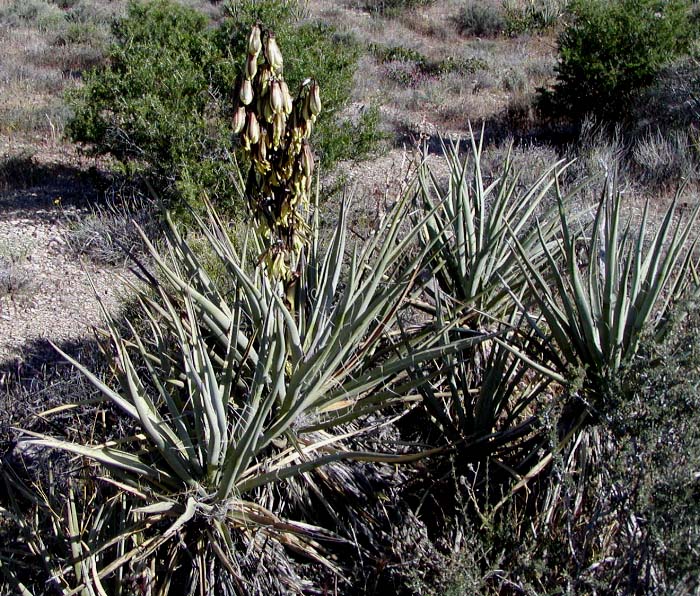
Arkansas Yucca is either stemless or has a stem no taller than 76 cm. Its flowers are greenish-white, and its flowering stalk can reach 180 cm in height.[4][5][6]
Its leaves are softer than those of Yucca glauca and lack spine tips.[7]
Reproduction and life cycle
Female yucca moths pollinate yucca flowers while depositing their eggs into the flower ovaries. Their specialized anatomy and behaviors enable them to cross-fertilize flowers while laying eggs.[8][9]
Yucca flowers generally cannot produce viable seeds without cross-pollination by moths. Yucca moth larvae consume some, but not all, of the developing seeds.[10][11]
Several yucca moth species use Arkansas Yucca as a host plant for laying eggs. Tegeticula intermedia is one of these species.[12][13]
Similar species
Arkansas Yucca has softer leaves than Yucca glauca, and its leaves lack spine tips.[7]
Classification of the Arkansas Yucca
| Kingdom | Plantae |
|---|---|
| Subkingdom | Pteridobiotina |
| Phylum | Tracheophyta |
| Class | Liliopsida |
| Order | Asparagales |
| Family | Asparagaceae (Asparagus Family) |
| Genus | Yucca (Spanish-bayonet) |
| Species | Yucca arkansana Trel. |
Where the Arkansas Yucca is found
Checklists and occurrence records place Yucca arkansana in 1 country across North America. GBIF holds 2,308 georeferenced records of it.
Countries
Regions and cities with the most records
- Texas, United States 1,740
- Addison, United States 370
- Allen, United States 354
- Plano, United States 353
- Richardson, United States 352
- Garland, United States 346
- Rowlett, United States 335
- Sachse, United States 334
- Colleyville, United States 303
- Benbrook, United States 299
- White Settlement, United States 294
- Fort Worth, United States 289
- Murphy, United States 269
- Arlington, United States 263
- Wylie, United States 242
- Haltom City, United States 241
- North Richland Hills, United States 233
- Saginaw, United States 223
- Watauga, United States 218
- McKinney, United States 215
- Bedford, United States 214
- Hurst, United States 214
- Highland Village, United States 200
- Corinth, United States 195
- Farmers Branch, United States 190
- Frisco, United States 188
- Dallas, United States 166
- Rockwall, United States 163
- Lewisville, United States 158
- Arkansas, United States 146
- Carrollton, United States 145
- Flower Mound, United States 144
- Mesquite, United States 142
- Prosper, United States 140
- Oklahoma, United States 139
- Coppell, United States 137
A number beside a place is its count of GBIF occurrence records. A place without a number comes from a checklist alone. Records show where a species has been observed or collected, which can include escapes and vagrants.
Common names
English
- Arkansas Yucca
Names in 1 other language
- French
- Yucca de l'Arkansas
Synonyms
4 other scientific names have been used for this species and are now treated as synonyms of Yucca arkansana.
- Yucca angustifolia var. mollis Engelm.
- Yucca arkansana var. paniculata McKelvey
- Yucca glauca var. mollis (Engelm.) Branner & Coville
- Yucca louisianensis var. paniculata (McKelvey) Shinners
Related species
-
 Joshua TreeYucca brevifolia
-
 Adam's-needleYucca filamentosa
-
 Adam's NeedleYucca gloriosa
-
 Spineless YuccaYucca gigantea
-
 Big Bend YuccaYucca rostrata
-
 Spanish BayonetYucca aloifolia
-
 Banana YuccaYucca baccata
-
 Mohave YuccaYucca schidigera
Compare
Questions and answers
What is the scientific name of the Arkansas Yucca?
The scientific name of the Arkansas Yucca is Yucca arkansana. Written with its author, the full name is Yucca arkansana Trel..
Which family does the Arkansas Yucca belong to?
Yucca arkansana belongs to the family Asparagaceae, in the order Asparagales and the class Liliopsida.
Where is the Arkansas Yucca found?
Checklists and occurrence records place Yucca arkansana in 1 country: United States.
What is the conservation status of the Arkansas Yucca?
The IUCN Red List category recorded for Yucca arkansana is Least Concern (LC).
What is the habitat of yuccas?
Arkansas Yucca generally grows in gravelly, sunlit environments, including rocky outcrops and prairies. In southern Missouri, it grows in glades, open rocky woods, and roadsides.[1][3]
What animals eat yuccas?
Yucca moth larvae consume some, but not all, of the developing seeds in yucca flowers.[11]
Sources
Passages the profile rests on
- This species generally grows in gravelly, sunlit environments, including rocky outcrops and prairies. Source passage: “It generally grows in gravelly, sunlit locations such as rocky outcrops, prairies, etc.” — English Wikipedia
- In Missouri, Arkansas yucca occurs only in the southern Ozarks along the Arkansas border. Source passage: “Another soapweed, Arkansas yucca (Yucca arkansana), is a native that in our state is found only in the southern portion of Missouri’s Ozarks, along the Arkansas border.” — mdc.mo.gov
- In southern Missouri, Arkansas yucca grows in glades, open rocky woods, and roadsides. Source passage: “Y. arkansana is found in glades, open rocky woods, and roadsides in southern Missouri” — mdc.mo.gov
- Yucca arkansana is either stemless or has a stem no taller than 76 cm. Source passage: “acaulescent or with a stem no more than 76 cm tall.” — English Wikipedia
- Its flowers are greenish-white. Source passage: “Flowers are greenish-white” — English Wikipedia
- Its flowering stalk can reach 180 cm in height. Source passage: “borne on a flowering stalk up to 180 cm (72 inches) tall.” — English Wikipedia
- Arkansas yucca has softer leaves than Yucca glauca, and its leaves lack spine tips. Source passage: “it has softer leaves that are not spine-tipped.” — mdc.mo.gov
- Female yucca moths pollinate yucca flowers while depositing their eggs into the flower ovaries. Source passage: “Only a certain type of moth can fertilize yuccas, which occurs as the female moth deposits eggs into the flower’s ovary.” — mdc.mo.gov
- Female yucca moths possess specialized anatomy and behaviors that enable them to cross-fertilize yucca flowers while laying eggs. Source passage: “The yucca can afford that price because the female moth possesses the specialized anatomy, and even special behaviors, to cross-fertilize the flowers as she deposits her eggs.” — mdc.mo.gov
- Yucca flowers generally cannot produce viable seeds without cross-pollination by moths. Source passage: “Without the cross-pollination effected by the moth, the yucca flowers generally cannot produce viable seeds.” — mdc.mo.gov
- Yucca moth larvae consume some, but not all, of the developing seeds in yucca flowers. Source passage: “The moth larvae, hatching from eggs laid in the pistil of the yucca flower, will eat some but not all of the yucca’s hundreds of developing seeds.” — mdc.mo.gov
- Several yucca moth species use Yucca arkansana as a host plant for laying eggs. Source passage: “A number of yucca moths lay their eggs upon Y. arkansana as a host plant” — English Wikipedia
- Tegeticula intermedia is one of the yucca moth species that lays eggs on Arkansas yucca. Source passage: “an example being Tegeticula intermedia.” — English Wikipedia
Data
- Catalogue of Life, 2026-10-16 XR cc by
- Global Biodiversity Information Facility CC BY 4.0
- Wikidata CC0
- GeoNames CC BY 4.0
- Wikimedia Commons per image; credit shown with each image
- Within the Catalogue of Life, this name comes from The World Checklist of Vascular Plants (WCVP) cc by
References
- Rep. (Annual) Missouri Bot. Gard. 13: 63 (1902) where the name was published
This species in other databases
- Catalogue of Life 5CT4Q
- Wikidata Q2601585
- iNaturalist 170383
- World Flora Online wfo-0000752097
- GRIN 452327
Page built on 27 November 2026. See how the catalog is made and all sources and licences.
Cite this page
ScientificNames.org. (2026). Yucca arkansana (Arkansas Yucca). Retrieved November 27, 2026, from https://scientificnames.org/species/yucca-arkansana
“Yucca arkansana (Arkansas Yucca).” ScientificNames.org, 2026, scientificnames.org/species/yucca-arkansana. Accessed 27 Nov. 2026.
ScientificNames.org. “Yucca arkansana (Arkansas Yucca).” Accessed November 27, 2026. https://scientificnames.org/species/yucca-arkansana.
@misc{scientificnames_yucca_arkansana_arkansas_yucca,
  author = {{ScientificNames.org}},
  title = {Yucca arkansana (Arkansas Yucca)},
  year = {2026},
  url = {https://scientificnames.org/species/yucca-arkansana},
  note = {Accessed 2026-11-27}
}