Species · Flowering plants
Plains Yucca Yucca campestris
The scientific name of the Plains Yucca is Yucca campestris. It is a species of flowering plant in the family Asparagaceae (asparagus family), order Asparagales.
- Scientific name
- Yucca campestris McKelvey
- Common name
- Plains Yucca
- Genus
- Yucca
- Family
- Asparagaceae (Asparagus Family)
- Order
- Asparagales
- Class
- Liliopsida
- Red List category
- EN Endangered
- Recorded in
- 1 country
- Name status
- accepted in the Catalogue of Life

Overview
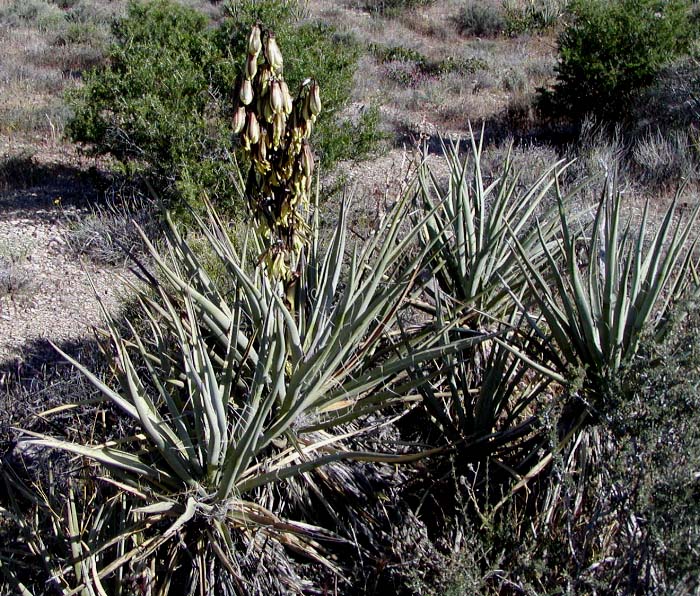
Yucca campestris is endemic to the Panhandle region of northwestern Texas. It is a low-growing plant that forms large colonies of leaf rosettes and produces showy white flowers.
Written 27 November 2026 from the sources listed below. Each statement was checked against the passage it cites; statements that could not be supported were removed.
Appearance
Its leaves can reach 65 cm in length and rarely exceed 15 mm in width. Its flowers are white and drooping, arranged in showy panicles.[1][2][3][4]
Its fruit is a dry capsule containing glossy black seeds.[5]
Habitat
Plains Yucca grows in deep sandy soils. It occurs in Havard oak and sand sagebrush vegetation communities in east-central and southeastern areas.[6][7]
Conservation
Plains Yucca is considered endangered. Habitat loss is identified as the main reason for its endangered status.[8][9]
Uses
Plains Yucca can be cultivated as an ornamental plant in desert regions. When cultivated, it prefers warm climates and full sunlight.[10][11]
Classification of the Plains Yucca
| Kingdom | Plantae |
|---|---|
| Subkingdom | Pteridobiotina |
| Phylum | Tracheophyta |
| Class | Liliopsida |
| Order | Asparagales |
| Family | Asparagaceae (Asparagus Family) |
| Genus | Yucca (Spanish-bayonet) |
| Species | Yucca campestris McKelvey |
Where the Plains Yucca is found
Checklists and occurrence records place Yucca campestris in 1 country across North America. GBIF holds 555 georeferenced records of it.
Countries
Regions and cities with the most records
- Texas, United States 418
- New Mexico, United States 101
- Lubbock, United States 71
- Midland, United States 34
- Odessa, United States 14
- West Odessa, United States 13
- Big Spring, United States 11
- Roswell, United States 9
- Oklahoma, United States 6
- Abilene, United States 5
- Plainview, United States 5
- Hereford, United States 4
- Amarillo, United States 3
A number beside a place is its count of GBIF occurrence records. A place without a number comes from a checklist alone. Records show where a species has been observed or collected, which can include escapes and vagrants.
Common names
English
- Plains Yucca
Names in 1 other language
- Spanish
- Yuca de las planicies
Related species
-
 Joshua TreeYucca brevifolia
-
 Adam's-needleYucca filamentosa
-
 Adam's NeedleYucca gloriosa
-
 Spineless YuccaYucca gigantea
-
 Big Bend YuccaYucca rostrata
-
 Spanish BayonetYucca aloifolia
-
 Banana YuccaYucca baccata
-
 Mohave YuccaYucca schidigera
Compare
Questions and answers
What is the scientific name of the Plains Yucca?
The scientific name of the Plains Yucca is Yucca campestris. Written with its author, the full name is Yucca campestris McKelvey.
Which family does the Plains Yucca belong to?
Yucca campestris belongs to the family Asparagaceae, in the order Asparagales and the class Liliopsida.
Where is the Plains Yucca found?
Checklists and occurrence records place Yucca campestris in 1 country: United States.
What is the conservation status of the Plains Yucca?
The IUCN Red List category recorded for Yucca campestris is Endangered (EN).
Sources
Passages the profile rests on
- Its leaves can reach 65 cm in length. Source passage: “Leaves are long and narrow, up to 65 cm long” — English Wikipedia
- Its leaves rarely exceed 15 mm in width. Source passage: “but rarely more than 15 mm wide.” — English Wikipedia
- Its flowers are white and drooping. Source passage: “Flowers are white and drooping.” — English Wikipedia
- The species produces showy white flowers arranged in panicles. Source passage: “panicles of showy white flowers.” — English Wikipedia
- Its fruit is a dry capsule containing glossy black seeds. Source passage: “Fruit is a dry capsule with glossy black seeds.” — English Wikipedia
- The species grows in deep sandy soils. Source passage: “Yucca campestris grows in deep sands” — English Wikipedia
- Plains yucca occurs in Havard oak and sand sagebrush vegetation communities in east-central and southeastern areas. Source passage: “Havard oak-sand sagebrush (Artemisia filifolia)-plains yucca (Yucca campestris)/sand bluestem (Andropogon hallii)-purple threeawn (Aristida purpurea) in east-central and southeast” — fs.usda.gov
- The species is considered endangered. Source passage: “It is considered to be endangered” — English Wikipedia
- Habitat loss is identified as the main reason for the species' endangered status. Source passage: “mainly due to habitat loss.” — English Wikipedia
- The species can be cultivated as an ornamental plant in desert regions. Source passage: “It can be grown as an ornamental in desert regions” — English Wikipedia
- The species prefers warm climates and full sunlight when cultivated. Source passage: “preferring warm climates and full sunlight.” — English Wikipedia
Data
- Catalogue of Life, 2026-10-16 XR cc by
- Global Biodiversity Information Facility CC BY 4.0
- Wikidata CC0
- GeoNames CC BY 4.0
- Wikimedia Commons per image; credit shown with each image
- Within the Catalogue of Life, this name comes from The World Checklist of Vascular Plants (WCVP) cc by
References
- Yuccas Southw. U.S. 2: 173 (1947) where the name was published
This species in other databases
- Catalogue of Life 5CT59
- Wikidata Q1444632
- iNaturalist 122612
- World Flora Online wfo-0000752232
- GRIN 459639
Page built on 28 November 2026. See how the catalog is made and all sources and licences.
Cite this page
ScientificNames.org. (2026). Yucca campestris (Plains Yucca). Retrieved November 28, 2026, from https://scientificnames.org/species/yucca-campestris
“Yucca campestris (Plains Yucca).” ScientificNames.org, 2026, scientificnames.org/species/yucca-campestris. Accessed 28 Nov. 2026.
ScientificNames.org. “Yucca campestris (Plains Yucca).” Accessed November 28, 2026. https://scientificnames.org/species/yucca-campestris.
@misc{scientificnames_yucca_campestris_plains_yucca,
  author = {{ScientificNames.org}},
  title = {Yucca campestris (Plains Yucca)},
  year = {2026},
  url = {https://scientificnames.org/species/yucca-campestris},
  note = {Accessed 2026-11-28}
}