Species · Flowering plants
Soaptree Yucca elata
The scientific name of the Soaptree is Yucca elata. It is a species of flowering plant in the family Asparagaceae (asparagus family), order Asparagales.
- Scientific name
- Yucca elata (Engelm.) Engelm.
- Common name
- Soaptree
- Genus
- Yucca
- Family
- Asparagaceae (Asparagus Family)
- Order
- Asparagales
- Class
- Liliopsida
- Red List category
- LC Least Concern
- Recorded in
- 2 countries
- Name status
- accepted in the Catalogue of Life

Overview
Yucca elata grows in dry, semi-desert conditions and occurs in desert scrub communities and semi-desert grasslands.
Written 26 November 2026 from the sources listed below. Each statement was checked against the passage it cites; statements that could not be supported were removed.
Appearance
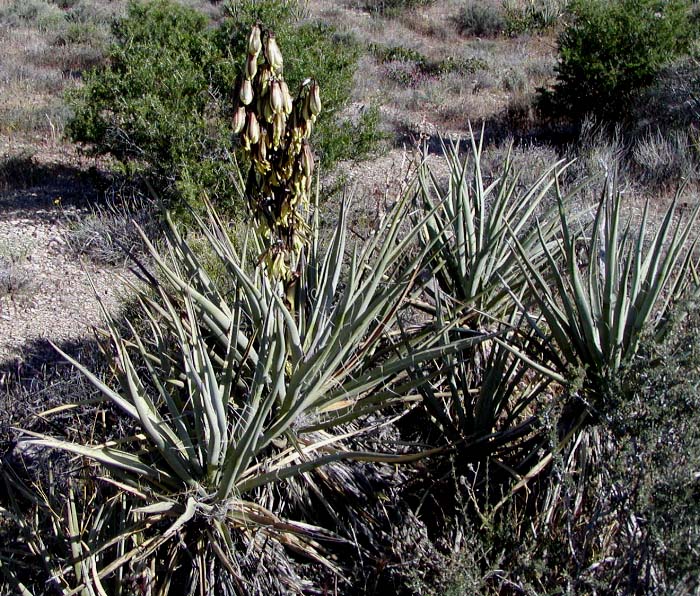
Its flowers are creamy-white and bell-shaped, sometimes tinged with pink or green. They measure between 32 and 57 millimeters long.[1][2]
Its fruit is a brown capsule that splits into three sections when mature. The capsules measure 4–8 centimeters long and 2–4 centimeters wide, and the seeds are black.[3][4][5]
Soaptree grows between 1.2 and 4.5 meters tall. Its leaves measure between 25 and 95 centimeters long and 0.2 to 1.3 centimeters wide.[6][7]
Habitat
Soaptree grows in dry, semi-desert conditions and occurs in numerous desert scrub communities. It is an important component of semi-desert grasslands.[8][9][10]
In southeastern Arizona's San Simon Valley, it occurs in communities dominated by creosotebush, tarbush, mesquite, or acacia. It also occurs in shrub communities in the Huachuca Mountains below 1,370 meters.[11][12]
Soaptree occurs in grasslands dominated by grama grasses, threeawns, tobosagrass, and dropseeds. It is a predominant shrub in the Mesilla Basin dune fields of New Mexico and adjacent Chihuahua, Mexico.[13][14]
Diet
Cattle use Soaptree leaves as a secondary or seasonal food source and browse them during winter and spring when young regrowth is available. At the Jornada Experimental Range, cattle consumed leaves amounting to 14% of their diet in March and 17% in December.[15][16][17]
Soaptree leaves can constitute up to 20% of cattle diets in winter and spring in southern New Mexico. White-throated woodrats obtain up to 33% of their diet by volume from the leaves, while southern plains woodrats obtain up to 16%.[18][19][20]
Black-tailed jackrabbits consume a small proportion of their diet from the leaves when they are within reach. Kangaroo rats consume the seeds as a minor component of their diet.[21][22]
Desert mule deer consume the leaves and inflorescence stalks. Pronghorn consume the inflorescences.[23][24]
Behaviour
Soaptree does not produce flowers every year. It is highly tolerant of cold conditions but requires abundant sunlight.[25][26]
Reproduction and life cycle
Soaptree fruit capsules mature during summer and split into three sections to release seeds. Yucca moth larvae can leave holes in the plant's trunk when they escape.[27][28]
Conservation
Although Soaptree is widely distributed, its population appears to be decreasing.[29]
Uses
Native Americans used Soaptree leaf fibers to manufacture sandals, belts, cloth, baskets, cords, and mats. Apache communities used the fibers to make dental floss and rope.[30][31]
Native Americans consumed Soaptree flowers. Its trunk and roots contain a soapy substance rich in saponins that was historically used to make soap and shampoo.[32][33][34]
Ranchers have used chopped Soaptree trunks and leaves as emergency cattle feed during droughts.[35]
Similar species
Soaptree has been reported to hybridize with soapweed yucca in northern Arizona and New Mexico. It reportedly hybridizes with Buckley yucca in Pecos and Howard Counties, Texas, and southeastern New Mexico.[36][37]
Utah yucca and narrow-leaved yucca hybrids are common in southwestern Utah and southeastern Nevada.[38]
Classification of the Soaptree
| Kingdom | Plantae |
|---|---|
| Subkingdom | Pteridobiotina |
| Phylum | Tracheophyta |
| Class | Liliopsida |
| Order | Asparagales |
| Family | Asparagaceae (Asparagus Family) |
| Genus | Yucca (Spanish-bayonet) |
| Species | Yucca elata (Engelm.) Engelm. |
Where the Soaptree is found
Checklists and occurrence records place Yucca elata in 2 countries across North America. GBIF holds 19,125 georeferenced records of it.
Countries
Regions and cities with the most records
- New Mexico, United States 8,442
- Arizona, United States 8,005
- Texas, United States 1,896
- Alamogordo, United States 531
- Las Cruces, United States 502
- Sierra Vista, United States 433
- Horizon City, United States 265
- Douglas, United States 249
- Agua Prieta, Mexico 228
- Sunland Park, United States 224
- El Paso, United States 209
- Socorro, United States 190
- Chihuahua, Mexico 185
- Socorro Mission Number 1 Colonia, United States 184
- Ciudad Juárez, Mexico 162
- Tanque Verde, United States 150
- Tucson, United States 119
- Oro Valley, United States 102
- Fountain Hills, United States 82
- Catalina Foothills, United States 80
- Casas Adobes, United States 79
- Flowing Wells, United States 70
- Sahuarita, United States 65
- Drexel Heights, United States 56
- Carlsbad, United States 55
- Green Valley, United States 50
- Sonora, Mexico 40
- Prescott Valley, United States 37
- Coahuila, Mexico 26
- Prescott, United States 21
- Payson, United States 20
- Rio Rico, United States 12
- Manuel Ojinaga, Mexico 10
- Marana, United States 8
- Nuevo Casas Grandes, Mexico 8
- Tempe, United States 7
1 more country has a few records outside this range
These countries hold a few records of Yucca elata but lie outside the range the checklists give for it. Such records are often zoo or garden specimens, museum material or vagrants, so the species is not counted as occurring there.
A number beside a place is its count of GBIF occurrence records. A place without a number comes from a checklist alone. Records show where a species has been observed or collected, which can include escapes and vagrants.
Common names
English
- Soaptree
- Palmella
- Soapweed
- Soaptree Yucca
- Soapweed Yucca
Names in 8 other languages
- Chinese
- 皂樹絲蘭
- German
- Seifen-Palmlilie
- Lithuanian
- Aukštoji juka
- Russian
- Юкка высокая
- Slovak
- juka vysoká
- Spanish
- Cortadillo
- Turkish
- İspanyol Süngüsü
- Ukrainian
- Юкка висока
Synonyms
2 other scientific names have been used for this species and are now treated as synonyms of Yucca elata.
- Yucca angustifolia var. elata Engelm.
- Yucca angustifolia var. elata Pursh
Subspecies and varieties
- Yucca elata var. elata variety
- Yucca elata var. verdiensis (Verde Yucca) variety
Related species
-
 Joshua TreeYucca brevifolia
-
 Adam's-needleYucca filamentosa
-
 Adam's NeedleYucca gloriosa
-
 Spineless YuccaYucca gigantea
-
 Big Bend YuccaYucca rostrata
-
 Spanish BayonetYucca aloifolia
-
 Banana YuccaYucca baccata
-
 Mohave YuccaYucca schidigera
Compare
Questions and answers
What is the scientific name of the Soaptree?
The scientific name of the Soaptree is Yucca elata. Written with its author, the full name is Yucca elata (Engelm.) Engelm..
Which family does the Soaptree belong to?
Yucca elata belongs to the family Asparagaceae, in the order Asparagales and the class Liliopsida.
Where is the Soaptree found?
Checklists and occurrence records place Yucca elata in 2 countries: United States and Mexico.
What is the conservation status of the Soaptree?
The IUCN Red List category recorded for Yucca elata is Least Concern (LC).
What other names does the Soaptree have?
Yucca elata is also known in English as Palmella, Soapweed, Soaptree Yucca and Soapweed Yucca.
What animal eats yucca plants?
Cattle, white-throated woodrats, southern plains woodrats, black-tailed jackrabbits, kangaroo rats, desert mule deer, and pronghorn consume parts of Soaptree.[15][16][17][18][19][20][21][22][23][24]
Where are yucca plants native to?
Soaptree is native to southwestern North America, including the United States and northern Mexico. Its documented United States range includes western Texas, New Mexico, Arizona, southern Nevada, and southwestern Utah. Its documented Mexican range includes Chihuahua, Coahuila, Sonora, and Nuevo León.[39][40][41]
Sources
Passages the profile rests on
- Its flowers are creamy-white, bell-shaped, and sometimes tinged with pink or green. Source passage: “The white, bell-shaped flowers grow in a dense cluster on a slender stem at the apex of the stem, each flower 32–57 mm long, creamy white, often tinged pinkish or greenish.” — English Wikipedia
- Its flowers measure between 32 and 57 millimeters long. Source passage: “each flower 32–57 mm long” — English Wikipedia
- Its fruit is a brown capsule that splits into three sections when mature. Source passage: “The soaptree yucca's fruit is a capsule 4–8 cm long and 2–4 cm broad, maturing brown in summer, when it splits into three sections” — English Wikipedia
- Its seeds are black. Source passage: “to release the black seeds.” — English Wikipedia
- Its fruit capsules measure 4–8 centimeters long and 2–4 centimeters wide. Source passage: “a capsule 4–8 cm long and 2–4 cm broad” — English Wikipedia
- Yucca elata grows between 1.2 and 4.5 meters tall. Source passage: “This plant grows from 1.2 to 4.5 m tall” — English Wikipedia
- Its leaves measure between 25 and 95 centimeters long and 0.2 to 1.3 centimeters wide. Source passage: “each leaf 25–95 cm long and very slender, 0.2-1.3 cm broad.” — English Wikipedia
- Yucca elata grows in dry, semi-desert conditions. Source passage: “These plants fare best in dry, semi-desert conditions.” — English Wikipedia
- The species occurs in numerous desert scrub communities. Source passage: “Soaptree yucca is present in many desert scrub communities” — fs.usda.gov
- The species is an important component of semi-desert grasslands. Source passage: “and is also an important component of semi-desert grasslands.” — fs.usda.gov
- In southeastern Arizona's San Simon Valley, the species occurs in communities dominated by creosotebush, tarbush, mesquite, or acacia. Source passage: “creosotebush (Larrea tridentata), tarbush (Flourensia cernua), mesquite (Prosopis spp.), or acacia (Acacia spp.) were dominant” — fs.usda.gov
- The species occurs in shrub communities in the Huachuca Mountains below 1,370 meters. Source passage: “Similar shrub communities were described in the Huachuca Mountains of the southern border of Arizona below 4,500 feet (1,370 m).” — fs.usda.gov
- Yucca elata occurs in grasslands dominated by grama grasses, threeawns, tobosagrass, and dropseeds. Source passage: “Soaptree yucca occurs in an irregular, clumped distribution in grasslands dominated by gramas (Bouteloua spp.), threeawns, tobosagrass (Pleuraphis mutica), and dropseeds (Sporobolus spp.).” — fs.usda.gov
- The species is a predominant shrub in the Mesilla Basin dune fields of New Mexico and adjacent Chihuahua, Mexico. Source passage: “Soaptree yucca, creosotebush, and fourwing saltbush (Atriplex canescens) are the predominant shrubs in the large area of dune fields known as the Mesilla Basin, New Mexico and adjacent Chihuahua, Mexico” — fs.usda.gov
- Cattle use the leaves as a secondary or seasonal food source. Source passage: “Livestock use soaptree yucca leaves as a secondary or seasonal source of feed.” — fs.usda.gov
- Cattle browse the leaves during winter and spring when young regrowth is available. Source passage: “Livestock browse soaptree yucca leaves during winter and spring months when young regrowth is available” — fs.usda.gov
- Cattle consumed soaptree yucca leaves amounting to 14% of their diet in March and 17% in December at the Jornada Experimental Range. Source passage: “Cattle on the Jornada Experimental Range consumed soaptree yucca leaves in March (14% of diet) and December (17%)” — fs.usda.gov
- Soaptree yucca leaves can constitute up to 20% of cattle diets in winter and spring in southern New Mexico. Source passage: “in southern New Mexico soaptree yucca leaves comprise up to 20% of cattle diets in winter and spring” — fs.usda.gov
- White-throated woodrats obtain up to 33% of their diet by volume from the leaves. Source passage: “leaves are up to 33% of diet (by volume)” — fs.usda.gov
- Southern plains woodrats obtain up to 16% of their diet from the leaves. Source passage: “leaves are up to 16% of diet” — fs.usda.gov
- Black-tailed jackrabbits consume a small proportion of their diet from the leaves when they are within reach. Source passage: “leaves a small part of diet (mean = 2%) when within reach” — fs.usda.gov
- Kangaroo rats consume the seeds as a minor component of their diet. Source passage: “seeds are minor part of diet” — fs.usda.gov
- Desert mule deer consume the leaves and inflorescence stalks. Source passage: “leaves, inflorescence stalks part of diet” — fs.usda.gov
- Pronghorn consume the species' inflorescences. Source passage: “inflorescences consumed” — fs.usda.gov
- Yucca elata does not produce flowers every year. Source passage: “They do not flower every year.” — English Wikipedia
- The species is highly tolerant of cold conditions but requires abundant sunlight. Source passage: “They are very cold-hardy, but need much sunlight.” — English Wikipedia
- Its fruit capsules mature during summer and split into three sections to release seeds. Source passage: “maturing brown in summer, when it splits into three sections to release the black seeds.” — English Wikipedia
- Yucca moth larvae can leave holes in the plant's trunk when they escape. Source passage: “often has holes drilled by escaping yucca moth larvae.” — English Wikipedia
- Although Yucca elata is widely distributed, its population appears to be decreasing. Source passage: “Yucca elata is widely distributed, although its population appears to be decreasing.” — English Wikipedia
- Native Americans used the species' leaf fibers to manufacture sandals, belts, cloth, baskets, cords, and mats. Source passage: “Native Americans used the fiber of the soaptree yucca's leaves to make sandals, belts, cloth, baskets, cords, and mats” — English Wikipedia
- Apache communities used the species' leaf fibers to make dental floss and rope. Source passage: “The Apaches also use yucca leaf fibers to make dental floss and rope.” — English Wikipedia
- Native Americans consumed the flowers of Yucca elata. Source passage: “they also ate the flowers.” — English Wikipedia
- The plant's trunk and roots contain a soapy substance rich in saponins. Source passage: “Inside the trunk and roots of the plant is a soapy substance high in saponins.” — English Wikipedia
- The plant's soapy substance was historically used to make soap and shampoo. Source passage: “In the past, this substance was commonly used as soap and shampoo” — English Wikipedia
- Ranchers have used chopped trunks and leaves as emergency cattle feed during droughts. Source passage: “In times of drought ranchers have used the plant as an emergency food supply for their cattle; the chopped trunk and leaves can be eaten.” — English Wikipedia
- Soaptree yucca has been reported to hybridize with soapweed yucca in northern Arizona and New Mexico. Source passage: “Soaptree yucca × soapweed yucca (Y. glauca) hybrids have been reported in northern Arizona and New Mexico” — fs.usda.gov
- Soaptree yucca reportedly hybridizes with Buckley yucca in Pecos and Howard Counties, Texas, and southeastern New Mexico. Source passage: “Soaptree yucca reportedly hybridizes with Buckley yucca (Y. constricta) in Pecos and Howard Counties, Texas, and in southeastern New Mexico” — fs.usda.gov
- Utah yucca and narrow-leaved yucca hybrids are common in southwestern Utah and southeastern Nevada. Source passage: “In southwestern Utah and southeastern Nevada, Utah yucca × narrow-leaved yucca (Y. angustissima) hybrids are common” — fs.usda.gov
- Yucca elata is native to southwestern North America, including the United States and northern Mexico. Source passage: “It is native to southwestern North America” — English Wikipedia
- Its documented United States range includes western Texas, New Mexico, Arizona, southern Nevada, and southwestern Utah. Source passage: “in the Sonoran Desert and Chihuahuan Desert in the United States (western Texas, New Mexico, Arizona), southern Nevada, southwestern Utah” — English Wikipedia
- Its documented Mexican range includes Chihuahua, Coahuila, Sonora, and Nuevo León. Source passage: “and northern Mexico (Chihuahua, Coahuila, Sonora, Nuevo León).” — English Wikipedia
Data
- Catalogue of Life, 2026-10-16 XR cc by
- Global Biodiversity Information Facility CC BY 4.0
- Wikidata CC0
- GeoNames CC BY 4.0
- Wikimedia Commons per image; credit shown with each image
- Within the Catalogue of Life, this name comes from The World Checklist of Vascular Plants (WCVP) cc by
References
- Bot. Gaz. 7: 17 (1882) where the name was published
This species in other databases
- Catalogue of Life 5CT6B
- Wikidata Q200844
- iNaturalist 170387
- World Flora Online wfo-0000752259
- GRIN 42149
Page built on 26 November 2026. See how the catalog is made and all sources and licences.
Cite this page
ScientificNames.org. (2026). Yucca elata (Soaptree). Retrieved November 26, 2026, from https://scientificnames.org/species/yucca-elata
“Yucca elata (Soaptree).” ScientificNames.org, 2026, scientificnames.org/species/yucca-elata. Accessed 26 Nov. 2026.
ScientificNames.org. “Yucca elata (Soaptree).” Accessed November 26, 2026. https://scientificnames.org/species/yucca-elata.
@misc{scientificnames_yucca_elata_soaptree,
  author = {{ScientificNames.org}},
  title = {Yucca elata (Soaptree)},
  year = {2026},
  url = {https://scientificnames.org/species/yucca-elata},
  note = {Accessed 2026-11-26}
}