Species · Flowering plants
Jalisco Yucca Yucca jaliscensis
The scientific name of the Jalisco Yucca is Yucca jaliscensis. It is a species of flowering plant in the family Asparagaceae (asparagus family), order Asparagales.
- Scientific name
- Yucca jaliscensis (Trel.) Trel.
- Common name
- Jalisco Yucca
- Genus
- Yucca
- Family
- Asparagaceae (Asparagus Family)
- Order
- Asparagales
- Class
- Liliopsida
- Red List category
- VU Vulnerable
- Recorded in
- 1 country
- Name status
- accepted in the Catalogue of Life

Overview
Written 27 November 2026 from the sources listed below. Each statement was checked against the passage it cites; statements that could not be supported were removed.
Appearance
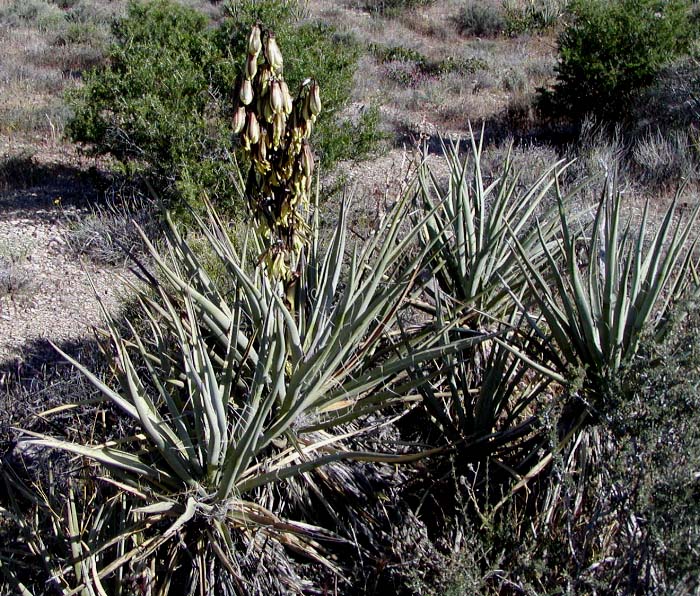
Jalisco yucca is a tall, tree-like plant with an upright or mildly multi-trunked growth form. It typically develops approximately five to eight upright branches from its short trunk.[1][2]
Its leaves are stiff to flexible, blue to green, strap-shaped, and spineless. They can reach 1 metre in length and 8 centimetres in width, while old leaves usually detach naturally from the trunk over time.[3][4][5]
Its branched inflorescence may grow upright or incline sideways and measures approximately 0.4 to 1 metre in length. Its flowers are white and ball-shaped, measuring 2 to 3.5 centimetres long and 1 to 1.5 centimetres wide.[6][7][8][9]
Its fruits measure approximately 4 to 5 centimetres in diameter.[10]
Mature specimens can reach 10 metres in height, although the plant usually grows to less than 7.5 metres. Its spread can reach 6 metres.[11][12][13]
Its short trunk base is commonly 0.5 to 2 feet wide. The trunk base of old specimens can exceed 4 to 5 feet in diameter.[14][15]
Habitat
Jalisco yucca occurs on plains and low hills at elevations of approximately 3,000 to 7,000 feet. It inhabits forested ravines, narrow, winding stream gorges, and deciduous tropical forests.[16][17][18]
Its most frequently reported habitat is pine, oak, or other broad-leaved forest near narrow stream gorges. It also inhabits dry hills and steep, rocky volcanic slopes.[19][20]
It can occur in semi-arid, rocky subtropical short-oak forests and is sometimes found in open agricultural fields containing corn or other crops.[21][22]
The species is native to the Mexican states of Jalisco, Colima, and Guanajuato. Its native range lies in the highlands of southwestern Mexico near the Pacific coast.[23][24][25]
It is geographically associated with Agave colimana and other Agave species.[26]
Reproduction and life cycle
Jalisco yucca produces flowers from September through May, although flowering may occur almost any time of year.[27]
The species can be propagated using suckers, cuttings, or seeds.[28]
Conservation
Jalisco yucca is described as rare and geographically isolated from other representatives.[29]
Similar species
Yucca schottii, Yucca madrensis, and Yucca grandiflora are identified as close relatives of Jalisco yucca.[30][31][32]
Classification of the Jalisco Yucca
| Kingdom | Plantae |
|---|---|
| Subkingdom | Pteridobiotina |
| Phylum | Tracheophyta |
| Class | Liliopsida |
| Order | Asparagales |
| Family | Asparagaceae (Asparagus Family) |
| Genus | Yucca (Spanish-bayonet) |
| Species | Yucca jaliscensis (Trel.) Trel. |
Where the Jalisco Yucca is found
Checklists and occurrence records place Yucca jaliscensis in 1 country across North America. GBIF holds 91 georeferenced records of it.
Countries
Regions and cities with the most records
- Jalisco, Mexico 41
- Sayula, Mexico 10
- Nayarit, Mexico 9
- México, Mexico 7
- Ixtapan de la Sal, Mexico 6
- Durango, Mexico 5
- Ixtlán del Río, Mexico 5
A number beside a place is its count of GBIF occurrence records. A place without a number comes from a checklist alone. Records show where a species has been observed or collected, which can include escapes and vagrants.
Common names
English
- Jalisco Yucca
- Jalisco Soapwort
Synonyms
3 other scientific names have been used for this species and are now treated as synonyms of Yucca jaliscensis.
- Yucca barrancasecca Pasq.
- Yucca schottii var. jaliscensis Engelm.
- Yucca × schottii var. jaliscensis Trel.
Related species
-
 Joshua TreeYucca brevifolia
-
 Adam's-needleYucca filamentosa
-
 Adam's NeedleYucca gloriosa
-
 Spineless YuccaYucca gigantea
-
 Big Bend YuccaYucca rostrata
-
 Spanish BayonetYucca aloifolia
-
 Banana YuccaYucca baccata
-
 Mohave YuccaYucca schidigera
Compare
Questions and answers
What is the scientific name of the Jalisco Yucca?
The scientific name of the Jalisco Yucca is Yucca jaliscensis. Written with its author, the full name is Yucca jaliscensis (Trel.) Trel..
Which family does the Jalisco Yucca belong to?
Yucca jaliscensis belongs to the family Asparagaceae, in the order Asparagales and the class Liliopsida.
Where is the Jalisco Yucca found?
Checklists and occurrence records place Yucca jaliscensis in 1 country: Mexico.
What is the conservation status of the Jalisco Yucca?
The IUCN Red List category recorded for Yucca jaliscensis is Vulnerable (VU).
What other names does the Jalisco Yucca have?
Yucca jaliscensis is also known in English as Jalisco Soapwort.
Sources
Passages the profile rests on
- Yucca jaliscensis is a tall, tree-like plant with an upright or mildly multi-trunked growth form. Source passage: “Yucca jaliscensis is a tall tree-like species.” — English Wikipedia
- The plant typically develops approximately five to eight upright branches from its short trunk. Source passage: “There is usually around 5 to 8 branches growing upright off the short trunk” — English Wikipedia
- Its leaves are stiff to flexible, blue to green, strap-shaped, and spineless. Source passage: “The leaves are stiff to flexible, variably blue to green colored, strap-like, spineless” — English Wikipedia
- Its leaves can reach 1 metre in length and 8 centimetres in width. Source passage: “up to 1 m (3 ft) in length, and up to 8 cm (3 in) in width.” — English Wikipedia
- Old leaves usually detach naturally from the trunk over time. Source passage: “The old leaves usually self clean from the trunk over time.” — English Wikipedia
- Its inflorescence is branched and may grow upright or incline sideways. Source passage: “The branched, upright or sideways inclined inflorescence” — English Wikipedia
- Its inflorescence measures approximately 0.4 to 1 metre in length. Source passage: “0.4 m (1 ft) to 1 m (3 ft) long” — English Wikipedia
- Its flowers are white and ball-shaped. Source passage: “The ball-shaped white flowers bloom September to May” — English Wikipedia
- Its flowers measure 2 to 3.5 centimetres long and 1 to 1.5 centimetres wide. Source passage: “Flowers are 2-3.5 cm long and 1-1.5 cm wide.” — English Wikipedia
- Its fruits measure approximately 4 to 5 centimetres in diameter. Source passage: “The fruits are 4–5 cm in diameter.” — English Wikipedia
- Mature specimens can reach 10 metres in height. Source passage: “Although at old age it can grow up to 10 m (33 ft) in height” — English Wikipedia
- The plant usually grows to less than 7.5 metres in height. Source passage: “it is usually found at less than 7.5 m (25 ft) in height.” — English Wikipedia
- Its spread can reach 6 metres. Source passage: “with a spread to 6 m (20 ft)” — English Wikipedia
- Its short trunk base is commonly 0.5 to 2 feet wide. Source passage: “The usually short trunk base is often found at 0.5 to 2 feet wide” — English Wikipedia
- The trunk base of old specimens can exceed 4 to 5 feet in diameter. Source passage: “but can grow to over 4 or 5 feet in diameter on old specimens.” — English Wikipedia
- The species occurs on plains and low hills at elevations of approximately 3,000 to 7,000 feet. Source passage: “on plains and low hills between about 3000–7000 ft.” — English Wikipedia
- It occurs in forested ravines and narrow, winding stream gorges. Source passage: “can be found in ravines that are forested, in narrow, winding stream gorges” — English Wikipedia
- It occurs in deciduous tropical forests. Source passage: “in deciduous tropical type forests” — English Wikipedia
- Its most frequently reported habitat is pine, oak, or other broad-leaved forest near narrow stream gorges. Source passage: “but most often found in pine, oak, or other broad-leaved trees forests that are in or near narrow and winding stream gorges.” — English Wikipedia
- It also inhabits dry hills and steep, rocky volcanic slopes. Source passage: “Other habitats include dry hills or steep rocky volcanic slopes” — English Wikipedia
- It can occur in semi-arid, rocky subtropical short-oak forests. Source passage: “with semi-arid and rocky subtropical short oak tree forests” — English Wikipedia
- The species is sometimes found in open agricultural fields containing corn or other crops. Source passage: “also it's sometimes found in open fields with corn or other crops.” — English Wikipedia
- The species is native to the Mexican states of Jalisco, Colima, and Guanajuato. Source passage: “It is native to mountainous areas at about 5000 feet in the States of Jalisco, Colima and Guanajuato.” — English Wikipedia
- Its native range is in southwestern Mexico near the Pacific coast. Source passage: “Yucca jaliscensis grows in Mexico near the Pacific coast” — English Wikipedia
- The species is native to the highlands of southwestern Mexico. Source passage: “Yucca jaliscensis is a Yucca species native to the highlands of southwestern Mexico.” — English Wikipedia
- The species is associated geographically with Agave colimana and other Agave species. Source passage: “Associated with Agave colimana and other Agave species.” — English Wikipedia
- The species produces flowers from September through May, although flowering may occur almost any time of year. Source passage: “The ball-shaped white flowers bloom September to May or sometimes almost any time of the year.” — English Wikipedia
- The species can be propagated using suckers, cuttings, or seeds. Source passage: “Propagation is by suckers, cuttings or seed.” — English Wikipedia
- The species is described as rare and geographically isolated from other representatives. Source passage: “Yucca jaliscensis is rare and is geographically isolated from other representatives.” — English Wikipedia
- Yucca schottii is identified as a close relative of Yucca jaliscensis. Source passage: “It is closely related to Yucca schottii, Yucca madrensis, and Yucca grandiflora.” — English Wikipedia
- Yucca madrensis is identified as a close relative of Yucca jaliscensis. Source passage: “It is closely related to Yucca schottii, Yucca madrensis, and Yucca grandiflora.” — English Wikipedia
- Yucca grandiflora is identified as a close relative of Yucca jaliscensis. Source passage: “It is closely related to Yucca schottii, Yucca madrensis, and Yucca grandiflora.” — English Wikipedia
Data
- Catalogue of Life, 2026-10-16 XR cc by
- Global Biodiversity Information Facility CC BY 4.0
- Wikidata CC0
- GeoNames CC BY 4.0
- Wikimedia Commons per image; credit shown with each image
- Within the Catalogue of Life, this name comes from The World Checklist of Vascular Plants (WCVP) cc by
References
- Contr. U.S. Natl. Herb. 23: 92 (1920) where the name was published
This species in other databases
Page built on 29 November 2026. See how the catalog is made and all sources and licences.
Cite this page
ScientificNames.org. (2026). Yucca jaliscensis (Jalisco Yucca). Retrieved November 29, 2026, from https://scientificnames.org/species/yucca-jaliscensis
“Yucca jaliscensis (Jalisco Yucca).” ScientificNames.org, 2026, scientificnames.org/species/yucca-jaliscensis. Accessed 29 Nov. 2026.
ScientificNames.org. “Yucca jaliscensis (Jalisco Yucca).” Accessed November 29, 2026. https://scientificnames.org/species/yucca-jaliscensis.
@misc{scientificnames_yucca_jaliscensis_jalisco_yucca,
  author = {{ScientificNames.org}},
  title = {Yucca jaliscensis (Jalisco Yucca)},
  year = {2026},
  url = {https://scientificnames.org/species/yucca-jaliscensis},
  note = {Accessed 2026-11-29}
}