Species · Flowering plants
Twisted-leaf Yucca Yucca rupicola
The scientific name of the Twisted-leaf Yucca is Yucca rupicola. It is a species of flowering plant in the family Asparagaceae (asparagus family), order Asparagales.
- Scientific name
- Yucca rupicola Scheele
- Common name
- Twisted-leaf Yucca
- Genus
- Yucca
- Family
- Asparagaceae (Asparagus Family)
- Order
- Asparagales
- Class
- Liliopsida
- Red List category
- LC Least Concern
- Recorded in
- 2 countries
- Name status
- accepted in the Catalogue of Life

Overview
Yucca rupicola is native to the Edwards Plateau region of Texas, Coahuila and Nuevo Leon in Mexico. It is distinguished among stemless yuccas by its twisted, flaccid leaves.
Written 26 November 2026 from the sources listed below. Each statement was checked against the passage it cites; statements that could not be supported were removed.
Appearance
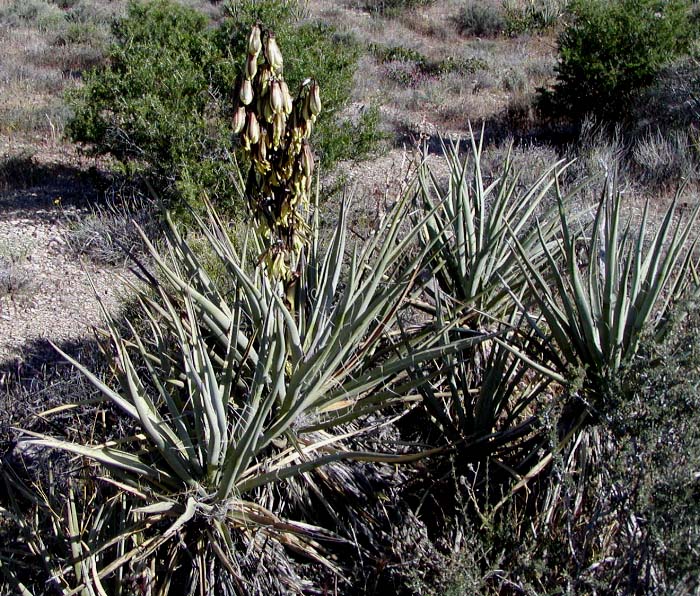
Twisted-leaf Yucca forms colonies of rosettes without above-ground trunks and produces a branched caudex beneath the soil surface.[1][2]
Its narrowly lanceolate, slightly succulent leaves are twisted and measure approximately 40 mm at their widest point. The leaves twist as they mature.[3][4][5]
Its flowers are drooping, bell-shaped and white or greenish. Its fruit is a dry capsule that can reach 6 cm in length, and mature capsules have a dull black appearance.[6][7][8]
Habitat
Twisted-leaf Yucca grows in rocky, open environments, including limestone ledges. It grows well in dry caliche soil and can grow in either full sun or partial shade.[9][10][11][12]
Behaviour
Twisted-leaf Yucca serves as a larval host for the moth Megathymus yuccae. Young larvae feed on the tips of its leaves and bore down to the plant's root to pupate.[13][14][15]
Reproduction and life cycle
Twisted-leaf Yucca flowers between April and June. Its flowering stalk can grow to 1.8 m tall.[16][17]
Uses
Its blossoms provide nectar for moths.[18]
Classification of the Twisted-leaf Yucca
| Kingdom | Plantae |
|---|---|
| Subkingdom | Pteridobiotina |
| Phylum | Tracheophyta |
| Class | Liliopsida |
| Order | Asparagales |
| Family | Asparagaceae (Asparagus Family) |
| Genus | Yucca (Spanish-bayonet) |
| Species | Yucca rupicola Scheele |
Where the Twisted-leaf Yucca is found
Checklists and occurrence records place Yucca rupicola in 2 countries across North America. GBIF holds 7,735 georeferenced records of it.
Countries
Regions and cities with the most records
- Texas, United States 7,620
- Austin, United States 1,428
- Cedar Park, United States 1,280
- Brushy Creek, United States 1,164
- Round Rock, United States 1,009
- Leander, United States 976
- Live Oak, United States 894
- Pflugerville, United States 750
- San Antonio, United States 704
- Georgetown, United States 676
- Converse, United States 585
- Universal City, United States 488
- Kyle, United States 431
- Schertz, United States 413
- San Marcos, United States 377
- Canyon Lake, United States 284
- Cibolo, United States 253
- Hutto, United States 205
- New Braunfels, United States 159
- Kerrville, United States 155
- Belton, United States 45
- Harker Heights, United States 37
- Temple, United States 31
- Killeen, United States 18
- Fort Cavazos, United States 16
- Copperas Cove, United States 13
- Grand Prairie, United States 5
- Irving, United States 5
- Dallas, United States 4
- Duncanville, United States 4
- Farmers Branch, United States 4
- Balch Springs, United States 3
- Brownwood, United States 3
- Chihuahua, Mexico 3
- Chihuahua, Mexico 3
- Mesquite, United States 3
A number beside a place is its count of GBIF occurrence records. A place without a number comes from a checklist alone. Records show where a species has been observed or collected, which can include escapes and vagrants.
Common names
English
- Twisted-leaf Yucca
- Twisted-leaf Spanish-dagger
- Twist-leaf Yucca
Synonyms
5 other scientific names have been used for this species and are now treated as synonyms of Yucca rupicola.
- Yucca lutescens Carrière
- Yucca rupicola var. rupicola
- Yucca rupicola var. tortifolia Engelm.
- Yucca tortifolia Lindh. & G.M.Ross
- Yucca tortilis Carrière
Related species
-
 Joshua TreeYucca brevifolia
-
 Adam's-needleYucca filamentosa
-
 Adam's NeedleYucca gloriosa
-
 Spineless YuccaYucca gigantea
-
 Big Bend YuccaYucca rostrata
-
 Spanish BayonetYucca aloifolia
-
 Banana YuccaYucca baccata
-
 Mohave YuccaYucca schidigera
Compare
Questions and answers
What is the scientific name of the Twisted-leaf Yucca?
The scientific name of the Twisted-leaf Yucca is Yucca rupicola. Written with its author, the full name is Yucca rupicola Scheele.
Which family does the Twisted-leaf Yucca belong to?
Yucca rupicola belongs to the family Asparagaceae, in the order Asparagales and the class Liliopsida.
Where is the Twisted-leaf Yucca found?
Checklists and occurrence records place Yucca rupicola in 2 countries: United States and Mexico.
What is the conservation status of the Twisted-leaf Yucca?
The IUCN Red List category recorded for Yucca rupicola is Least Concern (LC).
What other names does the Twisted-leaf Yucca have?
Yucca rupicola is also known in English as Twisted-leaf Spanish-dagger and Twist-leaf Yucca.
Sources
Passages the profile rests on
- Yucca rupicola forms colonies of rosettes without above-ground trunks. Source passage: “Yucca rupicola forms colonies of rosettes, lacking trunks above-ground” — English Wikipedia
- The plant produces a branched caudex beneath the soil surface. Source passage: “producing a branched caudex under the surface.” — English Wikipedia
- Its leaves are narrowly lanceolate, slightly succulent, and twisted. Source passage: “Leaves are narrowly lanceolate, slightly succulent, twisted” — English Wikipedia
- Its leaves measure approximately 40 mm at their widest point. Source passage: “about 40 mm wide at its widest point.” — English Wikipedia
- Its leaves twist as they mature. Source passage: “twist as the leaf matures(3).” — apps.cals.arizona.edu
- Its flowers are drooping, bell-shaped, and white or greenish. Source passage: “Flowers are pendant (drooping), bell-shaped, white or greenish” — English Wikipedia
- Its fruit is a dry capsule that can reach 6 cm in length. Source passage: “Fruit is a dry capsule up to 6 cm long” — English Wikipedia
- Its mature fruit capsules have a dull black appearance. Source passage: “that is dull black in appearance.” — English Wikipedia
- The species grows in rocky, open environments. Source passage: “Yucca rupicola grows in rocky, open areas” — English Wikipedia
- Its habitats include limestone ledges. Source passage: “including limestone ledges” — English Wikipedia
- The species grows well in dry caliche soil. Source passage: “It grows well in dry, caliche soil” — English Wikipedia
- It can grow in either full sun or partial shade. Source passage: “in sun or partial shade.” — English Wikipedia
- Yucca rupicola serves as a larval host for the moth Megathymus yuccae. Source passage: “Yucca rupicola is a larval host for Megathymus yuccae” — English Wikipedia
- Young Megathymus yuccae larvae feed on the tips of the plant's leaves. Source passage: “which feed on the tips of leaves when young” — English Wikipedia
- Megathymus yuccae larvae bore down to the plant's root to pupate. Source passage: “bore down to the root to pupate.” — English Wikipedia
- The plant flowers between April and June. Source passage: “bloom from April through June.” — English Wikipedia
- Its flowering stalk can grow to 1.8 m tall. Source passage: “The blooming stalk can measure up to 1.8 m tall (6 feet).” — English Wikipedia
- The blossoms provide nectar for moths. Source passage: “The blossoms are also a source of nectar for moths.” — English Wikipedia
Data
- Catalogue of Life, 2026-10-16 XR cc by
- Global Biodiversity Information Facility CC BY 4.0
- Wikidata CC0
- GeoNames CC BY 4.0
- Wikimedia Commons per image; credit shown with each image
- Within the Catalogue of Life, this name comes from The World Checklist of Vascular Plants (WCVP) cc by
References
- Linnaea 23: 143 (1850) where the name was published
This species in other databases
Page built on 29 November 2026. See how the catalog is made and all sources and licences.
Cite this page
ScientificNames.org. (2026). Yucca rupicola (Twisted-leaf Yucca). Retrieved November 29, 2026, from https://scientificnames.org/species/yucca-rupicola
“Yucca rupicola (Twisted-leaf Yucca).” ScientificNames.org, 2026, scientificnames.org/species/yucca-rupicola. Accessed 29 Nov. 2026.
ScientificNames.org. “Yucca rupicola (Twisted-leaf Yucca).” Accessed November 29, 2026. https://scientificnames.org/species/yucca-rupicola.
@misc{scientificnames_yucca_rupicola_twisted_leaf_yucca,
  author = {{ScientificNames.org}},
  title = {Yucca rupicola (Twisted-leaf Yucca)},
  year = {2026},
  url = {https://scientificnames.org/species/yucca-rupicola},
  note = {Accessed 2026-11-29}
}