Species · Flowering plants
Torrey's Yucca Yucca torreyi
The scientific name of the Torrey's Yucca is Yucca torreyi. It is a species of flowering plant in the family Asparagaceae (asparagus family), order Asparagales.
- Scientific name
- Yucca torreyi Shafer
- Common name
- Torrey's Yucca
- Genus
- Yucca
- Family
- Asparagaceae (Asparagus Family)
- Order
- Asparagales
- Class
- Liliopsida
- Red List category
- LC Least Concern
- Recorded in
- 2 countries
- Name status
- accepted in the Catalogue of Life

Overview
Yucca torreyi is native to the Chihuahuan Desert and occurs widely throughout much of that desert. It has rigid, spine-tipped leaves and waxy, bell-shaped flowers, and is genetically distinct from Yucca treculiana.
Written 27 November 2026 from the sources listed below. Each statement was checked against the passage it cites; statements that could not be supported were removed.
Appearance
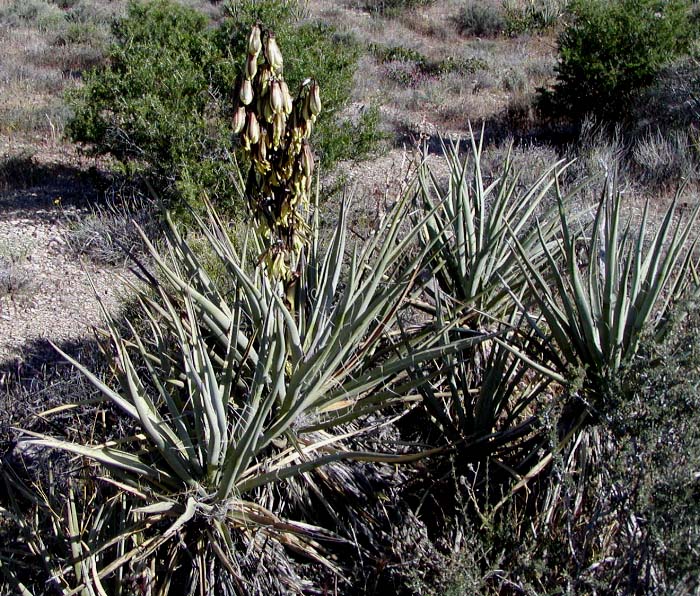
Torrey's yucca has an often-branched trunk, although some individuals have a single stem. Its straight, rigid leaves radiate around the stem and terminate in sharp spines.[1][2]
Its flowers are bell-shaped, creamy-white or purple-tinged, and waxy. Each flower has six tepals, six stamens, and one pistil.[3][4]
The plant can reach 20 feet in height, although it more commonly grows between 3 and 10 feet tall. Its leaves measure between two and four and a half feet long, and their terminal spines measure between one and a half and two inches long.[5][6][7]
The flower head can extend up to two feet along the upper portion of the stem. Individual flowers measure between two and three inches in length, and the pistil measures between one and one and a half inches long.[8][9][10]
Habitat
Torrey's yucca is native to the Chihuahuan Desert and occurs widely throughout much of the desert.[11][12]
In the United States, it occurs from south-central and southeastern New Mexico through Trans-Pecos Texas to central Texas. It is most numerous in the Trans-Pecos region of Texas.[13][14]
In Mexico, it occurs in eastern Chihuahua, Coahuila, far eastern Durango, and western Nuevo Leon.[15]
Uses
The pulpy fruits of Torrey's yucca were eaten raw or roasted by Native Americans. The fruits were also dried and ground into meal for winter use.[16][17]
The coarse fibers from its leaves were used to make ropes, mats, sandals, baskets, and cloth.[18]
Similar species
Torrey's yucca is genetically distinct from the often-confused species Yucca treculiana. It is more closely related to Yucca filifera, Yucca potosina, Yucca decipiens, and Yucca queretaroensis than to Yucca treculiana.[19][20]
Classification of the Torrey's Yucca
| Kingdom | Plantae |
|---|---|
| Subkingdom | Pteridobiotina |
| Phylum | Tracheophyta |
| Class | Liliopsida |
| Order | Asparagales |
| Family | Asparagaceae (Asparagus Family) |
| Genus | Yucca (Spanish-bayonet) |
| Species | Yucca torreyi Shafer |
Where the Torrey's Yucca is found
Checklists and occurrence records place Yucca torreyi in 2 countries across North America. GBIF holds 3,443 georeferenced records of it.
Countries
Regions and cities with the most records
- Texas, United States 2,350
- New Mexico, United States 705
- Alamogordo, United States 499
- Sunland Park, United States 260
- El Paso, United States 250
- Ciudad Juárez, Mexico 153
- Coahuila, Mexico 66
- Chihuahua, Mexico 55
- Las Cruces, United States 46
- Del Rio, United States 45
- Ciudad Acuña, Mexico 36
- Durango, Mexico 34
- Carlsbad, United States 29
- Nuevo León, Mexico 25
- Horizon City, United States 12
- García, Mexico 9
- Hidalgo, Mexico 9
- Midland, United States 7
- Gómez Palacio, Mexico 5
- Lerdo, Mexico 5
- Manuel Ojinaga, Mexico 4
- Cibolo, United States 3
- Schertz, United States 3
- Universal City, United States 3
A number beside a place is its count of GBIF occurrence records. A place without a number comes from a checklist alone. Records show where a species has been observed or collected, which can include escapes and vagrants.
Common names
English
- Torrey's Yucca
- Spanish-dagger
Names in 4 other languages
- Czech
- juka Torreyova
- German
- Torrey-Palmlilie
- Russian
- Юкка Трекуля
- Spanish
- palma china
Synonyms
6 other scientific names have been used for this species and are now treated as synonyms of Yucca torreyi.
- Sarcoyucca macrocarpa (Torr.) Linding.
- Yucca baccata var. macrocarpa Torr.
- Yucca crassifolia Engelm.
- Yucca macrocarpa (Torr.) Merriam
- Yucca macrocarpa (Torr.) Coville
- Yucca torreyi f. parviflora McKelvey
Related species
-
 Joshua TreeYucca brevifolia
-
 Adam's-needleYucca filamentosa
-
 Adam's NeedleYucca gloriosa
-
 Spineless YuccaYucca gigantea
-
 Big Bend YuccaYucca rostrata
-
 Spanish BayonetYucca aloifolia
-
 Banana YuccaYucca baccata
-
 Mohave YuccaYucca schidigera
Compare
Questions and answers
What is the scientific name of the Torrey's Yucca?
The scientific name of the Torrey's Yucca is Yucca torreyi. Written with its author, the full name is Yucca torreyi Shafer.
Which family does the Torrey's Yucca belong to?
Yucca torreyi belongs to the family Asparagaceae, in the order Asparagales and the class Liliopsida.
Where is the Torrey's Yucca found?
Checklists and occurrence records place Yucca torreyi in 2 countries: United States and Mexico.
What is the conservation status of the Torrey's Yucca?
The IUCN Red List category recorded for Yucca torreyi is Least Concern (LC).
What other names does the Torrey's Yucca have?
Yucca torreyi is also known in English as Spanish-dagger.
Is Spanish dagger edible?
The pulpy fruits of Torrey's yucca were eaten raw or roasted by Native Americans. They were also dried and ground into meal for winter use.[16][17]
What is the habitat of yuccas?
Torrey's yucca is native to the Chihuahuan Desert.[11]
Sources
Passages the profile rests on
- Yucca torreyi has an often-branched trunk, although some individuals have a single stem. Source passage: “The trunk is often branched, but sometimes has a single stem.” — English Wikipedia
- The leaves are straight, rigid, radiate around the stem, and terminate in sharp spines. Source passage: “Leaves are 2-4 1/2 feet long, straight and rigid, ending in a sharp spine 1 1/2-2 inches long, they radiate around the stem.” — English Wikipedia
- The flowers of Yucca torreyi are bell-shaped, creamy-white or purple-tinged, and waxy. Source passage: “The flowers are bell-shaped, 2-3 inches long, creamy-white or tinged with purple, waxy” — English Wikipedia
- Each flower has six tepals, six stamens, and one pistil. Source passage: “with 6 tepals, 6 stamens, and 1 pistil” — English Wikipedia
- Yucca torreyi can reach a height of 20 feet, although it more commonly grows between 3 and 10 feet tall. Source passage: “Yucca torreyi grows up to 20 feet tall, but more commonly reaches 3-10 feet.” — English Wikipedia
- The leaves measure between two and four and a half feet long. Source passage: “Leaves are 2-4 1/2 feet long” — English Wikipedia
- The terminal leaf spines measure between one and a half and two inches long. Source passage: “ending in a sharp spine 1 1/2-2 inches long” — English Wikipedia
- The flower head can extend up to two feet along the upper portion of the stem. Source passage: “The flower head may extend to 2 feet on the upper portion of the stem.” — English Wikipedia
- The flowers measure between two and three inches in length. Source passage: “The flowers are bell-shaped, 2-3 inches long” — English Wikipedia
- The pistil measures between one and one and a half inches long. Source passage: “1 pistil which is 1-1 1/2 inches long.” — English Wikipedia
- Yucca torreyi is native to the Chihuahuan Desert. Source passage: “Yucca torreyi is native to the Chihuahuan Desert” — English Wikipedia
- Yucca torreyi occurs widely throughout much of the Chihuahuan Desert. Source passage: “occurs widespread across much of the region.” — English Wikipedia
- In the United States, Yucca torreyi occurs from south-central and southeastern New Mexico through Trans-Pecos Texas to central Texas. Source passage: “In the United States it occurs from south-central to southeastern New Mexico to Trans-Pecos Texas to central Texas” — English Wikipedia
- Yucca torreyi is most numerous in the Trans-Pecos region of Texas. Source passage: “being most numerous in the Trans-Pecos.” — English Wikipedia
- In Mexico, Yucca torreyi occurs in eastern Chihuahua, Coahuila, far eastern Durango, and western Nuevo Leon. Source passage: “In Mexico it occurs in eastern Chihuahua, Coahuila, far eastern Durango, and western Nuevo Leon.” — English Wikipedia
- The pulpy fruits of Yucca torreyi were eaten raw or roasted by Native Americans. Source passage: “Native Americans ate the pulpy fruits of this and related shrubby species either raw or roasted” — English Wikipedia
- The fruits of Yucca torreyi were dried and ground into meal for winter use. Source passage: “they also dried and ground them into meal for winter use.” — English Wikipedia
- The coarse fibers from Yucca torreyi leaves were used to make ropes, mats, sandals, baskets, and cloth. Source passage: “The coarse fibers of the long leaves were made into ropes, mats, sandals, baskets, and cloth.” — English Wikipedia
- Yucca torreyi is genetically distinct from the often-confused species Yucca treculiana. Source passage: “found Yucca torreyi and the often-confused Yucca treculiana to not only be distinct species, but of different lineages.” — English Wikipedia
- Yucca torreyi is more closely related to Yucca filifera, Yucca potosina, Yucca decipiens, and Yucca queretaroensis than to Yucca treculiana. Source passage: “Y. torreyi was found to be more closely related to Y. filifera, Y. potosina, Y. decipiens, and Y. queretaroensis than it is to Y. treculiana.” — English Wikipedia
Data
- Catalogue of Life, 2026-10-16 XR cc by
- Global Biodiversity Information Facility CC BY 4.0
- Wikidata CC0
- GeoNames CC BY 4.0
- Wikimedia Commons per image; credit shown with each image
- Within the Catalogue of Life, this name comes from The World Checklist of Vascular Plants (WCVP) cc by
References
- N.L.Britton & J.A.Shafer, N. Amer. Trees: 157 (1908) where the name was published
This species in other databases
- Catalogue of Life 7GB9L
- Wikidata Q1569369
- iNaturalist 170397
- World Flora Online wfo-0000752180-2026-06
- GRIN 316866
Page built on 27 November 2026. See how the catalog is made and all sources and licences.
Cite this page
ScientificNames.org. (2026). Yucca torreyi (Torrey's Yucca). Retrieved November 27, 2026, from https://scientificnames.org/species/yucca-torreyi
“Yucca torreyi (Torrey's Yucca).” ScientificNames.org, 2026, scientificnames.org/species/yucca-torreyi. Accessed 27 Nov. 2026.
ScientificNames.org. “Yucca torreyi (Torrey's Yucca).” Accessed November 27, 2026. https://scientificnames.org/species/yucca-torreyi.
@misc{scientificnames_yucca_torreyi_torreys_yucca,
  author = {{ScientificNames.org}},
  title = {Yucca torreyi (Torrey's Yucca)},
  year = {2026},
  url = {https://scientificnames.org/species/yucca-torreyi},
  note = {Accessed 2026-11-27}
}