Species · Flowering plants
Utah Yucca Yucca utahensis
The scientific name of the Utah Yucca is Yucca utahensis. It is a species of flowering plant in the family Asparagaceae (asparagus family), order Asparagales.
- Scientific name
- Yucca utahensis McKelvey
- Common name
- Utah Yucca
- Genus
- Yucca
- Family
- Asparagaceae (Asparagus Family)
- Order
- Asparagales
- Class
- Liliopsida
- Red List category
- LC Least Concern
- Recorded in
- 1 country
- Name status
- accepted in the Catalogue of Life

Overview
Yucca utahensis is native to Utah, Nevada, and Arizona. It has narrow, needle-like leaves with fibers separating along their margins and creamy white, nodding, bell-shaped flowers.
Written 27 November 2026 from the sources listed below. Each statement was checked against the passage it cites; statements that could not be supported were removed.
Appearance
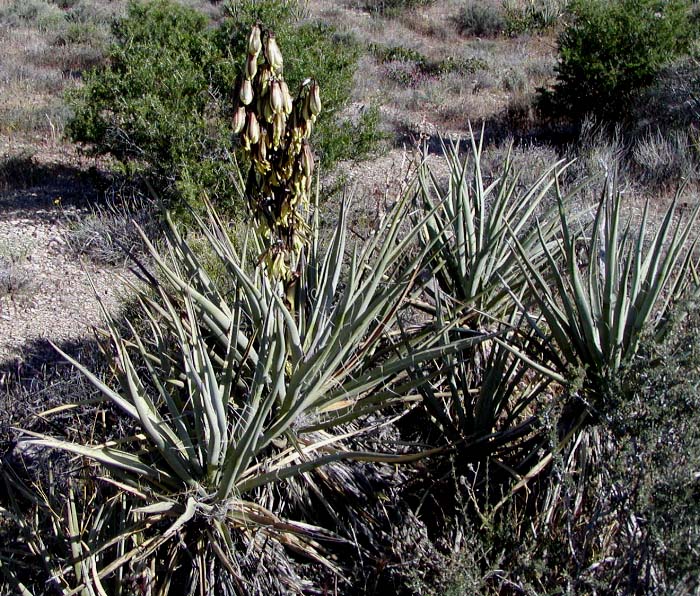
Utah yucca has narrow, needle-like leaves with fibers separating along their margins. Its creamy white flowers are nodding and bell-shaped.[1][2]
Its fruit is a dry capsule containing black seeds.[3]
The plant can reach approximately 3 metres in height, although it is usually smaller. Its leaves can grow up to 70 centimetres long and are rarely wider than 2 centimetres.[4][5]
Habitat
Utah yucca occurs from Nevada eastward to southwestern Arizona and southward to north-central Arizona. It is found in Zion National Park, where it is one of five recorded yucca species.[6][7]
Behaviour
Its stems can grow along the ground, and multiple stems may occur within a colony.[8]
Reproduction and life cycle
Yucca moths pollinate flowers by inserting collected pollen into small depressions within the flower's style. They mark pollinated flowers with a chemical scent that discourages other moths from laying eggs on them.[9][10]
Yucca moth larvae feed on seeds within yucca fruits. They consume some seeds while leaving others available for dispersal.[11][12]
Similar species
Yucca utahensis is most closely related to Yucca elata.[13]
Classification of the Utah Yucca
| Kingdom | Plantae |
|---|---|
| Subkingdom | Pteridobiotina |
| Phylum | Tracheophyta |
| Class | Liliopsida |
| Order | Asparagales |
| Family | Asparagaceae (Asparagus Family) |
| Genus | Yucca (Spanish-bayonet) |
| Species | Yucca utahensis McKelvey |
Where the Utah Yucca is found
Checklists and occurrence records place Yucca utahensis in 1 country across North America. GBIF holds 905 georeferenced records of it.
Countries
Regions and cities with the most records
- Arizona, United States 294
- Utah, United States 291
- Nevada, United States 254
- Washington, United States 152
- Saint George, United States 125
- Hurricane, United States 80
- Cedar City, United States 18
- Mesquite, United States 7
A number beside a place is its count of GBIF occurrence records. A place without a number comes from a checklist alone. Records show where a species has been observed or collected, which can include escapes and vagrants.
Common names
English
- Utah Yucca
Synonyms
2 other scientific names have been used for this species and are now treated as synonyms of Yucca utahensis.
- Yucca elata subsp. utahensis (McKelvey) Hochstätter
- Yucca elata var. utahensis (McKelvey) Reveal
Related species
-
 Joshua TreeYucca brevifolia
-
 Adam's-needleYucca filamentosa
-
 Adam's NeedleYucca gloriosa
-
 Spineless YuccaYucca gigantea
-
 Big Bend YuccaYucca rostrata
-
 Spanish BayonetYucca aloifolia
-
 Banana YuccaYucca baccata
-
 Mohave YuccaYucca schidigera
Compare
Questions and answers
What is the scientific name of the Utah Yucca?
The scientific name of the Utah Yucca is Yucca utahensis. Written with its author, the full name is Yucca utahensis McKelvey.
Which family does the Utah Yucca belong to?
Yucca utahensis belongs to the family Asparagaceae, in the order Asparagales and the class Liliopsida.
Where is the Utah Yucca found?
Checklists and occurrence records place Yucca utahensis in 1 country: United States.
What is the conservation status of the Utah Yucca?
The IUCN Red List category recorded for Yucca utahensis is Least Concern (LC).
Sources
Passages the profile rests on
- The plant has narrow, needle-like leaves with fibers separating along their margins. Source passage: “Leaves are narrow and needle-like, up to 70 cm long but rarely more than 2 cm wide, with fibers separating along the margins.” — English Wikipedia
- Its flowers are creamy white, nodding, and bell-shaped. Source passage: “Flowers are creamy white, nodding, bell-shaped.” — English Wikipedia
- Its fruit is a dry capsule containing black seeds. Source passage: “Fruit is a dry capsule with black seeds.” — English Wikipedia
- The plant can reach approximately 3 metres in height, although it is usually smaller. Source passage: “Yucca utahensis can reach a height of 10 feet (3 m), though it is usually much smaller.” — English Wikipedia
- Its leaves can grow up to 70 centimetres long and are rarely wider than 2 centimetres. Source passage: “up to 70 cm long but rarely more than 2 cm wide” — English Wikipedia
- Utah yucca occurs from Nevada eastward to southwestern Arizona and southward to north-central Arizona. Source passage: “Utah yucca occurs from Nevada east to southwestern Arizona and south to north-central Arizona.” — fs.usda.gov
- Utah yucca is found in Zion National Park, where it is one of five recorded yucca species. Source passage: “Zion is home to five different species of yucca: the Banana or Datil yucca (Yucca baccata), Narrowleaf yucca (Yucca angustissima), Kanab yucca (Yucca kanabensis), Utah yucca (Yucca utahensis), and Mohave datil (Yucca vespertina).” — nps.gov
- Its stems can grow along the ground and multiple stems may occur within a colony. Source passage: “Stems are sometimes procumbent, often several per colony” — English Wikipedia
- Yucca moths pollinate flowers by inserting collected pollen into small depressions within the flower's style. Source passage: “they pollinate the flower by pushing the sticky pollen into tiny depressions within the style.” — nps.gov
- Yucca moths mark pollinated flowers with a chemical scent that discourages other moths from laying eggs on them. Source passage: “the moth marks it with a chemical pheromone (scent) that warns other moths from laying their eggs on the same flower.” — nps.gov
- Yucca moth larvae feed on seeds within yucca fruits. Source passage: “the only food yucca moth larvae are able to eat are the seeds of the yucca fruit.” — nps.gov
- Yucca moth larvae consume some seeds while leaving others available for dispersal. Source passage: “eating only some of the seeds and leaving the rest to be scattered and hopefully grow into new yucca plants.” — nps.gov
- Yucca utahensis is most closely related to Yucca elata. Source passage: “Yucca utahensis is most closely related to Y. elata” — iucnredlist.org
Data
- Catalogue of Life, 2026-10-16 XR cc by
- Global Biodiversity Information Facility CC BY 4.0
- Wikidata CC0
- GeoNames CC BY 4.0
- Wikimedia Commons per image; credit shown with each image
- Within the Catalogue of Life, this name comes from The World Checklist of Vascular Plants (WCVP) cc by
References
- Yuccas Southw. U.S. 2: 94 (1947) where the name was published
This species in other databases
- Catalogue of Life 7GB2H
- Wikidata Q15507955
- iNaturalist 498722
- World Flora Online wfo-0000752188
- GRIN 452289
Page built on 28 November 2026. See how the catalog is made and all sources and licences.
Cite this page
ScientificNames.org. (2026). Yucca utahensis (Utah Yucca). Retrieved November 28, 2026, from https://scientificnames.org/species/yucca-utahensis
“Yucca utahensis (Utah Yucca).” ScientificNames.org, 2026, scientificnames.org/species/yucca-utahensis. Accessed 28 Nov. 2026.
ScientificNames.org. “Yucca utahensis (Utah Yucca).” Accessed November 28, 2026. https://scientificnames.org/species/yucca-utahensis.
@misc{scientificnames_yucca_utahensis_utah_yucca,
  author = {{ScientificNames.org}},
  title = {Yucca utahensis (Utah Yucca)},
  year = {2026},
  url = {https://scientificnames.org/species/yucca-utahensis},
  note = {Accessed 2026-11-28}
}