Species · Birds
Henderson Crake Zapornia atra
The scientific name of the Henderson Crake is Zapornia atra. It is a species of bird in the family Rallidae (rail), order Gruiformes. The name dates from 1908.
- Scientific name
- Zapornia atra (North, 1908)
- Common name
- Henderson Crake
- Genus
- Zapornia
- Family
- Rallidae (Rail)
- Order
- Gruiformes
- Class
- Aves
- Red List category
- VU Vulnerable
- Recorded in
- 1 country
- Name status
- accepted in the Catalogue of Life

Overview
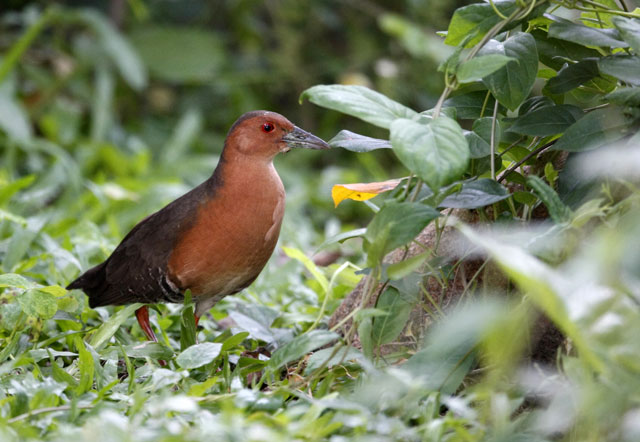
The Henderson Crake is a flightless bird. It is endemic to Henderson Island in the southeast Pacific Ocean. It has entirely deep black plumage, a bright reddish-orange eye-ring and legs, and a yellowish-green bill.
Written 26 November 2026 from the sources listed below. Each statement was checked against the passage it cites; statements that could not be supported were removed.
Appearance
The Henderson Crake has entirely deep black plumage. Its eye-ring and legs are bright reddish-orange, and its bill is yellowish-green.[1][2][3][4]
Behaviour
The Henderson Crake is flightless and is described as bold and curious.[5][6]
Helpers sometimes provide additional parental care by defending eggs and chicks against crabs and rats.[7]
Habitat
The Henderson Crake inhabits dense to open forest throughout Henderson Island's plateau. It occurs in forests dominated by Pisonia and by Pisonia and Xylosma, as well as in Timonius thickets.[8][9][10]
The species also inhabits Pandanus–Thespesia–Argusia embayment forests and coconut groves on beaches. Henderson Island is a small, uninhabited, raised-reef island.[11][12][13]
Diet
The Henderson Crake feeds opportunistically and takes advantage of seasonal increases in prey. It forages among leaf litter and consumes eggs of the skink Emoia cyanura.[14][15][16]
Reproduction and life cycle
The breeding season extends from late July to mid-February. The species sometimes produces two broods in a breeding season.[17][18]
Helpers sometimes defend eggs and chicks against crabs and rats. The estimated minimum reproductive success is 0.95 chicks surviving to one month old per pair annually.[7][19]
Conservation
The Henderson Crake was assessed for the IUCN Red List in 2022. A failed rodent eradication campaign on Henderson in 2011 severely affected its population, which had returned to pre-eradication levels by 2015.[20][21][22]
The estimated population in 2022 was 5,600 mature individuals, with a range of 3,800 to 8,400. The estimated total population was approximately 8,500 individuals.[23][24]
Adult annual survival is estimated at a minimum of 43%, based on a small sample.[25]
Classification of the Henderson Crake
| Kingdom | Animalia |
|---|---|
| Phylum | Chordata |
| Subphylum | Vertebrata |
| Infraphylum | Gnathostomata |
| Parvphylum | Osteichthyes |
| Megaclass | Tetrapoda |
| Class | Aves (Bird) |
| Order | Gruiformes (Rails) |
| Family | Rallidae (Rail) |
| Genus | Zapornia (Zapornia Crakes) |
| Species | Zapornia atra (North, 1908) |
Where the Henderson Crake is found
Checklists and occurrence records place Zapornia atra in 1 country across Oceania. GBIF holds 99 georeferenced records of it.
Countries
Range as the checklists state it
Oceania
A number beside a place is its count of GBIF occurrence records. A place without a number comes from a checklist alone. Records show where a species has been observed or collected, which can include escapes and vagrants.
Common names
English
- Henderson Crake
- Henderson Island Crake
- Henderson Island Rail
- Red-eyed Crake
Names in 26 other languages
- Arabic
- مرعة هندرسون
- Catalan
- rasclet de l'illa Henderson
- Chinese
- 亨岛田鸡, 北秧雞
- Croatian
- hendersonska štijoka
- Czech
- chřástal hendersonský
- Danish
- Hendersonrørvagtel, Tuamotu Rørvagtel
- Dutch
- Hendersonporseleinhoen
- Esperanto
- hendersona ralo
- Estonian
- nõgihuik
- Finnish
- nokihuitti
- French
- Marouette de Henderson, Râle de Henderson
- German
- Hendersonsumpfhuhn, Tuamotusumpfhuhn
- Hungarian
- henderson-szigeti vízicsibe
- Italian
- Schiribilla di Henderson
- Japanese
- ヘンダーソンクイナ
- Lithuanian
- Hendersono švygžda
- Norwegian
- hendersonrikse
- Polish
- kureczka smolista
- Portuguese
- franga-d'água-da-henderson, franga-d'água-de-henderson, franga-de-água-da-henderson, sanã-da-henderson
- Russian
- Туамотский погоныш, Чёрный островной погоныш
- Serbian
- Barski petlić sa ostrva Henderson
- Slovak
- chriašť čierny
- Spanish
- Polluela de isla Henderson, Polluela de la Henderson
- Swedish
- hendersonsumphöna
- Turkish
- Henderson Adası Yelvesi
- Ukrainian
- погонич чорний
Synonyms
3 other scientific names have been used for this species and are now treated as synonyms of Zapornia atra.
- Nesophylax ater (North, 1908)
- Porzana atra North, 1908
- Porzana murrayi Ogilvie-Grant, WR, 1913
Related species
-
 Baillon's CrakeZapornia pusilla
-
 Little CrakeZapornia parva
-
 Black CrakeZapornia flavirostra
-
 Spotless CrakeZapornia tabuensis
-
 Hawaiian RailZapornia sandwichensis
-
 Ruddy-breasted CrakeZapornia fusca
-
 Brown CrakeZapornia akool
-
 Band-bellied CrakeZapornia paykullii
Compare
Questions and answers
What is the scientific name of the Henderson Crake?
The scientific name of the Henderson Crake is Zapornia atra. Written with its author, the full name is Zapornia atra (North, 1908).
Which family does the Henderson Crake belong to?
Zapornia atra belongs to the family Rallidae, in the order Gruiformes and the class Aves.
Where is the Henderson Crake found?
Checklists and occurrence records place Zapornia atra in 1 country: Pitcairn.
What is the conservation status of the Henderson Crake?
The IUCN Red List category recorded for Zapornia atra is Vulnerable (VU).
What other names does the Henderson Crake have?
Zapornia atra is also known in English as Henderson Island Crake, Henderson Island Rail and Red-eyed Crake.
Sources
Passages the profile rests on
- The Henderson Island Crake has entirely deep black plumage. Source passage: “An entirely deep black crake” — ebird.org
- The species has a bright reddish-orange eye-ring. Source passage: “bright reddish-orange eye-ring and legs.” — ebird.org
- The species has bright reddish-orange legs. Source passage: “bright reddish-orange eye-ring and legs.” — ebird.org
- The species has a yellowish-green bill. Source passage: “Bill is yellowish green.” — ebird.org
- The Henderson Island Crake is flightless. Source passage: “a species of flightless bird in the family Rallidae.” — English Wikipedia
- The species is described as bold and curious. Source passage: “Flightless, bold, and curious.” — ebird.org
- Helpers sometimes provide additional parental care by defending eggs and chicks against crabs and rats. Source passage: “Helpers may provide extraparental care, such as defending eggs and chicks from crabs and rats.” — English Wikipedia
- The species inhabits dense to open forest throughout Henderson Island's plateau. Source passage: “found in dense to open forest throughout the island plateau” — English Wikipedia
- The species occurs in forests dominated by Pisonia and by Pisonia and Xylosma. Source passage: “both in forest dominated by Pisonia and Pisonia/Xylosma” — English Wikipedia
- The species inhabits Timonius thickets. Source passage: “and in Timonius thicket” — English Wikipedia
- The species also occurs in Pandanus–Thespesia–Argusia embayment forests. Source passage: “also occurring in Pandanus–Thespesia–Argusia embayment forests” — English Wikipedia
- The species occurs in coconut groves on beaches. Source passage: “and coconut groves on the beaches.” — English Wikipedia
- Henderson Island is described as a small, uninhabited, raised-reef island. Source passage: “a small uninhabited, raised-reef island” — datazone.birdlife.org
- The species feeds opportunistically and takes advantage of seasonal increases in prey. Source passage: “appears to be an opportunistic feeder, taking advantage of seasonal increases in prey.” — English Wikipedia
- The species forages among leaf litter. Source passage: “It forages in the leaf-litter” — English Wikipedia
- The species consumes eggs of the skink Emoia cyanura. Source passage: “such as skink Emoia cyanura eggs” — English Wikipedia
- The breeding season extends from late July to mid-February. Source passage: “The breeding season is long, extending from late July to mid February” — English Wikipedia
- The species sometimes produces two broods in a breeding season. Source passage: “double broods are not uncommon” — English Wikipedia
- The estimated minimum reproductive success is 0.95 chicks surviving to one month old per pair annually. Source passage: “reproductive success is a minimum of 0.95 chicks surviving to one month old per pair, per annum.” — English Wikipedia
- The species was assessed for the IUCN Red List in 2022. Source passage: “has most recently been assessed for The IUCN Red List of Threatened Species in 2022.” — iucnredlist.org
- A failed rodent eradication campaign on Henderson in 2011 severely affected the species' population. Source passage: “The population of the species was severely affected by a failed rodent eradication campaign on Henderson in 2011” — English Wikipedia
- The species' population had returned to pre-eradication levels by 2015. Source passage: “but had returned to pre-eradication levels by 2015.” — English Wikipedia
- The estimated population in 2022 was 5,600 mature individuals, with a range of 3,800 to 8,400. Source passage: “the population of this species is estimated to be 5,600 mature individuals (range: 3,800 – 8,400)” — English Wikipedia
- The estimated total population in 2022 was approximately 8,500 individuals. Source passage: “roughly equivalent to 8,500 individuals in total.” — English Wikipedia
- Adult annual survival is estimated at a minimum of 43%, based on a small sample. Source passage: “Based on a small sample, adult annual survival is at least 43%” — English Wikipedia
Data
- Catalogue of Life, 2026-10-16 XR cc by
- Global Biodiversity Information Facility CC BY 4.0
- Wikidata CC0
- GeoNames CC BY 4.0
- Wikimedia Commons per image; credit shown with each image
- iNaturalist per image; credit shown with each image
- Within the Catalogue of Life, this name comes from The Integrated Taxonomic Information System cc0
References
- Dickinson, E. C., and J. V. Remsen Jr., eds. (2013). The Howard and Moore Complete Checklist of the Birds of the World, 4th Edition, Vol. 1 Non-Passerines.
This species in other databases
Page built on 27 November 2026. See how the catalog is made and all sources and licences.
Cite this page
ScientificNames.org. (2026). Zapornia atra (Henderson Crake). Retrieved November 27, 2026, from https://scientificnames.org/species/zapornia-atra
“Zapornia atra (Henderson Crake).” ScientificNames.org, 2026, scientificnames.org/species/zapornia-atra. Accessed 27 Nov. 2026.
ScientificNames.org. “Zapornia atra (Henderson Crake).” Accessed November 27, 2026. https://scientificnames.org/species/zapornia-atra.
@misc{scientificnames_zapornia_atra_henderson_crake,
  author = {{ScientificNames.org}},
  title = {Zapornia atra (Henderson Crake)},
  year = {2026},
  url = {https://scientificnames.org/species/zapornia-atra},
  note = {Accessed 2026-11-27}
}