Species · Birds
Little Crake Zapornia parva
The scientific name of the Little Crake is Zapornia parva. It is a species of bird in the family Rallidae (rail), order Gruiformes. The name dates from 1769.
- Scientific name
- Zapornia parva (Scopoli, 1769)
- Common name
- Little Crake
- Genus
- Zapornia
- Family
- Rallidae (Rail)
- Order
- Gruiformes
- Class
- Aves
- Red List category
- LC Least Concern
- Environment
- freshwater, terrestrial
- Recorded in
- 62 countries
- Name status
- accepted in the Catalogue of Life

Overview
The Little Crake is a very small waterbird belonging to the family Rallidae. It breeds in reed beds in Europe, predominantly in eastern regions, and extends into western Asia. It has a short, yellow bill with a red base, green legs with long toes and a short tail with black-and-white barring underneath.
Written 26 November 2026 from the sources listed below. Each statement was checked against the passage it cites; statements that could not be supported were removed.
Appearance
Adult males have predominantly brown upperparts and blue-grey faces and underparts. Adult females have buff underparts, with grey coloration restricted to the face.[1][2]
Immature Little Crakes resemble females but have white faces and breasts. Chicks have black down.[3][4]
The species has a short, straight bill that is yellow with a red base. Its legs are green with long toes, and its short tail has black-and-white barring on the underside.[5][6][7]
The Little Crake measures 17–19 cm in length and is slightly smaller than the Spotted Crake.[8][9]
Habitat
The Little Crake breeds in reed beds in Europe, predominantly in eastern regions, and extends into western Asia.[10]
It constructs its nests in dry locations within reed vegetation.[11]
Diet
The Little Crake's diet consists mostly of insects. It also consumes aquatic animals.[12][13]
Behaviour
Little Crakes search for food by probing mud or shallow water with their bills. They also collect food by sight.[14][15]
Little Crakes are highly secretive during the breeding season and are more often heard than seen. They are easier to observe during migration.[16][17]
During migration, Little Crakes make noisy, yapping calls described as kua.[18]
Conservation
The species is covered by the Agreement on the Conservation of African-Eurasian Migratory Waterbirds (AEWA).[19]
Similar species
The Little Crake resembles Baillon's Crake, which has strongly barred flanks and is slightly smaller.[20]
Classification of the Little Crake
| Kingdom | Animalia |
|---|---|
| Phylum | Chordata |
| Subphylum | Vertebrata |
| Infraphylum | Gnathostomata |
| Parvphylum | Osteichthyes |
| Megaclass | Tetrapoda |
| Class | Aves (Bird) |
| Order | Gruiformes (Rails) |
| Family | Rallidae (Rail) |
| Genus | Zapornia (Zapornia Crakes) |
| Species | Zapornia parva (Scopoli, 1769) |
Where the Little Crake is found
Checklists and occurrence records place Zapornia parva in 62 countries across Asia. GBIF holds 32,236 georeferenced records of it.
Countries
- Armenia 40
- Austria 275
- Azerbaijan 29
- Belarus 125
- Belgium 661
- Bosnia and Herzegovina 15
- Bulgaria 357
- China 12
- Croatia 204
- Cyprus 1,310
- Czechia 245
- Denmark 395
- Estonia 613
- Finland 272
- France 1,665
- Georgia 636
- Germany 624
- Greece 2,010
- Hungary 457
- India 162
- Iran 65
- Iraq 22
- Israel 3,283
- Italy 866
- Jordan 72
- Kazakhstan 48
- Kosovo 5
- Kuwait 583
- Kyrgyzstan 4
- Latvia 87
- Lebanon 69
- Lithuania 74
- Luxembourg 5
- Malta 22
- Moldova 16
- Mongolia 7
- Montenegro 10
- North Macedonia 15
- Norway 237
- Oman 131
- Pakistan 14
- Palestinian Territory 9
- Poland 1,338
- Portugal 82
- Qatar 26
- Romania 364
- Russia 519
- Saudi Arabia 180
- Serbia 107
- Slovakia 202
- Slovenia 154
- Spain 1,381
- Sweden 5,001
- Switzerland 520
- Syria 16
- The Netherlands 3,710
- Turkey 1,294
- Ukraine 1,048
- United Arab Emirates 151
- United Kingdom 381
- Uzbekistan 4
- Yemen 7
Regions and cities with the most records
- Southern District, Israel 1,833
- Aqaba, Jordan 1,486
- Eilat, Israel 1,486
- Steenwijk, The Netherlands 1,334
- Meppel, The Netherlands 1,331
- Overijssel, The Netherlands 1,090
- Emmeloord, The Netherlands 1,088
- Stockholm, Sweden 1,085
- Uppsala, Sweden 1,001
- Staphorst, The Netherlands 989
- Pafos, Cyprus 900
- Paphos, Cyprus 880
- Flevoland, The Netherlands 831
- Jakobsberg, Sweden 732
- Sollentuna, Sweden 730
- Märsta, Sweden 681
- Upplands Väsby, Sweden 676
- Provence-Alpes-Côte d'Azur, France 667
- Kalmar, Sweden 642
- Skåne, Sweden 630
- Northern District, Israel 627
- Täby, Sweden 623
- Vallentuna, Sweden 623
- Kristianstad, Sweden 595
- Batumi, Georgia 584
- Catalonia, Spain 512
- Al Jahrā’, Kuwait 507
- Central District, Israel 457
- Sundbyberg, Sweden 450
- Solna, Sweden 444
- Merksem, Belgium 443
- Schoten, Belgium 440
- Diemen, The Netherlands 438
- Enköping, Sweden 438
- Bussum, The Netherlands 436
- Naarden, The Netherlands 436
9 more countries have a few records outside this range
These countries hold a few records of Zapornia parva but lie outside the range the checklists give for it. Such records are often zoo or garden specimens, museum material or vagrants, so the species is not counted as occurring there.
Range as the checklists state it
Europe & Northern Asia (excluding China)
Southern Asia
A number beside a place is its count of GBIF occurrence records. A place without a number comes from a checklist alone. Records show where a species has been observed or collected, which can include escapes and vagrants.
Common names
English
- Little Crake
Names in 60 other languages
- Afrikaans
- Europese Kleinriethaan
- Albanian
- Porzana zogëzë
- Arabic
- مرعة صغيرة
- Armenian
- Եվրոպական ճահճահովվիկ, Ճահճահովվիկ եվրոպական
- Azerbaijani
- Xırda porzan
- Basque
- Uroilanda hankaberdea
- Belarusian
- Малы пагоніч
- Breton
- Rakig bihan
- Bulgarian
- Средна пъструшка
- Catalan
- rascletó
- Chinese
- 姬田雞, 姬田鸡
- Croatian
- siva štijoka
- Czech
- chřástal malý
- Danish
- Lille Rørvagtel
- Dutch
- Klein Waterhoen
- Esperanto
- eta ralo, malgranda porzano
- Estonian
- väikehuik
- Faroese
- Lítil tjarnarsmetta
- Finnish
- pikkuhuitti
- French
- Marouette poussin, Râle poussin
- Galician
- Poliña bastarda
- Georgian
- ჭაობის პატარა ქათამურა
- German
- Kleines Sumpfhuhn, Kleinralle, Kleinsumpfhuhn
- Greek
- Μικροπουλάδα, Μικροπουλλάδα
- Hebrew
- ברודית קטנה
- Hungarian
- kis vízicsibe
- Icelandic
- Flóðrella
- Irish
- Gearr beag
- Italian
- Schiribilla, Schiribilla comune, Schiribilla eurasiatica
- Japanese
- コクイナ
- Kazakh
- Кішкене тартар
- Latvian
- mazais ormanītis
- Lithuanian
- plovinė vištelė
- Luxembourgish
- Kleng Rall
- Macedonian
- сива барска кокошка
- Maltese
- Gallozz Żgħir
- Northern Sami
- Uhcajeaggevuonccis
- Norwegian
- sumprikse
- Persian
- یلوه کوچک
- Polish
- zielonka
- Portuguese
- franga-d'água-bastarda, franga-de-água-bastarda
- Romanian
- Cresteţ mic, Cresteț cenușiu
- Russian
- Малый погоныш
- Serbian
- Sivi barski petlić, Сиви барски петлић
- Slovak
- chriašteľ malý, chriašť malý
- Slovenian
- mala tukalica
- Spanish
- Polluela bastarda
- Swedish
- mindre sumphöna
- Tamil
- Chinna Kaanaan Kozhi
- Turkish
- Bataklık Suyelvesi, Bataklık sutavuğu
- Ukrainian
- Мала курочка, погонич малий
- Welsh
- Rhegen Fach, Rhegennod Bach
- bak
- Һыу бүҙәнәһе
- chv
- Пӗчӗк шывавтань
- cor
- Crek byghan
- csb
- Kùropatinka
- glv
- Eean raip beg
- pnb
- نکی کریک
- roh
- Pulsauna pitschna
- uig
- چىقچىق
Synonyms
9 other scientific names have been used for this species and are now treated as synonyms of Zapornia parva.
- Crex pusilla
- Gallinula minutissima Brehm, CL, 1831
- Porzana minuta (Gmelin)
- Porzana parva (Scopoli, 1769)
- Porzana parva subsp. parva
- Rallus parvus Scopoli, 1769
- Rallus peyrousei Vieillot, LJP, 1819
- Zapornia minuta Leach, WE, 1816
- Zapornia parva parva Scopoli, GA, 1769
Related species
-
 Baillon's CrakeZapornia pusilla
-
 Henderson CrakeZapornia atra
-
 Black CrakeZapornia flavirostra
-
 Spotless CrakeZapornia tabuensis
-
 Hawaiian RailZapornia sandwichensis
-
 Ruddy-breasted CrakeZapornia fusca
-
 Brown CrakeZapornia akool
-
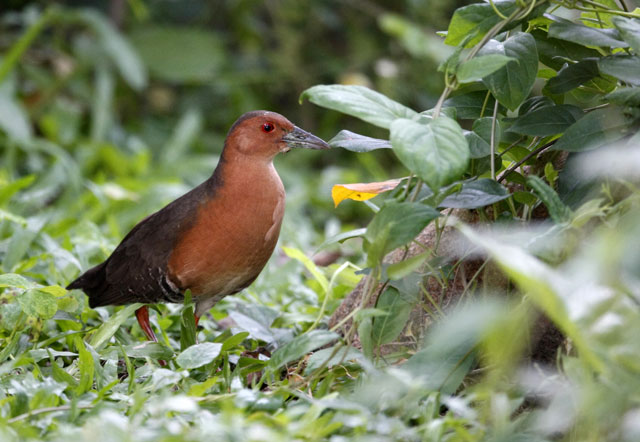 Band-bellied CrakeZapornia paykullii
Compare
Questions and answers
What is the scientific name of the Little Crake?
The scientific name of the Little Crake is Zapornia parva. Written with its author, the full name is Zapornia parva (Scopoli, 1769).
Which family does the Little Crake belong to?
Zapornia parva belongs to the family Rallidae, in the order Gruiformes and the class Aves.
Where is the Little Crake found?
Checklists and occurrence records place Zapornia parva in 62 countries, including Sweden, The Netherlands, Israel, Greece, France and Spain.
What is the conservation status of the Little Crake?
The IUCN Red List category recorded for Zapornia parva is Least Concern (LC).
Sources
Passages the profile rests on
- Adult male Little Crakes have predominantly brown upperparts and blue-grey faces and underparts. Source passage: “Adult males have mainly brown upperparts and blue-grey face and underparts.” — English Wikipedia
- Adult females have buff underparts and grey coloration restricted to the face. Source passage: “Females have buff underparts, and are grey only on the face” — English Wikipedia
- Immature Little Crakes resemble females but have white faces and breasts. Source passage: “Immature little crakes are similar to the female but have a white face and breast.” — English Wikipedia
- Little Crake chicks have black down. Source passage: “The downy chicks are black, as with all rails.” — English Wikipedia
- The species has a short, straight bill that is yellow with a red base. Source passage: “The little crake has a short straight bill, yellow with a red base.” — English Wikipedia
- Little Crakes have green legs with long toes. Source passage: “They have green legs with long toes” — English Wikipedia
- The species has a short tail with black-and-white barring on its underside. Source passage: “a short tail which is barred black and white underneath.” — English Wikipedia
- The Little Crake measures 17–19 cm in length. Source passage: “At 17–19 cm (6.7–7.5 in) in length” — English Wikipedia
- The Little Crake is slightly smaller than the Spotted Crake. Source passage: “they are slightly smaller than the spotted crake” — English Wikipedia
- The species breeds in reed beds in Europe, predominantly in eastern regions, and extends into western Asia. Source passage: “Its breeding habitat is reed beds in Europe, mainly in the east, and just into western Asia.” — English Wikipedia
- Little Crakes construct their nests in dry locations within reed vegetation. Source passage: “They nest in a dry location in reed vegetation” — English Wikipedia
- The Little Crake's diet consists mostly of insects. Source passage: “The diet of this species consists mostly of insects” — datazone.birdlife.org
- Little Crakes mainly consume insects and aquatic animals. Source passage: “They mainly eat insects and aquatic animals.” — English Wikipedia
- Little Crakes search for food by probing mud or shallow water with their bills. Source passage: “These birds probe with their bill in mud or shallow water” — English Wikipedia
- The species also collects food by sight. Source passage: “also picking up food by sight.” — English Wikipedia
- Little Crakes are highly secretive during the breeding season and are more often heard than seen. Source passage: “Little crakes are very secretive in the breeding season, and are then mostly heard rather than seen.” — English Wikipedia
- Little Crakes are easier to observe during migration than during the breeding season. Source passage: “They can be easier to see on migration.” — English Wikipedia
- During migration, Little Crakes make noisy, yapping calls described as kua. Source passage: “They are then noisy birds, with a yapping kua call.” — English Wikipedia
- The Little Crake is covered by the Agreement on the Conservation of African-Eurasian Migratory Waterbirds (AEWA). Source passage: “The little crake is one of the species to which the Agreement on the Conservation of African-Eurasian Migratory Waterbirds (AEWA) applies.” — English Wikipedia
- The Little Crake resembles Baillon's Crake, which has strongly barred flanks and is slightly smaller. Source passage: “They resemble the sympatric Baillon's crake (Z. pusilla), which has strongly barred flanks and is a little smaller.” — English Wikipedia
Data
- Catalogue of Life, 2026-10-16 XR cc by
- Global Biodiversity Information Facility CC BY 4.0
- Wikidata CC0
- GeoNames CC BY 4.0
- Wikimedia Commons per image; credit shown with each image
- Within the Catalogue of Life, this name comes from The Integrated Taxonomic Information System cc0
References
- Dickinson, E. C., and J. V. Remsen Jr., eds. (2013). The Howard and Moore Complete Checklist of the Birds of the World, 4th Edition, Vol. 1 Non-Passerines.
This species in other databases
- Catalogue of Life CPPDW
- Wikidata Q270680
- iNaturalist 508919
- WoRMS urn:lsid:marinespecies.org:taxname:1488280
- Avibase litcra1
Page built on 28 November 2026. See how the catalog is made and all sources and licences.
Cite this page
ScientificNames.org. (2026). Zapornia parva (Little Crake). Retrieved November 28, 2026, from https://scientificnames.org/species/zapornia-parva
“Zapornia parva (Little Crake).” ScientificNames.org, 2026, scientificnames.org/species/zapornia-parva. Accessed 28 Nov. 2026.
ScientificNames.org. “Zapornia parva (Little Crake).” Accessed November 28, 2026. https://scientificnames.org/species/zapornia-parva.
@misc{scientificnames_zapornia_parva_little_crake,
  author = {{ScientificNames.org}},
  title = {Zapornia parva (Little Crake)},
  year = {2026},
  url = {https://scientificnames.org/species/zapornia-parva},
  note = {Accessed 2026-11-28}
}