Species · Birds
Ambon White-eye Zosterops kuehni
The scientific name of the Ambon White-eye is Zosterops kuehni. It is a species of bird in the family Zosteropidae (white-eye), order Passeriformes. The name dates from 1906.
- Scientific name
- Zosterops kuehni Hartert, 1906
- Common name
- Ambon White-eye
- Genus
- Zosterops
- Family
- Zosteropidae (White-eye)
- Order
- Passeriformes
- Class
- Aves
- Red List category
- LC Least Concern
- Recorded in
- 1 country
- Name status
- accepted in the Catalogue of Life

Overview
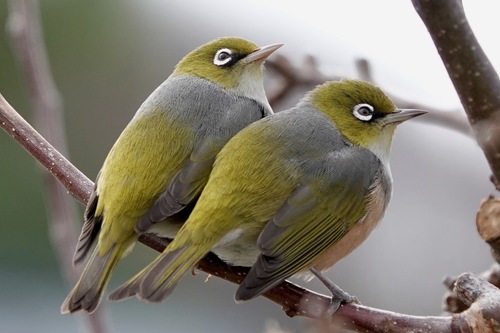
The Ambon White-eye is an omnivorous bird. It inhabits lowland forests. It is distinguished by a conspicuous white eye-ring, green upperparts, and a bright yellow throat.
Written 27 November 2026 from the sources listed below. Each statement was checked against the passage it cites; statements that could not be supported were removed.
Appearance
The Ambon White-eye measures approximately 12 cm in length. It has a conspicuous white eye-ring, a green face, and green upperparts.[1][2][3]
The top of its head and its underparts are olive green. Its chin, throat, and undertail are bright yellow, while the remaining underbody is greyish-white.[4][5][6]
A black streak runs beneath its eye. Its tail and wing feathers are black and brownish, blending with the olive-green coloration.[7][8]
The upper bill is black and the lower bill is greyish. Its legs are grey.[9][10]
Male and female Ambon White-eyes have similar appearances.[11]
Habitat
The Ambon White-eye inhabits lowland forests. It is relatively common in suitable habitats on Ambon Island.[12][13]
The species is endemic to Indonesia and is reported from Ambon and Seram islands. According to BirdLife DataZone, its distribution is restricted to Ambon Island, Indonesia.[14][15][16]
Diet
The Ambon White-eye is an omnivore that feeds on insects, fruit, and nectar.[17][18][19][20]
Behaviour
The species has a tiny-tipped tongue that enables it to collect nectar from flowers and feeders. It is cautious when feeding.[21][22]
Ambon White-eyes are usually observed in pairs or groups of three or four. They produce a short call consisting of a single 'teeu' note.[23][24]
The Ambon White-eye is described as non-migratory.[25]
Conservation
The species' habitat on Ambon Island is diminishing. Deforestation and habitat loss are identified as threats to the species.[26][27]
Continued forest destruction on Ambon Island could cause a future population decline.[28]
Classification of the Ambon White-eye
| Kingdom | Animalia |
|---|---|
| Phylum | Chordata |
| Subphylum | Vertebrata |
| Infraphylum | Gnathostomata |
| Parvphylum | Osteichthyes |
| Megaclass | Tetrapoda |
| Class | Aves (Bird) |
| Order | Passeriformes (Passerine) |
| Family | Zosteropidae (White-eye) |
| Genus | Zosterops (Lesser White-eyes) |
| Species | Zosterops kuehni Hartert, 1906 |
Where the Ambon White-eye is found
Checklists and occurrence records place Zosterops kuehni in 1 country. GBIF holds 172 georeferenced records of it.
Countries
Regions and cities with the most records
A number beside a place is its count of GBIF occurrence records. A place without a number comes from a checklist alone. Records show where a species has been observed or collected, which can include escapes and vagrants.
Common names
English
- Ambon White-eye
- Ambon Yellow White-eye
Names in 25 other languages
- Catalan
- zostèrops de l'illa Ambon
- Chinese
- 安汶繡眼, 库氏绣眼鸟
- Croatian
- ambonska bjelooka
- Czech
- kruhoočko ambonské
- Danish
- Ambon Brillefugl
- Dutch
- Ambonese Brilvogel
- Esperanto
- ambona zosteropo
- Finnish
- amboninrilli
- French
- Zostérops d'Amboine, Zostérops d'Ambon, Zostérops d’Amboine, Zostérops d’Ambon
- German
- Ambon-Brillenvogel, Ambonbrillenvogel
- Hungarian
- amboinai pápaszemesmadár
- Indonesian
- Kacamata-kuning ambon
- Italian
- Occhialino di Ambon
- Japanese
- アンボンメジロ
- Lithuanian
- amboninis baltavokis
- Polish
- szlarnik cytrynowogardły
- Portuguese
- olho-branco-de-ambon, olho-branco-de-amboíno
- Russian
- Амбоинская белоглазка, Амбонская белоглазка
- Slovak
- okánik ambonský
- Spanish
- Anteojitos de Ambon
- Swedish
- ambonglasögonfågel
- Turkish
- Ambon Gözlükçüsü
- Ukrainian
- окулярник амбонський
- Welsh
- llygadwyn Ambon
- pnb
- ایمبون چٹی اکھ
Synonyms
3 other scientific names have been used for this species and are now treated as synonyms of Zosterops kuehni.
- Zosterops huehni Hartert, EJO, 1906
- Zosterops juehni Hartert, EJO, 1906
- Zosterops kühni Hartert, EJO, 1906
Related species
-
 SilvereyeZosterops lateralis
-
 Warbling White-eyeZosterops japonicus
-
 Indian White-eyeZosterops palpebrosus
-
 White-chested White-eyeZosterops albogularis
-
 Bridled White-eyeZosterops conspicillatus
-
 Green-backed White-eyeZosterops xanthochroa
-
 Mauritius Grey White-eyeZosterops mauritianus
-
 Mauritius Olive White-eyeZosterops chloronothos
Compare
Questions and answers
What is the scientific name of the Ambon White-eye?
The scientific name of the Ambon White-eye is Zosterops kuehni. Written with its author, the full name is Zosterops kuehni Hartert, 1906.
Which family does the Ambon White-eye belong to?
Zosterops kuehni belongs to the family Zosteropidae, in the order Passeriformes and the class Aves.
Where is the Ambon White-eye found?
Checklists and occurrence records place Zosterops kuehni in 1 country: Indonesia.
What is the conservation status of the Ambon White-eye?
The IUCN Red List category recorded for Zosterops kuehni is Least Concern (LC).
What other names does the Ambon White-eye have?
Zosterops kuehni is also known in English as Ambon Yellow White-eye.
Which bird has white eyes?
The Ambon White-eye has a conspicuous white eye-ring.[1]
Sources
Passages the profile rests on
- The Ambon White-eye has a conspicuous white eye-ring. Source passage: “A small songbird with a conspicuous white eye-ring” — ebird.org
- The species has a green face and green upperparts. Source passage: “a green face and upperparts” — ebird.org
- The Ambon White-eye measures approximately 12 cm in length. Source passage: “The Ambon white-eye is a small bird measuring about 12 cm long.” — English Wikipedia
- The top of the bird's head and its underparts are olive green. Source passage: “The top of the bird's head and underparts are olive green” — English Wikipedia
- Its chin, throat, and undertail are bright yellow. Source passage: “The bird's chin, throat, and undertail is a bright yellow.” — English Wikipedia
- The remaining underbody is greyish-white. Source passage: “The rest of the underbody and legs is a grayish- white” — English Wikipedia
- The species has a black streak beneath its eye. Source passage: “with a black streak under the eye.” — English Wikipedia
- Its tail and wing feathers are black and brownish, blending with the olive-green coloration. Source passage: “The tail and wing feathers are black and brownish, merging with the olive green.” — English Wikipedia
- The species has a black upper bill and a greyish lower bill. Source passage: “with a black bill on the upper side and a greyish color below.” — English Wikipedia
- The species has grey legs. Source passage: “The bird also has grey legs.” — English Wikipedia
- Male and female Ambon White-eyes have similar appearances. Source passage: “Both of the Ambon white-eye genders look alike.” — English Wikipedia
- The Ambon White-eye inhabits lowland forests. Source passage: “Its natural habitats are lowland forest” — English Wikipedia
- The species is relatively common in suitable habitats on Ambon Island. Source passage: “where it is relatively common in suitable habitats,” — datazone.birdlife.org
- The Ambon White-eye is endemic to Indonesia. Source passage: “It is endemic to Indonesia.” — English Wikipedia
- The species is reported from Ambon and Seram islands in Indonesia. Source passage: “They are found on the islands Ambon and Serman in Indonesia.” — English Wikipedia
- The species is restricted to Ambon Island, Indonesia, according to BirdLife DataZone. Source passage: “Zosterops kuehni is restricted to Ambon Island, Indonesia,” — datazone.birdlife.org
- The Ambon White-eye is an omnivore. Source passage: “The Ambon white-eye is an omnivore bird.” — English Wikipedia
- The species feeds on insects. Source passage: “The bird feeds on insects, fruit, and nectar.” — English Wikipedia
- The species feeds on fruit. Source passage: “The bird feeds on insects, fruit, and nectar.” — English Wikipedia
- The species feeds on nectar. Source passage: “The bird feeds on insects, fruit, and nectar.” — English Wikipedia
- The species has a tiny-tipped tongue that enables it to collect nectar from flowers and feeders. Source passage: “The bird has a tiny tipped tongue. This allows the bird to collect nectar from flowers and feeders.” — English Wikipedia
- The species is cautious when feeding. Source passage: “The species is known to be cautious or careful when eating.” — English Wikipedia
- Ambon White-eyes are usually observed in pairs or groups of three or four. Source passage: “Ambon white-eyes are normally seen in pairs or small groups of three or four.” — English Wikipedia
- The species produces a short call consisting of a single 'teeu' note. Source passage: “The bird's call is short with a single “teeu” note.” — English Wikipedia
- The Ambon White-eye is described as non-migratory. Source passage: “The Ambon white-eye does not migrate” — English Wikipedia
- The species' habitat on Ambon Island is diminishing. Source passage: “The bird's habitat is slowly diminishing on Ambon island.” — English Wikipedia
- Deforestation and habitat loss are identified as threats to the species. Source passage: “This due to deforestation and loss of habitat.” — English Wikipedia
- Continued forest destruction on Ambon Island could cause a future population decline. Source passage: “If destruction of the forest on the island continues, it could lead to population decline in the future.” — English Wikipedia
Data
- Catalogue of Life, 2026-10-16 XR cc by
- Global Biodiversity Information Facility CC BY 4.0
- Wikidata CC0
- GeoNames CC BY 4.0
- Wikimedia Commons per image; credit shown with each image
- Within the Catalogue of Life, this name comes from The Integrated Taxonomic Information System cc0
References
- Gill, Frank, & and Minturn Wright. (2006). Birds of the World: Recommended English Names.
This species in other databases
Page built on 27 November 2026. See how the catalog is made and all sources and licences.
Cite this page
ScientificNames.org. (2026). Zosterops kuehni (Ambon White-eye). Retrieved November 27, 2026, from https://scientificnames.org/species/zosterops-kuehni
“Zosterops kuehni (Ambon White-eye).” ScientificNames.org, 2026, scientificnames.org/species/zosterops-kuehni. Accessed 27 Nov. 2026.
ScientificNames.org. “Zosterops kuehni (Ambon White-eye).” Accessed November 27, 2026. https://scientificnames.org/species/zosterops-kuehni.
@misc{scientificnames_zosterops_kuehni_ambon_white_eye,
  author = {{ScientificNames.org}},
  title = {Zosterops kuehni (Ambon White-eye)},
  year = {2026},
  url = {https://scientificnames.org/species/zosterops-kuehni},
  note = {Accessed 2026-11-27}
}