Species · Birds
Ethiopian White-eye Zosterops poliogastrus
The scientific name of the Ethiopian White-eye is Zosterops poliogastrus. It is a species of bird in the family Zosteropidae (white-eye), order Passeriformes. The name dates from 1861.
- Scientific name
- Zosterops poliogastrus Heuglin, 1861
- Common name
- Ethiopian White-eye
- Genus
- Zosterops
- Family
- Zosteropidae (White-eye)
- Order
- Passeriformes
- Class
- Aves
- Red List category
- LC Least Concern
- Recorded in
- 4 countries
- Name status
- accepted in the Catalogue of Life

Overview
The Ethiopian White-eye is a small passerine bird in the family Zosteropidae, order Passeriformes and class Aves. It inhabits the Ethiopian Highlands and East African highlands, at elevations of 1,340–3,640 metres. It has a vivid yellow head and crown, a white eye-ring, a narrow black line extending from the eye to its black beak, and lime-green flight feathers with brownish-black tips.
Written 27 November 2026 from the sources listed below. Each statement was checked against the passage it cites; statements that could not be supported were removed.
Appearance
The Ethiopian White-eye has a vivid yellow head and crown extending to its white eye-ring. A narrow black line extends from the eye to its black beak, while the area beneath the beak and the rest of the head are yellow.[1][2][3]
Its flight feathers are lime-green with brownish-black tips. Males and females have similar appearances.[4][5]
Habitat
The Ethiopian White-eye inhabits subtropical or tropical moist montane forests and subtropical or tropical high-altitude shrubland. Its habitat also includes plantations, rural gardens, woodland, forest edges and isolated cultivated areas.[6][7][8][9][10]
The species commonly occupies younger vegetation and shorter trees within its habitat.[11]
The Ethiopian White-eye is native to the Ethiopian Highlands and occurs in the East African highlands. Its recorded elevational range is 1,340–3,640 metres.[12][13][14]
Diet
The Ethiopian White-eye mainly feeds on berries and small insects. It forages on Leonotis flowers during September and November.[15][16]
Its diet varies seasonally. It is mainly frugivorous during the dry season and mainly insectivorous during the wet season.[17][18]
Behaviour
During the dry season, the Ethiopian White-eye commonly gathers in flocks of up to 50 birds. During the wet season, flocks of up to 50 birds are observed only in the early mornings or late afternoons.[19][20]
Classification of the Ethiopian White-eye
| Kingdom | Animalia |
|---|---|
| Phylum | Chordata |
| Subphylum | Vertebrata |
| Infraphylum | Gnathostomata |
| Parvphylum | Osteichthyes |
| Megaclass | Tetrapoda |
| Class | Aves (Bird) |
| Order | Passeriformes (Passerine) |
| Family | Zosteropidae (White-eye) |
| Genus | Zosterops (Lesser White-eyes) |
| Species | Zosterops poliogastrus Heuglin, 1861 |
Where the Ethiopian White-eye is found
Checklists and occurrence records place Zosterops poliogastrus in 4 countries across Africa. GBIF holds 6,412 georeferenced records of it.
Countries
Regions and cities with the most records
- Arusha, Tanzania 1,455
- Oromiya, Ethiopia 1,262
- Burayu, Ethiopia 1,212
- Addis Ababa, Ethiopia 1,176
- Addis Ababa, Ethiopia 1,116
- Sebeta, Ethiopia 830
- Usa River, Tanzania 740
- Kilimanjaro, Tanzania 672
- Arusha, Tanzania 603
- Karuri, Kenya 536
- Kiambu, Kenya 526
- Kikuyu, Kenya 518
- Nairobi, Kenya 486
- Imara Daima Estate, Kenya 458
- Nairobi County, Kenya 442
- Ngong, Kenya 331
- Ongata Rongai, Kenya 325
- Kiratu, Tanzania 318
- Githunguri, Kenya 290
- Limuru, Kenya 287
- Kingori, Tanzania 273
- Kiserian, Kenya 270
- Awasa, Ethiopia 222
- Fichē, Ethiopia 199
- Kiambu County, Kenya 192
- Shashamane, Ethiopia 186
- Nyeri County, Kenya 177
- Kofelē, Ethiopia 176
- Boma la Ngombe, Tanzania 152
- Amhara, Ethiopia 146
- Kajiado County, Kenya 145
- Goba, Ethiopia 127
- Nyeri, Kenya 115
- Tetu, Kenya 114
- Moshi, Tanzania 107
- Tarakea, Tanzania 107
A number beside a place is its count of GBIF occurrence records. A place without a number comes from a checklist alone. Records show where a species has been observed or collected, which can include escapes and vagrants.
Common names
English
- Ethiopian White-eye
- HEWE
- Heuglin's White-eye
- Montane White-eye
Names in 24 other languages
- Catalan
- zostèrops afroalpí
- Chinese
- 宽翼绣眼鸟, 寛眶繡眼, 環繡眼
- Croatian
- istočnoafrička bjelooka
- Czech
- kruhoočko východoafrické
- Danish
- Bredringet Brillefugl
- Dutch
- Heuglins Brilvogel, Hooglandbrilvogel
- Esperanto
- monta zosteropo
- Finnish
- etiopianrilli
- French
- Oiseau-lunettes des montagnes, Zostérops alticole
- German
- Bergbrillenvogel, Heuglinbrillenvogel
- Hungarian
- abesszin pápaszemesmadár
- Italian
- Occhialino quattrocchi
- Japanese
- アフリカヤマメジロ
- Lithuanian
- afrikinis baltavokis
- Norwegian
- bergbrillefugl
- Polish
- szlarnik białooki
- Portuguese
- olho-branco-etíope, olho-branco-montês
- Russian
- Желтобрюхая белоглазка, Серобрюхая белоглазка
- Slovak
- okánik ozdobný
- Spanish
- Anteojitos Serrano, Anteojitos serrano etíope
- Swedish
- heuglinglasögonfågel, höglandsglasögonfågel, simenglasögonfågel
- Turkish
- Dağ Gözlükçüsü
- Ukrainian
- окулярник мінливобарвний
- pnb
- موٹی چٹی اکھ
Synonyms
4 other scientific names have been used for this species and are now treated as synonyms of Zosterops poliogastrus.
- Zosterops poliogaster Heuglin, 1861
- Zosterops poliogaster poliogaster Heuglin, MT, 1861
- Zosterops poliogastra erlangeri Neumann, OR, 1908
- Zosterops senegalensis poliogastra Heuglin, MT, 1861
Subspecies and varieties
- Zosterops poliogastrus eurycricotus (Broad-ringed White-eye) subspecies
- Zosterops poliogastrus kaffensis (Kafa White-eye) subspecies
- Zosterops poliogastrus kulalensis (Kulal White-eye) subspecies
- Zosterops poliogastrus mbuluensis (Mbulu White-eye) subspecies
- Zosterops poliogastrus poliogastrus subspecies
- Zosterops poliogastrus winifredae (South Pare White-eye) subspecies
Related species
-
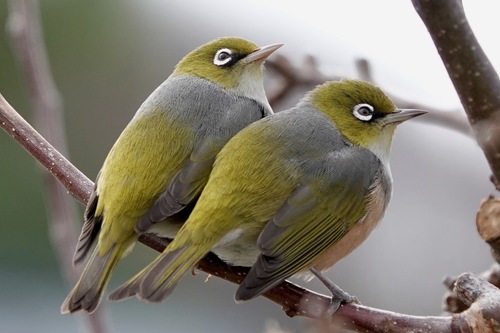 SilvereyeZosterops lateralis
-
 Warbling White-eyeZosterops japonicus
-
 Indian White-eyeZosterops palpebrosus
-
 White-chested White-eyeZosterops albogularis
-
 Bridled White-eyeZosterops conspicillatus
-
 Green-backed White-eyeZosterops xanthochroa
-
 Mauritius Grey White-eyeZosterops mauritianus
-
 Mauritius Olive White-eyeZosterops chloronothos
Compare
Questions and answers
What is the scientific name of the Ethiopian White-eye?
The scientific name of the Ethiopian White-eye is Zosterops poliogastrus. Written with its author, the full name is Zosterops poliogastrus Heuglin, 1861.
Which family does the Ethiopian White-eye belong to?
Zosterops poliogastrus belongs to the family Zosteropidae, in the order Passeriformes and the class Aves.
Where is the Ethiopian White-eye found?
Checklists and occurrence records place Zosterops poliogastrus in 4 countries: Ethiopia, Tanzania, Kenya and Eritrea.
What is the conservation status of the Ethiopian White-eye?
The IUCN Red List category recorded for Zosterops poliogastrus is Least Concern (LC).
What other names does the Ethiopian White-eye have?
Zosterops poliogastrus is also known in English as HEWE, Heuglin's White-eye and Montane White-eye.
Sources
Passages the profile rests on
- The Ethiopian white-eye has a vivid yellow head and crown extending to its white eye-ring. Source passage: “The Ethiopian white-eye has a vivid yellow head and crown that extends all the way to its white eyering” — English Wikipedia
- The species has a narrow black line extending from the eye to its black beak. Source passage: “a narrow black line extending from the eye to its black beak.” — English Wikipedia
- The area beneath the beak and the rest of the head are yellow. Source passage: “Underneath the beak, the rest of the head is yellow as well.” — English Wikipedia
- Its flight feathers are lime-green, with brownish-black tips. Source passage: “The flight feathers are lime-green. The tips of the feathers then shift to a brownish black.” — English Wikipedia
- Male and female Ethiopian white-eyes have similar appearances. Source passage: “The sexes are similar in appearance.” — English Wikipedia
- The species inhabits subtropical or tropical moist montane forests. Source passage: “subtropical or tropical moist montane forests” — English Wikipedia
- The species occurs in subtropical or tropical high-altitude shrubland. Source passage: “subtropical or tropical high-altitude shrubland” — English Wikipedia
- The species also inhabits plantations and rural gardens. Source passage: “plantations, and rural gardens.” — English Wikipedia
- Its habitat includes woodland and forest edges. Source passage: “The habitat generally consists of woodland and forest edges” — English Wikipedia
- The species occurs in isolated cultivated areas. Source passage: “as well as isolated cultivations.” — English Wikipedia
- The species commonly occupies younger vegetation and shorter trees within its habitat. Source passage: “they commonly live in younger growths or shorter trees.” — English Wikipedia
- The Ethiopian white-eye is native to the Ethiopian Highlands. Source passage: “It is native to the Ethiopian Highlands.” — English Wikipedia
- The species occurs in the East African highlands. Source passage: “This species occurs in the East African highlands, from ...” — datazone.birdlife.org
- The species' recorded elevational range is 1,340–3,640 metres. Source passage: “They live anywhere from 1340 to 3640 meters.” — English Wikipedia
- The Ethiopian white-eye mainly feeds on berries and small insects. Source passage: “The diet mainly consists of berries and small insects.” — English Wikipedia
- The species forages on Leonotis flowers during September and November. Source passage: “in the months of September and November they can be found foraging on Leonotis flowers.” — English Wikipedia
- The species is mainly frugivorous during the dry season. Source passage: “During the dry season, this bird is mainly frugivorous” — English Wikipedia
- The species is mainly insectivorous during the wet season. Source passage: “while insectivorous in the wet season.” — English Wikipedia
- During the dry season, the species commonly gathers in flocks of up to 50 birds. Source passage: “During the dry season, the Heuglin's white-eye are commonly found in large flocks of up to fifty birds.” — English Wikipedia
- During the wet season, flocks of up to 50 birds are observed only in the early mornings or late afternoons. Source passage: “However, in the wet season, flocks of this size are only seen in the early mornings or late afternoons.” — English Wikipedia
Data
- Catalogue of Life, 2026-10-16 XR cc by
- Global Biodiversity Information Facility CC BY 4.0
- Wikidata CC0
- GeoNames CC BY 4.0
- Wikimedia Commons per image; credit shown with each image
- Within the Catalogue of Life, this name comes from The Integrated Taxonomic Information System cc0
This species in other databases
Page built on 29 November 2026. See how the catalog is made and all sources and licences.
Cite this page
ScientificNames.org. (2026). Zosterops poliogastrus (Ethiopian White-eye). Retrieved November 29, 2026, from https://scientificnames.org/species/zosterops-poliogastrus
“Zosterops poliogastrus (Ethiopian White-eye).” ScientificNames.org, 2026, scientificnames.org/species/zosterops-poliogastrus. Accessed 29 Nov. 2026.
ScientificNames.org. “Zosterops poliogastrus (Ethiopian White-eye).” Accessed November 29, 2026. https://scientificnames.org/species/zosterops-poliogastrus.
@misc{scientificnames_zosterops_poliogastrus_ethiopian_white_eye,
  author = {{ScientificNames.org}},
  title = {Zosterops poliogastrus (Ethiopian White-eye)},
  year = {2026},
  url = {https://scientificnames.org/species/zosterops-poliogastrus},
  note = {Accessed 2026-11-29}
}