Species · Birds
Slender-billed White-eye Zosterops tenuirostris
The scientific name of the Slender-billed White-eye is Zosterops tenuirostris. It is a species of bird in the family Zosteropidae (white-eye), order Passeriformes. The name dates from 1837.
- Scientific name
- Zosterops tenuirostris Gould, 1837
- Common name
- Slender-billed White-eye
- Genus
- Zosterops
- Family
- Zosteropidae (White-eye)
- Order
- Passeriformes
- Class
- Aves
- Red List category
- VU Vulnerable
- Recorded in
- 2 countries
- Name status
- accepted in the Catalogue of Life

Overview
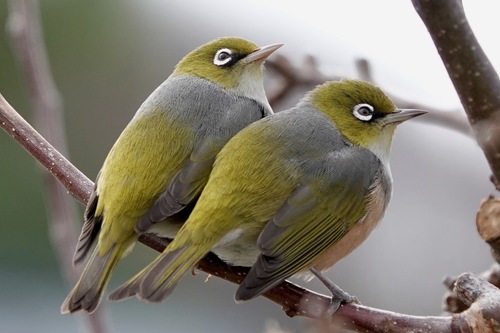
Zosterops tenuirostris is endemic to Norfolk Island, Australia. It is distinguished by its slender bill, predominantly olive-green upper plumage and conspicuous white feather ring around each eye.
Written 26 November 2026 from the sources listed below. Each statement was checked against the passage it cites; statements that could not be supported were removed.
Appearance
The Slender-billed White-eye measures approximately 12–13 centimetres in length, weighs approximately 8–12 grams and has a wingspan of approximately 16–18 centimetres.[1][2][3]
Its upper plumage is predominantly olive green, while its underparts are paler and often yellowish-green or buff. Its eyes are surrounded by a conspicuous white feather ring, and its legs and feet are usually greyish.[4][5][6][7]
Its bill is slenderer than those of its close relatives. There is little difference in size and coloration between males and females.[8][9]
Compared with the Silveryeye, the Slender-billed White-eye has plainer plumage and lacks buff flanks.[10]
Habitat
The Slender-billed White-eye inhabits subtropical moist lowland forests.[11]
Diet
Its diet includes nectar, fruits, berries and insects.[12]
Behaviour
The species forages at all forest levels but prefers the middle level. Individuals frequently forage in small groups and warn one another about possible threats.[13][14][15]
Reproduction and life cycle
The breeding season extends from September to January. A typical clutch contains two or three eggs, and the incubation period lasts approximately 12–14 days.[16][17][18]
Males may protect the nest and feed females during incubation. Both parents participate in raising the chicks, which are born helpless.[19][20][21]
The chicks receive parental feeding for approximately two weeks before fledging. Young birds remain with their parents for several weeks after fledging before joining a flock.[22][23]
Conservation
The species was most recently assessed for the IUCN Red List in 2021.[24]
Classification of the Slender-billed White-eye
| Kingdom | Animalia |
|---|---|
| Phylum | Chordata |
| Subphylum | Vertebrata |
| Infraphylum | Gnathostomata |
| Parvphylum | Osteichthyes |
| Megaclass | Tetrapoda |
| Class | Aves (Bird) |
| Order | Passeriformes (Passerine) |
| Family | Zosteropidae (White-eye) |
| Genus | Zosterops (Lesser White-eyes) |
| Species | Zosterops tenuirostris Gould, 1837 |
Where the Slender-billed White-eye is found
Checklists and occurrence records place Zosterops tenuirostris in 2 countries. GBIF holds 1,460 georeferenced records of it.
Countries
Regions and cities with the most records
A number beside a place is its count of GBIF occurrence records. A place without a number comes from a checklist alone. Records show where a species has been observed or collected, which can include escapes and vagrants.
Common names
English
- Slender-billed White-eye
Names in 27 other languages
- Catalan
- zostèrops becfí
- Chinese
- 細嘴繡眼, 细嘴绣眼鸟
- Croatian
- norfolška bjelooka
- Czech
- kruhoočko tenkozobé
- Danish
- Tyndnæbbet Brillefugl
- Dutch
- Dunsnavelbrilvogel
- Esperanto
- stretbeka zosteropo
- Finnish
- norfolkinsaarenrilli
- French
- Zostérops à bec fin
- German
- Dünnschnabel-Brillenvogel, Dünnschnabelbrillenvogel
- Hungarian
- vékonycsőrű pápaszemesmadár
- Italian
- Occhialino beccosottile
- Japanese
- ハシボソメジロ
- Lithuanian
- liaunasnapis baltavokis
- Norwegian
- smalnebbrillefugl
- Persian
- چشمسفید نوکباریک
- Polish
- szlarnik cienkodzioby
- Portuguese
- olho-branco-de-bico-fino, olho-branco-escuro-da-norfolk
- Russian
- Тонкоклювая белоглазка
- Serbian
- Tankokljuna belooka
- Slovak
- okánik tenkozobý
- Spanish
- Anteojitos picofino
- Swedish
- norfolkglasögonfågel
- Turkish
- İnce Gagalı Gözlükçü
- Ukrainian
- окулярник тонкодзьобий
- Welsh
- llygadwyn pigfain
- pnb
- پتلی چنجوالی چٹی اکھ
Synonyms
One other scientific name has been used for this species and is now treated as a synonym of Zosterops tenuirostris.
- Zosterops tenuirostris tenuirostris Gould, J, 1837
Related species
-
 SilvereyeZosterops lateralis
-
 Warbling White-eyeZosterops japonicus
-
 Indian White-eyeZosterops palpebrosus
-
 White-chested White-eyeZosterops albogularis
-
 Bridled White-eyeZosterops conspicillatus
-
 Green-backed White-eyeZosterops xanthochroa
-
 Mauritius Grey White-eyeZosterops mauritianus
-
 Mauritius Olive White-eyeZosterops chloronothos
Compare
Questions and answers
What is the scientific name of the Slender-billed White-eye?
The scientific name of the Slender-billed White-eye is Zosterops tenuirostris. Written with its author, the full name is Zosterops tenuirostris Gould, 1837.
Which family does the Slender-billed White-eye belong to?
Zosterops tenuirostris belongs to the family Zosteropidae, in the order Passeriformes and the class Aves.
Where is the Slender-billed White-eye found?
Checklists and occurrence records place Zosterops tenuirostris in 2 countries: Norfolk Island and Australia.
What is the conservation status of the Slender-billed White-eye?
The IUCN Red List category recorded for Zosterops tenuirostris is Vulnerable (VU).
Sources
Passages the profile rests on
- The slender-billed white-eye measures approximately 12–13 centimetres in length. Source passage: “It is about 12–13 centimetres (4.7–5.1 in) long” — English Wikipedia
- The species weighs approximately 8–12 grams. Source passage: “weighs around 8–12 grams (0.28–0.42 oz)” — English Wikipedia
- Its wingspan is approximately 16–18 centimetres. Source passage: “with a wingspan of around 16–18 centimetres (6.3–7.1 in).” — English Wikipedia
- Its upper plumage is predominantly olive green. Source passage: “Its plumage is mostly olive green on its upper parts” — English Wikipedia
- Its underparts are paler and often yellowish-green or buff. Source passage: “and paler underneath, often yellowish-green or buff.” — English Wikipedia
- Its eyes are surrounded by a conspicuous white feather ring. Source passage: “Its eyes are encircled by a bright white ring of feathers.” — English Wikipedia
- Its legs and feet are usually greyish. Source passage: “The legs and feet are usually greyish.” — English Wikipedia
- The species has a slenderer bill than its close relatives. Source passage: “it has a slenderer bill than its close relatives” — English Wikipedia
- There is little difference in size and coloration between males and females. Source passage: “there is little difference in size and coloration between males and females.” — English Wikipedia
- Compared with the Silveryeye, the slender-billed white-eye has plainer plumage and lacks buff flanks. Source passage: “Slender-billed is slightly larger, with a longer, thinner bill and plainer plumage, lacking the buff flanks of Silverye.” — ebird.org
- The species inhabits subtropical moist lowland forests. Source passage: “Its natural habitat is subtropical moist lowland forests.” — English Wikipedia
- Its diet includes nectar, fruits, berries and insects. Source passage: “feeding on nectar, fruits and berries and insects.” — English Wikipedia
- The species forages at all forest levels but prefers the middle level. Source passage: “It feeds at all forest levels, but prefers the mid-level” — English Wikipedia
- Individuals frequently forage in small groups. Source passage: “Individuals often forage in small groups” — English Wikipedia
- Individuals warn one another about possible threats. Source passage: “warn each other of possible threats.” — English Wikipedia
- The breeding season extends from September to January. Source passage: “The breeding season is in spring and summer, September to January.” — English Wikipedia
- The incubation period lasts approximately 12–14 days. Source passage: “The incubation period is around 12-14 days” — English Wikipedia
- A typical clutch contains two or three eggs. Source passage: “usually produces two or three eggs.” — English Wikipedia
- Males may protect the nest and feed females during incubation. Source passage: “the male may protect the nest and feed the female.” — English Wikipedia
- Both parents participate in raising the chicks. Source passage: “Both parents engage in chick rearing.” — English Wikipedia
- The chicks are born helpless. Source passage: “Chicks are altricial, i.e. born helpless” — English Wikipedia
- The chicks receive parental feeding for approximately two weeks before fledging. Source passage: “are fed for two weeks before fledging.” — English Wikipedia
- Young birds remain with their parents for several weeks after fledging before joining a flock. Source passage: “They remain with the parents for several weeks more before joining a flock.” — English Wikipedia
- The species was most recently assessed for the IUCN Red List in 2021. Source passage: “has most recently been assessed for The IUCN Red List of Threatened Species in 2021.” — iucnredlist.org
- Its slender, slightly downward-curved bill helps it obtain insects and spiders from crevices. Source passage: “makes it better able to grab insects and spiders from crevices” — English Wikipedia
- Its bill shape also facilitates nectar feeding from plants. Source passage: “to obtain nectar from plants.” — English Wikipedia
Data
- Catalogue of Life, 2026-10-16 XR cc by
- Global Biodiversity Information Facility CC BY 4.0
- Wikidata CC0
- GeoNames CC BY 4.0
- Wikimedia Commons per image; credit shown with each image
- Within the Catalogue of Life, this name comes from The Integrated Taxonomic Information System cc0
References
- Gill, Frank, & and Minturn Wright. (2006). Birds of the World: Recommended English Names.
This species in other databases
Page built on 27 November 2026. See how the catalog is made and all sources and licences.
Cite this page
ScientificNames.org. (2026). Zosterops tenuirostris (Slender-billed White-eye). Retrieved November 27, 2026, from https://scientificnames.org/species/zosterops-tenuirostris
“Zosterops tenuirostris (Slender-billed White-eye).” ScientificNames.org, 2026, scientificnames.org/species/zosterops-tenuirostris. Accessed 27 Nov. 2026.
ScientificNames.org. “Zosterops tenuirostris (Slender-billed White-eye).” Accessed November 27, 2026. https://scientificnames.org/species/zosterops-tenuirostris.
@misc{scientificnames_zosterops_tenuirostris_slender_billed_white_eye,
  author = {{ScientificNames.org}},
  title = {Zosterops tenuirostris (Slender-billed White-eye)},
  year = {2026},
  url = {https://scientificnames.org/species/zosterops-tenuirostris},
  note = {Accessed 2026-11-27}
}