Infraorder · Insects
Phthiraptera
Phthiraptera is a infraorder in the suborder Troctomorpha. The Catalogue of Life lists 5,630 species in it, 5,624 of them living.
- Scientific name
- Phthiraptera Haeckel, 1896
- Rank
- infraorder
- Belongs to
- Troctomorpha
- Species
- 5,630
- Direct members
- 7
- Name status
- accepted in the Catalogue of Life
Best-known species of Phthiraptera
-
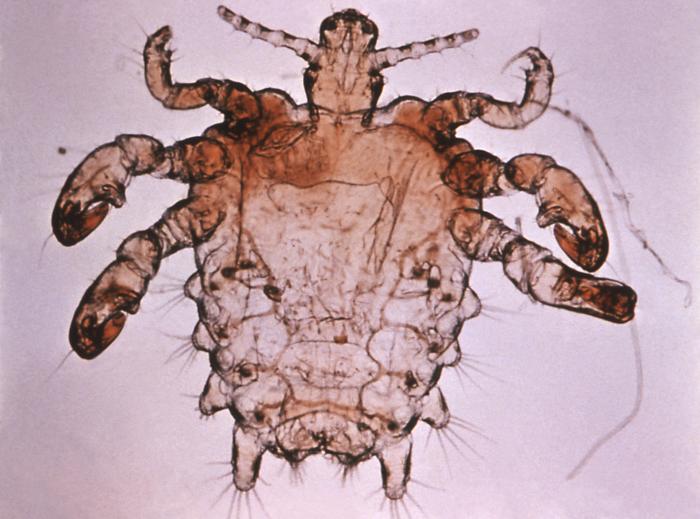 Crab LousePthirus pubis
-
 Human LousePediculus humanus
- Strigiphilus garylarsoni
-
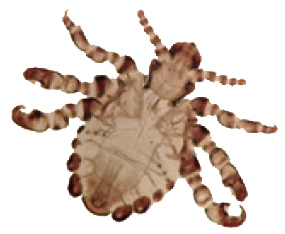 Gorilla LousePthirus gorillae
-
 Hog LouseHaematopinus suis
- Passenger Pigeon Chewing LouseColumbicola extinctus
- Dog Biting LouseTrichodectes (Trichodectes) canis
- Lepidophthirus macrorhini
- Pigeon LouseColumbicola columbae
- Cattle Biting LouseBovicola bovis
- Pygmy Hog Sucking LouseHaematopinus oliveri
- Huia LouseRallicola (Huiacola) extinctus
Members of Phthiraptera
7 in all. Those with an English name come first.
| Scientific name | Common name | Rank | Species |
|---|---|---|---|
| Ischnocera | parvorder | 3,100 | |
| Amblycera | parvorder | 1,549 | |
| Anoplura | parvorder | 607 | |
| Trichodectoidea | superfamily | 369 | |
| Rhynchophthirina | parvorder | 3 | |
| Protanoplura | parvorder | 1 | |
| Saurodectidae extinct | family | 1 |
Classification
| Kingdom | Animalia |
|---|---|
| Phylum | Arthropoda |
| Subphylum | Hexapoda |
| Class | Insecta (Insect) |
| Order | Psocodea |
| Suborder | Troctomorpha |
| Infraorder | Phthiraptera Haeckel, 1896 |
Sources
- Catalogue of Life, 2026-10-16 XR cc by
- Within the Catalogue of Life, this name comes from Psocodea Species File cc by
References
- Haeckel, E. (1896) Systematische Phylogenie. 2. Theil. In Systematische Phylogenie der wirbellosen Thiere (Invertebrata). Verlag von Georg Reimer, Berlin. 720 pp.
- Baldwin-Brown, J.G., Villa, S.M., Waight, E., Johnson, K.P., Bush, S.E., Clayton, D.H. & Shapiro, M.D. (2025) Genomics of Experimental Adaptive Radiation in the Cryptic Coloration of Feather Lice. Genome Biology and Evolution, 17(5: evaf083), 1–15. https://doi.org/10.1093/gbe/evaf083
- Grossi, A.A., Lee, M.-B., Tian, C., Zou, F., Choi, C.-Y. & Gustafsson, D.R. (2023) Host Migration and Size Do Not Influence the Prevalence of Most Chewing Lice (Phthiraptera: Amblycera and Ischnocera) on Shorebirds (Aves: Charadriiformes) across the World. Diversity, 15(2), 200: 19 pages. https://doi.org/10.3390/d15020200
- Kuabara, K.M.D., Valim, M.P. & Silveira, L.F. (2023) New records of chewing lice (Insecta: Phthiraptera) parasites of Brazilian Anhimidae, Threskiornithidae, and Aramidae (Aves). Papéis Avulsos de Zoologia, 63, e202363020: 13 pages. https://doi.org/10.11606/1807-0205/2023.63.020
- Stepanova, O.N. (2024) Lice of the genus Quadraceps (Phthiraptera, Rallicolidae) of waders in Siberia. Russkii Ornitologicheskii Zhurnal Ekspress Vypusk, 33(2407), 1517–1522.
- Sychra, O. & Sychra, J. (2025) In memoriam of František Balát on the centenary of his birth. Zootaxa, 5693(2), 151–167. https://doi.org/10.11646/zootaxa.5693.2.1
- Kahn, E.X., Jacobsen, J.M., Leyel, A., Rosati, M.C., Montgomery, G.A. & Tingley, M.W. (2025) The response of avian chewing lice (Psocodea: Phthiraptera) loads to early-1900s urbanization in the Western United States. Urban Ecosystems, 28(113), 1–14. https://doi.org/10.1007/s11252-025-01724-4
- Grossi, A.A., Tian, C., Ren, M., Zou, F. & Gustafsson, D.R. (2024) Co-phylogeny of a hyper-symbiotic system: Endosymbiotic bacteria (Gammaproteobacteria), chewing lice (Insecta: Phthiraptera) and birds (Passeriformes). Molecular Phylogenetics and Evolution, 190, 107957: 10 pages. https://doi.org/10.1016/j.ympev.2023.107957
- Yang, J.-ting, Huang, X.-bin, Wang, Y.-juan, Guo, X.-guo, Zhang, X.-zheng, Yang, H.-juan & Zheng, X.-yan (NO DATE) Ectoparasitic infestation on Miniopterus fuliginosus in Yunnan province, China. Zhongguo Meijieshengwuxue Ji Kongzhi Zazhi, 34(3), 406–411.
- Bush, S.E., Waller, M.M., Herman, J.M., Hobbs, K.S., Clayton, A.R., Watson, J.L., Oleyar, M.D. & Clayton, D.H. (2023) Birds groom more in regions with higher parasite pressure: a comparison of temperate and subtropical American kestrels. Animal Behaviour, 201, 125–135. https://doi.org/10.1016/j.anbehav.2023.04.015
- Boucheikhchoukh, M., Leulmi, H., Dib, L., Mechouk, N., Khalfallah, M. & Benakhla, A. (2023) Lice (Phthiraptera) diversity in ruminants and domestic birds in northeastern Algeria. International Journal of Tropical Insect Science, 43(6), 2233–2244.
- Stepanova, O.N. (2024) Lice of the genus Quadraceps (Phthiraptera, Rallicolidae) of gulls and terns Laridae in Siberia. Russkii Ornitologicheskii Zhurnal Ekspress Vypusk, 33(2404), 1363–1367.
- Bush, S.E., Waller, M.M., Davis, K.M., Clayton, S.F. & Clayton, D.H. (2024) Birds in arid regions have depauperate louse communities: Climate change implications? Ecology and Evolution, 14(9), e70280: 11 pages. https://doi.org/10.1002/ece3.70280
- Lin, X., Pu, J. & Dong, W. (2025) Evolution of the Neopsylla hongyangensis Mitogenome: Insights Into the Mitogenomic Evolution of the Orders Siphonaptera and the Phthiraptera. Ecology and Evolution, 15(e71108), 1–14. https://doi.org/10.1002/ece3.71108
- Souza, V.C., de Oliveira, J.B., de Lyra-Neves, R.M., Pelage, L., da Silva Oliveira, A.J., Oliveira-Silva, W., da Silva Cabral, L. & Telino-Júnior, W.R. (2024) Chewing lice (Insecta, Phthiraptera) and ticks (Arachnida, Ixodida) associated with birds in highland marshes of the Brazilian semiarid. Studies on Neotropical Fauna and Environment, 59(3), 956–966. https://doi.org/10.1080/01650521.2024.2307076
- Kazim, A.-R., Houssaini, J., Tappe, D. & Heo, C.-C. (2023) An annotated checklist of the chewing lice (Phthiraptera: Ischnocera, Amblycera, Rhynchophthirina) from domestic and wild mammals in Malaysia. Zootaxa, 5263(1), 040–060. https://doi.org/10.11646/zootaxa.5263.1.2
- Waller, M.M., Amedee, N.A., Warr, H.M., Bush, S.E. & Clayton, D.H. (2026) Prevalence and intensity of parasitic insects on Puerto Rican birds. Journal of Wildlife Diseases, 62(2), 407–420. https://doi.org/10.7589/jwd-d-25-00151
- Martin Říhová, J., Vodička, R. & Hypša, V. (2025) An obligate symbiont of Haematomyzus elephantis with a strongly reduced genome resembles symbiotic bacteria in sucking lice. Applied and Environmental Microbiology, 91(6: e00220-25), 1–12. https://doi.org/10.1128/aem.00220-25
- Delima-Baron, E.M., Tagoon, M.D.T. & Murao, L.A.E. (2024) Ectoparasites of avian species visiting selected fruit orchards of Davao City, Mindanao Island, Philippines. Serangga, 29(3), 176–192.
- Bailly, A., Monceau, K. & Moreau, J. (2026) Farming practices induce contrasted effects on parasitic infections in passerine birds in agricultural landscapes. Agriculture, Ecosystems and Environment, 396(110008), 1–17. https://doi.org/10.1016/j.agee.2025.110008
- Lima, M.A., Weckstein, J.D., Batista, R. & Ribas, C.C. (2023) Do Parasitic Lice Exhibit Endemism in Parallel with Their Avian Hosts? A Comparison across Northern Amazonian Areas of Endemism. Journal of Parasitology, 109(5), 506–513. https://doi.org/10.1645/18-135
- Gustafsson, D.R., Sychra, O. & Grossi, A.A. (2025) An estimate of the diversity and threat levels of avian chewing lice (Phthiraptera: Ischnocera, Amblycera), with a call for “pre-emptive red listing.” Biodiversity and Conservation, 34(3), 1015–1037. https://doi.org/10.1007/s10531-024-03006-5
- Little, A.J., Matthee, C.A., Ueckermann, E.A., Horak, I.G., Hui, C. & Matthee, S. (2024) Host and habitat shape ectoparasite diversity on Mastomys natalensis and Mastomys coucha (Muridae). Parasitology, 151(8), 769–783. https://doi.org/10.1017/s0031182024000714
- Gustafsson, D.R. & Najer, T. (2022) Fahrenholz's rule is not a valid methodology for determining species limits in chewing lice (Psocodea, Phthiraptera). Bionomina, 29(1), 1–73.
- Talabante, C. & Bernal, I. (2023) Chewing lice (Insecta: Phthiraptera) found on Griffon Vultures (Gyps fulvus) from a wild breeding colony in central Spain. Vulture News, 83, 32–38.
In other databases
Cite this page
ScientificNames.org. (2026). Phthiraptera. Retrieved November 24, 2026, from https://scientificnames.org/taxon/phthiraptera
“Phthiraptera.” ScientificNames.org, 2026, scientificnames.org/taxon/phthiraptera. Accessed 24 Nov. 2026.
ScientificNames.org. “Phthiraptera.” Accessed November 24, 2026. https://scientificnames.org/taxon/phthiraptera.
@misc{scientificnames_phthiraptera,
  author = {{ScientificNames.org}},
  title = {Phthiraptera},
  year = {2026},
  url = {https://scientificnames.org/taxon/phthiraptera},
  note = {Accessed 2026-11-24}
}