Comparison
American Alligator vs Black Caiman
American Alligator (Alligator mississippiensis) and Black Caiman (Melanosuchus niger) both belong to the family Alligatoridae (caimans) and part ways below it.

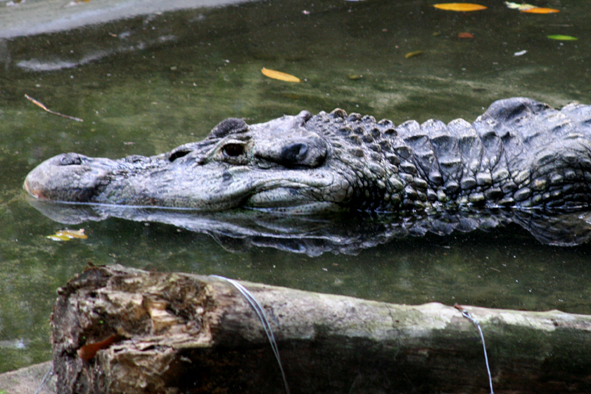


How they differ
The American alligator has a broad, U-shaped snout, an armored body, short legs and a muscular tail, while the black caiman has dark greenish-black skin, grey or brown bands on its lower jaw, and pale bands along its flanks. The American alligator is native to the southeastern United States, while the black caiman occurs throughout much of the Amazon Basin and northern and central South America. Adult male American alligators typically measure 3.4–4.8 metres in length, while most adult black caimans measure between 2.2 and 2.9 metres, although some old males exceed 5 metres. The American alligator is classified as Least Concern on the IUCN Red List, while black caiman populations remain severely depleted in four of the seven countries where the species occurs.
| American Alligator | Black Caiman | |
|---|---|---|
| Appearance | Adult American alligators can have olive, brown, gray, or black upper surfaces and a cream-colored underside. | Adult black caimans have dark greenish-black skin, grey or brown bands on the lower jaw, and white or pale yellow bands along the flanks. |
| Behaviour | American alligators produce bellows throughout the year to declare territory and locate potential mates. | Black caimans produce vocalizations resembling rumbling thunder to communicate with other individuals. |
| Diet | Adult American alligators consume fish, amphibians, reptiles, birds, mammals, and other American alligators. | Adult black caimans consume substantial quantities of fish, including piranhas and catfish, as well as molluscs. |
| Young Diet | Hatchling American alligators feed primarily on invertebrates. | Young black caimans eat insects, crustaceans and other invertebrates. |
| Distribution | The American alligator is native to the southeastern United States. | The documented black caiman range includes Brazil, eastern Ecuador, Peru, northern Bolivia, eastern French Guiana and southern Guyana. |
| Reproduction | American alligators lay their eggs in nests made of vegetation, sticks, leaves, and mud in sheltered locations on land near water. | Female black caimans construct nest mounds using soil and vegetation. |
| Conservation | The American alligator was listed as endangered in 1967 and removed from endangered status in 1987 following conservation efforts. | Deforestation and burning of swamplands are slowing black caiman population recovery. |
| Size | Adult male American alligators typically measure 3.4–4.8 metres in length and can weigh up to 450 kilograms. | Most adult black caimans measure between 2.2 and 2.9 metres in length, while some old males exceed 5 metres. |
Written from the checked facts listed further down. Statements that the sources did not support were removed.
Side by side
| American Alligator | Black Caiman | |
|---|---|---|
| Scientific name | Alligator mississippiensis (Daudin, 1801) | Melanosuchus niger (Spix, 1825) |
| English name | American Alligator | Black Caiman |
| Group | Reptiles | Reptiles |
| Class | Reptilia Reptile | Reptilia Reptile |
| Order | Crocodylia | Crocodylia |
| Family | Alligatoridae Caimans | Alligatoridae Caimans |
| Genus | Alligator Alligators | Melanosuchus Black Caiman |
| Named in | 1801 | 1825 |
| Red List category | Least Concern | Least Concern |
| Environment | freshwater | freshwater, terrestrial |
| Countries on record | 5 countries | 7 countries |
| GBIF occurrence records | 79,440 records | 1,924 records |
Rows where the two agree are shown in grey.
Where each is found
Only American Alligator (5)
Only Black Caiman (7)
From Catalogue of Life checklists and GBIF occurrence records. A country missing from a list means no record is held, which is not proof of absence.
Checked facts
| American Alligator | Black Caiman | |
|---|---|---|
| Appearance |
|
|
| Size |
|
|
| Habitat |
|
|
| Diet |
|
|
| Behaviour |
|
|
| Reproduction |
|
|
| Distribution |
|
|
| Conservation |
|
|
| Uses | No checked fact yet |
|
| Similar species |
| No checked fact yet |
| Other |
|
|
In brief
American Alligator
The American Alligator (Alligator mississippiensis) is a reptile in the family Alligatoridae, order Crocodylia, and class Reptilia. It is native to the southeastern United States and is distinguished by its broad, U-shaped snout, armored body, and muscular tail. Full profile
Black Caiman
The Black Caiman is the largest living member of the Alligatoridae family. It occurs throughout much of the Amazon Basin and northern and central South America, including Brazil, eastern Ecuador, Peru, northern Bolivia, eastern French Guiana and southern Guyana. Full profile
Compare something else
Page built on 24 November 2026 from the data on the two species pages, where every source is listed.
Cite this page
ScientificNames.org. (2026). American Alligator vs Black Caiman. Retrieved November 24, 2026, from https://scientificnames.org/compare/american-alligator-vs-black-caiman
“American Alligator vs Black Caiman.” ScientificNames.org, 2026, scientificnames.org/compare/american-alligator-vs-black-caiman. Accessed 24 Nov. 2026.
ScientificNames.org. “American Alligator vs Black Caiman.” Accessed November 24, 2026. https://scientificnames.org/compare/american-alligator-vs-black-caiman.
@misc{scientificnames_american_alligator_vs_black_caiman,
  author = {{ScientificNames.org}},
  title = {American Alligator vs Black Caiman},
  year = {2026},
  url = {https://scientificnames.org/compare/american-alligator-vs-black-caiman},
  note = {Accessed 2026-11-24}
}