Species · Reptiles
Black Caiman Melanosuchus niger
The scientific name of the Black Caiman is Melanosuchus niger. It is a species of reptile in the family Alligatoridae (caimans), order Crocodylia. The name dates from 1825.
- Scientific name
- Melanosuchus niger (Spix, 1825)
- Common name
- Black Caiman
- Genus
- Melanosuchus
- Family
- Alligatoridae (Caimans)
- Order
- Crocodylia
- Class
- Reptilia
- Red List category
- LC Least Concern
- Environment
- freshwater, terrestrial
- Recorded in
- 7 countries
- Name status
- accepted in the Catalogue of Life
Overview
The Black Caiman is the largest living member of the Alligatoridae family. It occurs throughout much of the Amazon Basin and northern and central South America, including Brazil, eastern Ecuador, Peru, northern Bolivia, eastern French Guiana and southern Guyana.
Written 24 November 2026 from the sources listed below. Each statement was checked against the passage it cites; statements that could not be supported were removed.
Appearance
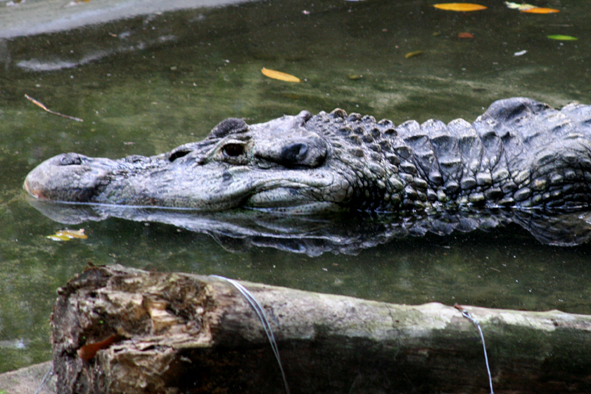
Adult Black Caimans have dark greenish-black skin, which can appear almost completely black in some individuals. Grey or brown bands occur on the lower jaw, while white or pale yellow bands along the flanks become less prominent as the animal matures.[1][2][3]
Most adults measure between 2.2 and 2.9 metres in length. Some old males exceed 5 metres, and large mature males can weigh more than 400 to 500 kilograms.[4][5][6]
The average length of adult females measured at their nests is approximately 2.8 metres. A Black Caiman measuring 3 metres and weighing 103 kilograms was recorded with a bite force of 4,310 newtons.[7][8]
Habitat
Black Caiman hatchling groups have been found in deeper water than groups of spectacled caimans.[9]
Black Caimans occur throughout much of the Amazon Basin and northern and central South America. Their documented range includes Brazil, eastern Ecuador, Peru, northern Bolivia, eastern French Guiana and southern Guyana.[10][11]
Black Caimans disperse across a wider area of their range during the Amazonian flooding period from May through July.[12]
Diet
Adult Black Caimans consume substantial quantities of fish, including piranhas and catfish, as well as molluscs. Young Black Caimans eat insects, crustaceans and other invertebrates.[13][14]
Black Caimans prey on capybaras and can also prey on domestic animals, including pigs, cattle, horses and dogs. They sometimes consume smaller individuals of their own species.[15][16][17]
Black Caimans may hunt on land as well as in water. Terrestrial hunting generally occurs at night.[18]
Behaviour
Black Caimans produce vocalizations resembling rumbling thunder to communicate with other individuals.[19]
Reproduction and life cycle
Female Black Caimans build nests during the dry season, which occurs from September through December. They construct nest mounds using soil and vegetation.[20][21]
Black Caiman nest mounds measure approximately 1.5 metres across and 0.75 metres wide. Females typically lay between 30 and 60 eggs per clutch, with an average clutch containing approximately 39.3 eggs.[22][23][24]
Black Caiman eggs generally hatch within two to three months, although incubation duration can vary with nest temperature.[25]
Female Black Caimans generally reproduce once every two to three years. They reach sexual maturity at approximately 20 years of age.[26][27]
Conservation
Deforestation and burning of swamplands are slowing Black Caiman population recovery. Competition with spectacled caimans is identified as another threat.[28][29]
Black Caiman populations remain severely depleted in four of the seven countries where the species occurs.[30]
Uses
Black Caiman skins have been commercially traded for leather. Their meat is traded locally on a small scale.[31][32]
Similar species
Black Caimans have an ecological niche that allows them to coexist with other caiman species. Competition with spectacled caimans is identified as a threat to Black Caiman population recovery.[29][33]
Classification of the Black Caiman
| Kingdom | Animalia |
|---|---|
| Phylum | Chordata |
| Subphylum | Vertebrata |
| Infraphylum | Gnathostomata |
| Parvphylum | Osteichthyes |
| Megaclass | Tetrapoda |
| Class | Reptilia (Reptile) |
| Order | Crocodylia |
| Family | Alligatoridae (Caimans) |
| Genus | Melanosuchus (Black Caiman) |
| Species | Melanosuchus niger (Spix, 1825) |
Where the Black Caiman is found
Checklists and occurrence records place Melanosuchus niger in 7 countries across South America. GBIF holds 1,924 georeferenced records of it.
Countries
Regions and cities with the most records
- Madre de Dios, Peru 359
- Amazonas, Brazil 250
- Sucumbíos, Ecuador 228
- Orellana Province, Ecuador 206
- Puerto Maldonado, Peru 159
- Loreto, Peru 91
- Beni Department, Bolivia 90
- Rondônia, Brazil 80
- Tocantins, Brazil 53
- Upper Takutu-Upper Essequibo, Guyana 45
- Manaus, Brazil 36
- Pará, Brazil 30
- Mato Grosso, Brazil 22
- Amapá, Brazil 18
- Leticia, Colombia 18
- Potaro-Siparuni, Guyana 18
- Tabatinga, Brazil 18
- Amazonas Department, Colombia 16
- Pastaza Province, Ecuador 16
- Pando, Bolivia 13
- Riberalta, Bolivia 12
- Roraima, Brazil 10
- Tefé, Brazil 10
- Goiás, Brazil 8
- La Paz Department, Bolivia 7
- Óbidos, Brazil 7
- Napo, Ecuador 5
- Porto Velho, Brazil 5
- Ananindeua, Brazil 4
- Belém, Brazil 4
- Iranduba, Brazil 4
- Marituba, Brazil 4
- Rio Grande do Sul, Brazil 4
- Barcarena, Brazil 3
- Cayenne, French Guiana 3
- Coari, Brazil 3
Range as the checklists state it
Bolivia (Beni), Brazil (Roraima, Amazonas, Pará), Colombia, Ecuador, French Guiana, Guyana, Peru
A number beside a place is its count of GBIF occurrence records. A place without a number comes from a checklist alone. Records show where a species has been observed or collected, which can include escapes and vagrants.
Common names
English
- Black Caiman
Names in 27 other languages
- Afrikaans
- Swartkaaiman
- Arabic
- كايمن أسود
- Asturian
- caimán prietu
- Belarusian
- Чорны кайман
- Bulgarian
- Черен кайман
- Chinese
- 黑凱門鱷
- Czech
- kajman černý
- Danish
- Sort kaiman
- Dutch
- Zwarte Kaaiman
- Finnish
- Suokaimaani
- French
- Caïman noir, Caïman noir (Le)
- German
- Mohrenkaiman, Schwarzer Kaiman
- Hebrew
- קיימן שחור
- Hungarian
- fekete kajmán
- Italian
- Caimano nero, Melanosuco
- Japanese
- Kuro Kaiman, クロカイマン
- Norwegian Bokmål
- Svartkaiman
- Polish
- Kajman czarny
- Portuguese
- Jacaré-Açú, Jacaré-Preto, Jacaré-açu
- Russian
- Чёрный кайман
- Serbian
- црни кајман
- Spanish
- Caimán del Amazonas, Lagarto Negro, Yacaré Negro
- Swedish
- morkajman, svart kajman
- Turkish
- Siyah Kayman
- Ukrainian
- Кайман чорний
- gcr
- Caïman nwé
- srn
- Blaka Caiman
Synonyms
7 other scientific names have been used for this species and are now treated as synonyms of Melanosuchus niger.
- Alligator niger Owen, 1840
- Caiman niger Spix, 1825
- Champsa nigra Wagler, 1830
- Crocodilus sclerops var. niger Cuvier, 1829
- Jacare niger Mook, 1921
- Jacare nigra Gray, 1844
- Jacaretinga niger Vaillant, 1898
Related species
- Melanosuchus latrubessei
-
 American AlligatorAlligator mississippiensis
-
 Chinese AlligatorAlligator sinensis
-
 Spectacled CaimanCaiman crocodilus
-
 Cuvier's Dwarf CaimanPaleosuchus palpebrosus
-
 Yacare CaimanCaiman yacare
-
 Broad-snouted CaimanCaiman latirostris
-
 Smooth-fronted CaimanPaleosuchus trigonatus
Compare
Questions and answers
What is the scientific name of the Black Caiman?
The scientific name of the Black Caiman is Melanosuchus niger. Written with its author, the full name is Melanosuchus niger (Spix, 1825).
Which family does the Black Caiman belong to?
Melanosuchus niger belongs to the family Alligatoridae, in the order Crocodylia and the class Reptilia.
Where is the Black Caiman found?
Checklists and occurrence records place Melanosuchus niger in 7 countries, including Brazil, Peru, Ecuador, Bolivia, Guyana and French Guiana.
What is the conservation status of the Black Caiman?
The IUCN Red List category recorded for Melanosuchus niger is Least Concern (LC).
What is a black caimans diet?
Adult Black Caimans eat fish, including piranhas and catfish, as well as molluscs and capybaras. They can also prey on domestic animals such as pigs, cattle, horses and dogs, and sometimes consume smaller individuals of their own species. Young Black Caimans eat insects, crustaceans and other invertebrates.[13][14][15][16][17]
Sources
Passages the profile rests on
- Adult black caimans have dark greenish-black skin, which can appear almost completely black in some individuals. Source passage: “the black caiman has a dark greenish-black coloration as an adult. In some individuals, the pigmentation can appear almost jet-black.” — English Wikipedia
- Black caimans have grey or brown bands on the lower jaw. Source passage: “The lower jaw has grey banding (brown in older animals)” — English Wikipedia
- White or pale yellow bands occur along the flanks and become less prominent as the animal matures. Source passage: “pale yellow or white bands are present across the flanks of the body, although these are much more prominent in juveniles.” — English Wikipedia
- Most adult black caimans measure between 2.2 and 2.9 metres in length. Source passage: “Most adult black caimans are 2.2 to 2.9 m (7 ft 3 in to 9 ft 6 in) in length” — English Wikipedia
- Some old male black caimans exceed 5 metres in length. Source passage: “with a few old males exceeding 5 m (16 ft 5 in).” — English Wikipedia
- Large mature male black caimans can weigh more than 400 to 500 kilograms. Source passage: “large mature specimens exceed 400 to 500 kg (880 to 1,100 lb)” — English Wikipedia
- The average length of adult females measured at their nests is approximately 2.8 metres. Source passage: “The average size of adult females at their nests was found to be 2.8 m (9 ft 2 in).” — English Wikipedia
- A black caiman measuring 3 metres and weighing 103 kilograms was recorded with a bite force of 4,310 newtons. Source passage: “A 3-metre (10 ft), 103-kilogram (227 lb) black caiman was found to have a bite force of 4,310 N (970 lbf).” — English Wikipedia
- Black caiman hatchling groups have been found in deeper water than groups of spectacled caimans. Source passage: “M. niger - pods were found to occur in areas of deeper water than -C. crocodilus-” — animaldiversity.org
- Black caimans occur throughout much of the Amazon Basin and northern and central South America. Source passage: “Black caimans are found throughout much of the Amazon Basin; their range includes much of northern and central South America.” — animaldiversity.org
- The documented range includes Brazil, eastern Ecuador, Peru, northern Bolivia, eastern French Guiana and southern Guyana. Source passage: “It is found in Brazil, eastern Ecuador and Peru, northern Bolivia, eastern French Guiana, and southern Guyana.” — English Wikipedia
- Black caimans disperse across a wider area of their range during the Amazonian flooding period from May through July. Source passage: “May through July marks a period of flooding in the Amazon, and during this time the populations of Black Caiman are dispersed amongst a wide expanse of its range.” — animaldiversity.org
- Adult black caimans consume substantial quantities of fish, including piranhas and catfish, as well as molluscs. Source passage: “Fish, such as piranhas and catfish, account for a large part of the adult Black Caiman's diet, as do molluscs.” — animaldiversity.org
- Young black caimans eat insects, crustaceans and other invertebrates. Source passage: “Young individuals tend to eat insects, crustaceans, and other invertebrates” — animaldiversity.org
- Black caimans prey on capybaras. Source passage: “It also preys on aquatic and terrestrial vertebrates, including some mammals such as capybara” — animaldiversity.org
- Black caimans can prey on domestic animals, including pigs, cattle, horses and dogs. Source passage: “domestic animals including pigs, cattle, horses, and dogs.” — English Wikipedia
- Black caimans sometimes consume smaller individuals of their own species. Source passage: “Large males have even been observed to cannibalize other Black Caimans.” — English Wikipedia
- Black caimans may hunt on land as well as in water, with terrestrial hunting generally occurring at night. Source passage: “Much hunting is done in the water, but the Black Caiman may emerge to hunt on land as well, usually at night” — animaldiversity.org
- Black caimans produce vocalizations resembling rumbling thunder to communicate with other individuals. Source passage: “M. niger emits vocalizations that sound like rumbling thunder to communicate with conspecifics.” — animaldiversity.org
- Female black caimans build nests during the dry season, which occurs from September through December. Source passage: “In the dry season, which runs from September through December, the female builds a nest mound” — animaldiversity.org
- Female black caimans construct nest mounds using soil and vegetation. Source passage: “females build a nest of soil and vegetation” — English Wikipedia
- Black caiman nest mounds measure approximately 1.5 metres across and 0.75 metres wide. Source passage: “which is about 1.5 m (4.9 ft) across and 0.75 m (2.5 ft) wide.” — English Wikipedia
- Female black caimans typically lay between 30 and 60 eggs per clutch. Source passage: “They lay up to 65 eggs (though usually somewhere between 30 and 60)” — English Wikipedia
- The average black caiman clutch contains approximately 39.3 eggs. Source passage: “Clutch size averages 39.3 eggs” — animaldiversity.org
- Black caiman eggs generally hatch within two to three months, although incubation duration can vary with nest temperature. Source passage: “The incubation period lasts between two to three months, but may vary with nest temperature.” — animaldiversity.org
- Female black caimans generally reproduce once every two to three years. Source passage: “The female black caiman only breeds once every 2 to 3 years” — English Wikipedia
- Female black caimans reach sexual maturity at approximately 20 years of age. Source passage: “doesn't become sexually mature until 20 years of age.” — English Wikipedia
- Deforestation and burning of swamplands are slowing black caiman population recovery. Source passage: “The destruction of its habitat by deforestation and burning of swamplands is slowing the recovery of populations” — animaldiversity.org
- Competition with spectacled caimans is identified as another threat to black caiman population recovery. Source passage: “as is increased competition for resources with Caiman crocodilus .” — animaldiversity.org
- Black caiman populations remain severely depleted in four of the seven countries where the species occurs. Source passage: “populations are still severely depleted in 4 of the 7 countries in which it occurs.” — animaldiversity.org
- Black caiman skins have been commercially traded for leather. Source passage: “it was hunted to near extinction primarily for its commercially valuable hide.” — English Wikipedia
- Black caiman meat is traded locally on a small scale. Source passage: “Local people still trade black caiman skins and meat today at a small scale” — English Wikipedia
- Black caimans have an ecological niche that allows them to coexist with other caiman species. Source passage: “M. niger appears to have its own ecological niche that enables it to coexist without too much competition.” — animaldiversity.org
Data
- Catalogue of Life, 2026-10-16 XR cc by
- Global Biodiversity Information Facility CC BY 4.0
- Wikidata CC0
- GeoNames CC BY 4.0
- Wikimedia Commons per image; credit shown with each image
- Within the Catalogue of Life, this name comes from The Reptile Database cc by
References
- Spix, J. B. von. (1825). Animalia nova sive species nova lacertarum quas in itinere per Brasiliam annis MDCCCXVII-MDCCCXX jussu et auspicius Maximiliani Josephi I Bavariae Regis suscepto collegit et descripsit Dr. J. B. de Spix. Lipsiae: T. O. Weigel; F. S. Hübschmanni, Monachii, 26 Pp.
- Gray, J. E. (1862). A synopsis of the species of Alligators. Ann. Mag. Nat. Hist. (3)10 : 327-331.
- Boulenger, G. A. (1889). Catalogue of the chelonians, rhynchocephalians, and crocodiles in the British Museum (Natural History). British Museum, London, 311 Pp.
- Göldi, E. A. (1900). Hufförmige Verbreiterungen an den Krallen von Crocodilembryonen. Zool. Anz. 23: 149-151.
- Niceforo, M. H. (1955). El caiman Yacare negro (Melanosuchus niger Spix) en Colombia. Caldasia 7 (32): 167-171.
- Medem, F. (1963). Osteología craneal, Distribución geográfica y Ecología de Melanosuchus niger (Spix), (Crocodylia: Alligatoridae). Revista Academia Colombiana de Ciencias Exactas Físicas Y Naturales 12 (45): 5-19.
- Wermuth, H., & Fuchs, K. (1978). Bestimmen von Krokodilen und ihrer Häute. Gustav Fischer Verlag, Stuttgart - New York, 100 Pages, [ISBN 3-437-30268-X].
- Medem, F. (1983). Los Crocodylia de Sur America. Vol. 2. Instituto de Ciencias Naturales, Museo de Historia Natural, Universidad Nacional. Bogotá. 270 Pp.
- Hoogmoed,M.S. and Gruber,U. (1983). Spix and Wagler type specimens of reptiles and amphibians in the Natural History Musea in Munich (Germany) and Leiden (The Netherlands). Spixiana Suppl. 9: 319-415.
- Gotch, A. F. (1986). Reptiles - Their Latin Names Explained. Blandford Press, 176 Pp.
- Thorbjarnarson, J. B., & McIntosh, P. E. (1987). Notes on a large Melanosuchus niger skull from Bolivia. Herpetological Review 18 (3): 49, 52.
- King, F. Wayne & Burke, Russel L. (1989). Crocodilian, Tuatara, and Turtles Species of the World: A Taxonomic and Geographic Reference. [type catalogue]. Assoc. Syst. Coll., Washington, DC, Xxii + 216 Pp.
- Herron, J.C., L.H. Emmons & J.E. Cadle. (1990). Observations on Reproduction in the Black Caiman, Melanosuchus niger. Journal of Herpetology 24 (3): 314-316.
- Duellman, W.E., & Salas, A.W. (1991). Annotated checklist of the amphibians and reptiles of Cuzco Amazonico, Peru. Occas. Papers Mus. Of Natur. Hist., Univ. Of Kansas, Lawrence (143): 13 Pp.
- Vasquez P G. (1991). Melanosuchus Gray. Black caiman. Catalogue of American Amphibians and Reptiles ( 530: 1-4.
- Herron, J. C. (1994). Body Size, Spatial Distribution, and Microhabitat Use in the Caimans, Melanosuchus niger and Caiman crocodilus, in a Peruvian Lake. Journal of Herpetology 28 (4): 508-513.
- Poe, & Steven. (1996). Data set incongruence and the phylogeny of Crocodilians. Systematic Biology 45 (4): 393-414.
- Ron, S.R., A. Vallejo & E. Asanza. (1998). Human Influence on the Wariness of Melanosuchus niger and Caiman crocodilus in Cuyabeno, Ecuador. Journal of Herpetology 32 (3): 320-324.
- Zug,G.R.; Vitt, L.J. & Caldwell, J.P. (2001). Herpetology, 2nd ed. Academic Press San Diego, London, [...]XIV + 630 Pp.
- Duellman, W. E. (2005). Cusco Amazónico: The Lives of Amphibians and Reptiles in an Amazonian Rainforest. Comstock Pub Assoc.
- Trutnau, L., & Sommerlad, R. (2006). Krokodile - Biologie und Haltung. Edition Chimaira, Frankfurt, 646 Pp. [Review in Reptilia Münster 11 (6): 95-96].
- Trutnau, L., & Sommerlad, R. (2006). Crocodilians. Their natural history and captive husbandry. Edition Chimaira, Frankfurt, 646 Pp. [Review in Reptilia GB 48: 8-10].
- Kunz, K. (2007). Neuer Schutzstatus für Mohrenkaiman und Guatemala-Skorpionskrustenechse. Reptilia (Münster) 12 (66): 5.
- Vogt, R. C., Ferrara, C. R., Bernhard, R., Carvalho, V. T., Balensiefer, D. C., Bonora, L., & Novelle, S. M. H. (2007). Capítulo 9. Herpetofauna. p. 127-143. In: Rapp Py-Daniel, L.; Deus, C.P.; Henriques, A.L.; Pimpão, D.M.; Ribeiro, O.M. (orgs.). Biodiversidade do Médio Madeira: Bases científicas para propostas de conservação. INPA: Manaus, 244pp.
- Villamarín-Jurado, F. & E. Suárez. (2007). Nesting of the Black Caiman (Melanosuchus niger) in Northeastern Ecuador. Journal of Herpetology 41 (1): 164-167.
This species in other databases
- Catalogue of Life 3ZBL4
- Wikidata Q504483
- iNaturalist 116532
- WoRMS urn:lsid:marinespecies.org:taxname:1603217
- ITIS 202215
Page built on 24 November 2026. See how the catalog is made and all sources and licences.
Cite this page
ScientificNames.org. (2026). Melanosuchus niger (Black Caiman). Retrieved November 24, 2026, from https://scientificnames.org/species/melanosuchus-niger
“Melanosuchus niger (Black Caiman).” ScientificNames.org, 2026, scientificnames.org/species/melanosuchus-niger. Accessed 24 Nov. 2026.
ScientificNames.org. “Melanosuchus niger (Black Caiman).” Accessed November 24, 2026. https://scientificnames.org/species/melanosuchus-niger.
@misc{scientificnames_melanosuchus_niger_black_caiman,
  author = {{ScientificNames.org}},
  title = {Melanosuchus niger (Black Caiman)},
  year = {2026},
  url = {https://scientificnames.org/species/melanosuchus-niger},
  note = {Accessed 2026-11-24}
}