Species · Reptiles
American Alligator Alligator mississippiensis
The scientific name of the American Alligator is Alligator mississippiensis. It is a species of reptile in the family Alligatoridae (caimans), order Crocodylia. The name dates from 1801.
- Scientific name
- Alligator mississippiensis (Daudin, 1801)
- Common name
- American Alligator
- Genus
- Alligator
- Family
- Alligatoridae (Caimans)
- Order
- Crocodylia
- Class
- Reptilia
- Red List category
- LC Least Concern
- Environment
- freshwater
- Recorded in
- 5 countries
- Name status
- accepted in the Catalogue of Life

Overview
The American Alligator (Alligator mississippiensis) is a reptile in the family Alligatoridae, order Crocodylia, and class Reptilia. It is native to the southeastern United States and is distinguished by its broad, U-shaped snout, armored body, and muscular tail.
Written 24 November 2026 from the sources listed below. Each statement was checked against the passage it cites; statements that could not be supported were removed.
Appearance
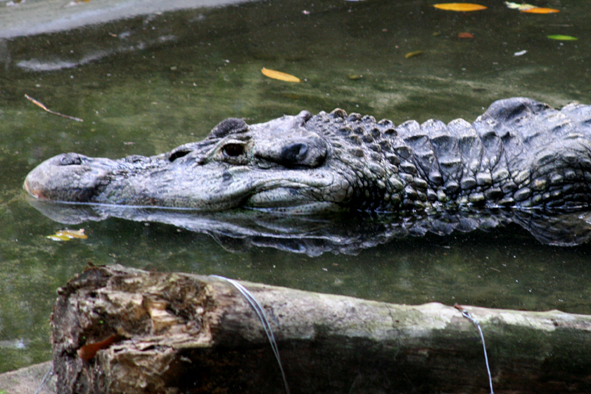
The American Alligator has an armored body, short legs, a muscular tail, and a long, rounded snout. Its broad, U-shaped snout distinguishes it from the sympatric American crocodile.[1][2]
Adults can have olive, brown, gray, or black upper surfaces and a cream-colored underside. They possess 74–80 teeth.[3][4][5]
Adult males typically measure 3.4–4.8 metres in length and can weigh up to 450 kilograms. Females typically measure 2.6–3.35 metres in length.[6][7][8]
Large adult males can reach approximately 4.6 metres in length, while large adult females can reach an expected maximum length of 3 metres.[9][10]
Habitat
The American Alligator inhabits subtropical and tropical freshwater wetlands, including marshes and cypress swamps.[11]
Diet
Adult American Alligators consume fish, amphibians, reptiles, birds, mammals, and other American Alligators. Hatchlings feed primarily on invertebrates.[12][13]
Behaviour
American Alligators produce bellows throughout the year to declare territory and locate potential mates. Males use infrasound to attract females.[14][15]
American Alligators create wetland habitats for other organisms by constructing alligator holes. They swim by moving their pelvic regions and tails from side to side.[16][17]
Reproduction and life cycle
American Alligators lay their eggs in nests made of vegetation, sticks, leaves, and mud in sheltered locations on land near water. Females protect their eggs throughout the incubation period.[18][19]
Newly hatched American Alligators have yellow bands around their bodies. Mothers transport their hatchlings to water using their mouths.[20][21]
American Alligator mothers provide parental care for as long as three years after birth.[22]
Conservation
The American Alligator is classified as Least Concern on the IUCN Red List. It was listed as endangered in 1967 and removed from endangered status in 1987 following conservation efforts.[23][24][25]
Alabama became the first state to prohibit American Alligator hunting when it introduced a ban in 1938.[26]
Similar species
The Chinese alligator is the only other living species in the genus Alligator. The American Alligator is larger than the Chinese alligator.[27][28]
Classification of the American Alligator
| Kingdom | Animalia |
|---|---|
| Phylum | Chordata |
| Subphylum | Vertebrata |
| Infraphylum | Gnathostomata |
| Parvphylum | Osteichthyes |
| Megaclass | Tetrapoda |
| Class | Reptilia (Reptile) |
| Order | Crocodylia |
| Family | Alligatoridae (Caimans) |
| Genus | Alligator (Alligators) |
| Species | Alligator mississippiensis (Daudin, 1801) |
Where the American Alligator is found
Checklists and occurrence records place Alligator mississippiensis in 5 countries across Asia and North America. GBIF holds 79,440 georeferenced records of it.
Countries
Regions and cities with the most records
- Florida, United States 42,499
- Texas, United States 15,326
- South Carolina, United States 5,808
- Louisiana, United States 5,669
- Gainesville, United States 4,833
- Georgia, United States 3,325
- Titusville, United States 3,037
- Apopka, United States 2,745
- Homestead, United States 2,560
- Brandon, United States 2,097
- Pine Hills, United States 2,083
- Tampa, United States 2,032
- Bonita Springs, United States 1,396
- Delray Beach, United States 1,310
- North Carolina, United States 1,298
- Boynton Beach, United States 1,292
- Pinellas Park, United States 1,222
- Mississippi, United States 1,195
- Clearwater, United States 1,158
- New Orleans, United States 1,154
- St. Petersburg, United States 1,122
- Alabama, United States 1,068
- Largo, United States 966
- Sugar Land, United States 963
- Savannah, United States 958
- Wellington, United States 921
- Boca Raton, United States 898
- Sanford, United States 883
- Deerfield Beach, United States 844
- Lakeland, United States 806
- Pasadena, United States 800
- Town 'n' Country, United States 741
- Palm Harbor, United States 724
- Missouri City, United States 709
- North Charleston, United States 687
- Charleston, United States 685
3 more countries have a few records outside this range
These countries hold a few records of Alligator mississippiensis but lie outside the range the checklists give for it. Such records are often zoo or garden specimens, museum material or vagrants, so the species is not counted as occurring there.
Range as the checklists state it
SE USA (Alabama, Arkansas, North Carolina, South Carolina, Florida, Georgia, Louisiana, Mississippi, Oklahoma, Texas), Mexico
A number beside a place is its count of GBIF occurrence records. A place without a number comes from a checklist alone. Records show where a species has been observed or collected, which can include escapes and vagrants.
Common names
English
- American Alligator
- Alligator
- Common Alligator
- Florida Alligator
- Gator
- Louisiana Alligator
- Louisiana Alligator.
- Mississippi Alligator
- White Alligator
- 密河鳄
Names in 31 other languages
- Afrikaans
- Amerikaanse Alligator
- Arabic
- قاطور أمريكي
- Asturian
- aligátor americanu
- Bulgarian
- Американски алигатор
- Chinese
- 美国短吻鳄、密河鳄, 美國短吻鱷
- Croatian
- Američki aligator
- Czech
- Aligátor severoamerický, aligátor americký
- Finnish
- Mississippinalligaattori
- French
- Alligator d'Amérique
- Galician
- aligátor do Mississippi
- German
- Hechtalligator, Mississippi-Alligator
- Greek
- Αμερικανικός Αλιγάτορας
- Hebrew
- אליגטור אמריקני
- Hungarian
- mississippi aligátor
- Icelandic
- Flatmunni
- Italian
- Alligatore del Mississippi
- Japanese
- アメリカアリゲーター, ミシシッピアリゲーター, ミシシッピワニ
- Korean
- 미시시피악어
- Norwegian Bokmål
- Amerikaalligator, Amerikansk Alligator
- Polish
- Aligator amerykański, Aligator missisipijski, Aligator missisipski
- Portuguese
- Aligátor-americano, Jacaré-americano
- Russian
- Миссисипский аллигатор
- Serbian
- Амерички алигатор
- Slovenian
- misisipijski aligator, misisipski aligator
- Spanish
- Aligator Americano, Aligátor americano, Caimán americano, Caimán del Mississippi
- Thai
- จระเข้ตีนเป็ดอเมริกัน
- Turkish
- Amerika Aligatoru
- Ukrainian
- Алігатор міссісіпський
- akz
- Hachonchoba
- chr
- ᏧᎳᏍᎩ
- mus
- hvlpvtv, vlepvtv, vlpvtv
Synonyms
7 other scientific names have been used for this species and are now treated as synonyms of Alligator mississippiensis.
- Alligator helois Cope, 1866
- Alligator lucius (Cuvier, 1807)
- Crocodilus cuvieri Leach, 1815
- Crocodilus lucius Cuvier, 1807
- Crocodilus mississipiensis Daudin, 1801
- Crocodylus alligator Meyer, 1795
- Crocodylus mississippiensis Daudin, 1802
Related species
-
 Chinese AlligatorAlligator sinensis
- Alligator hailensis
-
 Black CaimanMelanosuchus niger
-
 Spectacled CaimanCaiman crocodilus
-
 Cuvier's Dwarf CaimanPaleosuchus palpebrosus
-
 Yacare CaimanCaiman yacare
-
 Broad-snouted CaimanCaiman latirostris
-
 Smooth-fronted CaimanPaleosuchus trigonatus
Compare
Questions and answers
What is the scientific name of the American Alligator?
The scientific name of the American Alligator is Alligator mississippiensis. Written with its author, the full name is Alligator mississippiensis (Daudin, 1801).
Which family does the American Alligator belong to?
Alligator mississippiensis belongs to the family Alligatoridae, in the order Crocodylia and the class Reptilia.
Where is the American Alligator found?
Checklists and occurrence records place Alligator mississippiensis in 5 countries: United States, Japan, Belize, Mexico and Georgia.
What is the conservation status of the American Alligator?
The IUCN Red List category recorded for Alligator mississippiensis is Least Concern (LC).
What other names does the American Alligator have?
Alligator mississippiensis is also known in English as Alligator, Common Alligator, Florida Alligator, Gator, Louisiana Alligator and Louisiana Alligator..
Are alligators and crocodiles the same genus?
The American Alligator belongs to the genus Alligator.[27][29]
What is the diet of the American alligator?
Adult American Alligators consume fish, amphibians, reptiles, birds, mammals, and other American Alligators. Hatchlings feed primarily on invertebrates.[12][13]
What habitat does the American alligator live in?
The American Alligator inhabits subtropical and tropical freshwater wetlands, including marshes and cypress swamps.[11]
Sources
Passages the profile rests on
- The American alligator has an armored body, short legs, a muscular tail, and a long, rounded snout. Source passage: “The American alligator is a large crocodilian with an armored body, short legs, a muscular tail and a long, rounded snout.” — nationalzoo.si.edu
- The American alligator has a broad, U-shaped snout that distinguishes it from the sympatric American crocodile. Source passage: “It is distinguished from the sympatric American crocodile by its broader U-shaped snout” — English Wikipedia
- Adult American alligators can have olive, brown, gray, or black coloration on their upper surfaces. Source passage: “Dorsally, adult American alligators may be olive, brown, gray, or black.” — English Wikipedia
- The underside of an adult American alligator is cream-colored. Source passage: “Meanwhile, their undersides are cream-colored.” — English Wikipedia
- American alligators possess 74–80 teeth. Source passage: “American alligators have 74–80 teeth.” — English Wikipedia
- Adult male American alligators typically measure 3.4–4.8 metres in length. Source passage: “Adult male American alligators measure 3.4 to 4.8 m (11.2 to 15.7 ft) in length” — English Wikipedia
- Adult male American alligators can weigh up to 450 kilograms. Source passage: “and can weigh up to 450 kg (1,000 lb)” — English Wikipedia
- Female American alligators typically measure 2.6–3.35 metres in length. Source passage: “Females are smaller, measuring 2.6 to 3.35 m (8.5 to 11.0 ft) in length.” — English Wikipedia
- Large adult males can reach approximately 4.6 metres in length. Source passage: “Large male American alligators reach an expected maximum size up to 4.6 m (15 ft 1 in) in length” — English Wikipedia
- Large adult females can reach an expected maximum length of 3 metres. Source passage: “while females reach an expected maximum of 3 m (9 ft 10 in).” — English Wikipedia
- The American alligator inhabits subtropical and tropical freshwater wetlands, including marshes and cypress swamps. Source passage: “The American alligator inhabits subtropical and tropical freshwater wetlands, such as marshes and cypress swamps” — English Wikipedia
- Adult American alligators consume fish, amphibians, reptiles, birds, mammals, and other American alligators. Source passage: “American alligators are apex predators and consume fish, amphibians, reptiles, birds, mammals, and other American alligators.” — English Wikipedia
- Hatchling American alligators feed primarily on invertebrates. Source passage: “Hatchlings feed mostly on invertebrates.” — English Wikipedia
- American alligators produce bellows throughout the year to declare territory and locate potential mates. Source passage: “Throughout the year (in particular during the breeding season), American alligators bellow to declare territory, and locate suitable mates.” — English Wikipedia
- Male American alligators use infrasound to attract females. Source passage: “Male American alligators use infrasound to attract females.” — English Wikipedia
- American alligators create wetland habitats for other organisms by constructing alligator holes. Source passage: “They play an important role as ecosystem engineers in wetland ecosystems through the creation of alligator holes, which provide both wet and dry habitats for other organisms.” — English Wikipedia
- American alligators swim by moving their pelvic regions and tails from side to side. Source passage: “In the water, American alligators swim like fish, moving their pelvic regions and tails from side to side.” — English Wikipedia
- American alligators lay their eggs in nests made of vegetation, sticks, leaves, and mud in sheltered locations on land near water. Source passage: “Eggs are laid in a nest of vegetation, sticks, leaves, and mud in a sheltered spot on land near water.” — English Wikipedia
- Female American alligators protect their eggs throughout the incubation period. Source passage: “Mothers protect their eggs during the incubation period” — English Wikipedia
- Newly hatched American alligators have yellow bands around their bodies. Source passage: “Young are born with yellow bands around their bodies” — English Wikipedia
- Mother American alligators transport their hatchlings to water using their mouths. Source passage: “and move the hatchlings to the water using their mouths.” — English Wikipedia
- American alligator mothers provide parental care for as long as three years after birth. Source passage: “American alligators exhibit parental care for up to 3 years post birth.” — English Wikipedia
- The American alligator is classified as Least Concern on the IUCN Red List. Source passage: “American alligators are listed as least concern by the IUCN Red List” — English Wikipedia
- The American alligator was listed as endangered in 1967. Source passage: “In 1967, the American alligator was listed as an endangered species” — English Wikipedia
- The American alligator was removed from endangered status in 1987 following conservation efforts. Source passage: “Subsequent conservation efforts have allowed their numbers to increase and the species was removed from endangered status in 1987.” — English Wikipedia
- Alabama became the first state to prohibit American alligator hunting when it introduced a ban in 1938. Source passage: “Alabama banned alligator hunting in 1938, becoming the first state to do so” — English Wikipedia
- The Chinese alligator is the only other living species in the genus Alligator. Source passage: “It is one of the two extant species in the genus Alligator” — English Wikipedia
- The American alligator is larger than the Chinese alligator. Source passage: “and is larger than the only other living alligator species, the Chinese alligator.” — English Wikipedia
- The American alligator was first classified in 1801 by François Marie Daudin under the name Crocodilus mississipiensis. Source passage: “The American alligator was first classified in 1801 by French zoologist François Marie Daudin as Crocodilus mississipiensis.” — English Wikipedia
Data
- Catalogue of Life, 2026-10-16 XR cc by
- Global Biodiversity Information Facility CC BY 4.0
- Wikidata CC0
- GeoNames CC BY 4.0
- Wikimedia Commons per image; credit shown with each image
- Within the Catalogue of Life, this name comes from The Reptile Database cc by
References
- Meyer, F. A. A. (1795). Synopsis Reptilium, novam ipsorum sistens generum methodum, nec non Gottingensium huius ordinis animalium enumerationem. Vandenhoeck Und Ruprecht, Göttingen, 32 Pp [for Current Names See Rösler & Böhme 2021].
- Daudin, F. M. (1801). Histoire Naturelle, Générale et Particulière des Reptiles; ouvrage faisant suit à l’Histoire naturell générale et particulière, composée par Leclerc de Buffon; et rédigee par C.S. Sonnini, membre de plusieurs sociétés savantes. Vol. 2. F. Dufart, Paris, 432 Pp. [Publication Date Fide Harper 1940].
- Cuvier, G. (1807). Sur les différentes especes de crocodiles vivans et sur leurs caracteres distinctifs. Ann. Natl. Mus. Hist. Nat. Paris 10: 8-86.
- Cuvier, G. (1831). The Animal Kingdom arranged in conformity with its organization, by the Baron Cuvier, ... with additional descriptions of all the species hitherto named, and of many not before noticed, by Edward Griffith... and others. Vol. 9. Whittaker, Treacher and Co., London, 481 Pp.
- Bischoff, T. L. W. (1836). Ueber den Bau des Krocodilherzens, besonders von Crocodilus lucius. Arch. Anat. Physiol. : 1-12.
- Duméril, A.M. C. and G. Bibron. (1836). Erpetologie Générale ou Histoire Naturelle Complete des Reptiles. Vol. 3. Libr. Encyclopédique Roret, Paris, 528 Pp.
- Holbrook, John E. (1842). North American Herpetology; or, A description of the reptiles inhabiting the United States. Vol II (2nd ed.). J. Dobson, Philadelphia, 142 Pp.
- Dowler, B. (1846). Contributions to the natural history of the alligator (Crocodilus mississippiensis) with a microscopic addendum. New Orleans Med. Surg. J. 1846 (Nov.): 5-30.
- Fry, E. (1847). Note on the circulation of Crocodilus lucius. Proc. Zool. Soc. London 1847: 116-117.
- Cope, E. D. (1866). Third contribution to the herpetology of tropical America. Proc. Acad. Nat. Sci. Philadelphia 17: 185-198 [1865].
- Clarke, S. (1888). The nest and eggs of the alligator: Alligator lucius Cuv. Zool. Anz. 11: 368-370.
- Clarke, S. F. (1888). The nest and eggs of the Alligator (Alligator lucius, Cuv.). Ann. Mag. Nat. Hist. (6) 2: 509-511.
- Boulenger, G. A. (1889). Catalogue of the chelonians, rhynchocephalians, and crocodiles in the British Museum (Natural History). British Museum, London, 311 Pp.
- Mitchell, P. C., & Beddard, F. E. (1895). On the structure of the heart of the alligator. Proc. Zool. Soc. London 1895: 343-349.
- Lane, H. H. (1909). Alligator missippiensis in Oklahoma. Science 30 (782):923-924.
- Ortenburger, A. I. (1927). A report on the amphibians and reptiles of Oklahoma. Proc. Okla. Acad. Sci. 6: 89-100.
- Ortenburger, A. I. (1927). The University of Oklahoma Museum of Zoology Expedition of 1925. Proceedings of the Oklahoma Academy of Science 6 (Part 1): 85-88.
- Ortenburger, A. I. (1929). Reptiles and amphibians from Southeastern Oklahoma and Southwestern Arkansas. Copeia 1929 (170): 8-12.
- Allen, Morrow J. (1932). A survey of the Amphibians and reptiles of Harrison County, Mississippi. American Museum Novitates (542): 1-20.
- Viosca, P., Jr. (1939). External sexual differences in the alligator, Alligator mississippiensis. Herpetologica 1: 154-155.
- Harper, & Francis. (1940). Some works of Bartram, Daudin, Latreille, and Sonnini, and their bearing upon North American herpetological nomenclature. American Midland Naturalist 23 (3): 692-723.
- Lewis, Thomas H. (1946). Reptiles and Amphibians of Smith Island, N.C. American Midland Naturalist 36 (3): 682-684.
- Hock, R. J. (1954). The Alligator in Arizona. Copeia 1954 (3): 222-223.
- Hemming, F. (1956). Proposed use of the plenary powers to ensure that the specific name ‘mississipiensis’ Daudin [1801-2], as published in the combination ‘Crocodilus mississipiensis’ shall be the oldest available name for the North American alligator (Class Reptilia). Bull. Zool. Nomenclature 12 (6):163-175.
- Oliver, J. A. (1958). Proposition 97- Spelling of specific name of Alligator mississippiensis. Opin. Decl. Zool. Nomen. 1 (21): 125.
This species in other databases
- Catalogue of Life BTRB
- Wikidata Q193327
- iNaturalist 26159
- WoRMS urn:lsid:marinespecies.org:taxname:886665
- ITIS 551771
Page built on 24 November 2026. See how the catalog is made and all sources and licences.
Cite this page
ScientificNames.org. (2026). Alligator mississippiensis (American Alligator). Retrieved November 24, 2026, from https://scientificnames.org/species/alligator-mississippiensis
“Alligator mississippiensis (American Alligator).” ScientificNames.org, 2026, scientificnames.org/species/alligator-mississippiensis. Accessed 24 Nov. 2026.
ScientificNames.org. “Alligator mississippiensis (American Alligator).” Accessed November 24, 2026. https://scientificnames.org/species/alligator-mississippiensis.
@misc{scientificnames_alligator_mississippiensis_american_alligator,
  author = {{ScientificNames.org}},
  title = {Alligator mississippiensis (American Alligator)},
  year = {2026},
  url = {https://scientificnames.org/species/alligator-mississippiensis},
  note = {Accessed 2026-11-24}
}